
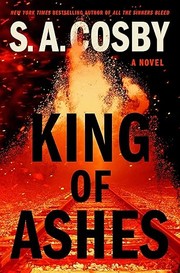
King of Ashes
2,229-word summary 10 min read 352 pages in the book
- First published
- 2025
- Publisher
- Flatiron Books (Pine & Cedar)
- Pages
- 352
- ISBN
- 9781250832078
Reading options
What's inside (8 sections)
I opened King of Ashes expecting a crime novel and found a family tragedy wearing a crime novel's clothes. S. A. Cosby has said the book is Godfather-inspired, and you feel that influence before anyone says a word about it. You can feel it in the way the family talks around what it actually does, in the way the men measure loyalty, and in the way the women are left to keep the books. There is a patriarch, a family business with a smell attached to it, a son who does not want the life, a daughter who does the work anyway, and a successor settling into a throne nobody voted on. The difference here is the business. The Carruthers family runs a crematorium in Jefferson Run, a decaying Virginia factory town that Cosby models on real post-industrial Southern cities. Everything burns, the family motto says, and by the last page you understand that it is less a motto than a diagnosis. I want to be honest about something up front: this is a violent book, and the violence is not decoration. It is the language the characters speak when words fail them, which in this town is often.
Jefferson Run
The town matters as much as any person in the book. Jefferson Run is the kind of place where the factory closed and the people stayed, and Cosby writes it with a patience I did not expect from a book this violent. You get the sense of a town that has been quietly cooling for decades, a place whose best years are recorded somewhere else and whose present is a series of small arrangements to get by. The post-industrial setting is not a backdrop so much as an argument. When the work leaves, what remains is family, debt and the informal economies that grow in the gaps. Cosby understands that, and he builds the whole novel on it.
Into that setting comes Roman Carruthers, an Atlanta wealth manager who has made a life for himself somewhere else. He is the son who left. The call that brings him home is about his father, Keith, who has been left comatose after a hit-and-run that was no accident. Roman arrives to find a father who cannot speak, a brother in over his head, and a sister who has been holding the family business together alone. The homecoming has none of the warmth of a prodigal return. It is an audit, and Roman is the man who has to do it.
At the center of the family's remaining business is Neveah, Roman's sister. She has been stranded running the Carruthers Crematorium alone, and while she manages the day-to-day work she is quietly reinvestigating the nineteen-year-old disappearance of their mother, Bonita. The town believes Keith solved that case by murder. Neveah is not so sure. Her private investigation is the book's slow-burning fuse, and it runs underneath the gang plot the way a fault line runs under a road. I found her sections the most absorbing part of the novel, partly because she is the only character still asking a question instead of issuing a threat.
There is a third sibling, Dante, an addict whose debt has set everything in motion. Roman has spent years building a clean, numbered life in Atlanta, a life of spreadsheets and calculated risk. In Jefferson Run, numbers are exactly what will be demanded of him, and not the kind he is used to.
The debt
The hit-and-run was carried out by the Black Baron Boys, a gang led by a pair of ruthless siblings named Torrent and Tranquil Gilchrist. The reason is specific and small and terrible. They wrecked the car because Dante was three weeks late on a three hundred thousand dollar debt for a stolen drug shipment. Three weeks. That is the whole distance between a late payment and a father in a coma. Cosby keeps the proportions ugly on purpose. The great tragedy begins with an ordinary failure to pay, and the people who commit the violence are not monsters from somewhere else. They are the neighbors.
Roman is summoned home to a family that needs money it does not have and a brother whose life has a price on it. To buy Dante's life, Roman offers his financial expertise. This is where the book stops being a revenge story and becomes something stranger: a story about a man who thinks he can solve a violence problem with a spreadsheet. I kept waiting for someone to point out how absurd that is. Nobody does, because it works, at least for a while, and that is the darker joke.
A man with numbers
Roman's contribution is laundering the gang's money. He sets up a pump-and-dump scheme and helps engineer a rigged municipal redevelopment deal, the kind of local arrangement where public money moves quietly into private pockets. Cosby is good on the small mechanics of this. The corruption is not a montage of offshore accounts. It is a redevelopment deal in a town that can ill afford one, and the people who benefit are the same people who wrecked Roman's father's car. The loop closes neatly, and Roman is the one closing it.
Torrent is not impressed by numbers alone. He forces Roman to prove loyalty by making him burn two accomplices alive in the crematory oven. That scene is the book at its most brutal, and it is also the moment the metaphor stops being subtle. The family trade is death, and now Roman is asked to practice it personally. He does it. From there, the question is no longer whether he will cross a line but how many lines he will cross before he decides to fight back. I put the book down after that chapter and did not pick it up again until the next day, which is a reaction I rarely have to a novel.
What I found compelling is that Roman is not a good man who is forced into bad acts. He is a man who discovers, with something like relief, that he is good at this. The numbers work. The deals close. The men with guns start listening to him. Cosby lets that pleasure show, which is more honest than the usual crime-novel insistence that the hero hates every minute of it. That willingness to make Roman enjoy his own corruption is what gives the book its bite. He is not a reluctant participant. He is a natural.
The counterinsurgency
Roman enlists Khalil, a former mercenary friend, to plan what is essentially a counterinsurgency against the Gilchrists. The word is right for it. This is not a brawl between two families but a campaign, with staging, patience and staged incidents. Roman arranges a drive-by to win the Gilchrists' trust, a piece of theater that says more about his character than any confession would. He can make violence look like anything he wants it to look like. The drive-by is not an attack so much as a resume, and the Gilchrists read it exactly that way.
Khalil's arrival is the closest the book comes to a trusted adviser entering the story, and Cosby clearly enjoys the arrangement. The former mercenary brings a soldier's patience to a family that has mostly been improvising. Under his influence, Roman stops reacting and starts designing. The shift shows up in the prose itself. The sentences get shorter and more certain as Roman gets more dangerous, and I noticed myself reading faster without quite meaning to.
He also begins a fraught romance with Jae, the Gilchrists' half-sister. It is fraught because everything in this book is fraught, and because the relationship sits across the exact line Roman is trying to erase. Loving Jae is a way of getting close to the enemy and a way of betraying his own side at the same time. Cosby does not give the romance much softness. It is another negotiation in a book full of them, another deal in which everybody is calculating the terms. I wanted a moment of genuine tenderness between them and got something close, but never quite.
Detective Chauncey Mansfield blackmails him, adding a second kind of pressure to the first. The law here is not a rescue. It is another gang with better paperwork. Meanwhile, Neveah's investigation closes in on the family's buried secret. She has been digging toward the truth for nineteen years, and now, with Keith comatose and Roman gone feral, there is no one left to stop her. The two plots had felt separate to me until this point. Seeing them converge was one of the more satisfying things the book does.
Everything burns
The novel builds to a bloody warehouse massacre, and Cosby earns it. Roman turns Torrent's own crew against him, an inside job that fits the man who has spent the book learning how institutions can be turned from within. He executes Torrent with his father's gun. The detail matters because it is a father's gun and because the father can no longer hold it. The succession is literal. Keith is a body in a bed, and Roman is the one holding the weapon. There is no ceremony, no blessing, just a son doing what the family has always done and calling it strategy.
He loses Dante to a rival's bullet in the same sweep. The brother he came home to save dies while the plan around him succeeds, which is about the bleakest arithmetic Cosby offers. Then the truth about Bonita comes out. A shattered cookie jar reveals her cremains and a melted ring, and Roman confesses that he, not Keith, accidentally killed her in a struggle back in 2004. The town had the right answer for the wrong reason. Keith took the blame, or the town gave it to him, and the family business kept running on a story everyone preferred. The melted ring is the detail that undoes me. After all this time, the one thing that survives is a piece of jewelry that no longer looks like a ring.
Neveah walks away. I did not blame her for a second. The final scene shows Roman installed as the new king of ashes, with Jae suspecting she is pregnant and whispering the family's fatal motto: everything burns. It is an ending that refuses the usual crime-novel clean-up. There is no arrest that restores order, no confession that heals the family. There is a man in his father's chair and a woman beside him who may be carrying his child, and the same sentence the family has always said under its breath. The last pages feel less like a resolution than a door closing on a room you were never meant to enter.
What stayed with me
The crematorium is the novel's best idea, and Cosby uses it throughout rather than saving it for a shock. It gives the family a literal relationship with death that most crime families only have a figurative one. Roman's father is dying in a bed upstairs while the family business downstairs is built to handle what comes after. That proximity is what makes the oven scene land as more than a stunt. The Carruthers have always been in the disposal business. Roman simply becomes the family's most hands-on practitioner.
Reception was strong, and the divisive note is worth hearing. Time named it a 100 Must-Read Book of 2025, and Kirkus listed it among the year's best. Chanelle Benz in The New York Times called it propulsive and powerful, with Roman a character of Shakespearean proportions. That is the right comparison. Roman is not a detective or a hero. He is a younger son who wants the kingdom and gets it by burning everyone who might have ruled it with him. The Shakespearean part is not the violence but the succession, the sense that a rotten structure can still be inherited cleanly if you are the last one standing.
Publishers Weekly found the nihilism more suffocating than powerful, and I understand the complaint. There are stretches where every relationship curdles into a transaction and every act of loyalty is a setup. The violence, especially the oven scene, is not for the faint of heart. Cosby is asking you to spend three hundred and fifty-two pages in a world where the only honest feeling is the family motto, and some readers will find that exhausting rather than bracing. I would not hand this to someone looking for a comfortable mystery. The bodies pile up, and the moral universe does not get cleaner as they do.
I landed closer to the Times than to Publishers Weekly, though with reservations. What kept me reading was not the body count but Neveah. She is the one person in the book who wants the truth rather than the business, and when she leaves at the end, the novel lets her have the only clean exit on offer. Roman gets the kingdom. She gets to walk away from it. In a book this determined to give everyone exactly what they deserve, that small act of escape is the closest thing to mercy Cosby allows. It is not much, but in Jefferson Run it is everything.
FAQ
Is King of Ashes a standalone novel?
Yes. It shares a hard-edged Southern setting with Cosby's other books, but the Carruthers family story is complete on its own.
What inspired the novel?
Cosby has described it as Godfather-inspired, and the family, the crematorium business and the succession plot show that influence.
How was it received?
Time named it a 100 Must-Read Book of 2025 and Kirkus listed it among the year's best, though Publishers Weekly found the nihilism suffocating.
Similar books

Whistler
Ann Patchett's eleventh novel follows a New York teacher who reconnects with a former stepfather at the Met and hears the strange story of a chestnut mare.
2,697-word summary · 12 min read

Hollow Bones
On 11 September 2001, two-month-old Molly Fitzgerald loses her mother at the World Trade Center. She grows up planning for disasters, until a crisis in her new…
2,703-word summary · 12 min read

A Spool of Blue Thread
Four generations of the Whitshank family in Baltimore, and the silences, resentments and quiet love they hand down without ever saying so.
2,408-word summary · 11 min read
The Accidental Tourist
Grieving Macon writes travel guides for haters of travel, then Muriel intrudes.
2,252-word summary · 10 min read

Kitchen
Orphan Mikage finds home in a kitchen with Yuichi and Eriko after loss.
2,597-word summary · 12 min read
Keep It in the Family
Mia and Finn renovate a long empty house and find seven children hidden in the attic.
2,270-word summary · 10 min read

We Begin at the End
Thirteen-year-old Duchess Day Radley shields her little brother Robin after their mother dies, as freed killer Vincent King returns and sick chief Walk tries…
2,956-word summary · 13 min read
Pieces of Her
After her mother kills a mall shooter with shocking skill, Andy Oliver uncovers a hidden 1980s past of radicals and wealth.
2,791-word summary · 12 min read
Little Secrets
A mother missing a son finds her husband cheating and handles both herself.
2,008-word summary · 9 min read
The Moonlight Child
On a cold January night, Sharon Lemke sees a child washing dishes in a neighbour's kitchen and decides she cannot ignore it.
2,169-word summary · 10 min read
Perfect Match
A Maine prosecutor shoots the priest she believes abused her son, then faces a trial that questions what justice can mean.
2,241-word summary · 10 min read
Only Son
A brief, funny, melancholy debut about a boy whose father dies in 1982 Florida, and the man he becomes, still trying to read the mystery of that loss.
2,170-word summary · 10 min read

Love Forms
A Trinidadian mother sent away at sixteen returns to the loss of her daughter forty years later, in Claire Adam's quiet, longlisted novel.
2,153-word summary · 10 min read
Left Neglected
A busy mother suffers left neglect after a car crash, forcing her family and her own attention to rebuild a slower life.
2,201-word summary · 10 min read

These Silent Woods
A father and his eight-year-old daughter live off-grid in the Appalachian woods, hiding from a past he cannot outrun. When their yearly supply run fails, their…
2,274-word summary · 10 min read
Theft
Gurnah traces three linked lives in Tanzania, where a servant's accusation of theft opens a family history of love, duty and quiet betrayal.
2,454-word summary · 11 min read

The Vacationers
A New York family's two-week stay in Mallorca turns into a comedy of exposed secrets when a magazine editor's affair and a son's debts come to light.
2,324-word summary · 10 min read
The Unquiet Grave
In Dervla McTiernan's fourth Cormac Reilly novel, a body found in a Galway bog turns out to be a missing school principal, and the case opens into something…
2,253-word summary · 10 min read

The Girl in the Ice
A young socialite is found frozen beneath the ice in a south London park, and DCI Erika Foster returns to work to lead the case. Grief, privilege and three…
2,492-word summary · 11 min read

The Emperor of Gladness
Ocean Vuong's second novel follows a young addict pulled back from a bridge in a dying Connecticut mill town and into the home of an elderly immigrant woman…
2,693-word summary · 12 min read

Tara Road
After her husband admits to an affair, a Dublin woman swaps houses for the summer with a grieving American, and each begins to heal inside the other's life.
2,020-word summary · 9 min read

Good Girl
A nineteen-year-old artist in Berlin, grieving her mother, falls into an unequal romance with an American author who offers escape from the ideal of the good…
2,579-word summary · 11 min read

Good Dirt
A stoneware jar made by an enslaved potter links a prominent Black New England family across a hundred and fifty years of prosperity, grief and buried history.
2,069-word summary · 9 min read
Dream Count
Four women narrate the 2020 lockdown in their own voices: a travel writer, a friend in early labor, a banker cousin and a housekeeper assaulted in a hotel room.
2,286-word summary · 10 min read
The Mermaid Chair
Jessie Sullivan returns to her childhood home on Egret Island to care for her agoraphobic mother, then finds her marriage, her faith, and a monk's vow thrown…
2,237-word summary · 10 min read
Boy Swallows Universe
In 1983 Brisbane, a boy with a mute brother, a jailed mother and a heroin-dealing stepfather tries to become a good man.
2,397-word summary · 11 min read

Six Years
A professor who promised to forget the woman he loved sees her husband's obituary and discovers that the wedding, the marriage, and the woman herself may never…
2,076-word summary · 9 min read

We Are Okay
Marin fled San Francisco after her grandfather vanished and stopped answering anyone. When Mabel visits her college dorm, she has to say what happened.
2,253-word summary · 10 min read

The Pilot's Wife
Kathryn Lyons's husband dies in a plane crash, and the investigation reveals a secret life that forces her to rethink their marriage.
2,006-word summary · 9 min read

The Best of Friends
Three lifelong friends discover their teenage sons were hiding more than anyone knew after a night that leaves one dead, one in a coma and one silent.
2,040-word summary · 9 min read