
Pieces of Her
2,791-word summary 12 min read 480 pages in the book
- First published
- 2018
- Publisher
- William Morrow
- Pages
- 480
- ISBN
- 9780062430274
- Series
- Andrea Oliver (#1)
Reading options
What's inside (8 sections)
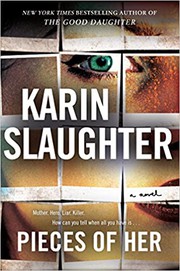
I came to this one sideways. I had read Pretty Girls and The Good Daughter back to back and needed something by Karin Slaughter that was not about sisters in Georgia trying to survive their hometown. Published in 2018 by William Morrow, 480 pages in the first US hardcover, Pieces of Her is a thriller about a daughter who learns, in the most violent way possible, that her mother is not who she claimed to be. It runs two timelines, present day and the 1980s, and it ends up being as much about money, power, and mothers and daughters as about chases and guns. Full spoilers follow, with my complaints mixed in.
A birthday lunch that turns bloody
Andrea Oliver is thirty, drifting, and back in her mother's orbit. She had left for New York years earlier with plans, and the plans did not hold. After her mother Laura's cancer scare, Andy moved home to their small coastal town in Georgia and stalled out. She works a job that does not fit her, dates nobody serious, and lets her brisk, capable mother run small parts of her life. Their thirtieth birthday lunch at a mall restaurant is supposed to be a reset, a nice afternoon before Laura starts pushing Andy to move out and move on.
Then a young man pulls out a gun and starts shooting people in the restaurant.
What happens next is the engine of the whole book. Laura, a middle aged woman Andy has always known as gentle and a little brisk, moves. She talks to the shooter, gets close, takes his knife, and kills him with shocking speed and skill. It happens fast, it is messy, and Andy watches her mother do things with her hands that no ordinary person knows how to do. In the parking lot afterward, with cameras everywhere, Laura gives Andy one strange instruction among the comfort. She says something wrong, off script, that Andy cannot shake.
The video goes everywhere. Within a day, Laura's face is on every screen in the country. Andy expects sympathy for a local hero. What she gets instead is dread. Her mother, who has always hated attention, looks hunted. Phone calls go unanswered. Old friends ask odd questions. And Andy starts noticing small things she had filed away for years. Her mother has no real past before Andy's childhood. No college friends, no old stories, no family beyond a vague outline. Laura claims she grew up quiet and ordinary. The woman in the video did not move like anyone ordinary.
Slaughter writes this opening as well as anything in her career. The shooting scene is short, physical, and sickening. No slow motion heroics. Just noise, bad decisions by bystanders, and then Laura doing something practiced. I believed every beat of Andy's confusion afterward, the way she replays the video, the way she defends her mother to strangers while doubting her in private. My only gripe this early is that Andy reads very passive. Things happen around her while she takes notes. That turns out to be the point, she has to grow teeth, but the first sixty pages can feel like watching someone get dragged through their own story.
The mother Andy thought she knew
Before the past crashes in, Slaughter spends time on the present day relationship, and it pays off later. Laura is the competent one. She beat cancer, or says she did. She keeps a neat house, volunteers, knows everyone in town, and manages Andy with brisk love. Gordon, Andy's father, is nearby but peripheral, a decent man who never quite held the center of the family. The parents split long ago without much drama. Andy grew up feeling watched over and also, in a way she could never name, managed.
The cancer history matters. When Laura was sick, Andy came home and never left. Three years later Laura is healthy and Andy is still there, sleeping in her old patterns. Laura pushes, gently and then less gently, for Andy to get a life. Andy hears criticism where Laura means fear. That misreading runs through the whole book. Laura is not trying to control her daughter out of habit. She is trying to keep Andy away from something.
Hints pile up in ordinary scenes. A locked drawer. A name Laura does not answer to on the news. Cash in places cash should not be. A look on Laura's face when a stranger stares too long at the mall. Slaughter is patient here, letting Andy notice and then talk herself out of noticing, the way people do with parents. You assume you know them. You fill gaps with love.
Then the second attack comes, and patience ends.
A man breaks into Laura's house. He is not a random burglar. He wants something, asks for someone by a name Andy does not know, and when Laura resists, he shoots her. Laura lives, barely, but she is in a hospital bed and cannot talk. Before she goes under, she gives Andy instructions that sound paranoid and specific. Go. Do not trust the police. Do not use cards. Take this money. Find this person. Andy, who has spent the book freezing while others act, finally moves. She runs with almost nothing, sick with worry, furious at being a thirty year old woman taking orders like a child.
This is where the thriller properly starts, and also where Slaughter's theme sharpens. Andy has to decide whether her mother is a victim, a liar, or both at once. The answer, stretched across four hundred pages, is both, with reasons.
On the run with nothing
The middle of the present day story is a road book built on shortage. Andy has little money, no plan, a phone she is afraid to use, and a set of directions from a woman who may have been lying to her for her entire life. She buses and hitches between small towns, sleeps badly, eats worse, and meets people who knew her mother under a different name and react to Andy's face like it is a ghost.
Two things make this stretch work. First, Andy is bad at being a fugitive, and the book admits it. She trusts the wrong stranger. She nearly gets caught because she checks her messages. She spends money she should save. Watching her learn caution in real time is more gripping than watching a professional operator glide through the same scenes. When she finally lies well, to a cop, to a clerk, to a man following her, the small win lands because you saw how much it cost her.
Second, the people hunting her are not cartoon hit men. Some are patient. Some have badges or money behind them. One in particular has been looking for Laura for decades and treats Andy as a loose thread worth pulling. Slaughter keeps the threat half visible. A car that stays two lengths back. A question asked twice in two towns. A friendly face that knows too much about Laura's medical history. Paranoia builds without a body count on every page, which suits a story about a woman uncovering a hidden identity rather than surviving a siege.
Gordon reappears in this stretch, and his scenes are sad in a useful way. He loved Laura, or the version of her he was allowed to love, and he raised Andy as best he could inside a marriage with a locked room. He wants to help now and mostly cannot, because the secrets predate him. His helplessness mirrors Andy's. Both of them are learning that loving someone does not mean knowing them.
The plotting here is not perfect. One coincidence involving a stranger's kindness stretches belief, and a police encounter resolves a little too neatly for a book this grim everywhere else. But the momentum holds. Every town gives Andy one more piece of the old name, Jane Queller, and one more reason to keep driving toward the people who destroyed her mother's first life.
1986, Jane Queller, and the group
The past timeline is the book's backbone, and Slaughter takes her time with it. In the mid 1980s, Laura is Jane Queller, the daughter of Martin Queller, a wealthy man whose family name sits on buildings and a healthcare company. Jane grows up inside money and its protections. Private schools, expectations, a brother, Jasper, who handles the family role more easily than she does. She is bright, restless, and angry at the unfairness she can see from inside the nice house. At college she falls in with a radical circle led by Nick Harp, a charismatic young man who talks about justice the way some people talk about religion.
Slaughter writes campus radicalism without nostalgia and without sneering. The group's complaints are real. The rich skate, the poor get policed, the family company profits from illness, the system shrugs. Nick gives Jane's anger a shape and a target. Meetings turn into actions. Actions turn into plans. What starts as protest talk curdles, in the way these stories do, into something with weapons in it. Jane, sheltered and hungry to matter, goes along further than she understands, sleeping with Nick, cutting ties with her family, learning to see her father as an enemy rather than a parent.
I will keep the worst of it lightly veiled, since the book's power sits in watching a smart girl walk step by step into disaster. A planned action goes wrong. People die who were not supposed to die. Jane finds herself tied to a killing she did not intend but cannot disown, with Nick's control tightening around her. Her family's money, which she had rejected as corrupt, becomes the force trying to bury the whole mess. Her father moves to protect the name. Lawyers appear. Stories get rewritten. Jane, pregnant and terrified, has to choose between loyalty to Nick and survival.
She chooses survival, and survival costs her everything. To escape Nick and the wreckage, and to keep her child safe from both the group and her own family's machinery, Jane becomes Laura. New town, new habits, new past, silence as a way of life for thirty years. Slaughter makes the transformation credible by showing what Jane gives up. Money, music, friends, books, opinions, anything that could link back. Laura's brisk, bland competence is camouflage built day by day.
These chapters are the strongest writing in the novel. The 1980s details feel lived in without being a costume parade. More important, Jane reads as a real young woman rather than a thesis. She is brave about small things and cowardly about big ones, generous and self pitying by turns. When she finally understands what Nick is, the scene lands because Slaughter waited for it instead of announcing him as a villain on page one.
If there is a flaw here, it is that Martin Queller and the family company sometimes feel like a press release for evil. Rich men pulling strings, records sealed, witnesses paid. None of it is implausible, and Slaughter ties it to real dynamics of healthcare money and influence, but a few scenes lean on the reader's readiness to believe the worst about wealth. I wanted one honest Queller ally to complicate the picture. Jasper gets fragments of sympathy, but mostly the family functions as a wall.
What Andy finds and what it costs
Back in the present, the two timelines start to braid. Andy tracks down survivors of the old group, finds records that were supposed to stay sealed, and learns the shape of what Jane did and what was done to her. The man who shot Laura connects back to that old violence. He has nursed his grievance for decades and sees finishing the job as justice. Other players circle with cleaner hands and colder motives, including people tied to the Queller money who would prefer the past to stay buried now that it is worth more buried.
Andy changes in these chapters in ways the early section promised. She stops asking to be told and starts demanding. She confronts Gordon with questions he cannot answer. She confronts a Queller representative with facts that make the polished mask slip. She visits her mother in the hospital carrying both love and accusation, and the bedside scenes are among the book's best. Laura cannot speak, and Andy finally talks honestly to the silence, saying the things dutiful daughters swallow. When Laura wakes enough to respond, their conversations are short, factual, and devastating. No big forgiveness scene. Just two women trading pieces of a story neither can carry alone.
The climax brings the hunter, the family machinery, and Andy together in a confrontation that is violent without being endless. Slaughter resists the temptation to stage a small war. The final violence is quick, ugly, and personal, consistent with the mall shooting that opened the book. Laura's old skills matter, but so does Andy's new willingness to act without permission. The resolution of the immediate threat feels earned. The resolution of the family questions stays messier, which I preferred. Money does not apologize. Institutions do not learn. What changes is that Andy stops living inside her mother's hiding place.
One note for readers of Slaughter's other work. This is violent but not as graphic, page for page, as Pretty Girls. The worst harms here are older, mourned rather than shown. There is shooting, a killing, domestic cruelty in the past timeline, and the long ache of a woman who gave up her name. Readers who found her earlier books too brutal to finish may still find this one heavy, but it is heavy in a different register. Grief more than gore.
The book also sets up what came next. Andy's story continues in Girl, Forgotten, published in 2022, which follows Andrea Oliver further. You do not need to know that to finish this one. It closes its own loop. But if you attach to Andy the way I did by the end, it helps to know there is more.
What I liked, what bugged me, and who should read it
Start with the good, because there is a lot. The dual timeline actually works. Both halves have their own tension, and the reveals in one reframe scenes in the other without cheating. Laura and Jane feel like one person seen across thirty years rather than two characters sharing a name. The theme of mothers managing daughters out of hidden fear gives the thriller weight. And the Netflix adaptation, which arrived in 2022 starring Toni Collette as Laura and Bella Heathcote as Andy and went to number one worldwide, is easy to picture while reading. The book is already paced like prestige television, short scenes, hard cuts, a reveal per episode.
Now the complaints, stated plainly. Andy's passivity lasts a long time. Slaughter needs her naive so the reveals land, but for a hundred pages she mostly receives information and reacts slowly. Readers who like competent protagonists may want to shake her. The Queller wealth plot sometimes runs on fumes. A sealed record here, a paid witness there, a lawyer who appears exactly when needed. It never breaks, but you can feel the machinery. And the middle sags once, around the third town on Andy's run, where two encounters teach her roughly the same lesson about trusting strangers. Twenty pages cut there would have helped.
There is also the question of likability. Jane in the past timeline makes terrible choices for chapters at a time. She follows Nick past every exit ramp. Some readers will lose patience with her before Slaughter lets her wake up. I stayed with her because the writing keeps showing the exits as Jane saw them, narrow, expensive, humiliating, rather than as the reader sees them. Still, if you need your protagonists sharp from page one, know what you are getting.
Who is this for. Readers who like family secrets thrillers with real violence and real patience will be at home. Fans of Slaughter's Grant County and Will Trent books will recognize the Georgia texture and the interest in how institutions fail women, though this one stands apart in cast. Readers coming from the Netflix show should know the book is slower and more interior, with much more of the 1980s. As the first Andrea Oliver book, it also works as an entry point. No prior Slaughter required.
For me, the test of a thriller this long is whether the last hundred pages feel fast. These did. I stopped underlining flaws and just needed to know who walked out. When a book about hidden identity ends with the hidden person still partly hidden, even to herself, and that feels honest rather than coy, the writer did something right.
FAQ
Is Pieces of Her part of a series?
Yes. It is the first Andrea Oliver book, followed by Girl, Forgotten in 2022. Both follow Andrea as she faces fallout from her mother's hidden past.
Was Pieces of Her adapted for television?
Yes. Netflix released it in March 2022 starring Toni Collette as Laura and Bella Heathcote as Andy, and it debuted at number one worldwide.
When was Pieces of Her published?
It was published in 2018 by William Morrow. The first US hardcover runs 480 pages and the ISBN cited here is 9780062430274.
Similar books
More from Andrea Oliver first, then related titles.

Girl, Forgotten
A rookie US marshal guards a judge with a stalker and ends up reopening the 1982 prom-night murder of the judge's pregnant daughter.
2,111-word summary · 9 min read

Keep It in the Family
Mia and Finn renovate a long empty house and find seven children hidden in the attic.
2,270-word summary · 10 min read
The Good Daughter
Twenty eight years after a home invasion shattered her family, a lawyer witnesses a school shooting that reopens old wounds.
2,505-word summary · 11 min read

Six Years
A professor who promised to forget the woman he loved sees her husband's obituary and discovers that the wedding, the marriage, and the woman herself may never…
2,076-word summary · 9 min read

The Best of Friends
Three lifelong friends discover their teenage sons were hiding more than anyone knew after a night that leaves one dead, one in a coma and one silent.
2,040-word summary · 9 min read

The Boy from the Woods
Wilde, found feral in a New Jersey forest in 1986, hunts for a missing teenager while a senator's secrets tear a wealthy town apart.
2,270-word summary · 10 min read
What Lies Between Us
Nina keeps mother Maggie locked upstairs for years, trading lies about sisters and deaths that unravel fast.
2,062-word summary · 9 min read
The Chain
Rachel must kidnap another child to save kidnapped Kylie, entering a chain where parents pass crime forward.
2,021-word summary · 9 min read
The Family Remains
Lucy returns to London as bones on the Thames reopen the Chelsea mansion deaths.
2,304-word summary · 10 min read

Anatomy of an Alibi
Two Louisiana women swap lives for twelve hours to spy on a husband, then he turns up murdered and only one of them has an alibi.
2,278-word summary · 10 min read

All the Little Houses
In 1980s Longview, Texas, social queen Charleigh and daughter Nellie guard mean-mom secrets when a new family threatens their empire.
2,206-word summary · 10 min read
Watching You
A new wife in Bristol fixates on a charismatic neighbor while a teen boy logs every move before a murder.
2,363-word summary · 11 min read
The Locked Door
Surgeon Nora Davis hides serial killer father while patients die.
2,465-word summary · 11 min read
The Family Upstairs
Libby Jones inherits a Chelsea mansion and a past tied to a cult house, two runaways, and a baby left waiting.
3,300-word summary · 15 min read
A Flicker in the Dark
Psychologist Chloe Davis faces copycat disappearances in Baton Rouge twenty years after her father confessed to murders.
3,074-word summary · 14 min read

Pretty Girls
Estranged sisters Claire and Lydia reunite after a murder exposes snuff films, their sister Julia's fate, and a killer near Lydia's daughter.
2,498-word summary · 11 min read

What She Knew
Rachel lets her eight-year-old son run ahead in a Bristol park, and the nine-day search turns her into a suspect in the public eye.
2,952-word summary · 13 min read

The Beach House
A young valet is beaten to death at a Hamptons party, and his law-student brother spends a year building a case against the family that covered it up.
2,049-word summary · 9 min read

Rules of Prey
Minneapolis detective Lucas Davenport hunts a killer who leaves a new rule at every scene and treats murder as a game of wits.
1,914-word summary · 9 min read

4th of July
Lindsay Boxer shoots two armed teenagers in self-defense, faces a wrongful-death trial, and spends her leave chasing a string of throat-slashing murders in…
2,192-word summary · 10 min read

61 Hours
A bus crash strands Jack Reacher in a snowbound South Dakota town where a drug gang, a corrupt police force, and a single witness are on a collision course.
2,227-word summary · 10 min read

The Girls in the Garden
Clare moves her daughters to a gated London garden where the community feels safe; at the midsummer party, twelve-year-old Pip finds her sister bleeding in the…
1,973-word summary · 9 min read

Still Missing
A realtor is abducted at a Vancouver Island open house and held for more than a year. Told through therapy sessions, the novel follows her escape and the hunt…
2,466-word summary · 11 min read

Bad Luck and Trouble
A deposit of $1,030 summons Jack Reacher back to his old army unit, which is being picked off one name at a time.
2,366-word summary · 11 min read

3rd Degree
The third Women's Murder Club novel follows a San Francisco terror cell and a three-day killing schedule, and it costs the club a member.
2,685-word summary · 12 min read

Worth Dying For
Reacher stops for one night in rural Nebraska and finds a family that runs the county, a missing girl and a shipment worth killing for.
2,021-word summary · 9 min read

Say You're Sorry
A widowed prosecutor defends the teenager accused of killing her babysitter, uncovering a small town's secrets and a killer hiding in plain sight.
2,116-word summary · 9 min read

Echo Burning
Reacher hitches a ride with a Texas woman who wants her abusive husband killed, then has to prove she did not murder him when he comes home.
2,209-word summary · 10 min read
The Drowning Woman
Living in her car in Seattle, Lee saves a wealthy stranger from drowning. The friendship that follows draws her into abuse, murder, and a plan to disappear.
2,578-word summary · 11 min read

The Woods
Twenty years after two teenagers were murdered and two vanished at summer camp, prosecutor Paul Copeland identifies a fresh corpse as one of the missing.
2,490-word summary · 11 min read