
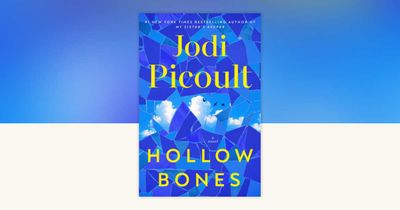
Hollow Bones
2,703-word summary 12 min read 464 pages in the book
- First published
- 2026
- Publisher
- Ballantine Books
- Pages
- 464
- ISBN
- 9780593726259
Reading options
What's inside (9 sections)
I picked this one up for a peculiar reason: it opens with a date, and the date is one I already carry around. The first line of Hollow Bones points us at 11 September 2001. Jodi Picoult's novel, published by Ballantine Books on 15 September 2026 and running to 464 pages, begins with two-month-old Molly Fitzgerald losing her mother that morning. Her mother went to an appointment at the World Trade Center and did not come home. That is the starting fact, and Picoult does not soften it. I read the whole book with that image in front of me, because nearly everything the story later does with fear and planning and the accounts we give of our own lives grows out of it.
What surprised me was how quiet the opening is. There is no drawn-out catastrophe on the page. There is a baby who is barely past newborn, a mother heading downtown to an appointment, and then an absence. Picoult has built her career on novels that take a large moral question and walk it into an ordinary family's rooms, and she uses the same move here. The historical tragedy is not background decoration. It is the thing that shapes a child's sense of what the world is capable of. Molly grows up with what the publisher calls a healthy dread of disasters, which is a careful phrase. It does not mean she is frozen. It means she learned, earlier than most children, that safety is something you arrange and rehearse rather than something you are simply given.
A childhood spent expecting the worst
The detail I keep returning to is that Molly is not an abandoned child. Her father is there, and the stepmother who raises her could not love her more. Picoult is not stacking injury upon injury to make us feel sorry for her heroine. The love in that house is real, and the dread is real too, and the book is interested in how those two things can live side by side for twenty years. A child can be cherished and still absorb the lesson that the ground can open without warning. That lesson is the inheritance the novel traces, and it arrives not as a wound someone inflicted but as a fact Molly was old enough to register and too young to process.
This is where the book's interest in mothers and daughters begins to take shape. Molly's mother is gone before Molly can know her, which means she exists for her daughter as a story, a set of facts and photographs and half-remembered accounts supplied by other people. The publisher describes the book as an epic story about the ties that bind mothers and daughters, and I think that absence is part of what the phrase is doing here. A mother who is not there to be argued with can become enormous in a child's mind. She can also become a blank screen onto which the child projects whatever she needs. Picoult does not tell us how Molly settles that account. She shows us a grown woman who has built her entire working life around the possibility of loss, and lets us draw the connection ourselves.
I found this part of the book the most convincing. The grief is not treated as a problem to be solved by the end. It is treated as a condition that a person organizes a life around, the way you might arrange furniture in a room because of where the light falls. There is a fidelity to the small, unglamorous way that early loss persists. It shows up as vigilance rather than tears, as a habit of checking exits and thinking several steps ahead. Whether every reader will recognize that habit depends on experience, but Picoult writes it with enough restraint that it does not feel like a lecture.
A career built around catastrophe
As an adult, Molly runs the Rhode Island Department for Emergency Preparedness. Her job is to map out ways to save lives during storms, epidemics and airplane crashes. I liked the logic of this enormously. The little girl who learned that disaster can arrive on a clear Tuesday grows into the woman whose professional task is to imagine disasters in advance and plan for them. Picoult is not being subtle about the connection, but she does not have to be. It is there in the job title, and the book trusts the reader to see it.
The work itself gives the novel its texture. Emergency planning is a strange kind of thinking: you spend your days rehearsing events you hope never happen, building responses for scenarios that are, by definition, hypothetical. There is a kind of control in it, but it is a control exercised over plans rather than outcomes. I read Molly's career as an attempt to take the one thing that once arrived unannounced and make it sit still long enough to be studied. The publisher describes the book as being about the plans people design to protect themselves at the worst moments, and Molly's whole professional life is an instance of that impulse scaled up to a state agency. She makes plans for strangers because she cannot make a plan for the thing that happened to her mother.
That is my reading of it, and I want to be honest that the book leaves a good deal of this unstated. Picoult gives us the job and the childhood and trusts the architecture to speak. Some readers will find that satisfying. Others will want the connection spelled out in a scene where Molly admits what she is doing. The novel never gives us that scene, and the refusal is part of its design, for better and for worse.
Jesse, and the marriage as shelter
Molly's husband is Jesse, a police polygraph expert with a history of crisis of his own. The two of them have built a marriage that the publisher describes as a solace in a dangerous world. I found the choice of Jesse's work quietly apt. A polygraph examiner studies the gap between what people say and what is true. He sits with people who are managing their accounts, people who want to be believed, people whose bodies may betray them even when their stories are polished. Put that man next to a woman who has spent her life planning for catastrophe, and you have two people who each, in different ways, work professionally with the gap between the surface of things and what lies underneath.
The marriage is new, and that matters. It is a recent shelter, not a decades-old arrangement, and the book treats it as something both characters are still learning to inhabit. The phrase about a solace in a dangerous world is the publisher's, but it captures what Picoult is after: two people who have each met the worst of things taking refuge in an ordinary partnership. I wanted more time inside that marriage, more of the daily texture of it, because the novel tells us it is a comfort before it shows us much about how that comfort works. Jesse's own crisis history is mentioned rather than dramatized, and I found myself wishing for a fuller account of what he has been through and how it shapes the way he loves.
Still, the setup does its job. When the book says something unexpected upends this new marriage and forces both of them to question everything they thought they knew, the stakes are clear. This is not a marriage that has grown stale and needs a jolt. It is a fragile, cherished thing, and the threat to it lands hard because we have been told how much both characters need it.
The upheaval the publisher keeps to itself
Here is where I have to be straight with you. Something happens upend the marriage, and Picoult's publisher deliberately withholds its nature. The jacket copy does not say what the upheaval is, and neither will I, because inventing it would mean making up the central event of a book I am supposed to be describing. What I can tell you is what the record supports. The book is described as an epic story about the lies people tell themselves while writing the narratives of their lives, about the plans they design to protect themselves at the worst moments, and about the ties that bind mothers and daughters. The upheaval is plainly the hinge on which all three of those themes turn.
That gap between the story we tell about ourselves and the truth we are avoiding is the novel's central preoccupation, as far as the published material lets me judge it. People write narratives of their lives the way a novelist writes a draft: selecting, cutting, smoothing over the awkward parts, emphasizing the scenes that flatter them. Picoult has always been drawn to characters who discover that the story they have been telling about themselves will not hold. Pair that with a husband whose job is detecting deception, and the thematic machinery is visible from a mile away. I think the book is asking what happens when a person's private account of her own life is challenged by someone who is trained to read the signs of a false one.
I also think the title is doing quiet work. Hollow bones are light and strong, the kind that let a bird fly, and they are also what is left after the soft parts are gone. The phrase holds both fragility and structure at once. That seems right for a book about people who build elaborate plans and careful stories to keep themselves aloft, and about a daughter whose mother is present mostly as an absence. This is my own reading rather than something the publisher states, so take it for what it is, but the resonance struck me early and stayed with me.
The publisher files the book under women's fiction and literary fiction, and it moves between past and present in the manner of Picoult's other research-driven moral-dilemma novels. That shifting timeline fits a story in which the past is never really past. Molly's childhood loss is not backstory; it is an active ingredient in the marriage she is now fighting to understand. The structure lets Picoult keep the old wound and the new crisis on the page at the same time, which is exactly what a book about the stories we inherit needs to do.
The return of My Sister's Keeper, and Picoult's method
Readers are told that fan-favorite characters from My Sister's Keeper return here, which links this novel to Picoult's earlier work. If you know that book, the return is a homecoming, a chance to find out what became of people you cared about. If you do not, it is a question mark, and Picoult does not stop to answer it in the material I have. Kirkus, in its starred review, noted the return of that character and called the book an intricate family drama spanning decades. The word decades is doing real work. This is not a novel about a single crisis weekend. It is about what a family carries forward, and the reappearance of familiar faces is one way Picoult shows that carry.
I have mixed feelings about this device. On one hand, returning characters reward the people who have read widely in an author's backlist, and they give a story like this a foundation of established affection. On the other hand, a book that leans on a reader's prior attachment can feel closed to newcomers, and I found myself wanting enough context to stand on its own. Picoult seems to be counting on goodwill here. For a writer with a readership this large, that is a reasonable bet, but it is still a bet.
The moral-dilemma method itself is on full display. Picoult takes a research-heavy subject, in this case emergency planning and the science of lie detection, and uses it as the scaffolding for a question about what a person owes to the people she loves. The research gives the book authority, and the dilemma gives it heat. When it works, as it often does in her hands, you can feel the two halves pushing against each other. When it does not, the research reads like homework and the dilemma reads like a trap laid by the author. Hollow Bones leans toward the former more often than not, though I can see where a less patient reader might land.
Reception, and where the book creaks
The numbers are impressive. Hollow Bones reached number one on the New York Times combined print and ebook fiction list in early October 2026, was a USA Today bestseller, and was nominated for a Goodreads Choice Award. Kirkus gave it a starred review, calling it impressive, important and fun to read. The audiobook is read by Rebecca Soler, MacLeod Andrews, Julia Whelan and Picoult herself, which is a strong cast and worth noting if you listen rather than read.
Now for the fair criticisms, because there are some. The publisher's own copy is coy about the central twist, and that coyness shapes the whole reading experience. I understand the commercial logic of withholding a secret, but it can feel like the book is being marketed on a withheld card trick, and I finished wishing the promotional material trusted the story enough to say what it is about. There is also the matter of Picoult's method of stacking a large historical tragedy on top of a marital crisis. That can feel engineered, as though the author has reached for the biggest possible backdrop to give a domestic story weight. I did not mind it here, because the 9/11 loss is genuinely the origin of Molly's character, but the risk is real and I can see a reader resenting the maneuver.
Picoult has openly said that she trades critical acclaim for readership, and that attitude helps explain both the strengths and the weaknesses of the book. She writes for a large audience, in a register that is accessible and emotionally direct, and she is not trying to win over the reviewers who want something more austere. Critic Janet Maslin's long-standing complaint that Picoult's prose occasionally bogs down in lyrical turns of phrase remains fair here. There are passages where the writing reaches for a kind of elevated reflection and lands a beat short of it. I noticed this most in the stretches that meditate on memory and loss, where a plainer sentence would have hit harder. The effect is not ruinous, but it is there, and it is the kind of thing that will irritate a reader already inclined against the author.
Who should read it
I would hand this to a reader who likes family dramas with a moral question at the center, and who is willing to sit with a book that keeps its biggest card close. If you want the upheaval described in the first chapter, this will frustrate you. If you read Picoult for the way she takes a professional world, learns its vocabulary, and then asks what it would feel like to live inside one of its worst cases, there is plenty here to reward you. The emergency planning material and the polygraph detail give the story a solid floor to stand on, and the mother-and-daughter thread gives it a long memory.
What has stayed with me since finishing is not the secret or the twist but that opening date. A baby two months old, a mother going to an appointment, a family that loves the child and cannot protect her from what she will grow up knowing. Everything else in the book is an elaborate answer to the question of what a person does with that knowledge. Picoult's answer, as far as the published page lets me see it, is that we plan and we narrate and we love the people in front of us, and that none of those things fully protects us. I think that is honest, and I think it is why this book will matter to the readers it finds.
FAQ
Is Hollow Bones part of a series?
No. It is a standalone 2026 novel from Ballantine Books, though fan-favorite characters from Jodi Picoult's earlier book My Sister's Keeper return in its pages.
What is the big twist in Hollow Bones?
The publisher deliberately withholds the nature of the upheaval that upends Molly and Jesse's marriage, so an honest summary stops short of describing it. What is on the record is that the book centers on the lies people tell themselves, the plans they make for worst moments, and the ties between mothers and daughters.
When was Hollow Bones published and how was it received?
Ballantine Books published it on 15 September 2026 at 464 pages. It reached number one on the New York Times combined print and ebook fiction list in early October 2026 and earned a starred review from Kirkus.
Similar books

A Spool of Blue Thread
Four generations of the Whitshank family in Baltimore, and the silences, resentments and quiet love they hand down without ever saying so.
2,408-word summary · 11 min read
Whistler
Ann Patchett's eleventh novel follows a New York teacher who reconnects with a former stepfather at the Met and hears the strange story of a chestnut mare.
2,697-word summary · 12 min read
The Vacationers
A New York family's two-week stay in Mallorca turns into a comedy of exposed secrets when a magazine editor's affair and a son's debts come to light.
2,324-word summary · 10 min read
King of Ashes
A Virginia crematorium, a debt owed to the Black Baron Boys and a family secret pull Roman Carruthers back into a war where everything burns.
2,229-word summary · 10 min read
The Mermaid Chair
Jessie Sullivan returns to her childhood home on Egret Island to care for her agoraphobic mother, then finds her marriage, her faith, and a monk's vow thrown…
2,237-word summary · 10 min read
Lone Wolf
A wolf expert lies in a coma after a crash, and the son who left home years ago returns to end his life support while his sister fights to keep him alive.
2,761-word summary · 12 min read

The Wilderness
Four Black women move through twenty years of friendship in Angela Flournoy's discontinuous, widely praised second novel.
2,141-word summary · 10 min read
The Rest of Our Lives
A law professor drives his daughter to college, then heads west instead of home, testing a private promise he made twelve years ago.
2,238-word summary · 10 min read
Palaver
A mother shows up uninvited at her estranged son's Tokyo apartment, and the two spend the weeks before Christmas talking their way toward something like…
2,465-word summary · 11 min read
Our Souls at Night
A widow asks her widower neighbor to lie beside her at night, not for sex but for company, and two lonely people in a small Colorado town begin again.
2,582-word summary · 11 min read
Only Son
A brief, funny, melancholy debut about a boy whose father dies in 1982 Florida, and the man he becomes, still trying to read the mystery of that loss.
2,170-word summary · 10 min read
One Boat
A woman returns to a Greek coastal town after her father's death, and the holiday she took nine years earlier after her mother's death keeps breaking through.
2,143-word summary · 10 min read
Love Forms
A Trinidadian mother sent away at sixteen returns to the loss of her daughter forty years later, in Claire Adam's quiet, longlisted novel.
2,153-word summary · 10 min read
Barefoot
Three women spend a summer on Nantucket facing chemotherapy, a lost career and a pregnancy shadowed by affairs.
2,323-word summary · 10 min read
The Kitchen God's Wife
Amy Tan's second novel pairs a San Jose speech therapist with her Chinese mother, whose account of war, an abusive husband, and a narrow escape comes out in a…
2,896-word summary · 13 min read
The Emperor of Gladness
Ocean Vuong's second novel follows a young addict pulled back from a bridge in a dying Connecticut mill town and into the home of an elderly immigrant woman…
2,693-word summary · 12 min read
The Collected Regrets of Clover
A death doula who writes down the last words of strangers keeps her own heart locked away, until a new neighbor, a dying photojournalist and a road trip to…
3,055-word summary · 14 min read
The Bookstore Sisters
A short, warm story about a woman who returns to her family's failing Maine bookstore and the sister she has spent years avoiding. Books, baking and old…
2,335-word summary · 10 min read
My Friends
A dying artist sends an eighteen-year-old stranger a painting, pulling her into the story of four teenagers and one summer on an abandoned pier.
2,219-word summary · 10 min read
Good Girl
A nineteen-year-old artist in Berlin, grieving her mother, falls into an unequal romance with an American author who offers escape from the ideal of the good…
2,579-word summary · 11 min read
Good Dirt
A stoneware jar made by an enslaved potter links a prominent Black New England family across a hundred and fifty years of prosperity, grief and buried history.
2,069-word summary · 9 min read
Dream Count
Four women narrate the 2020 lockdown in their own voices: a travel writer, a friend in early labor, a banker cousin and a housekeeper assaulted in a hotel room.
2,286-word summary · 10 min read
All Adults Here
A widow in upstate New York reconsiders the parent she was after a neighbor's death, then gathers her three grown children for a season of uneasy truths.
2,171-word summary · 10 min read

Sam's Letters to Jennifer
A grieving journalist reads her grandmother's letters and finds a decades-long love affair that changes how she sees her family.
2,310-word summary · 10 min read

We Are Okay
Marin fled San Francisco after her grandfather vanished and stopped answering anyone. When Mabel visits her college dorm, she has to say what happened.
2,253-word summary · 10 min read
The Pilot's Wife
Kathryn Lyons's husband dies in a plane crash, and the investigation reveals a secret life that forces her to rethink their marriage.
2,006-word summary · 9 min read

And Every Morning the Way Home Gets Longer and Longer
An elderly grandfather, his son, and his grandson share memories and fears as the old man's mind begins to fade, in a short novel about grief and love.
2,078-word summary · 9 min read
The Tiger's Wife
A young doctor in a war-scarred Balkan country chases the stories her grandfather left behind, including a deathless man and a deaf girl who loved an escaped…
2,232-word summary · 10 min read
Maame
Maddie Wright, 25, has spent years as the responsible one in her Ghanaian British family, and the year she finally tries to live for herself is the year…
2,108-word summary · 9 min read
The Accidental Tourist
Grieving Macon writes travel guides for haters of travel, then Muriel intrudes.
2,252-word summary · 10 min read