
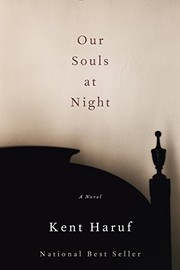
Our Souls at Night
2,582-word summary 11 min read 179 pages in the book
- First published
- 2015
- Publisher
- Alfred A. Knopf
- Pages
- 179
- ISBN
- 9781101875896
Reading options
What's inside (10 sections)
A late-night knock in Holt
I came to this book expecting something small, and it is small, but I was not ready for how much it would get right about the particular loneliness of growing old in a place where everyone knows your business. Kent Haruf's final novel appeared in 2015, published after his death by Alfred A. Knopf, and it runs to 179 pages in that first hardcover edition. It is set in Holt, Colorado, a town on the High Plains that Haruf based on Yuma and the other eastern Colorado places he knew growing up. If you have read his earlier books, the landscape will feel familiar: wide skies, hard winters, people who have lived side by side for decades without ever really speaking to one another.
What makes this one different is how narrow its focus is. There is no large mystery, no family saga stretched across generations, no young person trying to escape a hometown. Two people, both alone, decide to try something, and that is nearly the whole engine of the book. I found myself slowing down as I read, partly because Haruf's sentences are so plain that you want to notice how they work, and partly because the situation felt more risky than it sounds when you describe it. An old man and an old woman sleeping in the same bed in a small town is a recipe for whispers, and Haruf never lets you forget that the neighbors are watching from behind their curtains.
The novel was written in a hurry, in the last year of Haruf's life. He was diagnosed with interstitial lung disease in 2014 at seventy-one, and he finished a first draft in a matter of weeks, working on revisions until shortly before he died in November of that year. Knowing that history changes how you read the book, though I tried to set it aside at first. It is hard not to hear a man saying what he thinks matters most when he knows he will not have another chance.
What Addie actually asks for
Addie Moore comes to Louis Waters's house one evening and asks if he will come over at night and lie in bed with her. She is careful to explain that she is not proposing sex. She wants company, someone to talk to in the dark, a way to get through the long hours before morning. Louis is thrown by the request. He asks for time to think about it, and he is not a man who invites disruption into a settled life. The two of them have been neighbors for years without becoming friends. He eventually says yes, after an evening with other older men in town who gossip about their neighbors and fill the silence with talk that goes nowhere in particular.
The arrangement begins awkwardly. Louis admits that he does not say much, and the first nights have the feel of two strangers learning the shape of a bed they are sharing. Addie tells him to leave a few things at her house, suggests pajamas, and pushes him to come in through the front door instead of slipping around back. He worries about what people will say. She says she does not care, or at least she says she does not, and that difference between them becomes one of the quiet tensions running under the story. Louis has spent a lifetime managing how he is seen by other people. Addie, at this stage in her life, is past managing anything, or is trying to be.
What struck me is how practical the proposal is. Addie is not asking to be rescued or adored. She has identified a specific problem, which is that she cannot sleep and cannot bear another night of silence, and she has thought of a specific remedy. There is something almost workmanlike about the way she presents it. That practicality is what makes the book believable. If she had come over reciting poetry about loneliness, I might have put it down. Instead she makes a proposition that sounds like a plan for fixing a leaky faucet, and the oddness of that is what drew me in.
The pasts they carry
Once they are lying together night after night, they begin to tell each other things they have never told anyone. Louis confesses that thirty years ago he left his wife, Diane, and their daughter, Holly, for a teacher named Tamara. He moved in with Tamara and her daughter, then changed his mind and came home after a short time. The affair never fully faded from the town's memory, and it is part of why his daughter keeps her distance and why the old men at the cafe still talk about him. Addie's story is worse in a different way. Her daughter Connie was struck and killed by a car while playing outside, with her younger brother Gene watching. Gene never recovered from it, and Addie's marriage came apart in the years that followed.
These confessions are not delivered as dramatic revelations. Haruf lets them surface in the middle of ordinary evenings, the way real people eventually get around to the worst thing that ever happened to them, usually while doing something else with their hands. I kept thinking about how much of a life is made up of the things we have decided not to say out loud. The bed becomes a place where saying them is possible, because the dark makes it easier and because the person listening has his own shame to set beside hers. Neither of them asks for absolution. They ask to be known, which is a smaller and more stubborn need than forgiveness.
Holly, Louis's daughter, calls the house and worries when he does not answer. He jokes with her about getting hearing aids rather than admitting where he has been. That small evasion stayed with me, because it shows how quickly the new arrangement has already changed the way he moves through his own day. An old man who has been entirely predictable to his daughter for decades is suddenly hard to read, and he does not know how to explain it. Haruf is very good at this kind of small domestic awkwardness, the moment when a private change collides with a family routine.
A boy, a dog, and a summer
In the summer, Addie's son Gene drops off his own son Jamie, Addie's grandson, because his marriage is falling apart and he cannot manage the boy on his own. Jamie stays for several weeks. He is homesick and unsettled, and at night he comes into Addie's bed for comfort, which means Louis is there too. The three of them form an odd little household. They take in a dog to give the boy something to care for. They go to a softball game. Louis buys Jamie a mitt and teaches him to play catch, and they camp in the mountains, where the boy roasts marshmallows over the fire. These are the best passages in the book, and they are almost entirely without comment. Haruf describes what people do and trusts you to feel what it means.
I read those pages slowly, because they are so free of the usual machinery of a novel. There is no ominous music, no hint that the summer will end badly, no narrator telling us that this is a temporary paradise. A man throws a ball with a boy who is not his grandson, and the boy gets a little better at catching it, and that is the whole scene. It works because Haruf has earned the right to leave things out. By this point we know how much these small gestures matter to people who have spent years without them.
There is also a brief moment of metafiction that I liked. Addie and Louis talk about a Colorado novelist who writes books about Holt County, and they wonder whether someone could make a story out of the two of them. Haruf set his other novels in that same fictional county, so the joke is aimed partly at his own work. It is dry and quick, not the sort of thing that pulls you out of the book. It made me think about how much of his fiction is an argument for writing down ordinary lives at all, as though a life counts differently once it has been set on the page.
The family closes in
The summer cannot hold. Gene comes to collect Jamie and is angry when he learns about his mother's arrangement with Louis. He knows about the old affair, and he does not trust the man, and he understands that the one thing which will make Addie give in is the boy. He threatens to cut off her contact with Jamie if she keeps seeing Louis. Addie relents. This is the part of the novel that hurt most, because Addie is not a weak person, but she is a grandmother, and she chooses the child. Louis and she both struggle with the separation. They miss each other in the specific way people miss a habit they did not know they had grown dependent on, reaching for a presence that is no longer there.
Louis sees her again in the hospital after she breaks her hip, and Gene allows him five minutes. That scene is restrained almost to the point of aching. There is so much the two of them could say, and the clock on the wall makes saying any of it impossible. Afterward, Addie restarts the relationship over the phone, when her son is out of earshot. The book ends with the two of them talking in the dark, which is where it began, with voices rather than bodies. I will not pretend that this is a triumphant ending. It is a held-onto ending, and for these two people, boxed in by family and by their own histories, it is probably the honest one.
Gene's victory is an uncomfortable thing to watch, because the novel does not present him as a villain. He is a grieving man raising a damaged boy, and his anger has a real source in a betrayal that happened long before this story began. Haruf gives him that much. I appreciated it, even as I wanted to shake him. The best books about families tend to make you argue with every character in turn.
What Haruf is doing with silence
Haruf's prose is famously spare, and this is his most spare book. The vocabulary is plain, the sentences are short, and whole stretches pass with almost no dialogue at all. Some readers find that frustrating, and I understand why, but I think it is the whole point. The things these two people most need to say are the things they can least easily say, so the book keeps its attention on the space around the words. A hand in the dark, a walk to the store, a dog settling on the floor: these carry the weight that a long speech would carry in another novel.
The recurring image is sleep itself. The title promises souls at night, and the book keeps returning to what happens when the lights go out and there is nothing left to do but lie awake. Loneliness, Haruf suggests, is largely a nighttime problem. In the daytime there are errands and neighbors and the small duties of a household. At night there is only your own company, and if someone is beside you, even silently, the hours become survivable. That idea is so simple that it is easy to miss while you are reading, and then it arrives all at once when you close the book.
The repetition in the prose took some getting used to. Haruf lets certain phrases and gestures come back again and again, the way they do in real life when you are living closely with one other person. At first I thought it was a tic. Later I decided it was a way of describing intimacy: the shared language that two people build out of repeated small things. There is a rhythm to the nights that becomes its own kind of music.
The criticism, fairly stated
Let me be honest about where this book may lose you. Ursula K. Le Guin praised it in The Guardian, calling it moving and authentic given the circumstances in which Haruf wrote it, and remarking that a writer who has gone farther than the rest of us wants to tell us what matters there. Joan Silber, reviewing it in The New York Times, admired the way simple elements carry depth, but she also noted that the novel suffers from sparse dialogue in some scenes. That criticism is fair. If you like books where characters explain themselves at length, this one will feel closed to you, and the silences will read as emptiness rather than meaning.
There is also a real risk of sentimentality here. Two elderly people finding late love, a wounded grandson, a loyal dog, a dying author's final book: all of that could curdle into something sticky. Haruf mostly avoids it by keeping his tone level and by letting the awkwardness show. The first nights in bed are not romantic. They are stiff and slightly ridiculous. But the book does ask you to believe that a few hours of lying together can change the shape of a life, and if you resist that idea on principle, no amount of quiet craft is going to win you over.
The novel also leaves a good deal outside the frame. We never get a full account of Diane's life with Louis, or of the years Addie spent alone after her husband died. That is a choice, and I think it is the right one for a book this short, but it does mean that the pasts the characters describe sometimes feel more like introductions to stories than the stories themselves. If you want the whole history, you will have to imagine it.
Why it stays with you
I finished this book wanting to call someone. That is a strange response to a novel about people who mostly do not talk, but the loneliness in it is quietly contagious, and it made me think about the people in my own life who are alone and how rarely I ask after them. Haruf wrote the book in the last months of a life cut short, and his wife Kathy said that he loved their own nights of talking in bed, going over the day, over living and dying and kids. You can feel that knowledge pressing on the pages without ever being told. The 2017 film adaptation, with Robert Redford and Jane Fonda, brought the story to a larger audience, which is easy to understand once you have met Louis and Addie on the page.
This is a book about the dignity of small companionship, about how much it can mean to have someone beside you when the day is done. It is also the last thing its author had to say, and that gives it a weight it would not otherwise carry. I would hand it to a friend without hesitation, though I would warn them not to read it on a dark evening alone. It is a gentle book, but it knows exactly where the ache is, and it presses one finger there and leaves it.
FAQ
Is this a sequel to Kent Haruf's earlier novels?
No. It tells a self-contained story, though it returns to Holt, the fictional eastern Colorado town Haruf used in earlier books. It was his last novel, published by Knopf in 2015 after his death.
Was the book published while Haruf was alive?
No. He finished the manuscript shortly before his death from lung disease in November 2014, and Alfred A. Knopf published it in May 2015. His wife Kathy said he loved their own late-night talks, which helped inspire the story.
Does the novel have a happy ending?
Not in a conventional sense. Addie bows to her son's demands and the pair are kept apart, but they find their way back to talking on the phone. The ending is tender and unresolved rather than triumphant.
Similar books

The Rest of Our Lives
A law professor drives his daughter to college, then heads west instead of home, testing a private promise he made twelve years ago.
2,238-word summary · 10 min read

One Boat
A woman returns to a Greek coastal town after her father's death, and the holiday she took nine years earlier after her mother's death keeps breaking through.
2,143-word summary · 10 min read

The Collected Regrets of Clover
A death doula who writes down the last words of strangers keeps her own heart locked away, until a new neighbor, a dying photojournalist and a road trip to…
3,055-word summary · 14 min read
My Friends
A dying artist sends an eighteen-year-old stranger a painting, pulling her into the story of four teenagers and one summer on an abandoned pier.
2,219-word summary · 10 min read

Hollow Bones
On 11 September 2001, two-month-old Molly Fitzgerald loses her mother at the World Trade Center. She grows up planning for disasters, until a crisis in her new…
2,703-word summary · 12 min read

Heart the Lover
Lily King's seventh novel revisits a 1980s college love triangle thirty years on, as a woman who once gave up a baby decides what to tell the lover who never…
2,441-word summary · 11 min read

American Fantasy
Newly divorced and feeling replaceable at work, Annie takes a Boy Talk reunion cruise alone and finds buried feelings stirring.
2,403-word summary · 11 min read
The Mermaid Chair
Jessie Sullivan returns to her childhood home on Egret Island to care for her agoraphobic mother, then finds her marriage, her faith, and a monk's vow thrown…
2,237-word summary · 10 min read

Alone With You in the Ether
Two people in Chicago agree to six conversations, and the experiment becomes a love affair that is also a study of bipolar disorder, obsession, and the shape…
2,713-word summary · 12 min read

Memories of My Melancholy Whores
A ninety-year-old journalist pays for a night with a teenage girl, cannot go through with it, and discovers love for the first time in García Márquez's late…
2,101-word summary · 9 min read

A Spool of Blue Thread
Four generations of the Whitshank family in Baltimore, and the silences, resentments and quiet love they hand down without ever saying so.
2,408-word summary · 11 min read
The Marriage Plot
At Brown in 1982, Madeleine loves Austen while torn between brilliant Leonard and steady Mitchell.
2,804-word summary · 12 min read
The Unlikely Pilgrimage of Harold Fry
A retired man in Devon walks to Berwick to visit a dying friend, hoping his steps keep her alive.
2,246-word summary · 10 min read

The Immortalists
Four siblings visit a fortune teller in 1969 who tells each their death date, shaping how they live and love.
2,007-word summary · 9 min read

Universality
Natasha Brown's short second novel turns a lockdown fracas over a gold bar into a sharp satire of money, identity and public argument.
2,302-word summary · 10 min read

The Wilderness
Four Black women move through twenty years of friendship in Angela Flournoy's discontinuous, widely praised second novel.
2,141-word summary · 10 min read
Thank You for Listening
A former child star turned audiobook narrator takes a final romance job to help her grandmother, only to fall for the secretive voice reading opposite her.
2,148-word summary · 10 min read
Only Son
A brief, funny, melancholy debut about a boy whose father dies in 1982 Florida, and the man he becomes, still trying to read the mystery of that loss.
2,170-word summary · 10 min read

Love Forms
A Trinidadian mother sent away at sixteen returns to the loss of her daughter forty years later, in Claire Adam's quiet, longlisted novel.
2,153-word summary · 10 min read

Whistler
Ann Patchett's eleventh novel follows a New York teacher who reconnects with a former stepfather at the Met and hears the strange story of a chestnut mare.
2,697-word summary · 12 min read
Three Days in June
A Baltimore mother loses her job, and her ex-husband turns up with a rescue cat, in Anne Tyler's short, funny novel about the three days around her daughter's…
2,867-word summary · 13 min read

Theft
Gurnah traces three linked lives in Tanzania, where a servant's accusation of theft opens a family history of love, duty and quiet betrayal.
2,454-word summary · 11 min read

The Zahir
A bestselling novelist's wife vanishes from their Paris home, sending him on a search that becomes a reckoning with his own marriage and attention.
2,433-word summary · 11 min read
The Vacationers
A New York family's two-week stay in Mallorca turns into a comedy of exposed secrets when a magazine editor's affair and a son's debts come to light.
2,324-word summary · 10 min read

The Tunnel
A painter in a Buenos Aires prison recounts the glance, the woman and the jealousy that led him to murder the only person who understood him.
2,313-word summary · 10 min read

The Rachel Incident
A funny, sharp novel about two twenty-somethings in recession-era Cork whose bookshop friendship, tangled romance and a married professor's lie leave a secret…
2,346-word summary · 10 min read

The Pull of the Stars
Over three days in a Dublin maternity ward in 1918, a nurse, a suffragette doctor on the run and a young volunteer face the flu, childbirth and unexpected love.
2,578-word summary · 11 min read
The Impossible Fortune
Osman gathers the Coopers Chase pensioners for a fifth mystery that opens on a quiet year, a wedding, a vanishing guest and a code worth a fortune in Bitcoin.
2,685-word summary · 12 min read
The Emperor of Gladness
Ocean Vuong's second novel follows a young addict pulled back from a bridge in a dying Connecticut mill town and into the home of an elderly immigrant woman…
2,693-word summary · 12 min read

The Correspondent
A retired lawyer in Annapolis writes letters across a decade to family, literary heroes, and one recipient she never mails. Evans's debut turns correspondence…
2,296-word summary · 10 min read