
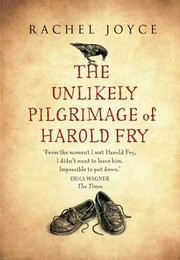
The Unlikely Pilgrimage of Harold Fry
2,246-word summary 10 min read 304 pages in the book
- First published
- 2012
- Publisher
- Doubleday
- Pages
- 304
- ISBN
- 9780857520647
- Series
- Harold Fry (#1)
Reading options
What's inside (8 sections)
I picked this one up because a friend kept pressing it on anyone who looked tired. She said it was about a man who goes for a walk, which sounded too slight to carry a whole novel. Then I started it on a train and missed my stop. Rachel Joyce published the book in 2012 with Doubleday, and the first UK hardcover runs 304 pages. It became her debut novel after years of writing radio plays, and you can sense that ear for voice in the way people talk past each other at first and then slowly land.
Harold Fry is sixty five and recently retired from a brewery sales job. He lives with his wife Maureen in a tidy house in Kingsbridge, in Devon. Their days have narrowed to small routines and smaller irritations. She hoovers. He trims the lawn. They eat apart in feeling if not in fact. Retirement, which was supposed to feel like rest, feels instead like being shelved. Harold misses the road in a way he cannot explain, the early starts, the familiar car parks, the polite talk with landlords and managers. Maureen misses the version of herself that had a son to raise and a schedule to keep. They are not unkind people. They have simply run out of things to say that do not hurt.
One Tuesday morning a letter arrives from Queenie Hennessy, a woman Harold worked with twenty years earlier and has not heard from since. She writes from a hospice in Berwick upon Tweed to say goodbye. She has cancer and is dying. The letter is brief and plain. It thanks him. That is almost all. Harold reads it at the kitchen table and reads it again, and something in his chest shifts out of place.
A reply that never gets posted
Harold writes back at once. His note is short and stiff, the kind of message a shy man writes when feeling floods past his skill. He seals it, puts on his yachting shoes because they are by the door, and sets out for the nearest post box to catch the collection.
What happens at the post boxes is the whole engine of the book. He passes the first one. Then the next. He keeps thinking of Queenie and of things left unsaid, and his feet keep moving. There is something honest in how Joyce stages this. Harold is not brave. He is not having a vision. He is a man who dislikes fuss and has spent decades smoothing things over, and suddenly the small act of posting a letter feels too small for what he feels.
At a petrol station he stops for a snack and falls into conversation with a young woman at the counter. She tells him about someone she knew who got better, and she puts it down to the mind, to keeping going, to refusing to give up. It is the sort of remark you hear every day and forget by dinner. Harold cannot forget it. He stands there in his light shoes with his letter in his pocket and forms a private bargain. He will walk to Berwick. He will keep walking, and while he walks, Queenie will keep living. He phones the hospice from the road and asks the staff to tell her that Harold Fry is coming, on foot, and she must hold on.
The first miles in the wrong shoes
The early chapters are my favorite part. Harold has no kit, no training, no map sense. He sleeps rough or takes cheap rooms. His feet blister. His back complains. He buys what he needs as he goes and learns the small arithmetic of the road, how far a tired body can go before it starts making deals with itself.
Joyce walks him north through real England, through towns and lay bys and drizzly fields. People he meets tend to give him one useful thing each. A doctor checks his feet and warns him. A farmer feeds him. A woman with her own grief talks to him for an evening and then is gone. None of these meetings feel arranged to teach a lesson. They feel like weather, passing over him and leaving him slightly changed.
What makes this stretch work is that Harold is so plainly unsuited to what he is doing. He gets lost. He feels foolish. He phones Maureen and the calls go badly, all clipped sentences and old static. He keeps going anyway, not from courage exactly but from a sense that turning back would break the one promise he has made in years.
Along the way his memory starts opening doors he had kept shut. He thinks about the brewery and the sales routes he drove for decades. He thinks about Queenie as she was then, capable and kind, the person who covered for others and noticed who needed help. And he thinks about David, his son with Maureen, who died young. Joyce releases this material slowly. At first David is only a pressure behind Harold's eyes. Then scenes come into focus. A bright boy. A difficult stretch. A distance between father and son that Harold never bridged. A loss that settled over the marriage like dust and was never wiped away.
Maureen and the empty house
The book cuts back to Maureen, and I am glad it does. A lesser version would leave her as the cold wife at home, the obstacle. Joyce gives her a full inner life. Maureen is angry, yes, but her anger has roots. She feels she failed David. She feels Harold failed him too, in a different way, by being soft where she thought firmness was needed, or absent where presence mattered. Since the funeral they have lived side by side without meeting.
Alone in the house, Maureen starts doing her own stocktaking. She replays scenes and finds details she missed. She remembers Harold young, funny in a dry way, gentler than she allowed him to be. She also has to face her own part in their coldness, the years of sharp remarks and closed doors. Her chapters move at a domestic pace. She gardens. She visits a neighbor. She considers driving north to fetch Harold home and then does not. At one point she takes out old photographs and finds herself studying David's face for signs she missed, the way parents do when grief turns them into detectives. She rings a friend and talks around the subject. She leaves the porch light on at night though there is nobody to come home to, because the dark house feels like an accusation. It is quiet writing, and it steadies the book, because we need to see what Harold is walking back toward, not only what he is walking away from.
One of the stronger choices here is that neither of them is cast as the villain of the marriage. Harold withdrew. Maureen hardened. Grief did the rest. If you have lived with someone through a bad stretch, these pages will ring true in an uncomfortable way.
When the walk becomes a show
About midway, Harold's private act stops being private. A newspaper picks up the story. Well wishers gather. For a stretch he walks at the head of a loose group of followers, each with their own reasons and their own placards, and the tone of the book shifts. There is comedy in it. There are arguments about routes and motives and who gets to speak for Harold. There is also a clear-eyed look at how quickly a simple thing curdles once cameras arrive.
I found this the weakest part on a first read and the most interesting on a second. On a first read it slows the forward pull. You want Harold alone with his thoughts, and instead you get committee meetings on foot. On a second read I saw what Joyce was doing. Harold had started walking to avoid speech, to let his feet say what his mouth could not. The crowd forces him back into words, explanations, poses. He starts performing hope instead of feeling it. His guilt, which had been loosening, tightens again because now other people depend on his story.
He handles it the way Harold handles most things, by enduring until he cannot, and then by slipping away. He leaves the group. The book exhales. The pace thins back to one man, one road, one promise. His last weeks alone are among the strongest pages, because the silence lets old scenes return whole. He remembers driving David to school and saying nothing the whole way. He remembers Queenie staying late to fix his paperwork without comment. He remembers Maureen laughing, years ago, at something he said, and how the sound surprised them both. None of these memories arrive as lessons. They arrive the way memories do on a long walk, uninvited and oddly complete. Some readers will still feel this section runs long. I think the point earns its pages, though Joyce could have cut one or two hangers on without losing anything.
What he remembers about Queenie
As the miles pile up, the past sharpens. Queenie was not only a colleague. She was the person at work who saw Harold clearly, including the parts Maureen had stopped looking at. Twenty years earlier, something happened around the time Queenie left the brewery suddenly, and it ties into David and into Harold's shame. Joyce holds the exact shape of it until late, which is fair. Harold himself has not looked at it straight for years.
I will not lay out the reveal beat by beat, since it lands better when you walk into it with Harold. The shape of it is this. Harold once failed to act when action might have helped someone he loved. Queenie once acted at cost to herself and was never thanked. Both of them carried the result in silence. The walk becomes Harold's way of answering a debt he can no longer pay directly, by doing the one thing he can still do, which is to keep going.
There is a risk of tidiness here, and Joyce mostly avoids it. Harold does not become a new man with a catchphrase. He stays awkward. He still says the wrong thing on the phone. What changes is his willingness to stay in the room with painful facts instead of stepping out to mow something.
Berwick and the woman who waited
Berwick upon Tweed sits at the far end of the map, nearly six hundred and thirty miles from where Harold started, a distance the book returns to like a drumbeat. He has been walking for close to three months by the time the town comes into reach. His body is thinner. His shoes are a joke. Maureen, by now, has set out herself, driving north in stages, stopping to see places tied to their early years, rehearsing what she might say.
The closing chapters move between Harold's last days on the road, Maureen's drive, and Queenie in the hospice, fading but still present. Joyce crosscuts with care. Nobody gets a miracle. What they get is smaller and better. Harold arrives. He sees Queenie. Maureen reaches him. Words are exchanged that should have been said years ago, and some that probably come too late to fix anything but still matter to say.
I will admit the final pages lean sweet. If you dislike open emotion, you may find yourself pulling back. For me the sweetness felt earned because the book does not pretend the future will be easy. The marriage is not mended by a walk. Grief is not cured by effort. What Harold and Maureen recover is the ability to face each other without flinching, which after twenty years of flinching counts as a lot.
A fair criticism sits alongside that praise. The story runs on coincidence and goodwill in ways real walks rarely do. Strangers are kinder than strangers tend to be. The press pack vanishes a touch too neatly. And Harold's central bargain, that his walking keeps Queenie alive, is magical thinking the book never quite owns or disowns. You have to accept it as Harold's private logic rather than the novel's claim about the world. Readers who need every thread tied will feel a few loose ends around Queenie's years away and around David, where Joyce gestures more than she explains.
Still, the whole thing holds. It holds because Harold is drawn with such patient attention, a man of small talk and smaller gestures who turns out to contain real endurance. It holds because the English road writing is concrete, all rain and verges and sore ankles and tea, with towns that smell of chips and fields that smell of cut grass after rain. And it holds because the marriage at the center feels lived in, with its jokes gone stale and its tenderness gone underground and then, slowly, coming back up. There is a scene near the end, which I will not spoil, involving Maureen doing something ordinary with great care, that moved me more than any of the big arrivals.
If you like quiet books that build to a loud feeling, this is for you. If you want twists or brisk plotting, look elsewhere. Read it on foot if you can, even if your walk is only to the shops. You will notice, as Harold does, how much passes unnoticed at car speed.
FAQ
When was The Unlikely Pilgrimage of Harold Fry published and who published it?
It was published in 2012 by Doubleday in a 304 page first UK edition. The summary follows that text and keeps its facts aligned.
Is this the first book in the Harold Fry series?
Yes. Penguin lists it as Harold Fry book 1, followed by the companion about Queenie and a later book about Maureen. This summary covers only the first book.
Why does Harold walk in yachting shoes?
He wears yachting shoes because he never planned the walk and owns no boots. His feet suffer for it, and the shoes become a small symbol of how unprepared and ordinary he is.
Similar books
More from Harold Fry first, then related titles.

We Are Okay
Marin fled San Francisco after her grandfather vanished and stopped answering anyone. When Mabel visits her college dorm, she has to say what happened.
2,253-word summary · 10 min read
Lisey's Story
Two years after her novelist husband dies, Lisey Landon follows a trail of clues into his childhood and the other world that made him a writer.
1,998-word summary · 9 min read

Memories of My Melancholy Whores
A ninety-year-old journalist pays for a night with a teenage girl, cannot go through with it, and discovers love for the first time in García Márquez's late…
2,101-word summary · 9 min read

Howards End
Forster's 1910 novel follows two families, a house in Hertfordshire, and a burned note, asking whether money and feeling can ever be connected.
2,187-word summary · 10 min read

The First to Die at the End
On the night Death-Cast launches, a boy with a bad heart meets a model with everything ahead of him, and one of them gets the call.
2,908-word summary · 13 min read
On Chesil Beach
Two newlyweds spend one terrible night on Chesil Beach in 1962, and the rest of their lives is decided by it.
2,456-word summary · 11 min read

Big Swiss
A transcriptionist for a sex coach falls for one of his clients, the tall Swiss gynecologist she calls Big Swiss, in a funny novel about work and secrets.
2,523-word summary · 11 min read

A Spool of Blue Thread
Four generations of the Whitshank family in Baltimore, and the silences, resentments and quiet love they hand down without ever saying so.
2,408-word summary · 11 min read
The Pilot's Wife
Kathryn Lyons's husband dies in a plane crash, and the investigation reveals a secret life that forces her to rethink their marriage.
2,006-word summary · 9 min read
Bring Up the Bodies
Thomas Cromwell sets out to destroy Anne Boleyn, building a case from rumor and revenge while Henry VIII waits to marry Jane Seymour.
2,066-word summary · 9 min read

And Every Morning the Way Home Gets Longer and Longer
An elderly grandfather, his son, and his grandson share memories and fears as the old man's mind begins to fade, in a short novel about grief and love.
2,078-word summary · 9 min read
The Tiger's Wife
A young doctor in a war-scarred Balkan country chases the stories her grandfather left behind, including a deathless man and a deaf girl who loved an escaped…
2,232-word summary · 10 min read
Olive, Again
Elizabeth Strout returns to Crosby, Maine, as Olive Kitteridge marries Jack Kennison, confronts her son, and faces old age, grief, and small-town judgment.
2,333-word summary · 10 min read
The No-Show
Three women are stood up on Valentine's Day by the same man, but the timeline is not what it seems. O'Leary's warmest book with a knife in it.
2,127-word summary · 9 min read
The Little Paris Bookshop
A Paris bookseller who prescribes novels as medicine finally opens a twenty one year old letter from his lost love and sails south through France to find her.
2,050-word summary · 9 min read

Someone Like You
Halley and her best friend Scarlett face a summer of grief, a surprise pregnancy, and Halley's dangerous first romance in Sarah Dessen's 1998 young adult novel.
2,218-word summary · 10 min read
The One Hundred Years of Lenni and Margot
Dying teen Lenni and 83-year-old Margot paint one hundred years of stories.
2,281-word summary · 10 min read
The Accidental Tourist
Grieving Macon writes travel guides for haters of travel, then Muriel intrudes.
2,252-word summary · 10 min read

Kitchen
Orphan Mikage finds home in a kitchen with Yuichi and Eriko after loss.
2,597-word summary · 12 min read

The Interestings
Meg Wolitzer follows Jules Jacobson from 1974 arts camp into middle age, as friendship with Ethan and Ash turns into envy, money gaps, marriage strain, and…
2,990-word summary · 13 min read

The Berry Pickers
A four year old vanishes from a Maine blueberry camp in 1962, and two families carry the loss for decades until Joe and Norma face the truth.
2,606-word summary · 12 min read
Summer Sisters
Vix and Caitlin share Martha's Vineyard summers from age twelve into adulthood, through first love, grief, marriage, and a disappearance that still haunts Vix.
3,633-word summary · 16 min read
We Are All Completely Beside Ourselves
Rosemary tells of twin sister Fern, a chimp raised as family, and research fallout.
2,058-word summary · 9 min read
The Mothers
Nadia hides abortion from church Mothers while Luke and Aubrey circle for years.
2,078-word summary · 9 min read
A Tale for the Time Being
A diary by bullied Tokyo teen Nao washes up in Canada, pulling novelist Ruth into her family past.
2,148-word summary · 10 min read
You've Reached Sam
After Sam dies, Julie calls his phone to hear his voicemail and he answers, forcing her to face grief and learn how to say goodbye.
2,887-word summary · 13 min read
Writers & Lovers
A broke waitress in Boston grieves her mother, finishes a novel, and chooses between two men.
2,473-word summary · 11 min read
The Valley of Vengeful Ghosts
A grieving therapist buys a model home in a rainy valley where the walls leak ghosts.
2,035-word summary · 9 min read
The Story of the Lost Child
Elena and Lila age through motherhood, quakes, and a vanishing.
2,500-word summary · 11 min read