
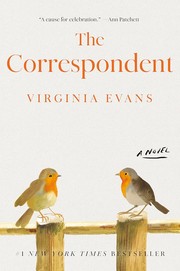
The Correspondent
2,296-word summary 10 min read 304 pages in the book
- First published
- 2025
- Publisher
- Crown
- Pages
- 304
- ISBN
- 9780593798430
Reading options
What's inside (9 sections)
I picked this up on a recommendation from someone who said it was the rare debut that made her miss her own mother. That sounded like a strange thing to say about a book written mostly in letters, but it turned out to be accurate in a way I did not expect. Virginia Evans published The Correspondent with Crown on 29 April 2025, a first novel of 304 pages, and it is built almost entirely out of letters and emails dated between 2012 and 2022. By the end I had grown so used to Sybil Van Antwerp's voice that opening an ordinary book felt like a shock.
A woman alone in Annapolis with a great deal to say
Sybil Van Antwerp is seventy-three, retired from the law, and living by herself in Annapolis, Maryland. She used to clerk for a judge. That detail matters more than it first appears, because her whole way of thinking is trained by the courtroom. She weighs evidence, she notices when someone's account does not add up, and she is quick to decide that a person has lied. She writes letters the way other people keep journals. The book is made of those letters, and the dates attached to them give the whole thing a slow, steady forward motion across a decade.
What surprised me first was how little Sybil sounds like a character an author invented. She sounds like a real older woman writing at a kitchen table, firm in her opinions, lonely without saying so, and far more curious about other people than she wants to admit. She is sharp, sometimes unfairly so. She has strong feelings about the way strangers behave in shops and on the street, and she will spend a whole letter on a small annoyance that a nicer person would have let go. Those passages are funny, but they also tell you something important. Sybil pays attention to everything because there is nobody else at home to pay attention with her.
Her days are not eventful in the usual sense. The drama arrives in the post and in her inbox. That is the quiet trick of the book. Evans takes a life that could look uneventful from the outside and lets the correspondence reveal how much is actually going on underneath. Every letter is a small act of reaching out, even when the person writing it insists that she does not need anything.
The people on the other end
Sybil writes to her brother Felix, who lives in France, and the letters to him have the easy familiarity of siblings who have known each other a very long time. They disagree. They remember things differently. Felix has a life she only partly understands, and her letters to him are full of questions she mostly does not want answered. She also writes to her daughter Fiona in Australia, at much greater distance, and those letters carry a different ache. Fiona is far away, and Sybil's love for her comes out sideways, in complaints about the weather and in careful news about her health.
There is an older son too, and she writes to him, but the letters to him are perhaps the most guarded in the book. Then there are the letters to writers. Sybil writes to Joan Didion, to Larry McMurtry, and to Ann Patchett, among others. These are not fan letters in the usual sense. She writes to them as if to equals, with complaints and questions about their work, and the fact that some of them write back is one of the pleasant surprises the book offers. I found those exchanges charming, though I also noticed how much they reveal about Sybil. She wants the company of people who think seriously about the world, and she is not shy about asking for it.
And then there is the one recipient she never actually sends to. Letter after letter is addressed to someone she cannot write to in any ordinary way, and she keeps them instead of mailing them. This is the book's central silence. Those unsent letters are where Sybil says the things she cannot say to Felix or Fiona or anyone else, and reading them feels like being let into a room she has kept locked for decades. Evans never makes a great show of the device. It simply sits there, gathering weight as the other letters accumulate around it.
The letter that turns the book cold
About a third of the way in, Sybil reads that the judge she once clerked for has died. That news brings a flood of memory, and it also brings something uglier. An aggrieved former defendant begins sending her threatening letters, calling her a "cold metal bitch." The phrase is shocking when it first appears, and it kept coming back to me because it is so precisely the kind of thing that would lodge in a person's mind. Sybil tries to treat the letters with the detachment of a lawyer. She analyzes them. She notes their tone and their grammar and what they reveal about the writer. But the anger gets under her skin anyway, and the book becomes much more interesting once it does.
This is where the epistolary form starts to pay off in a way that a conventional narrative could not. Because we only ever get Sybil's version of events, the threatening letters arrive as she chooses to reproduce them, and her responses tell us as much about her as they do about the man writing them. She is not an innocent bystander. She was part of the legal system that this man felt had wronged him, and she knows it. Watching her decide how much of that to admit, even in her own private letters, is one of the strongest threads in the book.
The death of the judge also pulls her back toward a period of her life she has spent a long time avoiding. Evans is careful here. She does not hand us a single dramatic revelation that explains everything. Instead, old letters surface, and with them come questions Sybil has spent decades pushing aside. The past does not break into the present so much as it keeps leaking into it, one page at a time.
Joan Didion writes back
One of the moments I remember most clearly comes in 2013, when Joan Didion actually replies to one of Sybil's letters. Didion offers sympathy as a fellow member of what she calls "the club of parents who have buried children." Sybil had a son who died at eight. That is the fact that quietly governs almost everything else in the book, though Sybil rarely states it plainly. She refers to it in passing, in the way people do when a loss is too large to keep describing. The letters around those passages are short. She writes about ordinary things. The absence sits in the gaps.
Didion's reply is a turning point, but not in the way a novel usually marks one. There is no scene of Sybil weeping over the letter. Instead she files it away, mentions it to other people, and carries on handling grief the way she always has: by keeping busy and keeping her feelings to herself. I thought this was the book at its best. Evans understands that bereavement is not a single event that a person gets over. It is a permanent change in how someone reads the world, and she shows it in the small decisions Sybil makes every day.
The correspondence with the writers also gives the book a lively intellectual texture. Sybil is not impressed by fame, and her letters to these women are full of arguments about their work. At the same time, she clearly needs them. That combination of independence and need is the truth of her character. She will tell a celebrated novelist exactly what she thinks of a sentence, and then wait by the post for a reply.
The son she lost and the mother she never knew
Two family threads run through the later letters. The first is Sybil's son, the one who died at eight, and the second is the DNA test that her older son gives her. Sybil was adopted. She has lived her whole life with a story about who she is, and the test threatens to complicate it. Her daughter Fiona, meanwhile, is worried about her failing eyesight, and those worries appear in the letters as practical questions about doctors and appointments and whether Sybil is taking care of herself.
I liked that the book keeps all of these concerns in play at once. A less assured writer might have separated them into neat storylines, but Evans lets them overlap, because that is how a person actually experiences a difficult stretch of life. A letter about a DNA result sits next to a letter about a cataract appointment, which sits next to a letter complaining about a neighbor. The effect is not chaotic. It is faithful to how worry works. You do not get to deal with one thing at a time.
The adoption thread is handled with restraint. Sybil does not suddenly become a different person when the test results arrive. She thinks about her birth parents in the same clear, slightly suspicious way she thinks about everything else. She wants facts. She also wants to know whether facts will change anything. That question, whether knowing the truth of your origins can rearrange a life already lived, is one I kept turning over after I finished the book.
Her daughter's concern about her eyesight is the thread that brought me closest to Sybil. Fiona is not trying to control her mother. She is simply frightened, and the worry comes out in the practical language of appointments and medication. Sybil, for her part, is annoyed and secretly pleased. She complains about being fussed over, and she keeps writing letters. The failing eyesight gives the book a quiet deadline. Every letter is written by a woman who may not always be able to write, and that fact adds weight to even the slightest of them.
What all these letters are doing
It took me a while to work out why the form feels so right for this particular story. Sybil is a woman who has spent her life making arguments and keeping records. A letter lets her do both at once. She can state a position, defend it, and leave a copy behind. The epistolary shape also gives Evans a way to control what we know. We never get a scene unless Sybil writes one, and she is a selective, opinionated witness. When she describes a conversation, we are getting her version, complete with her judgments about everyone's tone.
That selectivity is part of the pleasure, and it is also part of the difficulty. The book moves between past and present without much warning. A letter dated 2015 will send us back twenty years, and a letter from 2022 will pick up a thread that seemed to have ended hundreds of pages earlier. Some readers find these transitions jarring, and I understand the complaint. There were moments when I had to check the date at the top of a letter to work out where I was. Over a book of this length, that kind of disorientation can be tiring.
Still, the form earns its keep. The unsent letters in particular could have been a gimmick in a weaker novel. Here they are the emotional center. They are where Sybil stops performing competence for other people and admits what she actually feels. Because they are never mailed, they also stay unfinished in a way that feels true to grief. There is no final version of what she wants to say to the person she lost. There are only successive attempts, each one a little different, none of them sent.
The ending, and the complaint about it
The last chapters bring the threads together. Sybil decides whether she can offer forgiveness, and the earlier letter from the angry former defendant is answered in a way that closes that particular loop. The adoption questions reach a point of resolution, the family letters find a new balance, and Sybil's eyesight is treated as one more thing to live with rather than a defeat. It is a movement toward peace, and for most of the book I wanted it.
But I have to admit that the ending is tidier than the rest of the novel. Autumn Phillips, reviewing the book for the Post and Courier, called it "too neat," with every wound healed and every loose end tied, and I found myself agreeing with her even as I felt satisfied. A book that has spent three hundred pages refusing to explain away grief suddenly starts explaining things. Other critics have said the last chapters feel rushed after such a patient build, and there is something to that too. The patient accumulation of letters is the book's real achievement, and the wrap-up cannot quite match it.
I would still recommend The Correspondent without much hesitation. It is a debut, and it has the particular virtues of a debut: an idea the author clearly cared about for a long time, a voice that feels fully formed, and a willingness to trust the reader. It also has some of the usual faults. The ending simplifies what came before, and the jumps between time periods ask for more patience than the book always earns. But Sybil Van Antwerp is a memorable creation, and Evans gives her a dignity that never turns into sentiment. If you have ever written a letter you did not send, or wanted to, this book will know exactly what you were doing.
FAQ
Is The Correspondent Virginia Evans's first novel?
Yes, it is her debut, published by Crown on 29 April 2025 at 304 pages and told through letters and emails.
Who is Sybil Van Antwerp?
She is a seventy-three-year-old retired lawyer and former clerk to a judge, living alone in Annapolis, Maryland, who writes constantly to relatives and favorite authors.
Why did some critics dislike the ending?
The Post and Courier's Autumn Phillips called it too neat, with every wound healed and loose end tied, and others felt the final chapters were rushed after the slow build.
Similar books

We Are Okay
Marin fled San Francisco after her grandfather vanished and stopped answering anyone. When Mabel visits her college dorm, she has to say what happened.
2,253-word summary · 10 min read

The Wilderness
Four Black women move through twenty years of friendship in Angela Flournoy's discontinuous, widely praised second novel.
2,141-word summary · 10 min read
The True True Story of Raja the Gullible (and His Mother)
A gay philosophy teacher in Beirut revisits six decades of Lebanese history, family trauma, and his thorny bond with his mother.
2,274-word summary · 10 min read
The Rest of Our Lives
A law professor drives his daughter to college, then heads west instead of home, testing a private promise he made twelve years ago.
2,238-word summary · 10 min read
Palaver
A mother shows up uninvited at her estranged son's Tokyo apartment, and the two spend the weeks before Christmas talking their way toward something like…
2,465-word summary · 11 min read
The Vacationers
A New York family's two-week stay in Mallorca turns into a comedy of exposed secrets when a magazine editor's affair and a son's debts come to light.
2,324-word summary · 10 min read
The Emperor of Gladness
Ocean Vuong's second novel follows a young addict pulled back from a bridge in a dying Connecticut mill town and into the home of an elderly immigrant woman…
2,693-word summary · 12 min read
Dream Count
Four women narrate the 2020 lockdown in their own voices: a travel writer, a friend in early labor, a banker cousin and a housekeeper assaulted in a hotel room.
2,286-word summary · 10 min read
Olive, Again
Elizabeth Strout returns to Crosby, Maine, as Olive Kitteridge marries Jack Kennison, confronts her son, and faces old age, grief, and small-town judgment.
2,333-word summary · 10 min read
The Berry Pickers
A four year old vanishes from a Maine blueberry camp in 1962, and two families carry the loss for decades until Joe and Norma face the truth.
2,606-word summary · 12 min read
Summer Sisters
Vix and Caitlin share Martha's Vineyard summers from age twelve into adulthood, through first love, grief, marriage, and a disappearance that still haunts Vix.
3,633-word summary · 16 min read
Change of Heart
Jodi Picoult's Change of Heart follows June Nealon, her ill daughter Claire, and death-row inmate Shay Bourne, whose wish to donate his heart forces a trial…
2,746-word summary · 12 min read
The Story of the Lost Child
Elena and Lila age through motherhood, quakes, and a vanishing.
2,500-word summary · 11 min read
The History of Love
An elderly locksmith and a grieving teenage girl in New York are joined by a lost manuscript published in Spanish under another man's name.
2,805-word summary · 12 min read
Lock and Key
Abandoned Ruby moves in with her sister and learns to trust Nate and Cora.
2,407-word summary · 11 min read
Fly Away
After Kate's death, Tully, Marah, and Dorothy face grief and addiction while trying to rebuild their lives.
2,940-word summary · 13 min read
Those Who Leave and Those Who Stay
Elena publishes into Florence salons while Lila labors through Naples factories across the 1970s.
2,034-word summary · 9 min read

The Bean Trees
Taylor Greer flees Kentucky, inherits Cherokee toddler Turtle, and roots with Tucson strays.
2,082-word summary · 9 min read
The Unlikely Pilgrimage of Harold Fry
A retired man in Devon walks to Berwick to visit a dying friend, hoping his steps keep her alive.
2,246-word summary · 10 min read
The Elegance of the Hedgehog
A Paris concierge hides her brilliant mind while a gifted girl plans her death, until a new tenant sees through them both.
2,248-word summary · 10 min read
The Trumpet of the Swan
A mute trumpeter swan learns to read, write, and play a stolen trumpet to win a mate, in E.B. White's quiet 1970 tale of a boy who watches.
2,309-word summary · 10 min read
The South
A seventeen-year-old moves to his family's failing fruit orchard in 1990s Malaysia, where a summer love affair unfolds as the household and the land around him…
2,903-word summary · 13 min read
The Sisters
Three sisters watch one another take the lives they imagined, across thirty years in Stockholm and Tunisia, in a novel that bends time like an accordion.
2,199-word summary · 10 min read
The Nix
A stalled novelist and community college professor goes looking for the mother who left him and finds a radical activist whose rock thrown at a governor made…
2,214-word summary · 10 min read
The Long Haul
Greg Heffley's summer road trip goes sideways with a towed boat, a live pig, and a family in a purple van.
2,311-word summary · 10 min read
The Loneliness of Sonia and Sunny
Two Indian families, a failed arranged match, and years between Allahabad and New York shape a slow, sprawling romance.
2,092-word summary · 9 min read
Our Souls at Night
A widow asks her widower neighbor to lie beside her at night, not for sex but for company, and two lonely people in a small Colorado town begin again.
2,582-word summary · 11 min read
Only Son
A brief, funny, melancholy debut about a boy whose father dies in 1982 Florida, and the man he becomes, still trying to read the mystery of that loss.
2,170-word summary · 10 min read
Love Forms
A Trinidadian mother sent away at sixteen returns to the loss of her daughter forty years later, in Claire Adam's quiet, longlisted novel.
2,153-word summary · 10 min read
Left Neglected
A busy mother suffers left neglect after a car crash, forcing her family and her own attention to rebuild a slower life.
2,201-word summary · 10 min read