
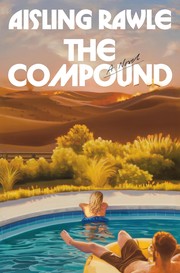
The Compound
2,150-word summary 10 min read 304 pages in the book
- First published
- 2025
- Publisher
- Random House
- Pages
- 304
- ISBN
- 9780593977279
Reading options
What's inside (9 sections)
Waking up in the desert
The first lines of this book place you in a place with no name. A woman wakes in a vast, dilapidated compound somewhere in a desert, alongside nineteen other people who, like her, have been told they are contestants on a hugely popular reality show. Nothing about the setup is explained. There is no host, no introduction, no clever title sequence. There is a big screen that issues instructions and small screens that offer rewards, and there are twenty people who have to figure out the rules by breaking them. Aisling Rawle's debut novel is set almost entirely inside this compound, and one of its quiet achievements is how complete that little world feels. After a while you stop expecting a view of the outside, because the book has convinced you that there is nothing to see.
The women arrive by bus. The men have to trek across the desert, and one of them does not make it, which tells you something about the show's idea of entertainment before a single task has been set. Ten women wait for nine men. That small imbalance is the first hint that the producers are not especially interested in fairness. It is also the beginning of a book that is, among other things, a study of how quickly people will accept a rule simply because it has been posted on a screen.
I picked this up because it kept being described as addictive, and it is. The chapters are short. The rules keep changing. Rawle has a gift for making a petty reward feel enormously desirable, partly because she understands that the contestants' desire is petty and enormous too.
The rules of the game
The compound runs on two kinds of instruction. The big screen gives group tasks. The contestants might be told to discuss their previous relationships in exchange for outdoor seating, which sounds harmless until you understand that outdoor seating is a luxury here and that the discussion will be watched and judged. The small screen each contestant carries offers personal rewards. Tell a secret and you get a comb. A hair straightener is available for the right price. These objects are absurdly trivial, and the book treats them with complete seriousness, because the contestants do. In a place where food is running short and nothing is yours, a comb is power.
The nightly eliminations hinge on a single rule: a contestant is safe if they have spent the night with someone of the other gender. It is a rule that turns intimacy into a form of currency and makes refusal a kind of death sentence. Rawle writes this without sensationalism. The characters are twenty-somethings who have grown up with the logic of reality television, and they understand the bargain immediately. Some of them are good at it. Some of them are not. The show watches them all.
As the book goes on, the tasks grow crueler. The screen asks someone to banish a resident. It asks a woman to spit in her bedmate's mouth. The numbers dwindle, the food runs short, and the alliances that formed in the first few days start to fray. What interested me most here is not the cruelty itself but the way the contestants process it. They complain, they compare notes, they suspect one another, and then they comply. The show does not need to hold a gun to anyone's head. It only needs to make the alternative worse than the task.
The people in the compound
The other contestants are drawn with a economy that suits the setting. Rawle gives them functions and then lets them become people. There are the women who arrive together on the bus, already sorting themselves into alliances before they have seen the rules. There are the men who come in on foot, carrying the physical evidence of a journey the women never had to make. One of them is missing, and his absence hangs over the early chapters like a weather system. Nobody explains what happened, and nobody is allowed to leave and find out. The show simply continues, which is the clearest possible statement of its values.
What struck me is how little these people need to be differentiated for the social dynamics to work. A beautiful woman who knows she is beautiful, a man who thinks the show is his chance to become someone, a quiet contestant who watches rather than performs, a couple whose alliance is held together by convenience. Rawle understands that reality television produces its own set of characters, and she writes the compound as a place where those characters have become the only ones available. When someone tries to step outside the role the show has written for them, the others notice immediately, and usually punish it.
This is also where the book's gender politics live. The rule that safety depends on spending the night with someone of the other gender makes every interaction into a possible transaction. The women are under particular pressure, because their value in the game is tied to a combination of youth, appearance and willingness to play along. Lily's history selling makeup in a department store matters here. She knows how to present herself, she knows what people want when they look at her, and she knows the difference between being admired and being used. That experience does not make her powerful, but it makes her observant in a way that some of the other contestants are not.
Lily, who knows what she is
The narrator is Lily, a beautiful, bored twenty-something who used to sell makeup in a department store. She is not a heroine in the usual sense, and the book is at its best when she says so. Lily freely admits that she is passive, that she is shallow, that she is not especially interesting. She does not arrive with a plan or a secret skill. She sees the show as a lark, largely because the world outside is falling apart and there is no obvious reason to be somewhere else. That dismissal is her armor, and Rawle lets it hold for a long time before she starts to take it apart.
Lily's passivity is the novel's central puzzle. Is she a person who has been shaped by a culture of spectatorship, someone who has watched so much reality television that she can treat her own life as content? Or is she simply a young woman who has never been given a reason to want anything difficult? Rawle keeps both possibilities open. Lily's voice is flat and funny and occasionally startling in its honesty. When she observes the other contestants, she notices the small things: who is performing, who is terrified, who is quietly calculating. She is a better reader of the game than she claims to be, and the slow dawning of that fact is the book's real plot.
There is a risk in writing a narrator who announces her own shallowness. Readers can take it as a license to stop caring about her. Rawle avoids that, mostly by giving Lily a sharp, reactive intelligence that shows up in her observations even when it is absent from her choices. You stay with her because she sees things, not because she does them.
The world that is not shown
The most intriguing thread in the book is the one Rawle refuses to pull. The contests take place in an unspecified desert, and the outside world is kept almost entirely off the page. Lily mentions that the world is falling apart, and at one point she wonders whether any of the men fought in the wars. That is the extent of it. There is no exposition about what happened, no map, no date. The compound is sealed not just physically but narratively, and the reader is made to share the contestants' ignorance.
That choice is the source of the book's dystopian charge. The rules of the show are bizarre, but they are not presented as a break from normal life. They are presented as the continuation of normal life by other means. The prizes are consumer goods. The eliminations are broadcast. The contestants understand the logic because they have been trained by a culture that rewards visibility and punishes obscurity. Rawle is not building a future so much as extending the present a little further, until the things we already accept become liturgical and strange.
The hints of war and collapse matter because they explain why nobody leaves. The contestants are not trapped by walls so much as by the absence of anywhere better to be. Lily's decision to treat the show as a lark is a rational response to a world in which the alternatives have already been ruined. The horror of the book is not that the game is cruel. It is that the game is plausible.
The slow realization
For a long time, Lily treats the whole thing as a stage. She plays along, she observes, and she keeps a certain distance from the other contestants even as she sleeps with them. Gradually, that distance becomes impossible to maintain. The tasks stop feeling like television and start feeling like tests. The producers, who are never seen, seem to be pushing the players toward genuinely dangerous situations, and the pattern of the challenges begins to look less like entertainment and more like an experiment with people who cannot refuse.
Lily's self-awareness dawns slowly, which is both the point of the novel and the source of its main criticism. She begins to suspect that the show is not what it claims, that the danger is real and that some of the other contestants know more than they are saying. A kind of investigation develops, pieced together from coincidences and overheard fragments and the private logic of the game. It is never a thriller in the conventional sense. There is no detective, no clear suspect, no moment where everything is explained. What there is instead is a young woman who starts to notice that the room she is in has no doors.
The New York Times called the novel smart and provocative and "so damn addictive," and Oprah Daily said it had all the substance of a literary classic. Both responses make sense. The book is propulsive and also oddly literary in its restraint. Rawle withholds so much that the reader is forced into the same position as Lily: watching the screens, reading the rules, and trying to decide what is real.
Where the book strains
The reservations are mostly about pacing and structure. Kirkus noted that Lily's self-awareness dawns too gradually for some readers, and that the story takes a while to gather steam. That is a fair complaint. There is a long middle stretch in which the investigation feels like marking time, with the contestants being moved around like pieces while Lily watches. The book's short chapters keep the pages turning, but turning pages is not the same as moving forward.
Other reviewers pointed to coincidences in the plotting, moments where the paths of suspicious characters intersect at exactly the right time, and to a resolution that rests on one character making a choice that feels slightly out of character. I noticed both. Rawle is so careful about the rules of the game that when a character behaves in a way the game does not explain, it stands out. The ending also arrives with less clarity than the setup promised. The outside world remains a rumor, and the producers remain unseen, which is a consistent artistic choice but can feel like an evasion if you have been waiting for an answer.
There is also a question of what the book is willing to say about the world it hints at. Rawle gives us a war, a collapsed economy perhaps, a place where people will do anything for a hair straightener, and she declines to connect the dots. That restraint keeps the novel focused on Lily's experience, which is clearly the intention, but it also means that the larger critique never quite lands as an argument. The book is content to be a study of one room. If you want a vision of how the world outside got this way, you will have to supply it yourself.
Still, I think the opacity is mostly a strength. This is a book about a person who cannot get a straight answer from the system she is inside, and it would be strange if the novel handed the reader the answer she never gets. What stays with you is not the resolution but the image of the compound itself: a place where every human need has been turned into a rule, and where the only thing more frightening than the game is the possibility that the game is the kindest thing waiting outside.
FAQ
What is The Compound by Aisling Rawle about?
It is a 2025 debut novel about a twenty-something woman who wakes in a desert compound with nineteen others to compete on a reality show. The tasks turn cruel, the food runs short, and she begins to suspect the unseen producers are forcing real danger.
Is The Compound a dystopian novel?
It has dystopian elements, including hints of war and a collapsing outside world, but Rawle keeps that world off the page. The focus stays on the rules of the game and the narrator's growing awareness rather than on explaining how society reached this point.
Who is Lily?
Lily is the narrator, a beautiful, bored former department-store makeup seller who freely admits she is passive, shallow and not especially interesting. Her slow change from observer to someone who notices the game's danger drives the novel.
Similar books
Battle Royale
A Japanese dystopian thriller about a class of students forced to kill one another on an island, and the three who refuse to play the game.
2,266-word summary · 10 min read
A Guardian and a Thief
Over one week in near-future Kolkata, a mother's flight plan and a homeless young man's hunger collide over a set of stolen travel documents.
2,306-word summary · 10 min read
I Who Have Never Known Men
Forty women in a cage, one child who remembers nothing, and a nearly empty world above the bunker. Harpman's quiet, unexplained dystopia.
2,025-word summary · 9 min read
The Long Walk
One hundred boys walk until one remains, watched by soldiers and the Major, in Bachman's 1979 contest story.
3,056-word summary · 14 min read
Tender Is the Flesh
After a virus makes animal meat lethal, states legalize breeding humans for meat. Marcos Tejo grieves at a processing plant when he is given a live female…
2,372-word summary · 11 min read
Blindness
A white blindness sweeps a city, and an eye doctor's wife who can still see guides seven strangers through camp and ruin.
2,772-word summary · 12 min read
Lord of the Flies
William Golding's Lord of the Flies retold: Ralph and Jack, the conch, the beast, Simon, Piggy, and why the rescue is no relief.
2,254-word summary · 10 min read
The New York Trilogy
Three linked novels turn a wrong-number call into a puzzle about names, authorship, and the stories people tell to stay sane.
2,259-word summary · 10 min read
The 100
Three centuries after a nuclear war, a hundred teenage prisoners are sent from a failing space colony to test whether Earth is livable again.
2,152-word summary · 10 min read
Misinterpretation
An unnamed Albanian interpreter in New York is drawn into the trauma of a Kosovo war victim, and the empathy she brings home begins to undo her marriage.
2,546-word summary · 11 min read
MaddAddam
Toby and Ren rebuild a camp after the plague while Zeb reveals the past and the Crakers invent a religion around Oryx and Crake.
2,201-word summary · 10 min read
Wild Dark Shore
On a remote island between Tasmania and Antarctica, a family guards a vast seed bank until a storm washes a stranger ashore and the radios go dead.
2,449-word summary · 11 min read
The Tunnel
A painter in a Buenos Aires prison recounts the glance, the woman and the jealousy that led him to murder the only person who understood him.
2,313-word summary · 10 min read
The Prince
Kiera Cass's 2013 novella replays the opening of The Selection from Prince Maxon's side, from his nerves before the lottery to his sharp first meeting with…
2,651-word summary · 12 min read
The Dream Hotel
A Muslim American archivist lands at LAX and is detained because her sleep implant says she might kill her husband. Lalami's near-future novel follows her into…
2,687-word summary · 12 min read
Sunrise on the Reaping
Twenty-four years before Katniss, sixteen-year-old Haymitch Abernathy is swept into the fiftieth Hunger Games, where District 12 must send four tributes and…
2,198-word summary · 10 min read
Stolen
A sixteen-year-old is drugged at a Bangkok airport and taken into the Australian Outback by a man who has watched her for years. Lucy Christopher tells it as a…
2,284-word summary · 10 min read
Migrations
A woman released on parole travels to Greenland to follow the last Arctic terns on a final migration toward Antarctica.
2,296-word summary · 10 min read

The Crying of Lot 49
A California woman named executor of her ex-lover's estate follows a muted post horn into a possible centuries-old postal conspiracy, and Pynchon refuses to…
2,003-word summary · 9 min read

Lisey's Story
Two years after her novelist husband dies, Lisey Landon follows a trail of clues into his childhood and the other world that made him a writer.
1,998-word summary · 9 min read

The Beach
A young backpacker follows a dead man's map to a hidden island community, then discovers what the people there are willing to do to keep it secret.
2,067-word summary · 9 min read
Year One
A plague released in Scotland kills most of humanity, and the survivors discover magic, build a town, and wait for a child who may save them.
2,029-word summary · 9 min read
The House of the Scorpion
A clone raised in a drug lord's poppy fields learns what he was made for and chooses what to do with the life he was given.
2,527-word summary · 11 min read
The Age of Miracles
A California girl grows up while the Earth's rotation slows, and ordinary adolescence continues alongside slow catastrophe.
2,417-word summary · 11 min read
Wither
In a future where women die at twenty, sixteen-year-old Rhine is sold as a bride to a wealthy stranger and plots an escape from a beautiful prison.
2,395-word summary · 11 min read
The Memory Police
On an unnamed island, ordinary things keep vanishing from memory, and a novelist hides her editor from the police who make sure the vanished stay forgotten.
2,440-word summary · 11 min read
Never Fade
Ruby, now a leader in the Children's League, must track down the boy whose memories she erased, because he holds the only proof of what caused the disease that…
2,188-word summary · 10 min read
The Twelve
The middle volume of the Passage trilogy braids the year America died, a picnic massacre decades earlier, and the survivors' war against the twelve master…
2,089-word summary · 9 min read
Luster
Edie, twenty-three and adrift in New York, falls into an affair with an older white archivist in an open marriage, and into the orbit of his wife and adopted…
2,049-word summary · 9 min read