
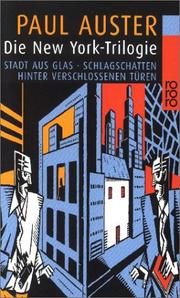
The New York Trilogy
2,259-word summary 10 min read 478 pages in the book
- First published
- 1987
- Publisher
- Faber & Faber
- Pages
- 478
- ISBN
- 9780571149254
Reading options
What's inside (8 sections)
I opened this book because of a wrong number. A friend told me Auster got the idea for City of Glass after someone dialed his home and asked to speak to the Pinkerton detective agency. That small, stubborn detail stayed with me. The volume on my desk is the 1987 Faber & Faber hardback, 478 pages, which gathers three novels first published on their own between 1985 and 1986. Bookshops file it under mystery. Reading it feels more like watching someone take a detective story apart in plain view and hold up each piece to ask what it is for.
The call that starts City of Glass
Daniel Quinn writes detective novels under the name William Wilson. He is good at it and tired of it. His wife and young son are dead, and his days have shrunk to a routine of walking, drinking, and inventing cases he never has to solve. Then the phone rings. A voice asks for Paul Auster, the private detective. Quinn says the caller has the wrong number. The phone rings again. After the third call he stops correcting the stranger and answers to a name that is not his.
That is the engine of the first book. A man agrees to be someone else on the telephone, and the agreement slowly eats him. The caller turns out to be Peter Stillman, the younger, who wants Quinn to follow his own father. Stillman senior spent years in prison for kidnapping his son and keeping him in a room without light or language. He has been released, and the son believes he intends to finish what he started. Quinn takes the job without much belief in it, which is exactly why the slide feels so quiet.
Auster lets the surveillance scenes breathe. Quinn follows Stillman through streets and subway cars, waits in doorways, and fills notebooks. Gradually he sees that his subject is not acting like a man preparing a crime. Stillman walks the city with purpose but gathers scraps instead of evidence. He picks up objects, talks to himself about words, and seems to be rebuilding a world out of the names of things. Quinn's reports to the son stop reading like detective work and start reading like the record of one man's attention. The case does not resolve. It thins out and vanishes.
There is a small scene I kept returning to, where Quinn writes down the words Stillman mutters and tries to guess at a system. A man who was locked away from language has grown into a man who collects it like sea glass. Auster does not explain what Stillman is building, and he does not have to. The image is enough: a father walking his son's city, picking up nouns and dropping them into his pockets, while the son waits at home for a report that will tell him whether to be afraid. It inverts the usual detective arrangement. The client wants an answer, the investigator finds a vocabulary, and the person being followed is the only one doing anything that looks like creation.
What held me was the number of people standing between the reader and the story. There is the unnamed narrator who claims he knew Quinn. There is Paul Auster the writer, who walks into his own novel while writing an essay about who really wrote Don Quixote. There is "Paul Auster the detective," a person Quinn invents to explain a wrong number. Then there are the two Stillmans and, at the bottom, Quinn. Every layer insists it is the real one. Quinn even shares initials with Cervantes' knight, and Auster's essay circles the question of Cide Hamete Benengeli, the supposed narrator of Quixote. By the time I reached the end I had stopped expecting an answer to who did what. The book had moved the question somewhere else entirely.
Quinn in the dark room
The second half of City of Glass gives up the pretence of a case. Quinn can no longer reach the son he was hired to report to, and the man he was following slips away. He takes a room, keeps a notebook, and waits for Stillman at a hotel who never arrives. He starts to speak to the figure he has invented, the detective Paul Auster, and the pages turn into the log of a mind closing in on itself. He lives in a dark room, eats little, and writes until his hand hurts. The narrator eventually tells us that this Quinn may never have existed at all, that the story is something he pieced together from papers left behind.
That reveal could have felt like a cheat. In Auster's hands it felt honest, because the book had never pretended to be a straightforward account. When the narrator says he only knew Quinn slightly, and that the truth of him is now lost, the uncertainty is the point. I put the book down and looked at the cover for a moment, unsure whether I had been reading a novel about a detective or a novel about the impossibility of knowing another person. It is both, and it refuses to choose between them.
Blue writes his reports in Ghosts
The second novel, Ghosts, is shorter and colder. A man named Blue is trained by Brown and sent by White to watch Black, who lives on Orange Street in Brooklyn. The assignment is simple: follow him, describe his days, send written reports, collect a fee. Blue rents a room facing Black's apartment and settles into the work. Black spends his time writing and walking and living an ordinary life. Nothing happens. That is the difficulty. Blue has been hired to wait for something, and waiting becomes the whole of his existence.
The color names are a game, and they are not a subtle one. White, Black, Brown, Blue: the men are labels before they are people. Blue writes his reports in a careful hand and mails them to White, who pays promptly and says almost nothing back. Meanwhile Blue begins to copy the man he watches. He takes the same walks, sits where Black sits, and starts to feel that Black's life is the real one while his own has become a performance. His employer's silence becomes a kind of authority. He cannot tell whether White cares about the case or whether there is a case at all.
The book has a runner who shows up, a woman Blue sees, and a few scenes of drinking that become more frequent as the weeks pass. Auster keeps the details thin on purpose. I found this the hardest of the three to warm to. The deliberate emptiness that makes City of Glass hypnotic here starts to feel like a refusal to give the reader anything to hold. Then again, that refusal is the argument. Blue loses the border between observer and observed, and the prose gets quieter as he gets less sure of who he is. By the end he is being cared for by a doctor, still talking about the case in a way that suggests it will never close. The last line of his report is not an answer but a condition: he is still there, still watching.
Fanshawe's room in The Locked Room
The third novel is the one I kept thinking about afterward. It has a first person narrator, a man who writes books but cannot make anything up. He has talent for the mechanical parts of writing: editing, arranging, finishing. What he lacks is the spark that starts a book. His childhood friend Fanshawe has that spark in abundance. Fanshawe drops out of Harvard, travels, writes brilliantly, then disappears. His wife Sophie writes to the narrator because she needs money and because someone has to decide what to do with the manuscripts Fanshawe left in a locked room.
The narrator edits and publishes the work. It succeeds. Fanshawe's reputation grows, the money arrives, and the narrator finds himself living inside another man's achievement. He goes further. He marries Sophie, raises Fanshawe's child, and begins a biography of his friend. He also searches for Fanshawe, following clues through Paris and among people who knew him, and he learns that the missing man is alive and hiding. He keeps that news to himself. I found the narrator genuinely unlikable here, and I think that is deliberate. He profits from a friend's absence, sleeps in his bed, and tells himself he is doing it all out of loyalty. Auster never lets him off the hook.
Word reaches him again, and he travels to a small town to meet Fanshawe. The last meeting takes place in a room that is locked from the inside. There is a gun and a struggle, and then the narrator is alone again, free at last to write a book that is his own. Auster gives us no clean account of what happened and no courtroom explanation. The narrator simply says that all three novels were the same story told at different stages of awareness, and then he stops. Herman Melville and Hawthorne hover in the background, and the title points back to the locked room mysteries of early detective fiction. The form is borrowed and then stripped of its promise that a room can be opened and explained.
What the three books are really about
Read together, the novels keep circling the same questions. What makes a name belong to a person? If a writer invents a detective, where does the detective end and the writer begin? Does a report describe a life or replace it? Auster called the trilogy a kind of shadow autobiography, an account of the life he might have led, and he let the fictional Paul Auster stand in for himself. That is why the books feel less like three cases than like three attempts to write the same impossible sentence. Each narrator tries to say I am the one who saw this, and each one fails in a slightly different way.
The city matters as much as any character. Quinn walks it collecting words, Blue stares across it at a single window, and the unnamed narrator moves through it looking for traces of a friend. New York is not a backdrop here. It is a text the men try to read, and it refuses to be read. I liked the way Auster makes walking feel like research and waiting feel like work. I also liked that he keeps the prose plain, almost dry, so that the strange turns land without warning. There is one moment in City of Glass where the narrator simply says he does not know whether Quinn existed, and the flatness of the sentence made it more unsettling for me than any shout would have been.
The criticism is fair to make. These are cold books, and they ask for patience. Ghosts in particular repeats its own emptiness until I wanted someone to say something plain. The narrators are often harder to like than the people they watch, and the plots end by declining to explain themselves. If you want a mystery that hands you a culprit, you will feel cheated. If you want every scene to advance a case, you will find long stretches that seem to do nothing. Auster knew exactly what he was doing, but knowing that does not make the drag disappear. I read the middle of the second novel over two sittings, and I could feel the book daring me to quit.
There is also a limit to how many times a writer can use the trick of an author appearing in his own fiction before it starts to feel like a signature rather than an idea. By the third book I was ahead of Auster on several turns, waiting for the metafictional wink instead of being surprised by it. What saved it for me was the emotional weight of Fanshawe. That story has a wife, a child, and a friendship going wrong, and it gave the philosophical game something to stand on. The last chapters are the most human in the collection, even though they end with the least certainty.
Who should read it
I would hand this to someone who likes a book that argues with itself and does not mind losing. It is a good fit for readers who enjoyed the puzzle boxes of Borges or the cold attention of a novel where nothing is solved. It is a poor fit for someone in the mood for a fast police procedural, because the procedures here are a decoration around a much stranger question. The three parts can be read in any order, although I think they work best as Auster arranged them, with the danse macabre of Ghosts between the collapse of Quinn and the quieter betrayal of the last book.
What I took away was not a solution but a habit of attention. After finishing I caught myself noticing how often I assume a name explains a person. Quinn becomes a detective because a caller needs one. Blue becomes Black because he watches him long enough. The narrator becomes Fanshawe because he can edit better than he can imagine. Auster's great trick is to make those changes feel ordinary, the sort of thing that happens when a person spends too long alone with a story. The trilogy ends without telling us who was real. It leaves us with the more useful question of what we were willing to believe while we read.
FAQ
Is The New York Trilogy one novel or three separate books?
It collects City of Glass (1985), Ghosts (1986), and The Locked Room (1986), first gathered in a single volume in 1987.
Do the three stories share the same characters?
They circle the same questions and a fictional Paul Auster appears in the first two, but each part has its own narrator, case, and set of names.
Which edition does this summary cite?
It follows the 1987 Faber & Faber hardback, 478 pages, ISBN 9780571149254. Later paperback editions use different page counts and ISBNs.
Similar books
The Tunnel
A painter in a Buenos Aires prison recounts the glance, the woman and the jealousy that led him to murder the only person who understood him.
2,313-word summary · 10 min read

The Crying of Lot 49
A California woman named executor of her ex-lover's estate follows a muted post horn into a possible centuries-old postal conspiracy, and Pynchon refuses to…
2,003-word summary · 9 min read
The Caves of Steel
Detective Elijah Baley must solve a Spacer's murder in a domed New York, partnered with R. Daneel Olivaw, a humaniform robot built in the victim's image.
2,445-word summary · 11 min read

The Yiddish Policemen's Union
An alcoholic detective in an alternate Sitka investigates a murder that leads toward a messianic plot and his own family's past.
2,247-word summary · 10 min read
Evil Under the Sun
Poirot's Devon holiday turns deadly when a flirtatious actress is strangled at a secluded seaside hotel in this 1941 puzzle.
2,380-word summary · 11 min read

The Secret of the Old Clock
The first Nancy Drew novel: a sixteen-year-old detective follows a clue hidden in a clock to overturn a will and restore a family's inheritance.
2,011-word summary · 9 min read

The Luminaries
Eleanor Catton's Booker-winning novel drops a young prospector into an 1866 New Zealand gold town where twelve men untangle a web of hidden gold, murder and…
2,949-word summary · 13 min read
The Bonfire of the Vanities
Tom Wolfe's first novel follows a Wall Street bond trader whose life unravels after a hit-and-run in the Bronx, in a satire of 1980s New York money, race and…
2,268-word summary · 10 min read
Possession: A Romance
A London Library discovery sends two scholars chasing a secret Victorian love affair, in a Booker-winning novel of invented letters, poetry and the race to own…
2,394-word summary · 11 min read
Five Little Pigs
Sixteen years after a painter's murder, Poirot reopens the case at the request of a daughter who believes her dead mother was innocent.
2,027-word summary · 9 min read
Hercule Poirot's Christmas
Simeon Lee invites his family to Gorston Hall for Christmas, then is found dead in a locked room. Poirot sorts a household where nearly everyone has a reason…
2,348-word summary · 10 min read
The Moonstone
A cursed yellow diamond vanishes on the night of a birthday party, and eight witnesses tell what they saw.
2,603-word summary · 12 min read

The Chosen
A shattered pair of glasses in a 1944 Brooklyn softball game starts a friendship between a Hasidic boy and his Orthodox neighbor, and their fathers pull them…
2,443-word summary · 11 min read
The Memoirs of Sherlock Holmes
Doyle's second Holmes collection gathers twelve Strand stories, including the early case of the Gloria Scott and the confrontation with Moriarty at Reichenbach…
2,390-word summary · 11 min read
The Murder on the Links
Poirot arrives in France too late to save his client, who is found stabbed in a grave and was not the man he claimed to be. Christie's second Poirot novel.
2,055-word summary · 9 min read
The Maltese Falcon
Sam Spade hunts a jeweled bird through lies after his partner is killed.
2,529-word summary · 11 min read
Case Histories
A Cambridge PI takes three cold cases that tangle with his own loss.
2,465-word summary · 11 min read
Bleak House
Jarndyce and Jarndyce grinds through Chancery while Esther finds her family.
2,480-word summary · 11 min read
The Body in the Library
A strange girl found dead in a library pulls Miss Marple into lies about dance halls and film.
2,017-word summary · 9 min read
The Sign of Four
Mary Morstan's pearls lead Holmes and Watson from foggy London to Agra treasure and a Thames chase.
2,114-word summary · 9 min read

The Age of Innocence
Engaged New York lawyer Newland Archer falls for Ellen Olenska, his fiancee's cousin fleeing a bad marriage, and must choose between love and duty in 1870s old…
3,100-word summary · 14 min read
The ABC Murders
Poirot and Hastings chase a killer who leaves an ABC railway guide near victims in Andover, Bexhill, and Churston. A salesman looks guilty, but publicity hides…
3,302-word summary · 15 min read
The Murder at the Vicarage
Vicar Leonard Clement narrates the shooting of Colonel Protheroe while Miss Marple watches St Mary Mead.
2,926-word summary · 13 min read

Chronicle of a Death Foretold
A town knows brothers will kill Santiago and no one stops it, retold to find why.
1,950-word summary · 9 min read

Sophie's World
Sophie gets philosophy lessons by mail, then finds she is fiction in a father birthday book for Hilde.
2,013-word summary · 9 min read
The Murder of Roger Ackroyd
Retired Poirot probes a locked study murder in King's Abbot, told by the village doctor.
3,582-word summary · 16 min read
The Adventures of Sherlock Holmes
Twelve Strand cases from Irene Adler to the Copper Beeches, with Holmes at his sharpest and strangest.
3,579-word summary · 16 min read
Death on the Nile
Poirot takes a Nile cruise where a young heiress is shot dead in her cabin.
4,077-word summary · 18 min read
The Hound of the Baskervilles
Holmes Watson probe spectral hound killing Baskervilles on Dartmoor.
2,596-word summary · 12 min read
The Mysterious Affair at Styles
Hastings reunites with refugee Poirot at Styles Court after Emily Inglethorp is poisoned in her locked room.
2,856-word summary · 13 min read