
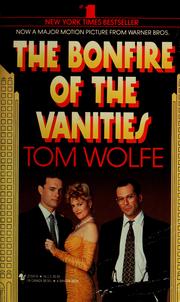
The Bonfire of the Vanities
2,268-word summary 10 min read 690 pages in the book
- First published
- 1987
- Publisher
- Farrar, Straus and Giroux
- Pages
- 690
- ISBN
- 9780553275971
Reading options
What's inside (10 sections)
I came to this book expecting a wall of 1980s swagger and found something stranger: a novel that keeps yanking the rug out from under the man it follows. It arrived in October 1987 from Farrar, Straus and Giroux, Tom Wolfe's first novel after roughly two decades of journalism, and it became the loudest literary event of that year. The first edition runs to about 690 pages, which is a great deal of space for a story that begins with one bad turn off an airport ramp. By the last page I understood why people called it the novel of the decade, and why so many of them were glad when it was over.
How a magazine serial became a novel
The book started life in the least novel-like place imaginable: the biweekly issues of Rolling Stone. Wolfe had hit a wall with the project and wrote to the magazine's editor, Jann Wenner, with a proposal borrowed from Charles Dickens and William Makepeace Thackeray. Those Victorian writers, whom Wolfe regarded as his models, had often published their novels in installments, and Wenner offered him around two hundred thousand dollars to do the same. From July 1984 to August 1985, each issue carried a new chunk of the story. Twenty-seven installments in all.
Wolfe later called that run his "very public first draft," and he was not fond of it. The deadline pressure was exactly what he had hoped for, but the version that reached bookstores in 1987 had been thoroughly rebuilt over two more years of research and revision. One telling change: the central character had been a writer in the serial, and Wolfe recast him as a bond salesman after spending a day on the government-bond desk at Salomon Brothers, surrounded by traders who would later surface in the Long-Term Capital Management story. He had also been doing homework of a grimmer kind, sitting in on cases at Manhattan Criminal Court and shadowing the Bronx homicide squad.
The title points back to a different century. A bonfire of the vanities was a real event, staged in Florence in 1497 under the Dominican priest Girolamo Savonarola, who ordered crowds to burn cosmetics, mirrors, books and art, the objects church authorities called sinful. Wolfe borrows the name for a book about a city convincing itself that a single accident can be burned away by public outrage.
The New York he is writing about was a place under strain. Wolfe wanted to catch the city in the 1980s, when Wall Street money sat on top of racial fury. Two killings in white neighbourhoods, of Willie Turks in Gravesend in 1982 and Michael Griffith in Howard Beach in 1986, had poisoned the atmosphere, and Bernhard Goetz had become a folk hero in 1984 after shooting young black men he said were trying to rob him on the subway. The novel does not name all of these cases, but you can feel them pressing behind the fiction.
Sherman McCoy, Master of the Universe
Sherman McCoy is a bond trader with a Park Avenue co-op worth three million dollars, a status that costs far more than he can comfortably afford. His wife Judy spends freely, his daughter Campbell is the one person he loves without calculation, and his income, large as it is, is being eaten alive by the requirements of his position. He has a private name for this: a "hemorrhaging of money." He also thinks of himself as a Master of the Universe, a piece of self-flattery the book repeats until it curdles.
The trouble starts on a night when McCoy drives to Kennedy Airport to collect his mistress, Maria Ruskin, and brings her back toward Manhattan. Somewhere in the Bronx they take a wrong turn. The ramp they need is blocked by trash cans and a tire, so McCoy gets out to move the obstacles. Two black men approach, and both McCoy and Maria read them as predators. They flee, Maria takes the wheel, and the car fishtails as she accelerates. It strikes one of the two men, a skinny youth named Henry Lamb. They do not stop.
That single sequence is the engine of the entire book. Everything after it is a study of what happens when a man who has always been protected by his status suddenly needs it to hold. McCoy tells himself he was nearly robbed and that the boy was an attacker. He is careful, in the days that follow, not to say too much to anyone. The lie is less a lie than a reflex, the habit of a man who has spent his life assuming that accounts will balance in his favour.
The people who feed on the case
While McCoy tries to keep his story straight, other people find a use for Henry Lamb. Peter Fallow is a washed-up, alcoholic reporter for a tabloid called City Light. He gets handed the chance of a lifetime when he is talked into writing a series about Lamb, a black youth who claims he was run down by a wealthy white driver. Fallow does not believe in the case, and he does not much care. What he cares about is the attention, and the attention arrives in bulk.
The man pulling the strings is Reverend Bacon, a Harlem religious and political operator who sees the injured youth as a projects success story gone wrong. Bacon understands the cameras better than the district attorney does, and he turns the hospital room into a stage. Fallow tolerates the manipulation and writes the pieces anyway. Protests follow. Reporters descend. A boy who had been all but invisible becomes a cause.
Abe Weiss, the Bronx County district attorney, is up for re-election and is being accused of dragging his feet. He is a man who watches the polls the way other men watch the tape. Under pressure, he pushes for McCoy's arrest. The evidence is thin but newsy: McCoy's car matches the description of the vehicle, and McCoy has been evasive with the police. That is enough for a man who needs a headline.
The fall, in slow motion
The arrest destroys McCoy piece by piece, and Wolfe takes his time about it. At work, McCoy is trying to land an investor for a six hundred million dollar bond, the deal on which he has staked his ability to service the loan on his home and pay his family's bills. Distraction makes him fumble it. His boss reprimands him, and at that moment his lawyer, Tommy Killian, calls to say the arrest is coming. McCoy has to admit his trouble aloud, and his boss puts him on leave.
From there the losses stack up. His friends in his social circle cut him. Judy leaves, taking Campbell to live with McCoy's parents, and the loss of his daughter is the one injury the book treats as genuinely private. The demonstrators gather outside his home. The machinery of the courts begins to turn.
Assistant district attorney Larry Kramer prosecutes, eager to impress his boss and a former juror named Shelly Thomas. He opens by asking for bail of two hundred and fifty thousand dollars and fails to get it. McCoy is released on ten thousand, which does not feel like freedom when a crowd is shouting outside his door. Kramer's ambition is one of the book's quieter jokes, because his grasp of the case is about as solid as his grasp of the woman he is trying to impress.
Maria, the wire and the recording
Fallow hears a rumour that Maria Ruskin was actually driving the car that hit Lamb and has fled the country. He wants the story, so he arranges to meet her husband, Arthur, at an expensive French restaurant, under the pretence of interviewing the rich and famous. Arthur talks about his life at length and then dies of a heart attack at the table, while other diners and an annoyed maître d'hôtel look on. It is one of the book's most malicious scenes and one of its funniest.
Maria has to come back for the funeral, and McCoy confronts her as the only witness who can clear him. Fallow, listening where he should not be, hears her admit she was at the wheel. The disclosure sets off a chain of deals. Kramer offers Maria immunity if she will back up the other man at the scene, Roland Auburn, who has said Sherman was driving. Refuse, and she will be treated as an accomplice.
Maria describes the offer to McCoy while he is wearing a wire. Then a private investigator working for Killian turns up a recording of a conversation that contradicts what Maria told the grand jury. The recording comes from an illegal voice-activated intercom installed by a landlord in a rent-controlled apartment as a way to get rid of tenants. Because the evidence was obtained that way, the judge declares Maria's testimony tainted and dismisses the case against McCoy. The man who nearly lost everything is saved by a landlord's dishonest device in someone else's apartment.
What happens to everyone afterwards
The ending refuses to hand out justice in tidy portions. Fallow wins a Pulitzer Prize and marries the daughter of Sir Gerald Steiner, the owner of City Light, which is the precise opposite of what a disgraced tabloid hack should expect. Maria escapes prosecution and remarries. McCoy's first trial ends in a hung jury split along racial lines. Kramer is removed from the prosecution after it emerges that he and Shelly Thomas were involved in a sexual encounter in the apartment that McCoy and Maria had once used.
The civil case goes the other way. McCoy loses to the Lamb family and is left with a twelve million dollar liability, pending appeal, and his assets are frozen. Henry Lamb, who had been almost forgotten while the reporters and lawyers fought over him, dies of his injuries. McCoy, broke and cut off from his wife and daughter, waits to stand trial for vehicular manslaughter. The boy is dead, the reporter is celebrated, the mistress is free, and the man at the centre of it all has been ground down by a process none of the participants seems able to control.
The voices, the models and the caricaturing
Wolfe has said his characters are composites, though several have recognizable originals. Tommy Killian is drawn from the New York lawyer Edward Hayes, to whom the book is dedicated. Reverend Bacon is widely read as a version of Al Sharpton or Jesse Jackson. A Bronx judge named Myron Kovitsky was modelled on Burton B. Roberts, a real jurist known for his imperious manner. The satirist is working from observation, not invention alone.
That is also where the book is easiest to attack. Wolfe is brilliant at the surface of status, at the clothes and the restaurants and the exact tone of a man protecting his position, and much less interested in what goes on underneath. Judy and Maria exist largely as figures in Sherman's drama. Fallow's alcoholism is played for laughs more often than for pity. Reverend Bacon can look like a caricature rather than a person, and the crowd scenes sometimes flatten everyone in them into a single motive. Wolfe's gift is for the loud public performance of feeling, and he can mistake that performance for the whole of a human being.
The reviews caught both sides. Frank Conroy, writing in The New York Times, called it "a big, bitter, funny, craftily plotted book that grabs you by the lapels and won't let go," while noting an "odd aftertaste, not entirely pleasant" once it was finished. National Review claimed that no one had portrayed New York society so accurately and devastatingly since Edith Wharton, and Louis Auchincloss simply called it a marvelous book. I think the aftertaste is the point. The book wants to be exhilarating and repellant at the same time, and it mostly manages both.
It has had a strange afterlife. Brian De Palma's 1990 film, with Tom Hanks as McCoy and Bruce Willis as Fallow, was a critical and commercial flop despite Wolfe being paid seven hundred and fifty thousand dollars for the rights. An opera with music by Stefania de Kenessey premiered in New York in 2015. Neither adaptation seems to have found what the novel had, which is the ungovernable energy of a writer listening to a city talk.
Why this one still gets read
What kept me turning pages was not the plot, which is fairly simple, but the pressure of the narration. Wolfe writes status panic with a kind of glee, and he never lets you forget that every person in this book is performing for someone else. The language is dense, the jokes are mean, and the book asks you to enjoy the spectacle while judging it, an uncomfortable combination that I found more honest than a clean moral would have been.
I would hand it to a reader who likes a novel with its sleeves rolled up, one that is willing to be wrong in interesting ways. I would be careful with a reader who wants their characters to be deeply known, because Wolfe keeps most of these people at the distance of a very sharp cartoonist. The book is long, it is loud, and it can be exhausting. It is also the fullest account we have of a particular moment in New York, written by someone who was standing in the courtroom and on the trading floor while it happened.
FAQ
Is The Bonfire of the Vanities Tom Wolfe's first novel?
Yes. It came out in October 1987 from Farrar, Straus and Giroux, his first novel after years of journalism and nonfiction, and it grew from a serial published in Rolling Stone.
Who is Henry Lamb and what happens to him?
Lamb is the black youth struck by McCoy's car in the Bronx. His case becomes a media cause, and he later dies of his injuries while McCoy waits for his own trial.
Does the novel end with McCoy getting justice?
Not really. The criminal case against him is dismissed, but he loses a civil suit, faces a twelve million dollar judgment with frozen assets, and awaits trial for vehicular manslaughter.
Similar books
Universality
Natasha Brown's short second novel turns a lockdown fracas over a gold bar into a sharp satire of money, identity and public argument.
2,302-word summary · 10 min read
The New York Trilogy
Three linked novels turn a wrong-number call into a puzzle about names, authorship, and the stories people tell to stay sane.
2,259-word summary · 10 min read
On Beauty
A Rembrandt scholar and his liberal family collide with a conservative rival's household in a Massachusetts college town, in Zadie Smith's comic, argumentative…
2,869-word summary · 13 min read
Behold the Dreamers
A Cameroonian chauffeur and his wife chase the American dream while driving a Lehman Brothers executive through the 2008 crash in Mbue's debut novel.
2,578-word summary · 11 min read
A Passage to India
Forster's 1924 novel follows two Englishwomen, an Indian doctor and a schoolmaster whose lives collide at the Marabar Caves, where a moment of panic exposes…
2,332-word summary · 10 min read
Last Night in Brooklyn
A copywriter in 2005 Fort Greene trades a scripted engagement for a bar crowd, a rising designer, and a neighborhood being remade around her.
2,540-word summary · 11 min read
Dead Souls
A charming stranger buys the rights to serfs who have died but remain on the census rolls, and a whole province turns against him.
2,255-word summary · 10 min read

The Crying of Lot 49
A California woman named executor of her ex-lover's estate follows a muted post horn into a possible centuries-old postal conspiracy, and Pynchon refuses to…
2,003-word summary · 9 min read
James
Percival Everett retells Huckleberry Finn from Jim's side, giving him a library, a hidden school, and a voice the novel lets loose.
2,211-word summary · 10 min read
Naked Lunch
Burroughs's banned 1959 collage novel follows Bill Lee through addiction, Tangier, and the nightmare bureaucracy of the Interzone.
2,082-word summary · 9 min read

The Chosen
A shattered pair of glasses in a 1944 Brooklyn softball game starts a friendship between a Hasidic boy and his Orthodox neighbor, and their fathers pull them…
2,443-word summary · 11 min read
Infinite Jest
A film that kills its viewers, a tennis academy, a halfway house for addicts, and a future America where corporations name the years, all tangled together.
2,084-word summary · 9 min read

Wide Sargasso Sea
Jean Rhys gives the first Mrs. Rochester a Caribbean childhood, a marriage built on money and suspicion, and a voice that Charlotte Bronte left in the attic.
2,021-word summary · 9 min read
If on a Winter's Night a Traveler
You, the Reader, chase a defective novel through bookshops and translators while ten other novels keep interrupting. Calvino's famous puzzle about the act of…
2,173-word summary · 10 min read
An Object of Beauty
Lacey climbs the art world from Sotheby to fraud and fall.
2,629-word summary · 12 min read
Song of Solomon
Milkman Dead leaves Michigan to hunt for family gold and finds instead the old song of his ancestor Solomon.
2,465-word summary · 11 min read
Post Office
Chinaski drifts through postal shifts, cheap rooms, horse tracks and rough love in Bukowski's 1971 debut about work, drink and survival.
2,444-word summary · 11 min read
The Age of Innocence
Engaged New York lawyer Newland Archer falls for Ellen Olenska, his fiancee's cousin fleeing a bad marriage, and must choose between love and duty in 1870s old…
3,100-word summary · 14 min read
The Bluest Eye
Pecola prays for blue eyes while her parents repeat the racism that broke them, and the town looks away.
2,024-word summary · 9 min read
Breakfast of Champions
A Pontiac dealer breaks down while a broke sci-fi writer brings the book that tells him others are robots.
2,013-word summary · 9 min read
A Confederacy of Dunces
Ignatius J. Reilly, jobless and full of opinions in New Orleans, meets work, his mother, and the law in Toole's posthumous Pulitzer winner.
3,089-word summary · 14 min read
The Master and Margarita
Devil Woland visits 1930s Moscow while Master writes Pilate and Margarita bargains.
2,535-word summary · 11 min read
My Year of Rest and Relaxation
A young art graduate tries to sleep for a year with pills and Reva while the city drifts toward 2001.
3,146-word summary · 14 min read
Yellowface
Struggling writer June steals her dead friend Athena's manuscript and publishes it as Juniper Song.
2,081-word summary · 9 min read
The Catcher in the Rye
J. D. Salinger's The Catcher in the Rye explained: Holden's weekend in New York, the phony adults, Phoebe's carousel, and why readers keep coming back to him.
2,477-word summary · 11 min read

The Wilderness
Four Black women move through twenty years of friendship in Angela Flournoy's discontinuous, widely praised second novel.
2,141-word summary · 10 min read
The Tunnel
A painter in a Buenos Aires prison recounts the glance, the woman and the jealousy that led him to murder the only person who understood him.
2,313-word summary · 10 min read
The Reluctant Fundamentalist
In a Lahore cafe, Changez tells a nervous American how Princeton and a New York career gave way to anger after September 11.
2,340-word summary · 10 min read
The Portrait of a Lady
A young American woman inherits a fortune, refuses two suitors, and marries a polished expatriate who makes her independence a trap. James watches her mind at…
2,903-word summary · 13 min read