
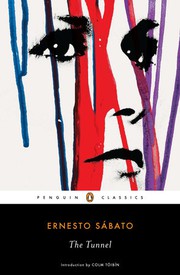
The Tunnel
2,313-word summary 10 min read 138 pages in the book
- First published
- 1948
- Publisher
- Penguin Classics
- Pages
- 138
- ISBN
- 9780143106531
- Original title
- El túnel
Reading options
What's inside (9 sections)
I read The Tunnel in a single evening, which is probably the only sensible way to read it. It is a short book that behaves like a long confession, and putting it down halfway would break the spell. By the last page I felt as if I had been sitting in a small room with a man who would not stop talking, which is exactly the effect Sabato wants. The voice is intimate, airless and occasionally exhausting. I closed it convinced that I had met someone, which is a strange thing to say about a murderer.
I had come to it sideways, through a friend who said it was the only book he knew that made jealousy feel like a disease with a temperature. That is a fair description. The Tunnel is not a mystery in the usual sense, because the crime is announced in the first lines and never in doubt. It is a study of the hours before a murder, told by the only person who cannot understand them. Knowing the destination changes the way you read every small slight and every missed signal. I found myself watching for the moment Castel could still have turned back.
Ernesto Sabato published the original, El túnel, in 1948 with Editorial Sur in Buenos Aires. He was thirty seven, a trained physicist who had worked at the Curie Institute and at MIT before leaving science to write and paint. The first English version appeared in 1950 as The Outsider, translated by Harriet de Onís. The version I read uses Margaret Sayers Peden's 1988 translation, published as The Tunnel, and carries an introduction by Colm Tóibín. My Penguin Classics paperback runs 138 pages with ISBN 9780143106531. The novel was greeted with real enthusiasm by Albert Camus and Graham Greene, and it has kept its hold for nearly eighty years. After reading it I could see why, and also why it can irritate. It was the first of only three novels Sabato wrote, and it is by far the shortest. He preferred to leave a small, sharp thing rather than a large one, and the compactness matters. Nothing here has room to wander.
The book has also had an odd afterlife on screen. There was an Argentine film in 1952 directed by León Klimovsky, a television version in 1977 and a 1988 film directed by Antonio Drove with Jane Seymour and Peter Weller. Alexander Payne made a comic adaptation for a film school project in 1990 called The Passion of Martin. I mention all of that only because the story seems to invite retelling. It is essentially one long speech, and a speech can be staged almost anywhere.
The man writing from a cell
The book wastes no time on pleasantries. Juan Pablo Castel introduces himself as the painter who killed María Iribarne. He is in prison, writing an account of how he got there, and he tells us the ending before he begins. That is a bold way to open a novel, because it removes suspense and replaces it with a harder question. If we already know what he did, we have to decide what to make of the person telling us.
Castel is a porteño, a man of Buenos Aires, and he is proud of his work and impatient with almost everyone else. His account is cool and architectural at the start, full of careful observation, and it slowly comes apart as he goes back through the year that ruined him. Sabato lets the prose tighten and loosen with Castel's state of mind. The early pages are controlled. Later ones run, repeat and double back. That is not a flaw in the translation. It is the sound of a man arguing with himself on paper.
There is a compactness to the device that I keep admiring. A diary from prison gives Sabato permission to skip everything that does not interest Castel, and to include everything that does. We never get a second account of the exhibition or the estancia. We get one man's memory of them, filtered through a sentence he is writing now, in a cell, with the benefit of knowing how it ends. That narrow frame is why the book feels claustrophobic. There is no world outside the narrator, and no one to correct him.
One detail in a painting
The story proper begins in the autumn of 1946 at an exhibition of Castel's work. A woman stands in front of one of his paintings, a work called Maternidad, or Maternity, and she is looking at a small detail near the edge that almost nobody else notices. It is the part of the painting Castel cares about most. He takes her attention as a recognition of something private, almost an invitation, and the fact that she is a stranger makes it more powerful rather than less.
He misses his chance to speak to her that day. For the next few months he circles the memory of her, inventing conversations, working out what he would say if he ever found her again. This section is where the book earns its reputation as a study of obsession. Nothing much happens outwardly. A man looks at a painting and then looks for the woman who looked at it. Yet Sabato makes the pursuit feel inevitable, and he does it without making Castel charming. The obsession is not romantic. It is a kind of hunger that mistakes itself for insight.
Posadas Street and the blind husband
Castel eventually sees the woman entering a building and works out where she might work. He approaches her and learns her name, María Iribarne. They talk about the painting, then meet again. She is married to a man named Allende, who is blind, and they live on Posadas Street in the northern part of the city. She does not use her husband's surname, and Castel keeps returning to that fact as if it were a door he could open.
This is where the relationship turns into an interrogation. Castel wants to know what she thinks, why she stays, what she feels when her husband touches her, why she will not say the things he wants her to say. María answers as best she can, but she cannot produce the certainty he is asking for. Nobody could. The chapter is a long lesson in what happens when one person treats another as a puzzle to be solved. I found myself wanting to shake him, which I take as a sign that Sabato is doing his job. The blind husband never appears fully in these scenes, yet his presence dominates them. Castel cannot stop thinking about what it means to be seen by someone who cannot see.
One thing the novel does better than I expected is give María a life of her own inside Castel's account. The Los Angeles Times reviewer noted that Sabato writes her desire as well as his, and that is true even though we never leave Castel's point of view. She has a husband she stays with, a family at the ranch, habits and obligations and a private fear of what this pursuit is becoming. He cannot read any of it. He only knows that she did not look at him the way he wanted to be looked at. That gap between two people in the same room is the saddest thing in the book, and it is there before anyone mentions love.
The estancia at Mar del Plata
The couple travel to an estancia, a country ranch near Mar del Plata owned by a cousin of Allende's named Hunter. The visit is a disaster from the start. The other relatives are watchful and cold, the atmosphere is strange, and Hunter is plainly jealous of María. Castel reads every gesture as evidence, and his paranoia feeds on the heat and the long meals and the fact that he has no idea what is expected of him. He leaves with barely a word to one of the staff.
He waits at the station for María to come after him. She does not come. That absence is the hinge of the book, because Castel treats it as proof of everything he has suspected rather than as an ordinary failure of communication. On the way back to Buenos Aires he writes a letter accusing her of sleeping with Hunter. He mails it, regrets it almost immediately and tries to persuade a postal worker to return it. He cannot. He decides that fate has chosen to let the letter arrive, which is a neat example of how his mind turns his own mistakes into decisions made by the world.
A letter he cannot take back
The letter does its damage. Castel reaches María by phone and she agrees to see him, though she tells him plainly that the meeting will probably do him more harm than good. When she fails to appear in Buenos Aires, he concludes that she has been lying all along, that she is a prostitute who has cheated on her husband with him and with Hunter and with others. The logic is grotesque and completely consistent. He has decided what she is, so every piece of evidence confirms it.
He drives out to the estancia again and waits outside the house until the guests have gone. While he waits, he imagines himself and María moving through life in separate passages, parallel tunnels that never meet. Then he sees his own life differently, as one dark and solitary tunnel containing his whole childhood and youth. This is the image the book is named for, and it arrives late enough to feel earned. It is not a clever metaphor pasted on at the end. It is the shape his loneliness has taken in his head, and he has been living inside it for years without knowing.
The tunnel itself
Castel enters the house and goes to María's room. He accuses her of leaving him alone in the world, and he stabs her to death. The killing is described without ceremony. There is no chase, no struggle worth mentioning, no grand speech. That restraint is what makes the scene disturbing. A man has talked his way into a murder over the course of a hundred pages, and the act itself takes only a moment.
He then goes to Allende's office to tell him what he has done, saying that he killed María because she slept with Hunter. Allende already knows about the affair. He calls Castel a fool again and again, and he tries weakly to fight him. Castel leaves and later turns himself in. Those last pages are quietly brilliant. The blind man is not a symbol that Sabato explains to us. He is a husband who has known for some time and who has not been able to act, and his sorrow is more terrible than Castel's rage. I finished the book thinking about that room more than the murder.
What the book leaves behind
The Los Angeles Times review of the 1988 translation, written by Christopher T. Leland, made a point that stayed with me. Some of the existential rhetoric can sound overwrought now, he wrote, but the power of the story remains. I agree with both halves. Castel sometimes sounds like a man reading his own press clipping, and there are passages where the philosophy sits too heavily on the fiction. At the same time, Sabato is very good on the small humiliations of Buenos Aires intellectual life. There is a cocktail party full of psychoanalysts and a set of conversations among wealthy people that are funny in a way that curdles.
He is also interested in bigger questions than the crime. How much can logic be trusted when the person using it is in pain? What power does a work of art actually have over someone who sees it? Why does blindness keep returning as both a fact and a figure? The novel does not answer these questions so much as keep them alive, which is probably the right decision for a book narrated by a man who is certain about everything.
There is an irony I could not put out of my mind. Sabato later chaired the National Commission on the Disappearance of Persons, investigating the crimes of Argentina's military dictatorship. Reading a story about a decent system of reasoning turned to violence by private obsession, it is hard not to hear the later work in the earlier one. He was not writing about the state in 1948. He was writing about a painter in a cell. The fact that the same pattern showed up in his country a generation later makes the novel feel less like a period piece than it otherwise might.
I also thought about the two English titles. The Outsider, which is what Harriet de Onís called it in 1950, points at Castel and his distance from other people. The Tunnel, which Margaret Sayers Peden gave us in 1988, points at the shape of his inner life. Both are defensible and they pull the reader in different directions. The earlier title makes him a type, the lonely man at the edge of the crowd. The later one makes him a place, and the book is far more interested in the place. I am glad the Peden version is the one that stayed in print.
I would not call The Tunnel an easy book to like. Castel is not redeemable, and Sabato offers no wink to soften him. What I got from it was a portrait of a mind arranging the world to deserve its own rage, told with enough skill that I kept listening even when I wanted to argue. The last thing I remember is not the knife. It is the blind man in his office, calling a murderer a fool, and being right.
FAQ
When was The Tunnel first published?
It appeared in Spanish as El túnel in 1948 with Editorial Sur in Buenos Aires. Harriet de Onís translated it into English as The Outsider in 1950.
Which English translation does this edition use?
The Penguin Classics edition uses Margaret Sayers Peden's 1988 translation, with an introduction by Colm Tóibín, and runs 138 pages.
Is The Tunnel a mystery?
Not in the usual sense. The murder is announced in the opening lines, and the book studies the obsession that leads up to it.
Similar books
The New York Trilogy
Three linked novels turn a wrong-number call into a puzzle about names, authorship, and the stories people tell to stay sane.
2,259-word summary · 10 min read

The Crying of Lot 49
A California woman named executor of her ex-lover's estate follows a muted post horn into a possible centuries-old postal conspiracy, and Pynchon refuses to…
2,003-word summary · 9 min read
The Luminaries
Eleanor Catton's Booker-winning novel drops a young prospector into an 1866 New Zealand gold town where twelve men untangle a web of hidden gold, murder and…
2,949-word summary · 13 min read

The Collector
A lonely clerk wins the football pools, buys a Sussex farmhouse, and kidnaps an art student he hopes will love him. Fowles's debut splits the story between…
2,618-word summary · 12 min read
Possession: A Romance
A London Library discovery sends two scholars chasing a secret Victorian love affair, in a Booker-winning novel of invented letters, poetry and the race to own…
2,394-word summary · 11 min read
Bleak House
Jarndyce and Jarndyce grinds through Chancery while Esther finds her family.
2,480-word summary · 11 min read
The Heart is a Lonely Hunter
A deaf man becomes the quiet center for lonely souls in a small Georgia mill town.
2,000-word summary · 9 min read

Chronicle of a Death Foretold
A town knows brothers will kill Santiago and no one stops it, retold to find why.
1,950-word summary · 9 min read
Sophie's World
Sophie gets philosophy lessons by mail, then finds she is fiction in a father birthday book for Hilde.
2,013-word summary · 9 min read

The Yiddish Policemen's Union
An alcoholic detective in an alternate Sitka investigates a murder that leads toward a messianic plot and his own family's past.
2,247-word summary · 10 min read
Our Souls at Night
A widow asks her widower neighbor to lie beside her at night, not for sex but for company, and two lonely people in a small Colorado town begin again.
2,582-word summary · 11 min read
Evil Under the Sun
Poirot's Devon holiday turns deadly when a flirtatious actress is strangled at a secluded seaside hotel in this 1941 puzzle.
2,380-word summary · 11 min read
You Are Not Alone
A lonely New Yorker witnesses a subway suicide and falls in with the dead woman's friends, where a makeover and a framed murder hide a hidden mastermind.
2,588-word summary · 12 min read
Wild Dark Shore
On a remote island between Tasmania and Antarctica, a family guards a vast seed bank until a storm washes a stranger ashore and the radios go dead.
2,449-word summary · 11 min read
What We Can Know
In McEwan's eighteenth novel, a lonely scholar in a flooded, diminished Britain chases a vanished poem that could win him the professorship he has long wanted.
2,408-word summary · 11 min read

The Zahir
A bestselling novelist's wife vanishes from their Paris home, sending him on a search that becomes a reckoning with his own marriage and attention.
2,433-word summary · 11 min read

The Secret of the Old Clock
The first Nancy Drew novel: a sixteen-year-old detective follows a clue hidden in a clock to overturn a will and restore a family's inheritance.
2,011-word summary · 9 min read
The Portrait of a Lady
A young American woman inherits a fortune, refuses two suitors, and marries a polished expatriate who makes her independence a trap. James watches her mind at…
2,903-word summary · 13 min read
The Paying Guests
A widowed mother and her unmarried daughter take in lodgers in 1922 south London, and a secret affair between Frances and Lilian pulls them into a murder case.
2,661-word summary · 12 min read

The Compound
Aisling Rawle's debut follows a bored, shallow contestant through a brutal reality show in a desert compound, where the rules get crueler and the world outside…
2,150-word summary · 10 min read
The Bonfire of the Vanities
Tom Wolfe's first novel follows a Wall Street bond trader whose life unravels after a hit-and-run in the Bronx, in a satire of 1980s New York money, race and…
2,268-word summary · 10 min read
Stolen
A sixteen-year-old is drugged at a Bangkok airport and taken into the Australian Outback by a man who has watched her for years. Lucy Christopher tells it as a…
2,284-word summary · 10 min read
Oranges Are Not the Only Fruit
An adopted girl in a strict Pentecostal household learns to read the Bible, preach sermons and love women, then faces her church and mother for it.
2,384-word summary · 11 min read
Five Little Pigs
Sixteen years after a painter's murder, Poirot reopens the case at the request of a daughter who believes her dead mother was innocent.
2,027-word summary · 9 min read
Crooked House
A family gathered around a dying patriarch in a twisted old house, and one of Christie's most famous revelations about who killed him.
2,059-word summary · 9 min read
American Pastoral
Roth's Pulitzer winner follows a Newark glove maker's son whose perfect family life is broken by his daughter's antiwar bombing, retold by a narrator who…
2,660-word summary · 12 min read
A Passage to India
Forster's 1924 novel follows two Englishwomen, an Indian doctor and a schoolmaster whose lives collide at the Marabar Caves, where a moment of panic exposes…
2,332-word summary · 10 min read
The Christie Affair
Agatha Christie vanishes for eleven days in 1926, and her husband's mistress claims to know why. Nan O'Dea's account runs from an Irish convent to a Yorkshire…
2,384-word summary · 11 min read
Invisible Cities
Marco Polo describes fifty-five impossible cities to Kublai Khan, and each one turns out to be a way of talking about memory, desire and the place we call home.
2,465-word summary · 11 min read
Hercule Poirot's Christmas
Simeon Lee invites his family to Gorston Hall for Christmas, then is found dead in a locked room. Poirot sorts a household where nearly everyone has a reason…
2,348-word summary · 10 min read