
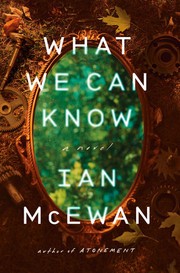
What We Can Know
2,408-word summary 11 min read 320 pages in the book
- First published
- 2025
- Publisher
- Knopf
- Pages
- 320
- ISBN
- 9780593804735
Reading options
What's inside (9 sections)
I picked this up because the pitch sounded like a puzzle made for me. A lost poem, a drowned Britain, a lonely scholar chasing a manuscript that might win him the job he has wanted for years. Then I noticed it was Ian McEwan's eighteenth novel, and I hesitated a little. A writer eighteen books in can afford to be clever in ways a novelist still proving himself cannot. What I found is a book that is clever in exactly that way, and far more interested in taking a puzzle apart than in handing you the finished pieces.
What We Can Know was published in September 2025. Most of it happens in 2119, in a Britain that rising seas and a nuclear accident have reduced to something smaller and harder to recognise. The book is McEwan's own kind of guessing game, and he has called it science fiction without the science. By the last page I had enjoyed the chase and also felt slightly cheated by it, which I suspect is the reaction he was after.
A smaller Britain and the age called the Derangement
The future here is not a shiny one. Britain has lost territory to the water, and a nuclear accident has made part of the country unusable. What is left is a scattering of small islands and a mainland that lives in the shadow of what came before. McEwan gives us the date and the damage quickly, then moves on, because the setting is mostly there to frame a question about knowledge rather than to be explored for its own sake.
The people of 2119 look back on the first half of the twenty-first century and call it the Derangement. The name is bitter and funny at once. It is the period when human beings understood climate change perfectly well and carried on anyway, cataloguing the problem and failing to act on it. That phrase is one of the sharpest things in the book, and it lands because it is not a prediction. It is a description of a mood that is already familiar to anyone reading the news.
Against this bleak backdrop, Thomas Metcalfe works as a literature scholar at the University of the South Downs, an institution McEwan invents for the purpose. Thomas is lonely, and his work has become the main relationship in his life. He is chasing a specific literary prize in the form of a recovered poem. If he can find it and establish it, he believes the professorship he has long wanted will finally be his. That stake is modest and deeply human. It is not money or power that drives him so much as the hope of being recognised by the small world he has spent his life inside.
A poem that vanished after one dinner party
The object of the search is a poem called A Corona for Vivien. It is a sequence of fifteen interlinked sonnets written by Francis Blundy, a celebrated poet, as a birthday present for his wife, Vivien. The story of the poem is almost a legend in Thomas's world. It was read aloud once, at a dinner party in 2014, and then the only copy disappeared. What remains is reputation and rumour, the kind of material that scholars build careers on and that can never quite be checked.
McEwan does something sly with this setup. He makes the poem both a literary treasure and a domestic object, a gift from one person to another that somehow became public property. Blundy is treated as a major figure, the sort of poet whose every scrap matters to researchers, but the poem was written inside a marriage. That gap between the public and the private is the engine of the whole novel. Thomas approaches the sonnets as a scholar chasing a text. The truth, when it arrives, turns out to be about two people and a room and a decision that had nothing to do with literary fame.
The dinner party of 2014 is the fixed point everyone keeps circling. It happened, the poem was heard, and then it was gone. Everything else about that evening is up for argument. I liked how the book treats the gap between those few certainties and the enormous structure of guesswork that scholars raise on top of them. Thomas knows more about the poem than anyone alive, and the novel quietly keeps reminding us how little that knowledge actually is.
The island, the capsule, and the violin
The first movement of the book plays like an academic detective story, and it is the part I enjoyed most. Thomas works alongside Rose Church, who is both his partner and a fellow researcher. They are a team in the literal sense and also a couple, and the book uses their closeness to keep the search from becoming too solitary. Rose has her own stake in the outcome, and the two of them share the same hopes about the professorship, which makes their partnership feel like a real collaboration rather than a supporting act.
Their archival work leads them to one of the small islands left of Britain. The trip is the nearest the novel comes to an adventure, and McEwan writes it with a light, almost brisk touch. On the island the researchers uncover a buried time capsule of documents, along with a valuable violin. The objects are exactly the sort of thing that excites this kind of scholar. Documents can settle arguments. A violin can be authenticated, dated, and tied to a name. For a while it genuinely feels as though the lost poem might be recovered and the case closed.
What impressed me here was the plainness of the detective work. There is no car chase and no danger. There are archives, trips, documents, and the slow business of matching one fact to another. McEwan is interested in how a researcher actually thinks, which is to say in habits of inference and the small thrills of a clue that fits. I found those passages convincing because the reward is intellectual rather than physical. When Thomas and Rose find something, the excitement is in what it might prove, and the book lets that dry kind of pleasure stand on its own.
The island episode also gives the future some texture, but only just. The seas and the accident are real pressures on this world, yet McEwan keeps them in the background. He is not writing a novel about survival in a flooded country. He is using a damaged future to ask what survives of the past, and a buried capsule is a neat image for that question. Things last, but they last without their context, and a document dug out of the ground can mean almost anything until someone tells you what it means.
The confession that turns the first half inside out
Then the book changes shape. The second movement is much shorter than the first, and it abandons Thomas's third-person investigation for a first-person confession from the earlier era. The voice comes from 2014, from the world of Blundy and Vivien and that dinner party, and it overturns nearly everything Thomas believes. The switch is abrupt enough to feel like a door opening in a different house. I remember reading the first pages of that section and realising that the rules had changed under me.
What the confession reveals is that the poem was never published for a reason far darker than the story Thomas has built. He has imagined a tale of artistic modesty, or of a manuscript simply lost to time. Both versions are comforting because they leave the poetry intact and the marriage more or less noble. The truth is uglier and more human, and it reframes the sonnets, the marriage, and the evening they were read aloud. McEwan is not content with adding a twist to the mystery. He uses the reveal to change what the whole search was for.
This is where the novel shows its hand. The careful detection of the first half was never really about solving a crime or recovering an object. It was about the distance between the fragments a culture keeps and the truth those fragments point toward. Thomas has spent his career treating texts as evidence that can be assembled into a case. The confession demonstrates that evidence can be assembled just as easily into a flattering fiction, and that a scholar's patience is no protection against wanting a particular answer.
I found the shift exhilarating and also a bit unfair. Exhilarating because the book has the courage to make its own first half look naive, and the writing in the confession is immediate in a way the earlier chapters are not. Unfair because the reveal arrives so fast that the long investigation can start to feel like a decoy rather than a genuine piece of detection. If you loved the archival work as I did, there is a small sting in realising that McEwan always intended to pull the rug out from under it.
Science fiction without the science
McEwan has described the book as science fiction without the science, and that is a fair summary of the method. The future is a set of conditions rather than a working machine. We get a reduced Britain, a named historical period, and a pair of environmental catastrophes, and we never get the machinery of how that world runs. There are no explanations of its politics or its technology worth the name. For a reader who came for the speculative detail, that will be a disappointment.
I do not think it is a failure of imagination so much as a choice about emphasis. The future exists to make the past strange. By placing the year 2014 at a far remove, McEwan can look at a poet and his wife and their famous dinner party the way an archaeologist might look at a ruin. The Derangement is the link between the two eras, the bridge between a culture that knew better and a culture that inherits the bill. That is a political idea, and the book wears it lightly.
Dwight Garner wrote in the New York Times that this was the best thing McEwan had written in ages, and I can understand the praise. There is a sureness to the construction, especially the way a small literary puzzle carries a much larger argument about public memory and private truth. Kevin Power, writing in the Guardian, read the novel as a liberal critique of liberalism, and that seems right too. The people in this book are intelligent and well meaning and trapped in a culture that congratulates itself on understanding things it refuses to change. The poem is a small version of the same habit. Everyone admires it, and almost no one wants to know what it cost.
Where the book loses its grip
I want to be straight about what did not work for me. The future is sketched more than it is lived in. The drowned islands and the nuclear accident are mentioned with an economy that sometimes feels like shortcutting. McEwan gives us just enough scenery to make the premise legible and then hurries back to the manuscript hunt. If you hoped to spend time inside 2119, you will find only a few rooms furnished.
The late reveal is the bigger problem. It arrives with such force and so little preparation that the first half can seem like a decoy planted by a writer who did not trust his own detective story. I felt that particularly in the island section, where the time capsule and the violin are presented with such care that I expected them to matter to the solution in a direct way. They matter to the theme, certainly, but the emotional information that actually changes the book comes from a different direction entirely. The result is a novel that is more interested in the gap between fragments and truth than in the pleasure of solving a mystery, which is a legitimate ambition, but it does leave the patient scholar in me a little short changed.
There is also a coolness to the book that I did not fully warm to. Thomas and Rose are drawn with care but kept at a distance, and even the confession, for all its first-person immediacy, feels engineered. McEwan is a writer who likes a trap, and you can sometimes see the edges of the trap. That is part of his skill, of course, and I am not asking him to stop being himself. I am noting that the design occasionally shows through the story in a way that made me admire the book more than I enjoyed it.
The joke at the end
The final turn is the one I keep coming back to. Thomas and Rose do get their professorships. After all the digging and the wrong turns and the confession that sends the whole investigation sideways, the two of them are rewarded with the positions they wanted. The catch is that nearly every conclusion they reached was wrong. They get the thing they were chasing, and they get it in spite of being mistaken about almost everything that mattered.
I like that ending because it refuses to tidy up. There is no moment where the scholar is vindicated by the text, no clean reward for correct interpretation. Instead the book leaves you with a picture of two people whose careful work was mostly wrong and whose careers advance anyway. That is a sharper joke than any twist about a lost manuscript, and it is the point where the novel's interest in what we can know becomes a question about what we need to believe in order to go on working.
I would hand this to a reader who enjoys a novel that argues with itself, and to anyone who has ever cared too much about a small scholarly question. I would be cautious with a reader who wants a fully built future or a mystery that pays off in the usual way. The book keeps its best trick for the last chapter, and once you have seen it, you may want to go back and read the early chapters again to watch the clues rearrange themselves. That is a real pleasure, and it is the one the book is most confident about offering.
FAQ
Is What We Can Know really science fiction?
McEwan has called it science fiction without the science. The year 2119 gives us a diminished Britain and a bitter name for the early twenty-first century, but the machinery of that world is barely explored.
What is the poem at the centre of the book?
It is A Corona for Vivien, fifteen interlinked sonnets written by Francis Blundy as a birthday gift for his wife Vivien. It was read once at a dinner party in 2014 before the only copy vanished.
Does the mystery get a satisfying solution?
A first-person confession from the earlier era explains why the poem was never published, but it overturns nearly everything the scholar believed and arrives abruptly enough that the first half can feel like a decoy.
Similar books
Departure(s)
Barnes's fifteenth and final novel blends fiction, memoir and essay as a grieving north London writer tests what memory can be trusted to deliver. Short,…
2,234-word summary · 10 min read
The First Fifteen Lives of Harry August
Harry August dies and is born again into the same life, again and again, until a warning from a child tells him the world is ending faster with each pass.
2,189-word summary · 10 min read
The Bone Clocks
A teenage runaway, a Cambridge con artist, a war reporter and a dying novelist circle a hidden war between immortals across sixty years, with Holly Sykes at…
2,125-word summary · 9 min read
The Memory Police
On an unnamed island, ordinary things keep vanishing from memory, and a novelist hides her editor from the police who make sure the vanished stay forgotten.
2,440-word summary · 11 min read
Ubik
A psychic agency crew dies in a blast and reality decays unless a spray called Ubik saves them.
2,674-word summary · 12 min read
Drive Your Plow Over the Bones of the Dead
An old woman in Poland blames animal revenge for murdered hunters.
2,597-word summary · 12 min read
The Humans
An alien borrows Andrew Martin's life to erase a proof, then a dog, peanut butter, and a tired family win him over.
2,959-word summary · 13 min read
Cloud Atlas
Six lives from 1850 to a post-apocalypse nest inside each other, linked by a comet birthmark, as souls drift like clouds across power and kindness.
2,390-word summary · 11 min read
Sophie's World
Sophie gets philosophy lessons by mail, then finds she is fiction in a father birthday book for Hilde.
2,013-word summary · 9 min read
Recursion
False pasts feel truer than true ones as a memory chair lets the grieving rewrite deaths.
1,995-word summary · 9 min read
Wayward
With Ethan Burke now sheriff, Wayward Pines runs on cameras, fear and a founder's private plan, until a murder forces him to choose between order and the truth.
2,252-word summary · 10 min read
The Yiddish Policemen's Union
An alcoholic detective in an alternate Sitka investigates a murder that leads toward a messianic plot and his own family's past.
2,247-word summary · 10 min read
The True True Story of Raja the Gullible (and His Mother)
A gay philosophy teacher in Beirut revisits six decades of Lebanese history, family trauma, and his thorny bond with his mother.
2,274-word summary · 10 min read
The South
A seventeen-year-old moves to his family's failing fruit orchard in 1990s Malaysia, where a summer love affair unfolds as the household and the land around him…
2,903-word summary · 13 min read
The Sisters
Three sisters watch one another take the lives they imagined, across thirty years in Stockholm and Tunisia, in a novel that bends time like an accordion.
2,199-word summary · 10 min read
The New York Trilogy
Three linked novels turn a wrong-number call into a puzzle about names, authorship, and the stories people tell to stay sane.
2,259-word summary · 10 min read
The Atlantis Gene
A geneticist and an intelligence operative chase two kidnapped boys through a global conspiracy about human evolution and a weapon built to cull humanity.
2,369-word summary · 11 min read
Shadow of the Hegemon
Battle School graduates return to Earth in 2197, where Achilles kidnaps Ender's Jeesh and Bean works to free them while Peter Wiggin plays for the title of…
2,093-word summary · 9 min read
One Boat
A woman returns to a Greek coastal town after her father's death, and the holiday she took nine years earlier after her mother's death keeps breaking through.
2,143-word summary · 10 min read
Wild Dark Shore
On a remote island between Tasmania and Antarctica, a family guards a vast seed bank until a storm washes a stranger ashore and the radios go dead.
2,449-word summary · 11 min read
Whistler
Ann Patchett's eleventh novel follows a New York teacher who reconnects with a former stepfather at the Met and hears the strange story of a chestnut mare.
2,697-word summary · 12 min read
The Zahir
A bestselling novelist's wife vanishes from their Paris home, sending him on a search that becomes a reckoning with his own marriage and attention.
2,433-word summary · 11 min read
The Tunnel
A painter in a Buenos Aires prison recounts the glance, the woman and the jealousy that led him to murder the only person who understood him.
2,313-word summary · 10 min read
The Secret of Secrets
Robert Langdon travels to Prague with Katherine Solomon, a scientist whose work on consciousness has made her a target. A dream, a bomb and a killer called the…
2,251-word summary · 10 min read
The Paying Guests
A widowed mother and her unmarried daughter take in lodgers in 1922 south London, and a secret affair between Frances and Lilian pulls them into a murder case.
2,661-word summary · 12 min read
The Luminaries
Eleanor Catton's Booker-winning novel drops a young prospector into an 1866 New Zealand gold town where twelve men untangle a web of hidden gold, murder and…
2,949-word summary · 13 min read
The Housekeeper and the Professor
A single mother becomes housekeeper to a mathematician who can remember nothing for more than eighty minutes, and builds a life with him around baseball and…
2,141-word summary · 10 min read
The Fix
Amos Decker watches a government contractor shoot a teacher outside FBI headquarters, then turn the gun on himself. The DIA wants the case shut.
2,315-word summary · 10 min read
The Dream Hotel
A Muslim American archivist lands at LAX and is detained because her sleep implant says she might kill her husband. Lalami's near-future novel follows her into…
2,687-word summary · 12 min read
Still Life with Woodpecker
An environmentalist princess and an outlaw bomber fall in love, then argue about freedom, sacrifice, and a pack of Camel cigarettes.
2,061-word summary · 9 min read