
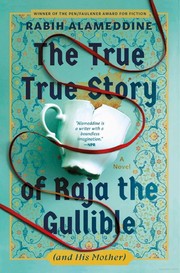
The True True Story of Raja the Gullible (and His Mother)
2,274-word summary 10 min read 336 pages in the book
- First published
- 2025
- Publisher
- Grove Press
- Pages
- 336
- ISBN
- 9780802166470
Reading options
What's inside (8 sections)
The title is the first joke
I picked this one up because the title made me laugh before I knew what the book was about. The True True Story of Raja the Gullible (and His Mother) is a mouthful, and it is clearly a joke about how unreliable the word true is going to be. Rabih Alameddine published it with Grove Press on 2 September 2025, it runs 336 pages, and it won the 2025 National Book Award for fiction. All of that is worth knowing before you start, because the award in particular sets up an expectation that the book immediately complicates. This is a novel about war, sexual violence, and a country coming apart, and it is also very funny. The two things are not in competition.
The narrator is Raja, a sixty-three-year-old gay high-school philosophy teacher who lives with his mother Zalfa in a tiny Beirut apartment. He loves books, long meditative walks, order, and solitude. Zalfa, who is in her eighties, treats his need for privacy as a personal insult and wants to know everything about his work and his love life. Their conversations are full of insults, curses, and charged silences, and the book returns again and again to a single retort. The phrase changes meaning as the story goes on, which is a neat trick. What begins as a joke between a mother and son ends up carrying a great deal more weight.
I have to admit that the comparison with the National Book Award took me a while to settle into. I kept expecting the book to announce its seriousness early, to lower the temperature once the history started arriving. It never does. The first chapter is a quarrel, and the chapter after that is a quarrel with different wording, and somehow the quarrel is doing more work than a page of exposition would. That is the book's confidence showing. Alameddine trusts that a reader will stay for a voice this sharp, and he is mostly right.
The invitation that sends him backward
The immediate trigger for the novel is an invitation to an all-expenses-paid writing residency in America. To Raja it looks like the answer to a prayer. He will get a room of his own, quiet, and distance from the woman who has spent decades dismantling his boundaries. Instead the invitation sends him backward through everything he has been trying to forget. This is the book's central machine. A trip that should be a clean escape becomes a forced review of a life, and the further Raja intends to travel the deeper he is pulled into memory.
The structure is deliberate and it takes some getting used to. The novel is organized in seven sections that jump between 2023, the long stretch from 2001 to 2021, the years before the civil war, 1975, and 2025. It moves across six decades of Lebanese history. The Lebanese civil war is there, and so is the 2019 banking collapse, the COVID-19 pandemic, and the 2020 Beirut port explosion. Anyone who likes a novel to announce its chronology clearly will spend the first chapter or two reorienting. Once I stopped trying to place every scene on a timeline and just followed Raja's voice, the jumping started to feel like the point. This is a man remembering, not a man reporting, and memory does not cooperate with calendars.
The great national events arrive sideways. The banking collapse shows up in the kind of small daily panic that follows a currency failing, and the port explosion arrives as something remembered rather than something described at length. Alameddine is not writing a history lesson. He is writing about what large disasters feel like when they happen to one apartment and one family, and the decision to keep the lens this narrow is what makes the wide history bearable. I found the section around 1975 the hardest to follow and also the most rewarding once the names sorted themselves out.
The people who surface
Raja's recollections are crowded. There is N, a roommate whose time in his life is fleeting, and Mansour, a manipulative figure with whom Raja spent two months underground. There is his cousin Nahed, another queer member of the family whose relationship to queerness differs from his own, which gives the book a useful way to argue with itself about identity. There is Micheline, who taught Raja to dance, and Boodie, with whom he later recreates that same choreography. There is Aunt Yasmine, of whom the book says she lived in a fantasy. Each of these people arrives in a fragment rather than a full introduction, and the fragments accumulate into a life.
The two months underground with Mansour are the clearest example of how the book handles a dangerous memory. Raja does not build it as a set piece. It is something he returns to obliquely, the way a person might circle an event they are not ready to describe straight on. Mansour's manipulation is unmistakable, and Raja's insistence that he was gullible grows out of that stretch. The dancing with Micheline and the later recreation with Boodie work as a quiet counterweight. One is a young man learning to move in a room, and the other is an older man repeating the same steps with someone else, trying to recover a version of himself.
Nahed matters because the book refuses to treat queerness as a single story. Raja is a gay man who has built his life around order and solitude, while his cousin's way of being queer is tied to a different set of choices and a different kind of family argument. The two of them are related by blood and by a shared difference from the people around them, and that is not enough to make them agree. Aunt Yasmine, meanwhile, is remembered as someone who lived inside a fantasy. Raja's recollection of her is affectionate and exasperated at once, and it reminds the reader that the novel's idea of truth has room for people who preferred a story to the facts.
The family dinner table is the recurring stage on which much of this plays out. Zalfa befriends everyone. She talks to a bank worker named Madame Taweel, she talks to Raja's students, and she turns every meal into an interrogation that Raja cannot quite escape. I liked these scenes even when they were exhausting, which is often. Alameddine understands that a family can be the place you are most known and the place you are most trapped at the same time. Raja can be a grown man, a teacher, a person with a carefully ordered private life, and still be reduced to a son across that table. The comedy comes from the speed of the insults. The sadness arrives a beat later.
What binds the fragments together is Raja himself. He is a philosopher by trade, and he has a habit of turning his humiliations into propositions. A stray thought about fate or education or the nature of a lie will suddenly open into a small argument, then collapse back into the argument he is having with his mother. Some readers will find this delightful. Others will find that the book stops too often to think. I was mostly on the delightful side, but I noticed that the philosophizing can arrive at moments when the story was moving well, and the pause costs a little momentum.
What the jokes are carrying
The book's tonal daring is what the National Book Award judges singled out. They marvelled that a work confronting war, sexual violence, and economic collapse could be so funny. Vox called it a treat from beginning to end, and The New Yorker praised Raja's relentless, funny voice. Kirkus noted what it called a sharp exploration of resilience in dark times. All of these responses point to the same achievement. Alameddine does not soften the material by making jokes about it. He uses the jokes to make the material bearable, and then he lets the bearable thing turn ugly again when you least expect it.
Sexual violence sits underneath the comedy, and the book does not announce it with a warning label. It surfaces in memories that Raja has organized his whole life to keep at a distance. The question of forgiveness runs through those memories. Raja does not offer an easy answer, and the book is better for it. Forgiveness here is not a decision he reaches and files away. It is something he keeps revisiting, often in the middle of an argument about something trivial, which is exactly how old trauma behaves. A mother's complaint about a missed phone call can open a door that was supposed to stay shut.
Alameddine drew partly on his own relationship with his ageing, memory-impaired mother, and that fact explains a lot about the book's emotional balance. Zalfa is infuriating and also deeply loved. Raja wants her to stop asking questions and is terrified of the day she will stop asking anything at all. That tension is the quiet engine beneath the loud dialogue. The retort that runs through the novel works because it can be an insult, a joke, a family ritual, and finally something closer to grief, depending on who is saying it and when. I caught myself laughing at a line and then realizing, a paragraph later, that there was nothing funny about the situation at all. That is the book at its best.
Gullible, or something else
Raja calls himself gullible repeatedly. It is the word he chooses for the person he was, the young man who believed people and paid for it. The novel tests that claim against the moments when Raja is anything but gullible. He can be shrewd, stubborn, and capable of drawing a line he will not cross. Mansour manipulates him, but Raja is not a fool for having trusted someone. He is a man who made different choices with the information he had, and the book is interested in the gap between how he remembers those choices and what they actually were.
That gap is what the double true in the title is about. Raja keeps revising his own story, and Zalfa keeps contradicting him, and the reader is never entirely sure which version is the one the novel endorses. I found this exhausting in a good way. There are passages where a detail from an earlier section returns with a different meaning, and the effect is that you want to go back and reread. The book trusts the reader to keep track, which is a compliment and also a small demand. It is not a novel to read half asleep on a train.
There are places where the demand feels too high. The non-linear structure can make the emotional beats land before you understand who they belong to. A few of the people in Raja's past, N in particular, are deliberately underdeveloped, which the book frames as a choice about memory rather than an omission. That works intellectually and less well as storytelling. I also thought the residency plot, which sets everything in motion, fades too far into the background. By the later sections I had forgotten that Raja was supposed to be leaving Beirut at all, and the frame does not return with enough force to matter.
What stays with you
By the end the comedy has not disappeared, but it has changed temperature. The same insults that opened the book land differently once you know what they have been covering. Raja's relationship with his mother remains unresolved, which feels honest. There is no scene where they finally understand each other and the music swells. There is a man in a small apartment with a woman who will not stop talking, and both of them know exactly what the other is avoiding. The last sections bring the story back toward the present and the invitation, but the real destination is that apartment.
What I took away is the strange generosity of the book. Alameddine could have written a novel that used Zalfa as a comic obstacle and Raja as a saintly victim. Instead he gives both of them a full share of the blame and a full share of the love. Raja is gullible, vain, funny, and sometimes cruel. Zalfa is suffocating, perceptive, and frightened. The novel holds all of that at once without asking the reader to choose a side. That is a hard thing to do with a mother and son, and it is the reason the book won the award it did.
I would hand this to a reader who likes a voice they have to keep up with, and who is willing to let a serious book be funny. The person I would not hand it to is someone who wants their history arranged in order or their protagonists easy to admire. Raja is neither a heroic survivor nor a reliable guide to Beirut. He is a man talking across a table, trying to get the last word in an argument that started decades ago, and the book stays in that room even when the country outside it is burning. Anyone looking for a tidy account of Lebanese history should go elsewhere. This is one man's memory of that history, told in fragments, argued with across a dinner table, and revised every time he says the word true. It is a difficult, brilliant, and often very enjoyable book, and the title is the first honest thing about it.
FAQ
Did The True True Story of Raja the Gullible win a major award?
Yes. It won the 2025 National Book Award for fiction.
Why is the story told out of order?
It follows Raja's memories rather than a calendar, jumping across seven sections and six decades of Lebanese history.
Is the book funny despite its serious subjects?
Yes. Its dark comedy sits alongside war, sexual violence, and the question of forgiveness, and that mixture drew praise from the award judges.
Similar books
The South
A seventeen-year-old moves to his family's failing fruit orchard in 1990s Malaysia, where a summer love affair unfolds as the household and the land around him…
2,903-word summary · 13 min read
The Sisters
Three sisters watch one another take the lives they imagined, across thirty years in Stockholm and Tunisia, in a novel that bends time like an accordion.
2,199-word summary · 10 min read
Palaver
A mother shows up uninvited at her estranged son's Tokyo apartment, and the two spend the weeks before Christmas talking their way toward something like…
2,465-word summary · 11 min read

Whistler
Ann Patchett's eleventh novel follows a New York teacher who reconnects with a former stepfather at the Met and hears the strange story of a chestnut mare.
2,697-word summary · 12 min read
The Correspondent
A retired lawyer in Annapolis writes letters across a decade to family, literary heroes, and one recipient she never mails. Evans's debut turns correspondence…
2,296-word summary · 10 min read
Red at the Bone
A girl's coming-of-age ceremony in a Brooklyn brownstone opens a family story shaped by Tulsa, teenage pregnancy, class and a second tragedy on September 11.
2,108-word summary · 9 min read
Oranges Are Not the Only Fruit
An adopted girl in a strict Pentecostal household learns to read the Bible, preach sermons and love women, then faces her church and mother for it.
2,384-word summary · 11 min read
Good Girl
A nineteen-year-old artist in Berlin, grieving her mother, falls into an unequal romance with an American author who offers escape from the ideal of the good…
2,579-word summary · 11 min read
Flashlight
Susan Choi's Booker-shortlisted novel opens with a father and daughter on a breakwater in 1978, then follows the loss outward through four generations and…
2,849-word summary · 13 min read

Detransition, Baby
Torrey Peters's debut follows three Brooklyn adults as an unexpected pregnancy pushes them to imagine an unconventional family. Funny, sharp, and unwilling to…
2,925-word summary · 13 min read

All Adults Here
A widow in upstate New York reconsiders the parent she was after a neighbor's death, then gathers her three grown children for a season of uneasy truths.
2,171-word summary · 10 min read

We Are Okay
Marin fled San Francisco after her grandfather vanished and stopped answering anyone. When Mabel visits her college dorm, she has to say what happened.
2,253-word summary · 10 min read
Infinite Jest
A film that kills its viewers, a tennis academy, a halfway house for addicts, and a future America where corporations name the years, all tangled together.
2,084-word summary · 9 min read

And Every Morning the Way Home Gets Longer and Longer
An elderly grandfather, his son, and his grandson share memories and fears as the old man's mind begins to fade, in a short novel about grief and love.
2,078-word summary · 9 min read
The Tiger's Wife
A young doctor in a war-scarred Balkan country chases the stories her grandfather left behind, including a deathless man and a deaf girl who loved an escaped…
2,232-word summary · 10 min read
White Noise
Jack Gladney teaches Hitler studies, flees a chemical cloud with his family, and chases a drug for dread in DeLillo's funny and bleak 1985 novel of…
2,768-word summary · 12 min read
The Island of Missing Trees
A talking fig links 1970s Cyprus lovers Kostas and Defne with their grieving London daughter Ada years later.
3,172-word summary · 14 min read

The Berry Pickers
A four year old vanishes from a Maine blueberry camp in 1962, and two families carry the loss for decades until Joe and Norma face the truth.
2,606-word summary · 12 min read
Change of Heart
Jodi Picoult's Change of Heart follows June Nealon, her ill daughter Claire, and death-row inmate Shay Bourne, whose wish to donate his heart forces a trial…
2,746-word summary · 12 min read
Life After Life
Ursula Todd dies and restarts through wars, flus, and bad marriages.
2,060-word summary · 9 min read
On Earth We're Briefly Gorgeous
A son writes to the mother who cannot read him: war, migration, first love, and loss in one Vietnamese American family in Hartford.
3,113-word summary · 14 min read

The Wilderness
Four Black women move through twenty years of friendship in Angela Flournoy's discontinuous, widely praised second novel.
2,141-word summary · 10 min read
The Rest of Our Lives
A law professor drives his daughter to college, then heads west instead of home, testing a private promise he made twelve years ago.
2,238-word summary · 10 min read

The Pelican Child
Twelve short stories by Joy Williams, where talking dogs, bleak comedy, and the nearness of death mark a late-career stylist at work.
2,415-word summary · 11 min read

The Nix
A stalled novelist and community college professor goes looking for the mother who left him and finds a radical activist whose rock thrown at a governor made…
2,214-word summary · 10 min read
The Loneliness of Sonia and Sunny
Two Indian families, a failed arranged match, and years between Allahabad and New York shape a slow, sprawling romance.
2,092-word summary · 9 min read
She Who Became the Sun
A peasant girl takes her dead brother's name and becomes Zhu Chongba, climbing from a Buddhist monastery toward a fractured China's throne.
2,170-word summary · 10 min read
Only Son
A brief, funny, melancholy debut about a boy whose father dies in 1982 Florida, and the man he becomes, still trying to read the mystery of that loss.
2,170-word summary · 10 min read

One Boat
A woman returns to a Greek coastal town after her father's death, and the holiday she took nine years earlier after her mother's death keeps breaking through.
2,143-word summary · 10 min read

Love Forms
A Trinidadian mother sent away at sixteen returns to the loss of her daughter forty years later, in Claire Adam's quiet, longlisted novel.
2,153-word summary · 10 min read