
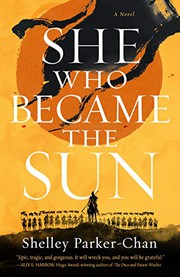
She Who Became the Sun
2,170-word summary 10 min read 416 pages in the book
- First published
- 2021
- Publisher
- Tor Books
- Pages
- 416
- ISBN
- 9781250621801
- Series
- The Radiant Emperor (#1)
Reading options
What's inside (8 sections)
The fortune teller's verdict
I picked this one up on a friend's recommendation, with only a vague sense that it was a fantasy about a woman who becomes an emperor in old China. What I got was a debut novel that reads more like a war chronicle than a magical adventure, and one with a much harsher moral temperature than I expected. She Who Became the Sun was published in 2021 by Tor Books in the United States and by Mantle in the United Kingdom. It is the first volume of The Radiant Emperor, and it reimagines the rise of the man who became the Hongwu Emperor, founder of the Ming dynasty.
The novel is set in the fourteenth century, during the Yuan dynasty and the Red Turban Rebellions. In this version of history, the Mandate of Heaven is a literal flame that an emperor can summon. As the empire fractures, other people discover they can call it too, which turns a metaphysical idea into a military objective. That single choice does a lot of work. It gives the book a clear source of stakes, and it lets Parker-Chan treat ambition as something almost physical, a hunger that sits in the chest and can be fed or starved.
The magic stays small on purpose. There are no schools of sorcerers or elaborate systems of spells here. The flame is a sign of legitimacy that can be seized, withheld, or claimed by force, and the book is far more interested in who gets to claim it than in how it works. This is historical fantasy with the emphasis on the first word. Battles are won through logistics, betrayal, and timing rather than enchantment, and the few moments that hinge on the Mandate feel powerful precisely because they are rare. Readers who want a large magical apparatus may be disappointed, but the restraint suits a story about a woman who has to prove she deserves a destiny that was assigned to someone else.
The story starts with a fortune teller and two children. A peasant family has a son and a daughter, and the teller pronounces their fates in the bluntest possible terms. The son is destined for greatness. The daughter is destined for nothing. Bandits kill their father soon after, the son wastes away and dies, and the daughter makes a decision that drives the entire novel. She takes her brother's name, Zhu Chongba, and presents herself as a boy so she can enter a Buddhist monastery and eat. Greatness, it turns out, is a thing you can steal from a corpse if you are desperate enough.
Life in the monastery
The monastery chapters are the best part of the book for me. Zhu stays there for years, keeping up the disguise, learning to read the room, and eventually becoming ordained as a monk. Parker-Chan writes these sections with a close attention to the physical business of survival: shaved heads, cold halls, the politics of who gets porridge and who gets sent to beg. Zhu is not strong or especially skilled at fighting at this stage. She gets by on nerve, observation, and a willingness to do things the other novices would rather not think about.
What makes the disguise compelling is that it is not treated as a simple costume change. Zhu has to learn how to occupy a male body in a world that reads maleness as authority. She watches how the monks stand, how they speak to one another, how they grant one another credit. The novel keeps returning to the idea that gender is something performed and rewarded, and that the performance can be learned by someone paying very close attention. At the same time, Zhu's knowledge of women's work and women's ways of seeing keeps giving her advantages the men around her cannot understand.
The monastery does not last. The abbot angers the Mongol authorities, and General Ouyang destroys the place. Zhu survives and joins the Red Turbans, the rebel movement gathering against the Yuan. Her rise from refugee to commander is told through a run of military engagements in which her decisions look, to everyone watching, like miracles. She keeps winning when she should not, and the men around her start to believe the fortune teller's prophecy attached itself to the right child after all.
Ouyang and the shape of the enemy
Every strong protagonist needs a worthy counterweight, and Ouyang is one of the more interesting antagonists I have read in recent fantasy. He is ethnically Han, castrated and enslaved by the Mongols because of his family's treason, and he has built a career inside the very system that ruined him. He plots to overthrow his masters while serving them, and the book gives him the same patient, calculating intelligence it gives Zhu. He is not a mustache-twirling villain. He is a man who has concluded that the only way to live with a humiliation is to become the person who can inflict it.
His soft spot is Esen, the Mongol prince he serves, and that attachment complicates everything. Ouyang's love for Esen pulls against his plans for revenge, and the tension between those two desires gives him a genuine inner life. He and Zhu clash repeatedly on the battlefield. In one of the book's most brutal turns, he cuts off Zhu's hand and lets her live. It is a mercy and a punishment at once, and it says more about both characters than a long speech could.
Bodies matter enormously in this novel, and Parker-Chan keeps returning to them as sites of both injury and power. Ouyang's castration is the original wound that made him what he is. Zhu's shaved head, her lost hand, and the way she dresses and moves are all part of the performance she has to maintain. The book treats bodily autonomy as a central question rather than a theme tacked on at the end. Zhu's ambition is not abstract. It is the demand of a person who has been told her body entitles her to nothing and who intends to prove otherwise on her own terms.
Ouyang eventually arranges the deaths of both Esen and Esen's father, then turns his forces against the Mongol emperor. The path there is long and full of maneuvering, and Parker-Chan does not flinch from the cost. By the time the two leads face one another near the end, neither is remotely innocent, and the reader has been made comfortable with the idea that nobody in this book gets to stay clean.
War, ambition, and the Mandate
The middle of the novel is dominated by campaign after campaign. Zhu consolidates her position among the Red Turban commanders, sometimes through loyalty and sometimes through quiet elimination. She captures the capital. She summons the Mandate of Heaven's flame. She is crowned king while Ma Xiuying watches. Ma Xiuying is the woman Zhu loves and marries, and her role is one of the more painful ones in the book. She loves Zhu, but she is troubled by the violence that Zhu believes greatness requires. Their marriage is a real relationship with real strain, not a reward at the end of a quest.
The slow narrowing of Zhu's options is what gives these chapters their weight. Each victory makes her more powerful and leaves her fewer people she can trust. The other Red Turban commanders are rivals waiting for a mistake, and the Mongol emperor is still a literal target. Zhu cannot afford hesitation, so she keeps choosing the solution that secures her position, even when it costs her something she cares about. Parker-Chan never lets the reader forget that the climb is also a series of losses. The crown at the end is heavy in a way the word "king" makes plain.
Parker-Chan's idea of Zhu's inner life is that she begins by believing she has to erase every trace of the girl she was. To claim her brother's destiny and escape the nothingness foretold for her, she thinks she must become entirely the man she is pretending to be. Over time that belief cracks. The insights she has as a woman, and the skills she learned in a world that underestimated her, keep opening doors that her performed masculinity cannot. The novel argues that she wins not by denying who she was but by using everything she has, including the parts she was told to hide.
The magic, such as it is, stays restrained. The Mandate is a flame and a claim, not a bag of spells. Readers looking for large magical set pieces may find the fantasy elements modest compared with other epic fantasies. What the book offers instead is political maneuvering on a large scale and a great deal of armed conflict. One reviewer noted that the scheming here makes George R. R. Martin look like a beginner, which struck me as fair. The battles and the betrayals carry the momentum.
What the book does with gender and history
This is a queer reimagining of the founding of the Ming dynasty, and it wears that description honestly. Zhu's disguise is never presented as a joke or a temporary inconvenience, and the novel treats desire and identity as serious subjects rather than decoration. Parker-Chan has spoken about wanting the emotional intensity of a romance inside a sweeping historical epic, while also queering the gender roles that such stories usually take for granted. The book delivers on that, and it is part of why the novel was a finalist for the Hugo Award for Best Novel and the Lambda Literary Award for Transgender Fiction, and why it won the British Fantasy Award for best novel and newcomer. It was also the first novel by an Australian writer to be a finalist for the Hugo.
The historical material is worn lightly but deliberately. The Red Turban Rebellions and the fall of the Yuan are real events, and Zhu's route from peasant orphan to emperor echoes the real Hongwu Emperor's story without being trapped by it. The fortune teller's prophecy gives the book a mythic frame, and the literal Mandate of Heaven turns a Chinese political concept into a contested prize. Nothing here is a documentary, and the novel is clear that it is a reimagining. That freedom lets Parker-Chan ask what kind of person it takes to found a dynasty, and what gets buried under the official story afterward.
Criticism and the finish
The book is not for every reader, and I want to be fair about that. It is relentless. The tone stays grim for long stretches, and the middle sags under the weight of one bleak confrontation after another. A review in Publishers Weekly made exactly this point, saying the unrelenting view of humanity bogs down the middle while praising the treatment of gender identity and bodily autonomy. A reviewer for USA Today gave it three and a half stars, calling it an important debut that expands the idea of who gets to be a hero, but also noting that scenes of kindness and compassion are nearly absent. Both criticisms rang true to me. There are long passages where the emotional range feels narrow and everyone is calculating, suffering, or killing.
The pacing has a similar problem. Parker-Chan gives us months of campaigning in brisk stretches, then slows down for a conversation that matters, and the shifts can feel abrupt. A reader looking for the slow build of a literary historical novel may find the action sections too rushed and the quiet sections too rare. On the other hand, a reader looking for a fast epic may find the meditative passages about identity and destiny an interruption. The book sits between those two audiences without fully belonging to either, though it has enough confidence in its own purpose that this rarely feels like indecision.
The ending, though, is earned. Zhu's final transformation is not a victory parade. She gets what the fortune teller promised, but the price is written all over her, and Ma Xiuying's presence keeps the human cost in frame. The last movement of the book resolves Zhu's private question about who she is supposed to be, and it does so in a way that fits the harsh logic the novel has built. She who was told she was nothing becomes the sun by refusing to accept the terms of the prophecy.
I finished it already wanting the sequel, He Who Drowned the World, which was published in 2023 and continues the duology. She Who Became the Sun is a debut with an unusually clear sense of what it wants to be: a war story, a story about gender, and a story about the stories powerful people tell about themselves. It does not always modulate well, and it can be a punishing read. For readers who like their fantasy morally complicated and their history made strange, it is an easy book to recommend.
FAQ
Is this based on a real emperor?
Yes. It reimagines the rise of the Hongwu Emperor, founder of the Ming dynasty, as the story of a girl who takes her dead brother's place in fourteenth-century China.
What is The Radiant Emperor series?
It is the duology made up of this 2021 novel and its 2023 sequel, He Who Drowned the World. She Who Became the Sun is the first volume.
How much fantasy does the book contain?
The magic is restrained. The Mandate of Heaven is a summonable flame, but most conflicts are decided by strategy, betrayal and armed warfare.
Similar books
More from The Radiant Emperor first, then related titles.
The Binding
In an alternate Victorian England, binders remove unbearable memories into books, and a young apprentice discovers his own past was erased from him.
2,036-word summary · 9 min read
The True True Story of Raja the Gullible (and His Mother)
A gay philosophy teacher in Beirut revisits six decades of Lebanese history, family trauma, and his thorny bond with his mother.
2,274-word summary · 10 min read
The Teacher of Nomad Land
In 1941 Iran, an orphaned boy straps a chalkboard to his back and sets off to teach nomads, hoping to keep his little sister with him.
2,534-word summary · 11 min read

The Last Bookshop in London
A woman who has never cared for reading takes a job in a dusty London bookshop as the Blitz begins, and finds her place in it.
2,264-word summary · 10 min read
I Must Betray You
In 1989 Romania, a seventeen-year-old is forced to inform on an American diplomat's family and records the truth in a hidden notebook.
2,258-word summary · 10 min read
Wolfsong
Ox Matheson grows up believing he is worth nothing. Then the Bennett family moves in next door, werewolves with a secret, and a boy named Joe begins to howl…
2,823-word summary · 13 min read
The Unicorn Hunters
Arden trades Russian folklore for fifteenth-century Brittany in a standalone about a duchess, a forced marriage, and a unicorn hunt that hides a secret wedding.
2,559-word summary · 11 min read
The Salt King
Sent back to the salt-mining town he fled, a Jesuit priest investigates miracles that turn pilgrims into pillars of salt. Pulley adds a slow-burning queer…
2,214-word summary · 10 min read

The River Has Roots
A fairy-tale novella in which a village on the edge of Faerie, a river that turns a girl into a swan and a harp that sings an accusation retell The Bonny Swans.
2,025-word summary · 9 min read
The Paying Guests
A widowed mother and her unmarried daughter take in lodgers in 1922 south London, and a secret affair between Frances and Lilian pulls them into a murder case.
2,661-word summary · 12 min read

The Kitchen God's Wife
Amy Tan's second novel pairs a San Jose speech therapist with her Chinese mother, whose account of war, an abusive husband, and a narrow escape comes out in a…
2,896-word summary · 13 min read

My Policeman
In 1999 a retired teacher writes a confession to the dying man her husband once loved, unpacking a 1950s Brighton love triangle that cost three people…
2,450-word summary · 11 min read

Endling
A Ukrainian scientist breeds endangered snails from her van and funds the work by posing as a mail-order bride, until a kidnapping plot meets the outbreak of…
3,041-word summary · 14 min read
Cinderella Is Dead
Two centuries after Cinderella, a Black teenager in love with another girl flees her kingdom's forced marriage ball.
2,250-word summary · 10 min read
Chain of Iron
In Edwardian London, a fake marriage, a murderer stripping Shadowhunters of their runes and a dead brother in a glass coffin draw the Herondales into a bargain…
2,029-word summary · 9 min read
Bury Our Bones in the Midnight Soil
Across five centuries, three women are turned into vampires by the same restless figure, and each must decide what her endless hunger will cost.
2,727-word summary · 12 min read
Birdsong
A love affair in Amiens before the First World War and a granddaughter's search through encoded journals decades later, joined by the tunnels of the Somme.
2,041-word summary · 9 min read
Alchemised
A memory-wiped alchemist wakes a prisoner of the regime that won Paladia's civil war, and her captor is the former rival who wants what remains inside her head.
2,596-word summary · 12 min read
The Paper Magician
A graduate magician is assigned to paper magic instead of metal, then must face a woman who tears out her mentor's heart.
2,454-word summary · 11 min read
The Lady of the Lake
Ciri is trapped by the Aen Elle while Geralt winters in Toussaint, and the Witcher saga closes with the siege of Stygga and a fog-bound farewell.
2,445-word summary · 11 min read
The Killer Angels
A Pulitzer-winning novel of Gettysburg, told through Lee, Longstreet, Chamberlain, and Buford. Shaara turns a familiar battle into a chain of choices made by…
2,242-word summary · 10 min read
The Desert Spear
Peter V. Brett's 2010 sequel moves the fight to Krasia, where spear-armed warriors hunt demons nightly and a rival rises to challenge the Warded Man.
2,283-word summary · 10 min read
The Bronze Horseman
On the day Germany invades the Soviet Union, Tatiana Metanova meets a mysterious Red Army officer, and their love is tested by the Siege of Leningrad.
2,461-word summary · 11 min read
Onyx Storm
A quest south with Violet Sorrengail, a dragon rider racing to cure Xaden before he turns venin. Yarros trades the academy for islands, irids and a costly war.
2,368-word summary · 11 min read

Corelli's Mandolin
A British doctor's daughter on a Greek island falls for the Italian captain billeted with her, until the German arrival turns a gentle occupation into a fight…
2,247-word summary · 10 min read
Blood Song
Anthony Ryan's Blood Song follows Vaelin Al Sorna from the Sixth Order's brutal training to the war that earns him the name Hope-Killer, in the first Raven's…
2,479-word summary · 11 min read

Atmosphere
A 1984 shuttle disaster opens this love story between two NASA astronauts who must hide their relationship. Reid builds toward the radio call that changes…
2,261-word summary · 10 min read
The Orphan's Tale
A Dutch teenager rescues a Jewish baby from a death train and joins a German circus, where a Jewish aerialist teaches her to fly.
2,943-word summary · 13 min read

The Blinding Knife
Kip trains to join the Blackguard while the Prism hides his true identity, loses his colors, and fights a war against a rogue drafter who wants to birth a god.
2,049-word summary · 9 min read
The Once and Future Witches
Three estranged sisters bring witchcraft back to an 1893 city where magic hides in nursery rhymes and the fight for the vote is also a fight for power.
2,132-word summary · 9 min read