
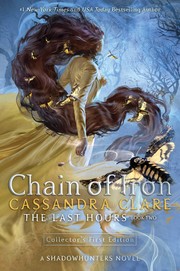
Chain of Iron
2,029-word summary 9 min read 624 pages in the book
- First published
- 2021
- Publisher
- Margaret K. McElderry Books
- Pages
- 624
- ISBN
- 9781481431903
- Series
- The Last Hours (#2)
Reading options
What's inside (8 sections)
A garden and a glass coffin
The book opens in the ruined garden of Chiswick House in Edwardian London, 1903. Lucie Herondale is experimenting. She has been trying to bring dead things back, starting with birds and rats, and her real ambition is her dead brother Jesse Blackthorn, whose body lies in a glass-topped coffin. Her friend Grace Blackthorn keeps pressing her toward necromancy rather than alchemy, which is the more respectable branch of the family art. Lucie has a power she has been hiding even from the people closest to her: she can command the dead.
That opening image, a girl in a ruined garden leaning over a corpse in a glass box, tells you a great deal about the book that follows. This is the second volume of The Last Hours, and it is much darker than the first. The wedding that the previous novel was building toward happens early, and almost everything after it is a consequence of secrets that people have been keeping from one another.
Cordelia Carstairs is days away from marrying James Herondale. The match is a sham, arranged for a year to protect her reputation after a scandal involving her father Elias's alcoholism. She is secretly in love with James. Her sword Cortana burns her when she touches it, which is a bad sign she does not understand. The person James is supposed to love, according to the spell that has been laid on him, is Grace. Almost nobody in this book is telling the truth, and the plot is built out of the collisions that follow.
The night before
On the eve of the wedding, Matthew Fairchild takes Cordelia to a Downworlder nightclub called the Hell Ruelle instead of the polite sledding party the Pouncebys are hosting. It is a wild, revealing sequence. Hypatia Vex talks about Lilith and the Festum Lamia. A faerie warns Cordelia that her husband does not love her. Another offers a bargain involving the forge of Wayland the Smith. Cordelia absorbs all of it and says little.
James spends his bachelor night with the Merry Thieves. He suffers vivid visions of Belial, and he is wearing a silver bracelet given to him by Grace. The bracelet is doing something specific: it makes him forget his love for Cordelia and believe that he loves Grace instead. It is one of the crueler devices in the book because it lets him experience his own feelings as a confusion rather than a betrayal. He knows something is wrong. He cannot know what.
The wedding takes place at the London Institute. The reception is marred by Elias Carstairs's drunken outburst and by Thomas Lightwood threatening Alastair. James and Cordelia set up house in Mayfair, establish rules for their fake marriage and sleep in separate bedrooms. What follows is the part of the book I found most engaging. A tentative domestic intimacy grows between them. They play chess. They talk. He gives her a gold globe pendant. At a Wentworth party he waltzes with her, and for a moment the arrangement looks as though it might become real.
Then Grace arrives, and the fragile structure shakes again.
The dead and the missing
Lucie's storyline runs in parallel. Her romantic novel about a ghost lover angers Jesse's spirit, who warns her to stop. She begins bargaining with Malcolm Fade, the High Warlock, for necromantic knowledge, all while hiding the full extent of her power. Her gift is not just a curiosity. She can make the dead do what she tells them, and that makes her both valuable and dangerous to everyone around her.
The central mystery of the book is a series of murders. Shadowhunters are being killed, one after another: Basil Pounceby, Filomena di Angelo, Elias Carstairs, Lilian Highsmith. Each victim is stripped of their permanent runes. James dreams the murders in detail before they happen, or seems to, and begins to fear that he is sleepwalking and committing them himself. He ties himself to his bed to prevent it. The next morning he wakes to find a demonic sigil scratched in ice in the room.
The investigation produces one of the book's best emotional turns. Thomas Lightwood is arrested for the murders. He is freed by the Mortal Sword after Alastair admits that he followed Thomas that night and knows he is innocent. Alastair and Thomas kiss and confess what they feel. It is a payoff that has been building across the series, and it arrives in the middle of a murder plot, which is very much Clare's method. The personal and the supernatural are never separate.
Meanwhile Cordelia seeks the smith Wayland at the Uffington White Horse after Cortana burns her again. She swears a paladin oath to him, and the blade is healed. The oath binds her to Lilith in disguise, which she does not discover until much later. This is the kind of bargain that fills the book: a solution that is also a trap, accepted in good faith by someone who had no other option.
The chessboard
The climax is long, crowded and occasionally hard to follow, but it is built out of the threads the book has been laying down. Lucie discovers that Jesse's preserved body holds the stolen runes and is an anchor for Belial's plan. She resolves to destroy it, but Grace knocks her unconscious first. Elsewhere, Magnus Bane takes James onto a chessboard-like shadow world where Belial denies sending the murder visions. Cordelia pulls James back with Cortana. The silver bracelet breaks. James collapses with black eyes, possessed by his demon grandfather.
Belial, speaking through Jesse's corpse, reveals what the murders were for. Each killing completed part of a sigil that will summon the sea demon Leviathan against the London Institute. Cordelia fights him with Cortana. Lilith reveals that she impersonated Wayland as Cordelia's patron. James shoots Lilith, and Lucie commands Jesse's body to expel Belial, banishing him to outer darkness. The scale escalates from a family argument to a battle for the city in the space of a few chapters, and the book mostly carries it.
The aftermath refuses to tidy things up. James lies to the Enclave and blames the possessed corpse. Cordelia confesses that she is Lilith's paladin. Lucie performs necromancy and brings Jesse back. Grace smashes a mirror and breaks free of her mother Tatiana. James confesses that he loves Cordelia and never truly loved Grace. And then Grace walks into the room and throws herself into his arms.
Cordelia, heartbroken, flees to Matthew Fairchild. He confesses his love and proposes that they run away to Paris together. James, discovering that Lucie has left with Malcolm Fade, chooses to search for his sister instead of following Cordelia. The choices are the point. Everyone in this book has to decide what they will put first, and nobody gets to keep everything. The epilogue shows Tatiana Blackthorn escaping the Adamant Citadel with adamas and handing Belial the key to the Iron Tombs on a volcanic plain, setting up the next book. It is a cold, efficient ending that refuses to let the reader rest in the victory. The demon is banished, the sigil is broken and the people of London are alive, but the wider machinery of the series is still turning. That is what makes it feel like a middle volume rather than a destination.
What holds it together
The themes are clear without being simple. True love is set against magically manufactured affection, and the bracelet is a literal device for making a person feel something they do not. Secrets are treated as a material force, the kind of thing that accumulates weight until it crushes the people keeping them. Demonic control appears in several forms, from possession to a mother's manipulation of her daughter. And sacrifice is everywhere: Matthew's confession, James's self-restraint in tying himself to the bed, Lucie risking her soul to bring her brother back.
The ensemble is the book's greatest strength. Clare keeps a very large cast in motion and gives nearly all of them a distinct want. Anna Lightwood and Ariadne Bridgestock have a quiet, guarded romance running alongside the main plot. Alastair's admission about following Thomas reframes a character who had been easy to dislike. Cordelia's paladin oath gives her a secret that matters to the plot rather than simply to her private life. Even the villains have a logic. Lilith's impersonation of Wayland is cruel but intelligible.
The historical setting is more than decoration. The clothes, the parties, the Institute and the rigid rules of respectable behavior all put pressure on the characters. A fake marriage in 1903 is a different thing from a fake marriage now, because the social cost of leaving it is different. Clare understands that the constraint of a period can do a novel's work for it.
I want to say a word about Cordelia and James's marriage, because it is the structural device that makes everything else possible. They agree to a year of pretending, with rules and separate bedrooms, and the book spends a great deal of time on the small things that happen inside that arrangement: a chess game, a waltz, a gift, the awkwardness of two people who are legally bound to each other and unsure what they are allowed to want. It is a good way to write a romance, because the obstacles are built into the domestic details rather than supplied by an external villain. When the magic finally does arrive, it has a real relationship to interrupt.
The title itself is a useful clue to the book's preoccupations. Iron is what the Shadowhunters use to bind demons, and the chain of the title is the series of causes and consequences that links one character's secret to another's ruin. A bracelet given as a gift becomes a spell that breaks a marriage. A bargain made to help a brother becomes seven years of stolen nights. A knife in a corpse becomes a door for Leviathan. Clare is interested in the way a small object carries a large obligation, and the book is built out of these transfers.
Where the book strains
It is long, at more than six hundred pages, and it uses all of them. There are several plots here that could have been novels on their own. The Anna and Ariadne thread, the mystery of the rune-stripping murders, the Grace and Tatiana storyline, and Cordelia and James's marriage each have enough material to carry more attention than they get. The result is a book that sometimes feels like four books spliced together, each one compressed so that the grand climax can arrive on schedule.
The climax itself is a test of patience. With so many supernatural mechanisms in play, a reader can lose track of who is possessed, who is pretending, and which object is doing what. Clare is generous with revelations but not always with orientation. I found myself rereading a few pages in the final chapters to work out whether Lilith was speaking through the smith or the corpse. That is a complication of the form, not a fatal flaw, but it is real.
There is also the issue of reading it alone. This is very much the second book of a series. Chain of Gold established these people and their histories, and a reader arriving here without that background will be swimming. The site has that earlier book posted, and the series connection is deliberate. Read in order, the emotional payoffs land. Out of order, much of the dialogue sounds like people referring to jokes you were not present for.
What I take away from it is the image of the garden at the start. Lucie leaning over a glass coffin, trying to bring back someone she loves, is the whole book in one picture. Every character here is trying to recover something: a love, a reputation, a brother, a sense of who they are when nobody has enchanted them. Some of them succeed at a cost. The books in this series understand that getting what you want and paying for it are the same event.
FAQ
Where does Chain of Iron fit in the series?
It is book two of The Last Hours, following Chain of Gold. It is set in Edwardian London in 1903 and is followed by Chain of Thorns.
Why does James believe he loves Grace?
He is wearing a silver bracelet given to him by Grace that makes him forget his love for Cordelia and believe his affection belongs to Grace. The bracelet breaks during the climax.
What are the murders meant to accomplish?
Belial, speaking through Jesse's possessed body, reveals that each murder completed part of a sigil intended to summon the sea demon Leviathan against the London Institute.
Similar books
More from The Last Hours first, then related titles.
Chain of Gold
Cordelia and James hunt demons in Edwardian London while hearts tangle.
2,364-word summary · 11 min read
The Paper Magician
A graduate magician is assigned to paper magic instead of metal, then must face a woman who tears out her mentor's heart.
2,454-word summary · 11 min read
World After
Penryn wakes from near-death to find her altered sister Paige hunted as a monster, and follows her into the angels' scorpion factory and Uriel's coup.
2,213-word summary · 10 min read
Grave Mercy
Convent assassin Ismae spares Gavriel and hunts traitors in Brittany.
2,357-word summary · 10 min read
Dreams of Gods & Monsters
Karou and Akiva unite chimera and seraphim against empires invading Earth.
2,179-word summary · 10 min read
Unearthly
Part-angel Clara moves to Wyoming to fulfill a vision of a boy and a forest fire.
2,241-word summary · 10 min read
Finale
Nora Grey must lead the Nephilim while her bond with Patch is tested by old vows and looming war over Coldwater. Hank's shadow still drives hate from beyond…
2,898-word summary · 13 min read
Days of Blood and Starlight
Karou takes up Brimstone's resurrection work while Akiva breaks with his empire as war burns Eretz.
2,866-word summary · 13 min read
Angelfall
After angels destroy the world, Penryn trades help with a wingless angel to rescue her sister from their stronghold.
2,420-word summary · 11 min read
Daughter of Smoke and Bone
Art student Karou with blue hair runs errands for chimera Brimstone until war finds her.
2,563-word summary · 11 min read
Queen of Air and Darkness
Emma and Julian face the Cohort, Thule, and the parabatai curse in Cassandra Clare's 880-page Dark Artifices finale of love, Faerie bargains, battle, weddings,…
2,653-word summary · 12 min read
Lord of Shadows
Emma and Julian face faerie war and forbidden love as the Cohort rises.
2,496-word summary · 11 min read
Lady Midnight
Emma and Julian hunt killer echoing old murders while parabatai love grows.
1,982-word summary · 9 min read
City of Heavenly Fire
Clary and Jace face Sebastian's dark army while Emma and Julian's story begins in Los Angeles.
2,039-word summary · 9 min read
Clockwork Princess
Tessa chooses between Jem and Will as Mortmain's clockwork army closes on the London Institute.
3,289-word summary · 15 min read
Clockwork Prince
Tessa Gray stays at the London Institute in 1878 as Will hides a curse, Jem weakens, and Mortmain moves his automatons.
2,784-word summary · 12 min read
City of Lost Souls
Clary leaves the Institute to stay close to a bound Jace while Alec, Izzy, Simon and Magnus search for a cure in New York.
2,782-word summary · 12 min read
City of Fallen Angels
Simon is turned and Jace dreams of killing Clary while Lilith plots to birth evil in New York.
2,249-word summary · 10 min read
Clockwork Angel
Tessa Gray finds Shadowhunters in Victorian London while the Magister hunts her.
3,288-word summary · 15 min read
City of Glass
Clary follows Jace to Alicante in Idris where Valentine plans to use the Soul-Sword on Shadowhunters and the Clave splits under pressure.
3,645-word summary · 16 min read
City of Ashes
Clary risks the Clave trial while Valentine raises demons and Jace pulls away in New York.
4,684-word summary · 21 min read
City of Bones
City of Bones retold: Clary sees Shadowhunters, Jace and the Cup, Valentine, and the Institute attack.
2,535-word summary · 11 min read

Revelations
Schuyler is pulled into the Force household as Silver Bloods rise, and a Conclave gathering in Rio ends in bloodshed.
2,166-word summary · 10 min read
Wings
A homeschooled fifteen-year-old grows a blue flower from her back and learns she is a faerie sent to guard a hidden gate. Pike's debut makes plant lore feel…
2,506-word summary · 11 min read

White Hot Kiss
Layla is half Warden, half demon, and one kiss from her steals a soul. A demon prince warns that Hell is hunting her, and she must choose between the clan that…
2,299-word summary · 10 min read
The Iron Knight
Winter prince Ash journeys to the End of the World to earn a soul and a mortal body so he can stand beside Meghan, the Iron Queen.
2,564-word summary · 11 min read