
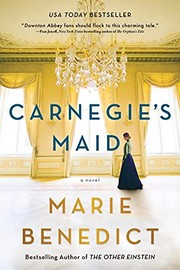
Carnegie's Maid
2,271-word summary 10 min read 352 pages in the book
- First published
- 2018
- Publisher
- Sourcebooks Landmark
- Pages
- 352
- ISBN
- 9781492662709
Reading options
What's inside (8 sections)
I almost skipped this one. The title and the cover suggested a familiar costume drama: a clever servant, a wealthy household, a romance that cannot possibly last. I have read a dozen of those. What made me keep going was a line in the publisher's description, that the novel asks what kind of woman could have inspired Andrew Carnegie to give away his fortune. That is not a costume drama. It is a historical puzzle with a real answer that nobody knows, and Marie Benedict, the pen name of the lawyer and novelist Heather Terrell, builds a plausible answer around it. The book came out in 2018 from Sourcebooks Landmark. It is more interested in the gap between the record and the imagination than in the furniture of the period, and that is what held me.
It helps to know a little about the person behind the name. Terrell studied history and art history at Boston College, then went to Boston University School of Law and spent about a decade as a litigator in New York before writing full time. She has said that her mission is to excavate the women of the past whose work has been buried under the names of men. You can feel the lawyer in the way this book is built. It lays out a case, admits what the evidence cannot prove, and then asks the reader to consider a possibility. That is a different rhythm from most historical romances, and it is the reason I kept turning pages.
Benedict has a habit of choosing women who stood near famous men and writing them back into the story. Her earlier novel The Other Einstein argued that Mileva Marić mattered to the work we credit to her husband. Later books would do the same for Hedy Lamarr and Clementine Churchill. Carnegie's Maid picks a woman who never existed, which is a stranger choice and, I think, a more honest one. Because Clara Kelley is invented, the author is free to admit that her explanation is a fiction. The novel never claims to have found a lost diary. It offers a what if and lets the reader decide how much of it to believe.
A letter, and a lie
The book opens with Carnegie himself, in a private letter written in December 1868. In it he pledges most of his fortune to benevolent purposes. That is a historical document, and Benedict uses it as a frame. Everything after it is an attempt to explain how a man who became one of the most ruthless industrialists in America ended up building libraries for ordinary people.
The explanation begins far from Pittsburgh. Clara Kelley is a farmer's daughter from an impoverished village in Galway, and her family's hold on their land is failing. She boards a ship for America in 1863 with almost nothing, travelling in steerage, driven by the knowledge that the money she sends home may be all that keeps her family from ruin. The voyage is brutal. She arrives in Philadelphia drained and dazed, moving through immigration with the other passengers and hoping nobody finds a reason to hold her.
The steerage crossing is not scenery. It is the reason she is willing to do almost anything once she lands, and the book keeps the memory of the voyage close to her decisions. She has no protector, no reference and no cushion. The only thing she owns that anyone else wants is the name she has been given by accident.
Then comes the mistake that makes the novel go. A well-dressed man is calling her name in the street. He is looking for another Clara Kelley, a fellow passenger who died during the crossing, and he has come to meet her on behalf of an employer. Clara knows the name belongs to someone else. She answers anyway. She tells herself it is a small lie she can correct once she gets where she is going, and that she will be safely in Pittsburgh by then. Of course she cannot correct it. The dead girl's papers and the living girl's needs are the same, and the lie becomes the shape of her life.
I liked this opening more than I expected to. There is no villain forcing the deception, no coercion, no grand scheme. Clara answers to a name because she is scared and because a job is worth more than a scruple. It is a small, human decision, and the book keeps returning to the cost of it.
The house and the mistress
The job is as lady's maid in one of the grandest households in Pittsburgh, the home of the Carnegies. Clara has never been a lady's maid. She does not know the duties, does not know the clothes, does not know the rules of a house that is about to become one of the wealthiest in America. What she has is a quick mind, a sharp tongue and an education she keeps having to hide. To survive, she has to perform a second identity on top of the first: a Protestant girl with experience in the elegant homes of Dublin.
The woman she answers to is Margaret Carnegie, the mother of Andrew and Tom. Benedict writes her as an icy mistress who rules her sons and her household with an iron fist. This is where the book finds its best tension. Clara is promising to be meek and useful while privately taking the measure of everyone in the house, and Margaret is not a fool. The two women circle each other across a number of scenes, and the power never really shifts. Clara can read a room, but she is still the servant.
The cook gives her the warning that stuck with me. She says she has seen too many masters and servants crossing the boundaries, and that it never ends well for the servant. That is the whole novel in one line. Everything Clara wants is on the other side of that boundary, and every step toward it puts her family and her position at risk.
Benedict paints 1860s Pittsburgh in sharp contrasts. There are fine gowns and banquets on one side and the black soot of poverty on the other. The city is becoming famous for steel, and Clara's resolve is compared to the metal being made in its mills. The simile is a little obvious, but it works, because the book understands that the wealth in these rooms was made somewhere else, by people who never entered them.
A mind for business
What makes Clara more than a Cinderella figure is her head for numbers and systems. She has an uncanny understanding of business, and it is this, more than her looks or her spirit, that brings her to Andrew Carnegie's attention. He begins to rely on her. She can follow an argument about costs and expansion, she can see what people want before they say it, and she has the confidence to speak when a servant should be silent. The attraction between them grows out of usefulness first.
This is the part of the book that I found most interesting and most frustrating at the same time. The publishers and several reviewers called it a chaste romance, and they were right. Andrew becomes something more than an employer, as the blurb promises, but the relationship never quite arrives at equality, or at real love. Clara is too careful, and he is too powerful, and the house has too many eyes. The Historical Novel Society reviewer Ann Pedtke made exactly this complaint, and I could not argue with her. The novel wants the feeling of a great romance without changing the conditions that make it impossible.
The money is the other reason she cannot simply walk away. Every wage she sends back to Galway buys time for the people she left behind, and the novel is clear that her family's survival is the ledger against which she measures every risk. Exposure would end her employment, and it would cut off the money as well, leaving her father and siblings with nothing. That is why the false name matters so much. It is not vanity or ambition in the abstract. It is a paycheck.
There are also problems with pacing. Several chapters end on a cliffhanger, as though the next scene will reveal that the affair has been discovered, and then the story skips ahead weeks or months with little resolution. That is a legitimate criticism. It made me feel manipulated a few times, as if the book were borrowing suspense from a genre it did not intend to pay off. At the same time, I understood what Benedict was doing. The gap between the moment of danger and the moment of revelation is where Clara actually lives. She is always waiting for the knock at the door.
The man behind the libraries
The real subject of the book is not the romance but the question in the letter. Why did Carnegie turn from making money to giving it away? The historical record does not supply a clean answer, and Publishers Weekly noted that the true reason remains a mystery. Benedict's imagination supplies a possibility, and it is a charming one: that a woman who knew what it meant to have nothing taught a man who had everything that a library could be a form of justice.
I have no idea whether any of this is plausible, and the book is careful not to insist. What it does insist on is that the people history leaves out may have shaped the decisions we credit to great men. That is the same argument Benedict made about Einstein's first wife, and it is plainly the project she cares about. In an interview she described her work as a kind of archaeology, excavating women whose contributions have been buried. Clara is not a real person to excavate, so the author has to invent one, and the invention is doing the work of an argument rather than the work of a biography.
The novel is at its weakest when the moral lines get too tidy. Clara's enemies are often quite openly wicked, her allies quite openly noble, and the motivations of both are sometimes more convenient than human. A reviewer for the Historical Novel Society made this point too, and I felt it in the scenes involving the household staff. Still, the book earns something with its ending. It does not let Clara rewrite history. The unfortunate truths of the period remain in place, and the romance is not granted the ending a modern reader might want. That restraint is the best thing about the book. It takes a fantasy seriously enough to know where fantasy has to stop.
What the reviewers said
The reception was mostly warm. Publishers Weekly called it an excellent historical novel and singled out the way Benedict keeps the Cinderella elements from drifting away from historical realities. Booklist noted that the chaste romance would appeal to readers of inspirational fiction, while the upstairs-downstairs structure would appeal to people who enjoy stories about all-but-invisible women originators of great men's ideas. Library Journal praised the well-drawn characters, the good pacing and the excellent sense of time and place, and said the book was neither saccharine nor overly dramatized. Erika Robuck, a historical novelist herself, compared it to Downton Abbey in the United States and praised the research.
Those reviews are fair, but they also explain why the book can feel slight in places. It is built to please readers who like the idea of the invisible woman, and it is put together with real care. The prose is clean, the period detail is specific, and the Clara we meet on the first page is the same Clara we leave at the end. What it lacks is the messiness that would make the characters feel like people rather than positions in an argument. Margaret is formidable, Andrew is conflicted, the cook is wise, and Clara is clever. Each of them is reduced to a function that the plot needs.
I still finished it in a couple of sittings. The question in that opening letter kept me going, and I wanted to see what the author would do with it. The answer is generous without being dishonest. Clara's influence is real inside the story and unprovable outside it, and the book never pretends otherwise.
Who should read it
I would hand this to a reader who enjoys historical fiction about ordinary people near famous ones, and who is willing to accept an invented life as a way of asking a real question. Fans of Benedict's other novels will recognize the method immediately. Readers looking for a sweeping love story should be warned that this one stays chaste and that the class barrier is never truly crossed. Readers looking for a puzzle will get more out of the opening letter than the ending.
What stayed with me was not the romance but the small lie in the street in Philadelphia. A frightened young woman answers to a name that is not hers because she needs work and her family needs money. Everything that follows, the gowns, the office, the quiet conversations with a future philanthropist, grows out of that moment. Benedict is asking us to notice how thin the line is between a life someone chooses and a life someone falls into. She is also asking what we lose when we only remember the man in the letter and forget the people who were standing behind him.
FAQ
Is Clara Kelley a real person?
No. She is invented. Marie Benedict uses a fictional maid to explore a real question, since no surviving document explains why Andrew Carnegie decided to give away his fortune and build libraries.
When and where is Carnegie's Maid set?
The story begins in 1863, when Clara sails from Ireland to Philadelphia, and then moves to Pittsburgh, inside the Carnegie household during the rise of the American steel industry.
Is Carnegie's Maid a romance?
There is a romantic thread, but reviewers described it as chaste. The class gap between Clara and Andrew is never closed, and the novel keeps their relationship within the limits of the period.
Similar books
The Only Woman in the Room
A novel about Hedy Lamarr's escape from an arms-dealer husband, her Hollywood career, and the frequency-hopping patent the Navy ignored.
2,067-word summary · 9 min read

Yellow Crocus
In 1837 Virginia, an enslaved wet nurse is separated from her own son to raise a planter's daughter, and the two women build a love the law says cannot exist.
2,094-word summary · 9 min read

Theft
Gurnah traces three linked lives in Tanzania, where a servant's accusation of theft opens a family history of love, duty and quiet betrayal.
2,454-word summary · 11 min read
Circling the Sun
A fearless young woman raised in colonial Kenya becomes a racehorse trainer, then a bush pilot, and finally flies solo across the Atlantic.
2,237-word summary · 10 min read

The Japanese Lover
A Polish refugee and the son of a Japanese gardener fall in love in San Francisco in 1939, then keep the affair secret for nearly seventy years.
2,286-word summary · 10 min read
Mrs. Everything
Two Jewish sisters in Detroit grow up, apart and together, across seven decades of American life, from the 1950s to the 2016 election.
2,362-word summary · 10 min read

Esperanza Rising
Esperanza trades ranch life for farm labor camps in California.
2,338-word summary · 10 min read
The Light Between Oceans
Lighthouse keeper Tom Sherbourne and Isabel raise a boat baby on Janus Rock and face her true mother on shore.
2,818-word summary · 13 min read

Zeitoun
A Syrian-American contractor rides out Hurricane Katrina by canoe, rescuing neighbors and stray dogs, until a routine arrest turns into twenty-three days…
2,097-word summary · 9 min read

The Wilderness
Four Black women move through twenty years of friendship in Angela Flournoy's discontinuous, widely praised second novel.
2,141-word summary · 10 min read
The Loneliness of Sonia and Sunny
Two Indian families, a failed arranged match, and years between Allahabad and New York shape a slow, sprawling romance.
2,092-word summary · 9 min read

Kiss the Sky
Rose Calloway signs her family up for a reality show to save her fashion line, and her old rival Connor Cobalt keeps pace.
2,178-word summary · 10 min read
I Must Betray You
In 1989 Romania, a seventeen-year-old is forced to inform on an American diplomat's family and records the truth in a hidden notebook.
2,258-word summary · 10 min read
Three Days in June
A Baltimore mother loses her job, and her ex-husband turns up with a rescue cat, in Anne Tyler's short, funny novel about the three days around her daughter's…
2,867-word summary · 13 min read

The Shoemaker's Wife
Two young Italians meet in the Alps, are separated by fate, and find each other again in New York before war pulls them apart, in a saga drawn from Adriana…
2,261-word summary · 10 min read
The Night Watchman
A Chippewa night watchman in 1953 North Dakota recognizes a bill as an attempt to end tribal recognition, while a young woman searches for her missing sister…
2,036-word summary · 9 min read

The Kitchen God's Wife
Amy Tan's second novel pairs a San Jose speech therapist with her Chinese mother, whose account of war, an abusive husband, and a narrow escape comes out in a…
2,896-word summary · 13 min read
The Emperor of Gladness
Ocean Vuong's second novel follows a young addict pulled back from a bridge in a dying Connecticut mill town and into the home of an elderly immigrant woman…
2,693-word summary · 12 min read

The Art of Hearing Heartbeats
When a New York lawyer vanishes, his daughter follows an old love letter to Burma, where a stranger narrates the story of the father she never knew.
2,950-word summary · 13 min read

Mother Mary Comes to Me
Arundhati Roy's memoir circles her mother, Mary Roy, a formidable Kerala school founder whose love and cruelty made her the writer she became and then resented…
2,413-word summary · 11 min read
Land
O'Farrell's tenth novel follows a Famine-survivor mapmaker who abandons the British Ordnance Survey to chart Ireland in Irish, as his family begins to scatter.
2,438-word summary · 11 min read

Good Dirt
A stoneware jar made by an enslaved potter links a prominent Black New England family across a hundred and fifty years of prosperity, grief and buried history.
2,069-word summary · 9 min read

Flashlight
Susan Choi's Booker-shortlisted novel opens with a father and daughter on a breakwater in 1978, then follows the loss outward through four generations and…
2,849-word summary · 13 min read
Dream Count
Four women narrate the 2020 lockdown in their own voices: a travel writer, a friend in early labor, a banker cousin and a housekeeper assaulted in a hotel room.
2,286-word summary · 10 min read

By the Shores of Silver Lake
Twelve-year-old Laura leaves Plum Creek for Dakota Territory, rides a pony, mourns old Jack, and learns to be eyes for her blind sister Mary.
2,540-word summary · 11 min read
Behold the Dreamers
A Cameroonian chauffeur and his wife chase the American dream while driving a Lehman Brothers executive through the 2008 crash in Mbue's debut novel.
2,578-word summary · 11 min read

Beautiful Oblivion
Cami tends bar and keeps her long distance boyfriend a secret, until a night at the Red Door puts Trenton Maddox in her way.
2,322-word summary · 10 min read
A Guardian and a Thief
Over one week in near-future Kolkata, a mother's flight plan and a homeless young man's hunger collide over a set of stolen travel documents.
2,306-word summary · 10 min read

The Next Always
A widowed architect restores an old hotel in Boonsboro and falls again for the bookseller across the street, in a warm small-town romance.
2,242-word summary · 10 min read

The Lady of the Rivers
Jacquetta of Luxembourg, mother of Elizabeth Woodville, narrates the years of Henry VI's reign, from Joan of Arc to the Wars of the Roses, in this prequel to…
2,296-word summary · 10 min read