
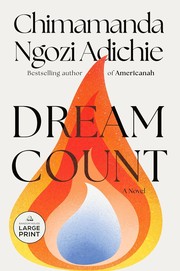
Dream Count
2,286-word summary 10 min read 416 pages in the book
- First published
- 2025
- Publisher
- Alfred A. Knopf
- Pages
- 416
- ISBN
- 9780593802724
Reading options
What's inside (9 sections)
I came to this one with the odd feeling that I already knew Adichie's voice from her earlier books, and then found that this book uses that voice differently. Dream Count came out in 2025, published by Alfred A. Knopf, and the edition I read runs 416 pages. It is her first novel in more than a decade, and it arrived with a good deal of expectation attached to it. What I found was quieter and stranger than I expected: a book made almost entirely of women talking about their own lives, with no author standing outside to arrange them into a lesson.
The whole thing takes place during the 2020 pandemic, and that setting is not decoration. Lockdown is what keeps these people apart and what forces them into the small rooms where they do their thinking. The novel is built from five first-person sections about four women, and Adichie lets each of them speak at length, in their own rhythm, without a narrator stepping in to judge. That structure was the first thing I noticed, and it turned out to be both the book's great strength and the source of my main frustration with it.
Four women, five sections, one locked-down year
The four women are Chiamaka, her friend Zikora, her cousin Omelogor and her former housekeeper Kadiatou. Chiamaka, who goes by Chia, is a Nigerian travel writer stuck alone in Maryland. The travel writing matters because it is the one part of her life that still moves, while everything around her is frozen. She fills her days on Zoom, checking in with her family in Nigeria, with Zikora in Washington, with Omelogor in Abuja and with Kadiatou, who used to work for her and who is now somewhere in America too.
Those calls are the book's connective tissue. They are ordinary, almost tedious at times, full of the small talk of people who are related or once were close and now mostly know each other through a screen. I found that convincing. A pandemic makes intimacy strangely bureaucratic; you schedule it, you wait for the connection, and you hang up when the time is up. Adichie understands that the things people reveal in such calls are often the things they have already rehearsed.
The four women do not simply take turns. Each section has its own texture, and the voices are distinct enough that you can tell who is speaking from the cadence alone. Chia is wry and a little self-protective. Zikora is direct. Kadiatou is careful, and her carefulness is earned. Omelogor is sharp about money and power. The effect of hearing them one after another is that no single version of events gets to stand as the truth. Each woman's account revises the ones around it, sometimes gently, sometimes with a jolt.
The five-section structure, with four women at its centre, took a little getting used to. There is a rhythm to the book that does not announce itself. A section will end and another will begin, and only gradually do you see how the pieces fit. That is a deliberate choice, and I think it is the right one for a story about people who are mostly alone in rooms.
Chia and the men she thought would complete her
Chia's section is the one I found most uncomfortable, which I suspect is the point. She lies on her bed and goes over the men she once hoped would complete her life. This is not a wistful review. It is closer to an audit, and she is not kind to herself about it.
There is Darnell, who mocked her writing. There is Chuka, who planned a wedding she was not ready for, and whose certainty about the two of them seems to have been greater than her own. There is an Englishman who was concealing his marriage. There is the Dutchman Luuk, and there is Johan. Adichie does not inflate any of these men into villains. They are mostly ordinary, and that is what makes Chia's reckoning sting. Each one represented a version of a life she thought she wanted, and none of them delivered it.
What sharpened this for me was the death of a friend's mother from COVID. Chia is not an unsympathetic person, but the death arrives in the middle of her private inventory and changes the temperature of it. A life cut short makes the question of a life misspent suddenly urgent, and Chia starts asking whether she has spent her years waiting for other people to make her whole. What frightens her is the suspicion that she has been mistaken about what she wanted, and that the mistake is only visible now that there is nothing else to do.
I liked this section more than I expected to, and I also wanted it to stop sooner. Chia's inventory is sharp, but it circles. She returns to the same men and the same question from slightly different angles, and by the later pages I felt I had understood her point several paragraphs before she finished making it. That is a small complaint about pacing in a book that otherwise moves with confidence.
Zikora, an early birth and a name of her own
Zikora goes into labour two weeks early, and the first thing her section establishes is that she is alone in a way she should not have to be. Her partner, Kwame, has fled. He blocks her calls. There is no gradual deterioration here, no ambiguous separation; he is simply gone when she needs him, and the abandonment is stated plainly.
Her mother comes to help. This is where Adichie slips a detail in so casually that it is easy to miss: Zikora's mother once hid a hysterectomy from Zikora's father. That single fact opens up a whole history of secrecy between the parents, and it sits beside the present moment of a daughter in labour without her partner. The women in this book keep paying for the things men have withheld from them. Adichie never spells out the connection, which is one of the reasons the section works.
When the baby arrives, Zikora names him Chidera. She is rejecting the name her father wanted, and the act is small and complete at the same time. There is no speech, no confrontation. She simply gives the child a different name, and in doing so she decides that this one thing at least will be hers. I found this the most satisfying moment in the book, partly because it is so quiet. After the noise of Kwame's disappearance and the tension of the birth, a name chosen in a sickroom carries more weight than an argument would have.
Zikora's section is short, and I wanted more of her. She has the clearest voice of the four and the least time on the page. That imbalance is a fair criticism of the book, though it also mirrors how sudden and unplanned her whole storyline is.
Kadiatou's long road to a hotel room
Kadiatou's section is the hardest to read, and it is also the one that makes the others make sense. She begins with her village childhood in Nigeria, and Adichie gives her the space to describe it fully before anything bad happens. This matters. If the abuse were the first thing we knew of her, she would be a case. Instead we meet a child and a family.
Her sister Binta dies after surgery. She marries Saidou, and their infant son dies. Then she leaves for America with Amadou, the love she knew as a child. Each of these losses is related without ornament, and the accumulation of them is almost unbearable by the time the present-day assault arrives. A hotel guest rapes her, and the investigation that follows turns on her asylum history rather than on her account of what happened. The machinery of disbelief is the real subject here. Everything about her life, including the flight to America and the years of precarious work, is used to cast doubt on her word.
I had to put the book down after this section. It is not graphic in the way that a thriller might be graphic, but it is relentless in its attention to how institutions process a woman's pain. Adichie is not interested in a dramatic confrontation or a clever twist. She is interested in the sceptical question, the way a person's history is treated as evidence against her. Reviewers found this material crushing, and I understand why. It is difficult to read without anger, and the anger is exactly what the writing is aiming for.
Kadiatou's voice is the one I found most affecting. She is careful with her words because she has learned that words can be used against her. That caution, which might read as meekness in a weaker book, comes across here as a survival skill honed over decades.
Omelogor and the fund she built quietly
Omelogor is Chia's cousin, and her section is the most apparently detached of the four until you see what it is hiding. She worked in finance, and she found that her firm was involved in illicit money. Rather than report it or walk away loudly, she diverted some of that money into a fund for women's businesses. It is a practical act, almost a boring one, and that is what makes it striking in a book full of people who cannot quite act.
She also left America after a graduate course on pornography left her disillusioned. That detail is easy to skim past, but it explains a lot about her. She went looking for an intellectual account of desire and power and found something that disappointed her, so she turned to the more concrete work of moving money. By the time we meet her in the novel she worries about a young woman whose education she pays for, and that worry is the closest this most guarded of the four women comes to admitting that she cares about an outcome she cannot control.
I liked Omelogor's section for its coolness, and I also found it the hardest to feel. She keeps herself at a distance even from the reader, and Adichie respects that. There is no late confession, no moment where she breaks down and explains herself. What you see is what she does, and what she does is quietly redirect resources. In a novel about the gap between what people intend and what they manage, that restraint feels honest.
The ending that refuses a courtroom victory
When prosecutors drop the case against Kadiatou's attacker, Chia expects despair. She has been bracing for it throughout the book, and so had I. What she finds instead is that Kadiatou and Binta are relieved the ordeal is over. That is the novel's last turn, and it is a deliberate refusal of the victory the reader has been trained to want.
There is no vindication. There is no courtroom scene, no guilty verdict where the system admits it was wrong. Adichie withholds all of it. Critics admired the structure of the book for its empathy, and they also found this choice hard to take. The account of assault and institutional disbelief is crushing, and then the ending declines to make it meaningful in the usual way. Relief, in this context, is not a happy feeling. It is what a person feels when a long nightmare stops, and the fact that it is the best available outcome is the point.
I have thought about that ending a lot since finishing. Part of me wanted the neat turn, the moment of recognition that would justify everything Kadiatou went through. Another part of me respects the book for refusing to manufacture it. A neat ending would have let the reader feel good and move on. This one leaves you sitting with the fact that the case was dropped because the system found it easier to doubt Kadiatou's history than to believe her. That is a harder thing to walk away from.
Who I would hand this to
This is a novel for readers who like to sit with voices rather than be carried by a plot. If you want a story that builds towards a confrontation, the structure will frustrate you. The five sections and the long first-person stretches ask for patience, and the book's refusal to reward its characters in familiar ways can feel like a tease if you are expecting a conventional payoff.
For readers who loved Americanah or Half of a Yellow Sun, there is a lot here that will feel familiar: the attention to how migration reshapes a person, the interest in the small cruelties of power, the refusal to make any country or culture into a single story. But this is a smaller, more enclosed book than those. Most of it happens in rooms, over calls, in the space between a memory and the telling of it. The pandemic setting keeps the world outside at a distance, and Adichie uses that distance to turn the focus inward.
I finished it admiring the voices and a little impatient with the stillness. Dream Count is a book about four women who have spent years being defined by other people's expectations, and its best moments come when one of them quietly decides to stop. Chidera is a name chosen instead of inherited. Kadiatou's money goes to women who will build things. Chia, at the end of her inventory, is at least honest about the men she waited on. None of that adds up to a triumph, and the book is smart enough not to call it one.
FAQ
Who narrates Dream Count?
Four women: Chiamaka, her friend Zikora, her cousin Omelogor and her former housekeeper Kadiatou. They narrate in the first person across five sections set during the 2020 pandemic.
Does Kadiatou ever get justice for the assault?
No. Prosecutors drop the case, and instead of despair Chia finds Kadiatou and Binta relieved that the ordeal is over. Adichie deliberately withholds a courtroom vindication.
When was Dream Count published?
It was published in 2025 by Alfred A. Knopf, and the edition cited here runs 416 pages with ISBN 9780593802724.
Similar books

The Wilderness
Four Black women move through twenty years of friendship in Angela Flournoy's discontinuous, widely praised second novel.
2,141-word summary · 10 min read

The Vacationers
A New York family's two-week stay in Mallorca turns into a comedy of exposed secrets when a magazine editor's affair and a son's debts come to light.
2,324-word summary · 10 min read

The Emperor of Gladness
Ocean Vuong's second novel follows a young addict pulled back from a bridge in a dying Connecticut mill town and into the home of an elderly immigrant woman…
2,693-word summary · 12 min read

Behold the Dreamers
A Cameroonian chauffeur and his wife chase the American dream while driving a Lehman Brothers executive through the 2008 crash in Mbue's debut novel.
2,578-word summary · 11 min read

This Is How You Lose Her
Yunior cycles through love affairs and betrayals in nine linked stories, tracing the damage he does and the family history behind it.
2,195-word summary · 10 min read

Those Who Leave and Those Who Stay
Elena publishes into Florence salons while Lila labors through Naples factories across the 1970s.
2,034-word summary · 9 min read
Americanah
Ifemelu leaves Nigeria for America on a scholarship, blogs about race and hair, while Obinze endures undocumented London until they reunite years later in…
2,527-word summary · 11 min read

The Loneliness of Sonia and Sunny
Two Indian families, a failed arranged match, and years between Allahabad and New York shape a slow, sprawling romance.
2,092-word summary · 9 min read
Palaver
A mother shows up uninvited at her estranged son's Tokyo apartment, and the two spend the weeks before Christmas talking their way toward something like…
2,465-word summary · 11 min read

Whistler
Ann Patchett's eleventh novel follows a New York teacher who reconnects with a former stepfather at the Met and hears the strange story of a chestnut mare.
2,697-word summary · 12 min read
The Reluctant Fundamentalist
In a Lahore cafe, Changez tells a nervous American how Princeton and a New York career gave way to anger after September 11.
2,340-word summary · 10 min read

The Kitchen God's Wife
Amy Tan's second novel pairs a San Jose speech therapist with her Chinese mother, whose account of war, an abusive husband, and a narrow escape comes out in a…
2,896-word summary · 13 min read
The Correspondent
A retired lawyer in Annapolis writes letters across a decade to family, literary heroes, and one recipient she never mails. Evans's debut turns correspondence…
2,296-word summary · 10 min read

Red at the Bone
A girl's coming-of-age ceremony in a Brooklyn brownstone opens a family story shaped by Tulsa, teenage pregnancy, class and a second tragedy on September 11.
2,108-word summary · 9 min read
King of Ashes
A Virginia crematorium, a debt owed to the Black Baron Boys and a family secret pull Roman Carruthers back into a war where everything burns.
2,229-word summary · 10 min read

Hollow Bones
On 11 September 2001, two-month-old Molly Fitzgerald loses her mother at the World Trade Center. She grows up planning for disasters, until a crisis in her new…
2,703-word summary · 12 min read

Good Dirt
A stoneware jar made by an enslaved potter links a prominent Black New England family across a hundred and fifty years of prosperity, grief and buried history.
2,069-word summary · 9 min read
Flashlight
Susan Choi's Booker-shortlisted novel opens with a father and daughter on a breakwater in 1978, then follows the loss outward through four generations and…
2,849-word summary · 13 min read
A Guardian and a Thief
Over one week in near-future Kolkata, a mother's flight plan and a homeless young man's hunger collide over a set of stolen travel documents.
2,306-word summary · 10 min read

The Boston Girl
Eighty-five-year-old Addie Baum tells her granddaughter how she grew up in Boston's North End, chased education and love, and became the woman she is.
2,439-word summary · 11 min read
Last Night in Brooklyn
A copywriter in 2005 Fort Greene trades a scripted engagement for a bar crowd, a rising designer, and a neighborhood being remade around her.
2,540-word summary · 11 min read

Unaccustomed Earth
Lahiri’s second story collection follows Bengali families in America and abroad, tracing the quiet distances between parents and children, spouses, and the…
2,333-word summary · 10 min read

We Are Okay
Marin fled San Francisco after her grandfather vanished and stopped answering anyone. When Mabel visits her college dorm, she has to say what happened.
2,253-word summary · 10 min read

A Spool of Blue Thread
Four generations of the Whitshank family in Baltimore, and the silences, resentments and quiet love they hand down without ever saying so.
2,408-word summary · 11 min read

Wide Sargasso Sea
Jean Rhys gives the first Mrs. Rochester a Caribbean childhood, a marriage built on money and suspicion, and a voice that Charlotte Bronte left in the attic.
2,021-word summary · 9 min read
The School for Good Mothers
A mother sent to a reform school fights to keep her daughter under cold surveillance and strict rules.
2,114-word summary · 9 min read

Song of Solomon
Milkman Dead leaves Michigan to hunt for family gold and finds instead the old song of his ancestor Solomon.
2,465-word summary · 11 min read

Summer Sisters
Vix and Caitlin share Martha's Vineyard summers from age twelve into adulthood, through first love, grief, marriage, and a disappearance that still haunts Vix.
3,633-word summary · 16 min read
The Mothers
Nadia hides abortion from church Mothers while Luke and Aubrey circle for years.
2,078-word summary · 9 min read