
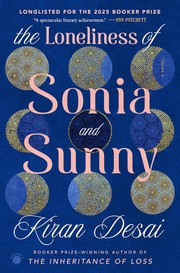
The Loneliness of Sonia and Sunny
2,092-word summary 9 min read 688 pages in the book
- First published
- 2025
- Publisher
- Hogarth
- Pages
- 688
- ISBN
- 9780307700155
Reading options
What's inside (10 sections)
I started this expecting a romance, because the title and the cover and the word about the Booker shortlist all pointed that way. Two young Indians, two families who were neighbours in Allahabad, grandparents who once tried to arrange a match. That much is true. What I did not expect was a book of 688 pages that keeps wandering off the course of the romance to sit with a retired railway clerk, a pair of servants, and a dispute about a cook who makes excellent kebabs. Desai published it in 2025, her first novel in nineteen years, and she seems in no hurry to get her two leads into the same room.
Nineteen years between books
The gap matters. This is Desai's first novel since the mid-2000s, and the anticipation around it was enormous, helped along by a shortlisting for that year's Booker Prize. The Hogarth edition runs to 688 pages, which is a lot of ground to cover, and the story itself runs mostly from 1996 to 2002. It moves between India and the United States without ever announcing that it is doing so. Chapters simply shift, and the reader follows.
That length has divided people. Critics called the result dizzyingly vast and insistently miniature, which sounds like a contradiction until you start reading. The book is vast in the number of lives it takes in and miniature in the attention it pays to each one. A minor character can get a scene as carefully observed as anything given to Sonia or Sunny. That is the design, and it is either the book's great virtue or its main obstacle, depending on how much patience you bring.
I found the first hundred pages slow, and then I stopped fighting it. There is a moment when you realise that Desai is not withholding the story from you. She is simply refusing to treat the two leads as more important than anybody else in the room. Once you accept that, the book's pace starts to feel like a decision rather than a flaw. If you are reading for the plot, you will spend a lot of time waiting. If you are reading for the lives, the wait is the point.
Sonia, alone in Vermont and New York
Sonia Shah finishes college in rural Vermont. She feels isolated there, and she finds consolation in Tolstoy, which tells you a fair amount about the inner life she is building for herself. From Vermont she moves to New York to be with an older, celebrated artist. He turns out to be a manipulative narcissist named Ilan de Toorjen Foss. He discourages her writing, which is the injury that matters most, and in the end he abandons her.
She goes back to India fearing that she is under a dark spell. That phrase is not a throwaway. The novel treats her state of mind as something that has slipped out of her control, and her return is not a triumphant homecoming. She arrives back in a family that has been waiting for her, or at least talking about her, for years. The grandparents who once tried to match her with Sunny are still there, and the failed arrangement has made the two young people awkward in each other's company before they even meet again. Ilan's discouragement of her writing matters more than the abandonment itself. A bad lover is a common enough injury. A man who tells a writer that she should not write is a different kind of harm, because it attacks the one thing she could carry away from the relationship intact.
The convincing part is that Sonia's loneliness is partly chosen. She wants the solitude of the writer, and she also cannot bear it. Desai never sorts those two feelings into a clean order. Tolstoy offers her a kind of company, and so does the fear that she has been bewitched. Both are ways of being alone with a story.
Sunny and the strange stories he files
Sunny Bhatia is a junior copy editor at the Associated Press in New York. He lives there partly to get away from his imperious mother, Babita, and from the plotting of his late father's brothers. That family grievance becomes one of the novel's long, low rumbling threads, and it eventually pulls Babita into something close to a noir intrigue, with the brothers and their fixation on wealth at the centre of it.
At work Sunny files human-interest stories that are stranger than the news usually allows. One is about a retired railway clerk in Mysore whose fingernails have grown so long that his family has to feed him. Another concerns a woman sold at a cattle fair in Rajasthan. These are not decorative anecdotes in the book. They are the raw material of his days, and they train him to notice lives that other people would walk past. He becomes, in his own modest way, another observer of the lives around him. His job title is junior copy editor, and the book is alert to what that means. He is a man who spends his days correcting other people's sentences while sending home stories about people who cannot correct anything about their own lives. That gap between the polished copy and the raw material is one of the quiet subjects of the book.
These were the sections that stayed with me longest. They arrive without fanfare, and then you realise half an hour later that you have been thinking about the clerk's fingernails longer than you were thinking about the romance. That is Desai's method in miniature.
The overnight train to Allahabad
When Sunny travels to Allahabad to visit his grandparents, he and Sonia meet on an overnight train. The old matchmaking scheme hangs over the encounter, which is why both of them are stiff with each other at first. The grandparents tried to arrange the match once and failed, and the failure has become a piece of family history that both young people are expected to know about and pretend not to care about. That is a very specific kind of awkwardness, and Desai gets it exactly. Neither is a character who falls into things easily. They are both watchers, both slightly outside the families they come from, and both carrying the damage of relationships that went wrong in New York.
A relationship does develop. Desai takes her time with it, which is the whole point of a book this size. She is interested in how two people become a couple, in the small embarrassments and the long pauses, and in the way a history that was decided by grandparents before either of them was old enough to object can still shape the way they look at each other on a train.
The romance is real, and it is also only one thread. Anyone looking for a straightforward love story will spend a lot of this book waiting for the plot to narrow. It never really does. The train is a beginning, not a funnel.
Aunts, a cook, and the lives at the edges
The Allahabad chapters are the funniest in the book. Sonia's relatives are stranded single aunts living in genteel poverty, and there is a dispute over a cook who is famous for his kebabs. The quarrel is treated with the seriousness of a minor diplomatic crisis, and the aunts are given the kind of dialogue that makes you hear them long after the chapter ends. Desai is very good at the comedy of people who have very little and still manage to be ridiculous about it.
Two servants in the household, referred to only as Vini-Puri, get as much attention as the principals. That naming is a deliberate small joke, and it is also a quiet statement about whose lives the book considers worth recording. By the end, a reader knows the servants as well as the family, which is more than most novels of this kind bother to do. It is a decision with consequences for the shape of the book. You cannot compress a story that keeps doubling in this way. Every time a minor figure gets a full scene, the centre shifts a little, and Sonia and Sunny stop being the only people in their own novel.
Babita's thread runs darker. Drawn into the intrigue around her husband's brothers and their obsession with wealth, she becomes a figure from a different genre entirely. The shift in tone is abrupt when it comes, and that is part of the book's restless movement. A comedy about a cook can sit within a few pages of something genuinely threatening.
The pressure to perform India
Underneath the comedy and the romance, Desai is writing about what it means to be an insider or an outsider, and about the specific pressure on an Indian writer to satisfy Western expectations of exoticism. Sonia says outright that she dismisses "orientalist nonsense" and stories that are "decorative outside and hollow inside." That is the clearest statement of the book's argument, and it comes from a character who has lived in the West and has seen what readers there want from her.
This is where the novel's size starts to make sense. If your subject is the way a whole culture gets packaged for export, a small, tidy story about two lawyers will not do. Desai needs the railway clerk and the cattle fair and the aunts and the servants, because those lives are exactly what the exotic version of India leaves out. The book keeps insisting that the small details are the real thing, and that the grand gestures are the decoration.
It also means the novel is wary of its own appeal. It knows that a Western reader may be looking for colour and trouble in Allahabad, and it keeps handing over colour and trouble while quietly refusing to let them stand for everything. That is a difficult balancing act, and Desai manages it more often than not.
A gothic register under the realism
Sonia suffers nightmares in which blood leaks from walls and from a pie. A marauding dog haunts her waking hours. These images give the novel a gothic register that sits oddly and effectively alongside the domestic comedy. The dog in particular keeps returning, a piece of threat that never quite resolves into a symbol you can pin down.
That strand is what made me trust the book. A novel can talk about the pressure of exoticism and still be merely clever. A novel that also puts blood in a pie and a dog in the street is admitting that fear is part of the picture alongside the politics. The title's loneliness is manifold here: exile, displacement, the solitude of artistic work, and also a peace that the characters actively seek. Desai does not treat loneliness as a problem with one cause.
The book was named one of Barack Obama's favourite books of 2025, and the UK edition came from Hamish Hamilton. Alex Clark wrote in The Guardian about the restless shifts of tone and the way minor lives matter as much as the central romance. Alexandra Jacobs in The New York Times admired the meticulous attention to those minor characters. Publishers Weekly called it a modern, globalized Romeo and Juliet. All three readings hold up, though none of them quite prepares a reader for how long it takes to get there.
What to make of the size
I would not hand this to someone who wants a swift, elegant novel about two people falling in love. It is heavy, and it asks for a level of attention that a 688-page book has no right to demand, and yet it keeps earning that attention. The criticism I would make is that the threads occasionally feel like they are being maintained for their own sake. Babita's intrigue, in particular, sometimes seems to be waiting for the principals to catch up.
Still, the ability to make a railway clerk's fingernails as memorable as a romantic confession is rare. Desai has written a book that is about the pressure to make a country legible to outsiders and about two people trying to be legible to each other. Those are the same problem at different scales, and that is why the strangest small story in the book belongs right where it is. By the end the romance feels less like the point of the thing than one more life the author has agreed to take seriously.
FAQ
Did The Loneliness of Sonia and Sunny win the Booker Prize?
No. It was shortlisted for the 2025 Booker Prize and was named one of Barack Obama's favourite books of that year.
How long is the novel and when is it set?
The Hogarth edition is 688 pages, and the story runs mostly from 1996 to 2002, moving between India and the United States.
Is it mainly a romance?
The relationship between Sonia and Sunny matters, but the book spends equal time on their families, servants, and the pressure on Indian writers to satisfy Western expectations.
Similar books

This Is How You Lose Her
Yunior cycles through love affairs and betrayals in nine linked stories, tracing the damage he does and the family history behind it.
2,195-word summary · 10 min read
This Is Where the Serpent Lives
Daniyal Mueenuddin's second novel follows an orphan who rises through Lahore and a gardener's son who becomes an outlaw, across a Pakistan of caste and capital.
2,257-word summary · 10 min read

The Shoemaker's Wife
Two young Italians meet in the Alps, are separated by fate, and find each other again in New York before war pulls them apart, in a saga drawn from Adriana…
2,261-word summary · 10 min read
The Emperor of Gladness
Ocean Vuong's second novel follows a young addict pulled back from a bridge in a dying Connecticut mill town and into the home of an elderly immigrant woman…
2,693-word summary · 12 min read

Flesh
David Szalay's Booker-winning sixth novel follows István, a Hungarian man carried from a housing estate to London's super-rich by forces he barely understands,…
2,537-word summary · 11 min read
Dream Count
Four women narrate the 2020 lockdown in their own voices: a travel writer, a friend in early labor, a banker cousin and a housekeeper assaulted in a hotel room.
2,286-word summary · 10 min read
Birdsong
A love affair in Amiens before the First World War and a granddaughter's search through encoded journals decades later, joined by the tunnels of the Somme.
2,041-word summary · 9 min read

Behold the Dreamers
A Cameroonian chauffeur and his wife chase the American dream while driving a Lehman Brothers executive through the 2008 crash in Mbue's debut novel.
2,578-word summary · 11 min read
A Guardian and a Thief
Over one week in near-future Kolkata, a mother's flight plan and a homeless young man's hunger collide over a set of stolen travel documents.
2,306-word summary · 10 min read
The Mermaid Chair
Jessie Sullivan returns to her childhood home on Egret Island to care for her agoraphobic mother, then finds her marriage, her faith, and a monk's vow thrown…
2,237-word summary · 10 min read

The Stationery Shop
Two teenagers fall in love in a Tehran stationery shop in 1953, are separated by the coup and a family deception, and meet again sixty years later.
2,024-word summary · 9 min read

The Shadow Sister
Star D'Apliese steps out of her sister's shadow and follows a bookshop clue into the Edwardian life of Flora MacNichol, a woman who gave up love for duty.
2,260-word summary · 10 min read

Howards End
Forster's 1910 novel follows two families, a house in Hertfordshire, and a burned note, asking whether money and feeling can ever be connected.
2,187-word summary · 10 min read

Unaccustomed Earth
Lahiri’s second story collection follows Bengali families in America and abroad, tracing the quiet distances between parents and children, spouses, and the…
2,333-word summary · 10 min read

The Lowland
Two brothers grow up beside a marshy lowland in Calcutta, and the choices of the younger one draw the older into a life of duty, distance, and quiet grief that…
2,213-word summary · 10 min read

A Spool of Blue Thread
Four generations of the Whitshank family in Baltimore, and the silences, resentments and quiet love they hand down without ever saying so.
2,408-word summary · 11 min read

2 States: The Story of My Marriage
A Punjabi boy from Delhi and a Tamil Brahmin girl from Chennai meet at IIM Ahmedabad, and turn a love marriage into a campaign to convince two families.
2,634-word summary · 12 min read
We Were the Mulvaneys
After a rape following a school dance, the Mulvaneys, a family that believed it was blessed, comes apart over fifteen years. Narrated by the youngest son.
2,094-word summary · 9 min read

The Accidental Tourist
Grieving Macon writes travel guides for haters of travel, then Muriel intrudes.
2,252-word summary · 10 min read

The Shell Seekers
Elderly Penelope Keeling must decide the fate of her father's treasured painting while her three children press her to sell.
2,592-word summary · 12 min read

The Berry Pickers
A four year old vanishes from a Maine blueberry camp in 1962, and two families carry the loss for decades until Joe and Norma face the truth.
2,606-word summary · 12 min read

Brooklyn
Eilis Lacey leaves Enniscorthy for Brooklyn boarding house work, love with Tony, then a home death forces divided choice.
2,143-word summary · 10 min read

My Life Next Door
A senator's daughter climbs down to the loud family next door and stays.
2,038-word summary · 9 min read

The White Tiger
A poor driver writes to the Chinese Premier about rich masters, corruption, and murder.
2,251-word summary · 10 min read

The Henna Artist
In 1950s Jaipur, a henna artist to rich women rebuilds her life until the sister she never knew arrives.
2,104-word summary · 9 min read

Interpreter of Maladies
Nine stories follow Bengali families split between Calcutta and New England, through marriage, grief, and arrival.
2,412-word summary · 11 min read

The Prince of Tides
A South Carolina man tells a psychiatrist about his family past to help his twin sister, and faces what he buried.
2,022-word summary · 9 min read
The Covenant of Water
Three generations of a Kerala family face a drowning affliction from 1900 to 1977, from child bride Big Ammachi to physician Mariamma who seeks its cause.
2,955-word summary · 13 min read
The Namesake
Jhumpa Lahiri follows Gogol Ganguli from a hated namesake to adult loss, marriage, and family reckoning between Calcutta and Boston.
2,878-word summary · 13 min read

The God of Small Things
Twins Rahel and Estha grow up in Kerala in 1969, where family rules and caste lines shape a loss that follows them into adulthood.
2,646-word summary · 12 min read