
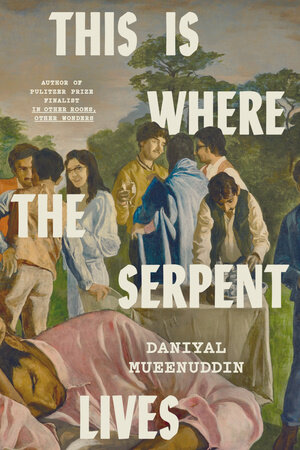
This Is Where the Serpent Lives
2,257-word summary 10 min read 368 pages in the book
- First published
- 2026
- Publisher
- Alfred A. Knopf
- Pages
- 368
- ISBN
- 9780525655152
Reading options
What's inside (8 sections)
I had been waiting for this book for a long time, the way you wait for a second novel from a writer whose first one you loved. Daniyal Mueenuddin's debut collection, In Other Rooms, Other Wonders, was a finalist for both the Pulitzer Prize and the National Book Award, and it left me with the feeling that he knew a version of Pakistan that most novelists only write about from a distance. This Is Where the Serpent Lives, published by Alfred A. Knopf in January 2026 and running 368 pages, is his second work of fiction, and it is a full-length novel rather than another collection. The title comes from Wallace Stevens's poem "The Auroras of Autumn," which tells you something about the register he is working in before you have read a page.
Mueenuddin was raised in Lahore and on a farm in Pakistan's South Punjab, and the book moves between those two worlds. It is a coming-of-age novel in a broad sense, though not the kind with a single clear protagonist. It follows a dozen or so characters whose lives are joined by violence and tragedy, by triumph and love. The publisher's description calls it intimate and epic, elegiac and profoundly moving, which is a lot of adjectives to hang on one book, but by the end I understood what they were reaching for.
Stevens's line is a strange one to borrow for a novel about Pakistan, and I kept returning to it. In the poem the serpent is a figure of renewal as much as menace, a creature associated with a garden and with a larger order that human beings do not control. That double meaning suits Mueenuddin's book. His characters are not simply victims of a cruel system; they are also people trying to make lives inside it, and the best of them change the places they pass through.
Yazid, the boy from the streets
The thread that holds the book together for me follows Yazid. He starts as an illiterate orphan fending for himself on the streets of the city. He has nothing: no family, no schooling, no protection. What he does have is intelligence, ambition, and a gift for getting along with people, and the novel watches him use those qualities to climb. He acquires literacy, then social mobility, and eventually lands a position of real responsibility and respect as the chauffeur in the Lahore household of Colonel Atar, a powerful industrialist and politician.
The chauffeur job is a small miracle in the world of this book, and Mueenuddin is precise about why. Yazid can move between social classes in a way that most people cannot. He is at ease with servants and with the elite circles that surround the colonel, and he builds relationships across that divide. His intelligence opens doors, but so does his sociability, that ability to read a room and make himself useful. Watching him navigate the household is one of the pleasures of the novel. He is never quite inside the world he is entering, and never quite outside it either.
Mueenuddin is good on the small mechanics of this kind of climb. Yazid's literacy is not a sudden gift but something acquired, and it changes what he can notice as much as what he can say. His social mobility is measured in the rooms he is allowed to enter and in the people who begin to treat him as a peer rather than a servant. The novel is attentive to these gradations in a way that makes the rise feel earned rather than convenient.
What makes the thread tense is that his position rests on loyalties that pull against each other and on trust that is misplaced. Yazid's rise is real, but it is also fragile. He has built a life out of relationships, and relationships in this novel can turn. I found myself wanting him to succeed in a way that surprised me, since the book gives you no reason to expect a happy ending and several reasons to fear one.
Saqib and the lawless countryside
The second major thread takes us to the colonel's country estate. Saqib is born there, the son of a poor gardener, and he is given responsibility for managing a pioneering business. This is the feudal countryside of the book, a place of caste and capital where a man's birth sets the terms of his life and where the law is whatever the powerful say it is. Saqib's intelligence and drive resemble Yazid's, and like Yazid he is given a chance to rise.
He overreaches, and the consequences are severe. When he crosses the wrong line, he becomes an outlaw, and the novel follows him into a confrontation with the violence of the corrupt Punjab Police. This is where the book's title starts to feel earned. The serpent is not a single character. It is the system of power that waits for people like Saqib, the arrangement that lifts a gifted man up and then turns the machinery of the state on him when he goes too far. Mueenuddin writes these sections with a tight, unforgiving focus. There is no romance in the outlaw life here.
Reading Saqib's chapters next to Yazid's is the clearest way to see what Mueenuddin is doing with the idea of a start in life. Both men are gifted, both are given a chance by the colonel's world, and both are expected to know their place within it. The difference is where that expectation comes from and how hard the correction is when they step beyond it. The countryside is not softer than the city in this book. It is simply more direct about who holds the power.
The colonel's son
A third thread concerns the colonel's own family. His son competes with a cherished brother for the love of a woman, and the woman's choice colours the son's life with unexpected darkness as well as light. It is the most conventional of the three storylines in shape, a rivalry over a woman, but Mueenuddin treats it as more than a romantic triangle. The competition exposes the fragile economics of affection inside a wealthy family, and the brother who is cherished is a reminder that love within a family is distributed unevenly and without appeal.
I want to be careful here, because the book gives you less than you want about the woman at the centre of this rivalry. She is defined largely by the choice she makes and by what it means to the two brothers. That is a limitation of the novel rather than a flaw in the story, and it fits the book's habit of viewing people from the outside, through the roles they play in someone else's life. The colonel himself looms over all three threads. As an industrialist and politician, he is the source of the power that the other characters navigate, and his household is the stage on which their ambitions play out.
The brothers' rivalry also shows how the novel distributes its sympathy. Neither brother is written as a villain, and neither is written as a hero. They are men reacting to a choice that was made by someone else, and the darkness that enters one brother's life is presented as a consequence he did not choose and cannot undo. That is a hard thing to write without sliding into melodrama, and Mueenuddin manages it by keeping the tone level.
The choice that runs underneath
Across these intertwined stories, the same question keeps surfacing. Characters have to choose between paths that are moral and just and more worldly choices that let them survive the systems they are living inside. Caste, capital, and social power are the three forces Mueenuddin keeps returning to, and they are not abstract background. They decide who gets an education, who gets a job, who gets protection from the police, and who gets crushed.
This is the book's real subject, and it is why the coming-of-age label feels both right and too narrow. Yazid, Saqib, and the colonel's son are all, in different ways, being initiated into a world whose rules they did not write. The question for each is whether to bend those rules or to be broken by them. The novel is interested in the cost of either choice. It does not offer a clean lesson about integrity, and it resists the easy version in which the good character is rewarded and the ambitious one is punished. Most of Mueenuddin's characters are a mixture, and their moral lives are as complicated as their social ones.
This is why the book resists being summarized as a story about inequality. It is about inequality in the way a novel is about a house: the rooms are built from it, but the people in them are more than the walls. The social order is the pressure that tests everyone, and different characters meet it with cunning, with submission, with rage, or with some uneasy combination. Watching those responses play out is the real pleasure of the book, more than any single plot turn.
The reception, and my reservations
The book arrived to real anticipation, and the reviews reflected it. Dwight Garner wrote in The New York Times under the heading "What if Chekhov Had Lived in Pakistan?", said the pages turn themselves, and predicted that readers would be hearing about the book when the big literary prize shortlists came around. Porter Shreve in The Washington Post called it worth the very long wait. Patrick Gale in The Guardian suggested it was set to be a standout novel of 2026, and John Self of The Sunday Times expected to see it all over prize lists. The Wall Street Journal framed it as a saga of power in Pakistan. It was a Kirkus Prize finalist.
I share the admiration, with some reservations. A dozen characters is a lot to carry, and there are stretches where the novel feels less like a single story than a collection of linked stories, which is perhaps unsurprising given the author's background. The violence is relentless, and the accumulation of tragedy can flatten the individual blows after a while. The book is also darker than the publisher's "elegiac and profoundly moving" language suggests, and a reader looking for consolation will not find much of it in the countryside chapters.
One more reservation, and it is a small one. The novel sometimes states its sense of doom a little too plainly, as if it does not trust the reader to register the trap closing. A quieter writer might have left more unsaid. But the book's confidence is also a strength. Mueenuddin knows this world in a way that lets him be certain about how it works, and that certainty is the source of the authority that reviewers responded to. I would rather have a novel that knows too much than one that is afraid to commit.
Those are matters of degree, though. The writing is the thing. Garner's Chekhov comparison is not idle. Mueenuddin has the short-story writer's eye for the moment in which a person's social position becomes visible, the small interchange that reveals who has power and who does not. He is less interested in plot machinery than in the slow accumulation of consequence, and the novel's structure follows that interest. If you want a tidy narrative with a clear arc, you may find it diffuse. If you want a world that feels fully inhabited, it is hard to do better.
What I tell people now
I tell people to read the Yazid chapters first if the opening feels slow, because that is where the book finds its footing and where its best material lives. I tell them the title is worth looking up, because Stevens's poem casts a longer shadow over the book than a single epigraph would suggest. And I tell them not to expect the kindness of the debut collection. This is a harder book, and its compassion is distributed in small, exact doses rather than spread across every page.
I would hand it to someone who loved the debut, but I would warn them that the earlier book's pleasures are different. In Other Rooms, Other Wonders could be read one story at a time, each with its own small architecture. This novel asks for patience across hundreds of pages and rewards a reader who keeps track of who owes whom and who is owed. It is a bigger book in every sense, and its ambitions explain both its power and its occasional looseness.
The book asks for patience, but it pays that patience back the way a long novel should, by letting small details from early chapters return with new weight later on. A remark made in one thread becomes the key to another, and the connections accumulate quietly until the whole design comes into view.
The scene that stays with me is not the most dramatic one. It is Yazid in the colonel's household, doing a job that depends entirely on being trusted, aware that trust is the one thing he cannot afford to lose and the one thing he cannot control. That is the serpent in a nutshell, though Mueenuddin would never put it so neatly. His people are always one relationship away from a fall, and the falling is what the book is really about. It took a long time to arrive, and I am glad it did.
FAQ
When was This Is Where the Serpent Lives published?
It was published by Alfred A. Knopf in January 2026 and runs 368 pages. It is Daniyal Mueenuddin's second work of fiction.
Where does the title come from?
The title is taken from Wallace Stevens's poem 'The Auroras of Autumn.'
Is this a sequel to In Other Rooms, Other Wonders?
No. It is a standalone novel, not a collection or sequel, though it follows Mueenuddin's debut collection, which was a finalist for the Pulitzer Prize and the National Book Award.
Similar books

The South
A seventeen-year-old moves to his family's failing fruit orchard in 1990s Malaysia, where a summer love affair unfolds as the household and the land around him…
2,903-word summary · 13 min read
The Loneliness of Sonia and Sunny
Two Indian families, a failed arranged match, and years between Allahabad and New York shape a slow, sprawling romance.
2,092-word summary · 9 min read
Only Son
A brief, funny, melancholy debut about a boy whose father dies in 1982 Florida, and the man he becomes, still trying to read the mystery of that loss.
2,170-word summary · 10 min read
Theft
Gurnah traces three linked lives in Tanzania, where a servant's accusation of theft opens a family history of love, duty and quiet betrayal.
2,454-word summary · 11 min read
Red at the Bone
A girl's coming-of-age ceremony in a Brooklyn brownstone opens a family story shaped by Tulsa, teenage pregnancy, class and a second tragedy on September 11.
2,108-word summary · 9 min read
Oranges Are Not the Only Fruit
An adopted girl in a strict Pentecostal household learns to read the Bible, preach sermons and love women, then faces her church and mother for it.
2,384-word summary · 11 min read
Good Girl
A nineteen-year-old artist in Berlin, grieving her mother, falls into an unequal romance with an American author who offers escape from the ideal of the good…
2,579-word summary · 11 min read
Boy Swallows Universe
In 1983 Brisbane, a boy with a mute brother, a jailed mother and a heroin-dealing stepfather tries to become a good man.
2,397-word summary · 11 min read

Howards End
Forster's 1910 novel follows two families, a house in Hertfordshire, and a burned note, asking whether money and feeling can ever be connected.
2,187-word summary · 10 min read

The Age of Miracles
A California girl grows up while the Earth's rotation slows, and ordinary adolescence continues alongside slow catastrophe.
2,417-word summary · 11 min read
Peace Like a River
An asthmatic boy in the early 1960s narrates his family's search for his older brother, who is accused of two killings and has escaped custody.
1,969-word summary · 9 min read

The Chosen
A shattered pair of glasses in a 1944 Brooklyn softball game starts a friendship between a Hasidic boy and his Orthodox neighbor, and their fathers pull them…
2,443-word summary · 11 min read

The Story of Edgar Sawtelle
A mute boy on a Wisconsin dog-breeding farm relives Hamlet as his uncle returns, his father dies in the barn, and the dogs inherit what is left.
2,392-word summary · 11 min read

Foster
A girl spends a summer with relatives on a Wexford farm and is cared for properly for the first time. A spare novella about family and what children notice…
2,043-word summary · 9 min read
Summer Sisters
Vix and Caitlin share Martha's Vineyard summers from age twelve into adulthood, through first love, grief, marriage, and a disappearance that still haunts Vix.
3,633-word summary · 16 min read
Purple Hibiscus
Kambili, fifteen, watches her devout factory-owner father rule the Enugu house through fear until a Nsukka visit teaches her speech and freedom.
2,595-word summary · 12 min read

Half His Age
Teen Waldo begins an affair with her teacher Mr. Korgy.
2,491-word summary · 11 min read

The Elegance of the Hedgehog
A Paris concierge hides her brilliant mind while a gifted girl plans her death, until a new tenant sees through them both.
2,248-word summary · 10 min read

The Cider House Rules
Homer Wells grows up in a Maine orphanage under Dr. Larch, who delivers babies and performs illegal abortions.
2,985-word summary · 13 min read

Dear Edward
Twelve-year-old Edward Adler survives a plane crash that kills his family, then learns how to live with grief, letters, and love.
2,903-word summary · 13 min read
The Namesake
Jhumpa Lahiri follows Gogol Ganguli from a hated namesake to adult loss, marriage, and family reckoning between Calcutta and Boston.
2,878-word summary · 13 min read
The God of Small Things
Twins Rahel and Estha grow up in Kerala in 1969, where family rules and caste lines shape a loss that follows them into adulthood.
2,646-word summary · 12 min read
On Earth We're Briefly Gorgeous
A son writes to the mother who cannot read him: war, migration, first love, and loss in one Vietnamese American family in Hartford.
3,113-word summary · 14 min read
Go Set a Watchman
Jean Louise Finch returns to Maycomb and finds her father changed: Lee's contested 2015 draft about family loyalty and race in Alabama.
3,478-word summary · 15 min read
She's Come Undone
Abused as a girl, divorced and struggling with weight, Dolores Price slowly finds healing after years of trauma.
2,550-word summary · 11 min read

My Dark Vanessa
Vanessa recalls teacher Strane abuse as adult reckoning looms.
2,600-word summary · 12 min read

Extremely Loud and Incredibly Close
Nine year old Oskar searches New York for a lock matching his father's key after 9/11.
2,999-word summary · 13 min read

The Curious Incident of the Dog in the Night-Time
Curious Incident retold: Christopher finds Wellington dead, maps primes, seeks truth in Swindon.
2,146-word summary · 10 min read

Universality
Natasha Brown's short second novel turns a lockdown fracas over a gold bar into a sharp satire of money, identity and public argument.
2,302-word summary · 10 min read

The Wilderness
Four Black women move through twenty years of friendship in Angela Flournoy's discontinuous, widely praised second novel.
2,141-word summary · 10 min read