
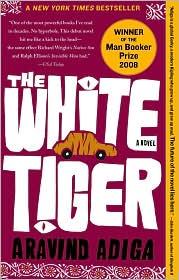
The White Tiger
2,251-word summary 10 min read 304 pages in the book
- First published
- 2008
- Publisher
- Free Press
- Pages
- 304
- ISBN
- 9781416562603
Reading options
What's inside (7 sections)
I picked up The White Tiger because a friend kept calling it funny and awful in the same sentence. That sounded strange for a book that won the Booker Prize. It came out in 2008 from Free Press, around 304 pages. It is told as a long letter from Balram Halwai, a Bangalore businessman, to the Premier of China, who is about to visit India. Balram writes over seven nights, under a chandelier he loves a little too much, and explains how he got out of poverty by doing something terrible.
The voice hooked me fast. Balram is polite, cheeky, eager to teach a foreign leader how India really works. Then he says plainly that he killed his former employer. He does not hide it. He wants you to understand why, and he wants you to admit you might have done the same. I believed him and distrusted him at the same time for the whole book, which made it hard to put down.
The boy from the Darkness
Balram grows up in Laxmangarh, a poor village in Gaya district, in a house packed with family. His grandmother runs everything. His father pulls a rickshaw until his body gives out. His brother works. Cousins crowd the rooms. Money goes to debts and weddings, not school.
At school, an inspector hears Balram read and calls him a white tiger, the rarest animal in the jungle, a boy who comes only once in a generation. Balram holds onto that name. It becomes both pride and pressure. He is smart, he listens well, he remembers what adults say when they think children are not paying attention.
Then school ends. The family needs money for a cousin dowry, so Balram is pulled out and sent to work in a teashop in Dhanbad with his brother. He breaks coal, wipes tables, listens to customers argue about politics. He learns how the village landlord system works, who takes a cut, who begs, who gets beaten. He also learns that his village is part of what he calls the Darkness, the poor, rural India left behind, while places like Delhi and Bangalore glow as the Light.
What makes these early chapters work is how Balram watches. He is not a sweet innocent. He studies people the way a good servant must, to survive. He notices which driver steals petrol, which shopkeeper waters the tea, which official takes envelopes. I liked that Adiga does not make poverty pretty. The teashop is hot, the hours are long, the family love is real but mixed with control. Balram loves his father and resents the family hold on him in equal measure.
One small complaint. The family members blur at first. Grandmother, aunts, cousins, landlords with nicknames. I had to keep a mental list for fifty pages. It settles once Balram leaves the village, but the start asks patience.
Learning to drive
Balram decides driving is his way out. Drivers see the Light. They wear cleaner shirts, they hear deals, they move between worlds.
He pays for lessons, learns fast, and gets hired by the Stork, a fat landlord from his home area who controls the village from afar. The Stork sons include Ashok, who has lived in America and married Pinky, an Indian woman raised partly in America. Balram starts as second driver of a small car, then schemes his way into the main job driving Ashok Honda City. He watches the first driver, finds a secret the man keeps about his faith, and uses it to get him removed.
I did not admire that move, and the book does not ask me to. Balram tells it almost proudly, as proof he is learning entrepreneurship, which to him means spotting weakness and acting. That cold logic runs through the whole novel. He calls himself half baked because Ashok once used that phrase for him, unschooled but eager, and he decides to bake himself by listening.
The Delhi chapters shift the air. Ashok, Pinky, and Balram move to Gurgaon, a suburb full of malls and offices for American companies. Pinky misses America, so Ashok brings America to her, glass buildings, pizza, shopping. Balram drives them through traffic that never stops, past beggars at lights and guards at gates. He sleeps in a small room below the apartment, Massages his legs after long days, spits paan, laughs with other drivers.
Adiga is good on the details of service here. Balram must be invisible and alert at once. He must open doors before Ashok reaches them, remember which official likes whiskey, which route avoids checkpoints. He sends less money home, skips visits, starts to feel separate from his family. He also starts to see how much of Ashok money depends on bribes for coal contracts. Files move only when envelopes move. Everyone knows, no one says.
The pace dips a little in this middle stretch. There are several scenes of waiting in the car, watching rich people eat, driving home drunk employers. The repetition is intentional, to show servitude as boredom plus alertness, but two or three of those nights feel similar. I kept reading for Balram commentary, which stays sharp, but the plot idles before the accident changes everything.
The accident and the coop
One night Pinky takes the wheel after drinking and hits something on a dark road. They drive on. Later it becomes clear a child likely died. The family machine kicks in. Lawyers appear. Ashok relatives pressure Balram to sign a statement saying he was driving alone. They promise money for his grandmother, threaten ruin if he refuses.
Balram almost signs. He has been trained since birth to take blame for masters. Then Pinky leaves for America, Ashok grows sadder and more tangled in bribes, and something in Balram hardens. He starts explaining his theory of the rooster coop. He has seen chickens in markets watch others get killed and still not run, because they are trained to stay inside wire. He thinks poor men in India live the same way, held by family, religion, debt, fear of police, habit of obedience. Breaking out, he thinks, may require a crime, not just hard work.
This is where the book turns from social comedy to something darker. Balram stops being only a witness. He counts Ashok money bag when bribes are carried. He notes when Ashok is alone. He thinks about his father wish that his son live like a man, not die bent over. He weighs his family safety against his own future and keeps weighing it.
I found these chapters upsetting in a way that felt planned. Adiga does not make Ashok a monster. Ashok is weak, sometimes kind, gentler than his father and brother, guilty about the accident, too soft to refuse bribes and too soft to stop them. That makes Balram plan worse to sit with. Killing a cruel man would be easier to read. Killing a flawed, tired man forces the question Balram wants asked, whether the system leaves any clean exit.
A fair criticism is that Pinky and the women around Balram get thin treatment. Pinky is vivid for a while, funny, angry, homesick, then she flies away and becomes a symbol. Balram grandmother is strong but mostly a voice of control. Later, women in Bangalore barely register. The book is so locked in Balram head that half the world stays flat. That may be the point, he uses people, but it still left me wanting more air.
Murder and flight
Balram kills Ashok with a broken bottle on a quiet road and takes the bribe money Ashok is carrying. The scene is short, clumsy, horrible. No skill, just force and panic. Then Balram runs.
He does not go back to the village. He knows Ashok family will punish his relatives. He takes buses south to Bangalore, the city of outsourcing and startups, where a man with cash and nerve can vanish and restart. He bribes a police officer to look away, rents a small office, buys cars, starts a taxi company for call center workers who need night rides.
The flight chapters move quickly after the slow Delhi build. New name boards, new shirts, new laugh for customers. Balram names his company after his school nickname and paints a tiger on the wall. He hires drivers, teaches them how to talk to foreign clients, how to keep water bottles cold, how to avoid police shakedowns by paying the right man monthly. He is proud, and his pride is gross and fun to read at once.
What stuck with me is how openly he describes bribing. He does not treat it as shameful. He treats it as tax, as the real law under the written law. He visits the police station with sweets and cash, learns names of children, gets his cars released when drivers crash. When one of his own drivers hits and kills a boy, Balram pays the victim family and protects his business, repeating the exact pattern Ashok family used on him. He notices the repeat and shrugs. That shrug chilled me more than the murder.
Adiga keeps Balram likable enough to keep you listening, which is a trick. Balram jokes about his chandelier, about English phrases he mangles then masters, about Chinese Premier traffic. Then he reminds you his family was almost certainly killed back home in revenge for what he did. He writes that freedom cost those lives, plus Ashok life, and asks if it was worth it. He answers yes. I sat staring at that yes. The book does not soften it or take it back.
If I have a complaint about this stretch, it is that Bangalore success comes a bit fast. Cash, bribes, cars, clients. Balram is clever, but the city opens like a door with no lock. I wanted one more failure, one deal collapsing, to feel the risk he keeps bragging about. As written, his rise reads smooth, which makes his claim of genius feel less tested than his claim of guilt.
Entrepreneur in the Light
The last nights of the letter slow down and look around. Balram is rich enough now to write, to drink tea in a big room, to keep a nephew close and teach him. He calls himself an entrepreneur, a man who sees tomorrow. He talks about how India changed, how American jobs came at night, how drivers and guards and cooks learned new English for new masters.
There is real insight here about class and globalization. Balram sees that the Light needs the Darkness to keep wages low and servants plenty. Call centers need drivers. Malls need cleaners. Apartments need guards who sleep by gates. The old caste rules bend a little when money moves, but new rules about who speaks English and who owns cars take their place. Balram broke through by crime, not by training programs, and he knows most boys like him will not get his chance.
He also keeps justifying. He says masters steal from servants every day through low pay and lies, so his one theft and one murder only balanced the scale. He says his family would have kept him in the coop forever. He says the child Pinky car hit got no justice, so justice is a story rich people tell. Each point has some truth, which is why the letter works as argument, not just confession. You refute one line and he has another ready.
I appreciated that Adiga lets the justification sound hollow by the end without having another character say so. Balram repeats himself more. His jokes get thinner. He checks locks. He keeps the nephew near partly from love and partly from fear of being alone. Success has not made him calm. The chandelier he boasts about lights a room where he writes to a stranger at night because he cannot tell this story to anyone he knows.
The ending does not offer arrest or pardon. Balram remains free, rich, afraid, waiting for the day police or Ashok kin find him. He signs off with plans to expand, to teach, to survive. I closed the book angry at him and unwilling to dismiss him, which seems to be exactly the response Adiga wants.
What lasts for me is not the murder but the servitude portrait before it, the small humiliations that pile up, being blamed, being pitied, being called family while being paid little, being asked to lie to police and smile. Those pages explain more than any speech about inequality. What limits the book is its narrow lens. Balram admits he is a murderer, so why trust his account of everyone else. I wished at least once for a scene he does not control, to check his story against the world. Still, as a debut that won the Booker in 2008 and later became a Netflix film with Adarsh Gourav, Priyanka Chopra Jonas, and Rajkummar Rao, directed by Ramin Bahrani, it earns its reputation for nerve. It is funny until it is not, and then it stays with you.
Content notes. There is poverty and child labor, animal slaughter imagery in the coop comparison, a drunk driving hit and run involving a child, bribery and corruption, murder with a bottle and blood, implied mass killing of family off page in revenge, mention of religious bias at work, mild sexual references and brothel talk, no explicit scenes. The revenge against Balram family and the road death may be hard for some readers.
FAQ
When was The White Tiger published?
Free Press published it in 2008. The paperback runs 304 pages and the ISBN is 9781416562603. The UK edition came from Atlantic Books.
Did it win the Booker Prize?
Yes. It won the 2008 Booker Prize as a debut novel by Aravind Adiga.
Is there a film version?
Yes. Netflix released a film in 2021 directed by Ramin Bahrani, with Adarsh Gourav as Balram.
Similar books

The Guest
Cast out of her wealthy boyfriend's Hamptons house, twenty-two-year-old Alex spends five days talking her way through other people's homes and accounts.
2,165-word summary · 10 min read

The Crying of Lot 49
A California woman named executor of her ex-lover's estate follows a muted post horn into a possible centuries-old postal conspiracy, and Pynchon refuses to…
2,003-word summary · 9 min read

Howards End
Forster's 1910 novel follows two families, a house in Hertfordshire, and a burned note, asking whether money and feeling can ever be connected.
2,187-word summary · 10 min read

James
Percival Everett retells Huckleberry Finn from Jim's side, giving him a library, a hidden school, and a voice the novel lets loose.
2,211-word summary · 10 min read
Naked Lunch
Burroughs's banned 1959 collage novel follows Bill Lee through addiction, Tangier, and the nightmare bureaucracy of the Interzone.
2,082-word summary · 9 min read
Infinite Jest
A film that kills its viewers, a tennis academy, a halfway house for addicts, and a future America where corporations name the years, all tangled together.
2,084-word summary · 9 min read
The Storyteller's Secret
A New York journalist goes to India to learn why her grandmother loved a British officer, and why a family servant kept the truth for forty years.
2,270-word summary · 10 min read
The Sisters Brothers
Two hired killers ride from Oregon to Gold Rush California to murder a prospector, and find their trade, their brotherhood, and the frontier myth coming apart.
2,095-word summary · 9 min read
If on a Winter's Night a Traveler
You, the Reader, chase a defective novel through bookshops and translators while ten other novels keep interrupting. Calvino's famous puzzle about the act of…
2,173-word summary · 10 min read
Men at Arms
The City Watch gets new recruits and a murder case when the Disc's only handgun turns up in Ankh-Morpork, in the fifteenth Discworld novel.
2,216-word summary · 10 min read
Severance
Candace keeps office routine as fever empties New York, then joins survivors.
2,340-word summary · 10 min read
Notes on an Execution
Ansel waits on death row while three women carry what he broke.
2,527-word summary · 11 min read

Eileen
A prison clerk in 1964 falls for a counselor before a violent break.
2,481-word summary · 11 min read
Case Histories
A Cambridge PI takes three cold cases that tangle with his own loss.
2,465-word summary · 11 min read

An Object of Beauty
Lacey climbs the art world from Sotheby to fraud and fall.
2,629-word summary · 12 min read

Burial Rites
Condemned for murder in 1829 Iceland, Agnes Magnusdottir spends her final winter on a crowded farm while a young priest listens to her story.
2,976-word summary · 13 min read
White Noise
Jack Gladney teaches Hitler studies, flees a chemical cloud with his family, and chases a drug for dread in DeLillo's funny and bleak 1985 novel of…
2,768-word summary · 12 min read

The Round House
At thirteen, Joe Coutts hunts for his mother's attacker when the law stalls, in Louise Erdrich's National Book Award novel of family, jurisdiction, and revenge…
2,391-word summary · 11 min read
Post Office
Chinaski drifts through postal shifts, cheap rooms, horse tracks and rough love in Bukowski's 1971 debut about work, drink and survival.
2,444-word summary · 11 min read
Midnight's Children
Saleem Sinai, born at India's independence midnight, narrates his family's saga as his life mirrors the new nation's history.
2,734-word summary · 12 min read
Lost Lambs
A coastal family fractures as an open marriage fails and three sisters spiral while the youngest traces a shipping magnate's plot.
2,471-word summary · 11 min read
The Dinner
Two couples meet for dinner in Amsterdam to decide what to do about a violent crime their teenage sons committed.
2,958-word summary · 13 min read
The Truth About the Harry Quebert Affair
A blocked writer tries to clear his mentor Harry Quebert after a girl missing since 1975 is found buried with his famous manuscript.
2,192-word summary · 10 min read
The Corrections
An aging Midwestern couple tries to gather three troubled adult children for one last Christmas at home.
2,094-word summary · 9 min read
The Covenant of Water
Three generations of a Kerala family face a drowning affliction from 1900 to 1977, from child bride Big Ammachi to physician Mariamma who seeks its cause.
2,955-word summary · 13 min read
Shantaram
An escaped Australian convict hides in Bombay slums, working for gangsters while running a free clinic.
2,042-word summary · 9 min read
Breakfast of Champions
A Pontiac dealer breaks down while a broke sci-fi writer brings the book that tells him others are robots.
2,013-word summary · 9 min read
The God of Small Things
Twins Rahel and Estha grow up in Kerala in 1969, where family rules and caste lines shape a loss that follows them into adulthood.
2,646-word summary · 12 min read
A Confederacy of Dunces
Ignatius J. Reilly, jobless and full of opinions in New Orleans, meets work, his mother, and the law in Toole's posthumous Pulitzer winner.
3,089-word summary · 14 min read