
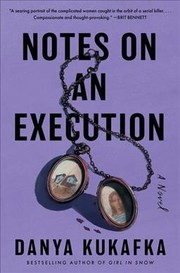
Notes on an Execution
2,527-word summary 11 min read 306 pages in the book
- First published
- 2022
- Publisher
- William Morrow
- Pages
- 306
- ISBN
- 9780063052734
Reading options
What's inside (8 sections)
I picked this one up because I was tired of true crime. Podcasts, documentaries, long threads that promise insight into a killer and end with nothing but a chill. When I heard that Danya Kukafka had written a novel about a man on death row told mostly through women, I wanted to see if it actually held that line. It does, for most of its length, and that choice shapes everything. William Morrow published it in 2022, and the hardcover runs 306 pages. It won the Edgar Award for Best Novel, which makes sense once you see how carefully it handles the crime plot while pointing at something larger.
The setup is simple and tight. Ansel Packer is waiting in prison for his execution. He has about twelve hours left. He was convicted of killing young women, and he has spent years turning himself into a figure in his own mind, someone worth studying. The book counts down those hours. Between the present-tense waiting, it moves back through the lives of three women connected to him. A mother. A sister-in-law. A detective. Their chapters carry most of the weight. Ansel gets his own short sections, but Kukafka keeps him small on purpose. He wants the spotlight. She does not give it to him.
If you want a straight thriller with clues and a last minute rescue, this is not that book. Spoilers follow, because the shape of the whole thing matters more than any single turn. I will keep the violence general. The book does the same. It is interested in what comes before and after the harm, not in replaying it.
Twelve hours and a man who wants to be known
Ansel is forty or so, raised in hard places, now housed on death row. He knows the routine of the day. Last meals, last visits, the walk, the witnesses. Kukafka writes these parts in a flat, close voice. He thinks about his childhood, his crimes, the women he hurt, the interviews he gave. He believes there is a reason he turned out this way and that a smart listener could find it. He has read the articles about himself. He corrects them in his head.
What struck me first is how ordinary his self pity feels. He is not written as a genius or a monster from a myth. He is needy. He wants his lawyer to admire him, his spiritual adviser to forgive him, the public to remember his name in the right tone. He rehearses lines for the final statement. He wonders who will cry. There is a scene where he thinks about the mothers of the girls he killed and frames himself as someone who understands their pain, which is such a strange and ugly move that I had to put the book down for a minute. Kukafka lets him talk without stepping in to correct him. The correction comes from the rest of the book.
The countdown gives the novel its pressure. Each section header moves closer to the hour. Guards change shifts. Phones ring. Paperwork moves. The prison runs on procedure, and Ansel tries to make procedure feel like ceremony. Around him, people do their jobs. Some are kind. Some are tired. None of them see him the way he sees himself, and that gap is the point. He expected meaning. He gets process.
I should say here that the book never argues he is innocent or that the system got the wrong man. He did it. The question Kukafka keeps circling is different. What does it cost the rest of us to keep looking at him? Who do we stop seeing while we stare?
Lavender, seventeen and out of options
The first woman we meet in full is Lavender, Ansel's mother. She is seventeen when her part starts, pregnant, poor, living with a mother who drinks and a boyfriend who drifts in and out. Kukafka writes her youth without romance. Lavender likes music, likes a boy's attention, likes the idea that a baby might give her a fresh start. Then the baby comes, then twins, and the fresh start never arrives.
Lavender cannot keep them. That sentence sounds cold on its own, so Kukafka spends time showing why it happens. No money. No help. A social worker with too many cases. A clinic visit that goes nowhere. A night when the crying will not stop and Lavender realizes she is scared of herself. She leaves the boys where they might be found, which the book presents as both a crime and a mercy. She does not vanish from the story after that. She grows older, works, tries to build a life, and the choice follows her in quiet ways.
I found these chapters the hardest and the best. Kukafka does not excuse Lavender and does not hang her either. She shows a girl with almost no margin making a decision inside that narrow space. Later, when Lavender learns what one of her sons became, the guilt lands in a specific way. She wonders if keeping them would have changed anything. She wonders if giving them up set the path. The book does not answer her. It lets her ask, and it shows how little room she ever had to ask anything at all.
There is a stretch where adult Lavender follows the news of Ansel's case from far away. She clips articles. She does not call. She tells herself the family that raised him owns this grief. It reads true to me, that mix of claim and refusal. She is his mother and she is not. Both facts hurt.
A small criticism. A couple of Lavender scenes lean on coincidence to bring her back near the case. A chance meeting, a recognized face. They work emotionally, but they felt arranged. I forgave it because her chapters earn their place, yet I noticed the strings.
Hazel and Jenny, twins pulled apart
The second thread belongs to Hazel, and through her, to her twin sister Jenny. The twins are close in the way some twins are, with their own jokes and a shared memory of every room they ever lived in. Hazel is the steadier one, or thinks she is. Jenny is softer, hungry for love, quick to explain away bad behavior in men. When Jenny meets Ansel as a young woman, Hazel dislikes him at once and cannot say why in a way Jenny will hear.
Ansel courts Jenny with focus. He remembers small things. He helps with chores. He talks about his hard childhood in a way that invites care. Hazel watches her sister lean in and feels the old twin pull go slack. Kukafka is good on this kind of slow loss. No big fight. Just fewer calls, canceled plans, a new apartment Hazel is not really welcome in. Jenny stops telling the full truth about bruises and absences. Hazel tells herself it is a rough patch.
The marriage turns controlling and then frightening. Ansel tracks Jenny's time. He borrows money from her friends. He charms Hazel when he needs to and freezes her out when he does not. Kukafka writes one visit scene I kept thinking about. Hazel comes for dinner. Ansel cooks and is funny and warm. Jenny laughs in a bright, high way that Hazel does not recognize. On the drive home Hazel cries without knowing exactly what she saw. That feels right for how abuse often looks from outside. Clear and unprovable at once.
Hazel's guilt after Jenny's death drives her chapters. She replays every moment she could have pushed harder. She kept a job, paid rent, stayed polite, and tells herself those choices were cowardice. The book pushes back gently. It shows what she did try. Calls, visits, offers of money and rooms. Jenny refused most of it. Kukafka refuses the simple story where one brave speech would have saved her. Control works by cutting the lines Hazel tried to use.
These pages also show how Ansel practiced on the women closest to him before he killed strangers. The pattern is there early. Charm, isolation, blame, apology. By the time the police connect him to the murdered girls, Hazel has already seen the private version for years. Her testimony later matters, and the book gives her day in court real weight without turning it into triumph.
Saffy, the detective who cannot look away
The third woman is Saffy, short for Saffron, a homicide detective who caught Ansel's case. She is sharp, tired, good at her job in a department that does not always reward that. She has her own history with violent men, including a brother whose trouble shaped her. She tells herself work is work. Then Ansel makes it personal by noticing her, writing to her, asking for her at the end.
Saffy's chapters move between the investigation years ago and the execution day. The old parts read like solid police work. Canvases, timelines, phone records, a witness who almost helps. Kukafka knows how slow these cases go. A girl goes missing near a lake. Then another near a highway. Jurisdictions argue. Evidence sits in envelopes. Saffy keeps a board with faces and dates and stares at it after hours. When Ansel is finally caught, it is not one brilliant hunch but steady pressure plus his own mistakes. He liked to keep tokens. Men like him often do.
On execution day Saffy has to decide whether to attend as a witness. Colleagues tell her to skip it. Her partner worries it will hollow her out. Part of her wants to see it through, to stand in for the girls. Part of her knows Ansel wants an audience and she refuses to be one. Kukafka lets her change her mind twice. I liked that. It felt honest about how these rituals pull at people who did the work.
Saffy's private life gets real space too. A relationship strained by late nights. A mother she calls and does not call. Health scares she puts off. The book suggests, without scolding, that hunting men like Ansel can become its own way of avoiding a life. Saffy solves cases. Her own rooms stay messy. That parallel could have felt cheap. Here it lands because Kukafka writes her as competent first and wounded second, not the other way around.
One of my favorite passages comes when Saffy looks at true crime coverage of the case. Young women online trade theories about Ansel's childhood. They write about his eyes. Saffy feels sick and then catches herself. She once wanted to understand him too. The book asks if there is a clean line between studying a killer to stop him and studying him for fun. Saffy is not sure there is.
What the book is doing with our attention
Kukafka has said in interviews that she wanted to shift focus from the killer to the women around him, and the structure does that work on every page. Ansel's sections are short. The women's sections are long and full of texture. Jobs, kitchens, cars that will not start, kids with fevers. The murdered girls are not props either. When they appear in memory, they get small, specific lives. A swim team. A bad haircut before school pictures. A song learned for a talent show. It is deliberate. The culture gave Ansel pages of analysis. Kukafka gives these girls paragraphs of life and asks which tells you more.
The justice question runs under all of it. The novel does not preach against the death penalty in speeches. It shows the machinery. Lawyers file last motions they know will fail. Guards trade gallows humor to get through the shift. A chaplain prays with a man he believes is evil. Witnesses sit in rows and try not to look at each other. Afterwards everyone goes to a parking lot and drives home. Ansel wanted a stage. He gets a process with forms. That gap feels like Kukafka's answer, though she never states it outright.
There is also a thread about class and care. Lavender with no support. Jenny with a job that does not pay enough to leave. Saffy with a department stretched thin. At each point someone could have stepped in with money, housing, time. Nobody does, or they do too late. The book does not claim those steps would have stopped Ansel. It claims they would have mattered to the women, which is its own argument.
The prose stays plain and close. Short sentences when time runs short. Longer, softer passages for memory. Kukafka likes physical detail. Hands, coats, food, weather. A burned meal. A wet shoe. These bits keep the novel grounded when the theme could float away. I read the last hundred pages in one sitting because the countdown pulls and because I wanted to stay with Hazel and Saffy more than I wanted to see Ansel's end.
Where it drags and who should read it
No book built this way escapes some drag. The middle repeats a few beats. Another article about Ansel. Another late night call Hazel regrets. Another moment Saffy stares at the board. Repetition is part of the theme, how violence loops through lives, but twice I felt the novel circling. A tighter cut of about twenty pages in Lavender's middle section would have helped. The Ansel interludes also blur together near the end. He thinks in circles by design, yet circles still tire.
Readers who need a fast plot may stall. This is a story where you know the ending on page one. He will die at the set hour. The tension is in how the women spend those hours and what they choose to carry out. If that sounds quiet for a crime novel, it is. The crime is loud in the background. The foreground is grief work.
Content notes matter here. The book deals with murder, domestic abuse, child neglect, and the death penalty. It keeps assault scenes brief and off center, which I appreciated, but the weight stays. Anyone worn down by stories of violence against women should pace this or skip it. Kukafka's whole point is that we consume these stories too easily. Reading slowly felt like respecting that point.
I closed it thinking about Hazel driving home from that dinner, and Saffy deciding where to stand, and Lavender at a kitchen table with old clippings. Ansel wanted to be the center that held. On the last page he is not. The women go on without him, hurt and still moving. That is not comfort. It is something steadier. A record of who paid and who stayed.
If you read a lot of literary crime and feel uneasy about why, start here. If you never read crime because the bodies feel like set dressing, this one answers that worry head on. It will not thrill you in the usual way. It will keep you close to three women for a day and ask you to look at them instead of him. I found that harder and more worth it than another profile of a killer who liked to be watched.
FAQ
When was Notes on an Execution published?
William Morrow published it in 2022. The hardcover runs 306 pages and the ISBN is 9780063052734.
Is Notes on an Execution part of a series?
No. It stands alone and follows Ansel Packer through one execution day plus the past lives of three women.
Does the book describe the murders in graphic detail?
It keeps assault scenes brief and off center, but murder, domestic abuse, child neglect and the death penalty run through the whole book.
Similar books
The Truth About the Harry Quebert Affair
A blocked writer tries to clear his mentor Harry Quebert after a girl missing since 1975 is found buried with his famous manuscript.
2,192-word summary · 10 min read

What She Knew
Rachel lets her eight-year-old son run ahead in a Bristol park, and the nine-day search turns her into a suspect in the public eye.
2,952-word summary · 13 min read

The Beach House
A young valet is beaten to death at a Hamptons party, and his law-student brother spends a year building a case against the family that covered it up.
2,049-word summary · 9 min read

Six Years
A professor who promised to forget the woman he loved sees her husband's obituary and discovers that the wedding, the marriage, and the woman herself may never…
2,076-word summary · 9 min read

The Trespasser
A Dublin Murder Squad detective investigates a staged dinner-party killing and finds a cover-up that reaches into her own department.
2,051-word summary · 9 min read

Rules of Prey
Minneapolis detective Lucas Davenport hunts a killer who leaves a new rule at every scene and treats murder as a game of wits.
1,914-word summary · 9 min read

The Late Show
Exiled to the LAPD night shift after accusing her supervisor, Renée Ballard keeps two cases that were meant to be handed off at dawn: a brutal assault and a…
2,563-word summary · 11 min read

4th of July
Lindsay Boxer shoots two armed teenagers in self-defense, faces a wrongful-death trial, and spends her leave chasing a string of throat-slashing murders in…
2,192-word summary · 10 min read

The Camel Club
Four Washington misfits witness a murder on Roosevelt Island and stumble into a conspiracy that reaches the Oval Office, with a hostage president and a nuclear…
2,354-word summary · 10 min read

61 Hours
A bus crash strands Jack Reacher in a snowbound South Dakota town where a drug gang, a corrupt police force, and a single witness are on a collision course.
2,227-word summary · 10 min read
The Last Mile
Melvin Mars is hours from execution for his parents' murder when another man confesses, and FBI cold case detective Amos Decker goes looking for the trap.
2,746-word summary · 12 min read

Still Missing
A realtor is abducted at a Vancouver Island open house and held for more than a year. Told through therapy sessions, the novel follows her escape and the hunt…
2,466-word summary · 11 min read

Bad Luck and Trouble
A deposit of $1,030 summons Jack Reacher back to his old army unit, which is being picked off one name at a time.
2,366-word summary · 11 min read

3rd Degree
The third Women's Murder Club novel follows a San Francisco terror cell and a three-day killing schedule, and it costs the club a member.
2,685-word summary · 12 min read

Worth Dying For
Reacher stops for one night in rural Nebraska and finds a family that runs the county, a missing girl and a shipment worth killing for.
2,021-word summary · 9 min read

Say You're Sorry
A widowed prosecutor defends the teenager accused of killing her babysitter, uncovering a small town's secrets and a killer hiding in plain sight.
2,116-word summary · 9 min read
Finlay Donovan Knocks 'Em Dead
Someone has put a contract on Finlay Donovan's ex-husband, and the novelist and her nanny have to find the hitman before the school pickup.
1,990-word summary · 9 min read

Echo Burning
Reacher hitches a ride with a Texas woman who wants her abusive husband killed, then has to prove she did not murder him when he comes home.
2,209-word summary · 10 min read
The Survivors
Kieran Elliott returns to Evelyn Bay twelve years after a storm killed his brother, and a young woman's murder forces the town to face what it has concealed.
2,571-word summary · 11 min read

Girl, Forgotten
A rookie US marshal guards a judge with a stalker and ends up reopening the 1982 prom-night murder of the judge's pregnant daughter.
2,111-word summary · 9 min read

The Woods
Twenty years after two teenagers were murdered and two vanished at summer camp, prosecutor Paul Copeland identifies a fresh corpse as one of the missing.
2,490-word summary · 11 min read

The Redbreast
Harry Hole chases an ageing sniper through modern Oslo while two Norwegian volunteers on the Eastern Front carry a fifty-year-old betrayal toward a royal…
2,453-word summary · 11 min read
The Poet
A crime reporter investigates his twin brother's apparent suicide and uncovers a killer who leaves Edgar Allan Poe quotes behind, in the novel that took…
2,020-word summary · 9 min read

The Boy from the Woods
Wilde, found feral in a New Jersey forest in 1986, hunts for a missing teenager while a senator's secrets tear a wealthy town apart.
2,270-word summary · 10 min read
Razorblade Tears
Two ex-con fathers, one Black and one white, hunt their murdered sons' killers in a Richmond that never gave the boys a fair shake.
2,880-word summary · 13 min read
Broken Harbor
A family is found slaughtered in a half-built Dublin estate where no one broke in, and star detective Scorcher Kennedy must explain the holes in the walls.
2,308-word summary · 10 min read

Without Fail
Reacher is asked to test vice presidential security by planning to kill.
2,084-word summary · 9 min read
Triptych
A GBI agent with dyslexia hunts a rapist while two Atlanta cops hide pasts.
2,576-word summary · 11 min read

Things We Do in the Dark
A comedian kills her husband, then a podcaster digs up her teen murder past.
2,427-word summary · 11 min read

The Widow
A widow of a suspected criminal faces reporters and police while hiding what her marriage really cost.
2,599-word summary · 12 min read