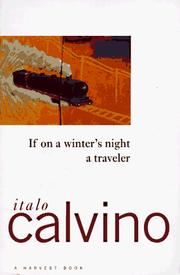
If on a Winter's Night a Traveler
2,173-word summary 10 min read 260 pages in the book
- First published
- 1979
- Publisher
- Harcourt Brace Jovanovich
- Pages
- 260
- ISBN
- 9780156439619
- Original title
- Se una notte d'inverno un viaggiatore
Reading options
What's inside (9 sections)
I have started this book four times and finished it twice, which feels right for a novel whose plot is a person trying to finish a novel. The first copy I owned was secondhand and had someone else's pencil notes in the margins, which made reading it feel like being the third person in a conversation. That is, in miniature, what the book is about: the strange intimacy of reading something someone else wrote, and the way books pass through hands the way rumors pass through a town.
Calvino published it in Italian in 1979 as Se una notte d'inverno un viaggiatore, and William Weaver's English translation arrived in 1981. I read the Harcourt edition, which runs about 260 pages, and it contains, depending on how you count, one novel and ten novels, or ten novels and no novel at all. The conceit is famous and worth restating plainly, because it is almost impossible to describe to someone who has not read it: the book addresses you, the Reader, in the second person, and then it keeps interrupting itself with other books that never get to finish.
That could be a gimmick. For about sixty pages on my first attempt, it felt like one. Then I stopped trying to get to the end of anything and started paying attention to what the interruptions were doing, and the book opened up like one of those carved puzzles where every piece is also a key.
You, Reader, are the protagonist
The novel begins by telling you that you are about to begin reading Italo Calvino's new novel, If on a Winter's Night a Traveler. You settle in. The first chapter, the one you are reading, is a taut little thriller about a traveler at a railway station on a winter night, a suitcase, a stranger who hands over a package, and a voice in a phone booth telling the protagonist he is a dead man. It is genuinely good, the kind of opening that would keep you up until three in the morning if the novel continued in that vein.
It does not continue in that vein. The text breaks off, glitches, and starts over from the beginning. Your copy is defective. You go to the bookshop, where you meet Mr. Cavedagna, the publisher's editor, who explains that a bindery error mixed up signatures from different books, and who promises to sort it out. You also meet the Other Reader, a woman named Ludmilla, who bought the same defective book and wants the same missing pages. You begin exchanging partial books with her, comparing notes about how you each read, and something starts that is not exactly romance and not exactly a book club.
That is the frame: a mild comic picaresque in which You hunt for a complete text through bookshops, publishers, professors, and a translator with a flexible relationship to the concept of originals. Every door you open contains a new novel, in a new genre, that breaks off after thirty or forty pages for a brand new bureaucratic or criminal reason. Printing errors. Stolen manuscripts. Forged letters. A translator who claims his originals were never written in any language at all. Censorship, academic grudge matches, simple fraud.
Ten novels that refuse to finish
The ten fragments are the beating heart of the book, and each is a pastiche calibrated to a different tradition. The first is the station thriller. The second, "Outside the town of Malbork," is a foggy northern story about a boy who trades places with another boy, the kind of thing Kafka might have written after a winter walk. Then come the two halves of a Cimmerian novel, "Leaning from the steep slope" and its reworked double "Without fear of wind or vertigo," which I will come back to because they are the book's best joke and its sharpest idea.
From there the genres tumble faster: "Looks down in the gathering shadow" is a sweaty Mediterranean crime story about a body that needs to disappear. "In a network of lines that enlace" and "In a network of lines that intersect" are mirror twins built around interwoven lines and doubles, miniature Borges pieces. "On the carpet of leaves illuminated by the moon" turns Japanese: night reading, forbidden desire, a moonlit floor of ginkgo leaves. "Around an empty grave" goes Latin American, with a village, a father's death, and a revolution in the margins. The final fragment, "What story down there awaits its end?", is about a man who appears to be dismantling the city around him, block by block, as if he were an author revising it out of existence.
None of them finish. That is the rule. But here is what I had not expected: the fragments are not throwaway sketches. Each one is good enough that you resent leaving it. Calvino wrote ten convincing first thirty pages in ten different modes, and the frustration you feel is the frustration the Reader in the book feels, which means the structure is doing to you exactly what it does to him. You want endings. The book is about why you want them.
There is a second layer to the trick. Because the frame is in the second person, the pronouns do the work of a magic trick. When the book says you went to the bookshop, you did not, but you remember the shop anyway, because every bookshop you have ever stood in is being gathered up into the sentence. When it says you are reading in bed while Ludmilla reads next to you, that is not your bedroom, and yet the posture is exact. Calvino understood that reading is a place where the line between your own experience and a stranger's sentences is already blurry, and he built a novel entirely out of that blur, then let the plot wander through it like a visitor.
By the last chapter, all ten titles cascade out in a single unbroken sentence, as if the fragments had given up pretending to be separate and fused into one impossible mega-novel. It is one of the great comic sentences in modern fiction and I will not spoil its mechanisms. Read it slowly when you get there.
Ludmilla, Lotaria, and the war over reading
Ludmilla, the Other Reader, is the novel's second main character even though she is seen only from outside. She reads for pleasure, purely and stubbornly, and she has no patience for readers who turn books into arguments. Her sister Lotaria is the opposite: a student-radical who reads for ideology and prizes the preface over the plot, and who wants the novelist Silas Flannery to answer her thesis on Trends of Contemporary Thought. The sisters argue about literature the way families argue about politics, with old wounds under every position.
Around them orbits Irnerio, a young man who lives near Ludmilla and holds the strangest position of all: he does not read published books. He dismantles them into raw paper and content, treating finished texts as raw material, and Ludmilla defends him because at least his relationship to books is real. The novel never exactly takes a side in this debate, which is one of the things I admire about it. It assigns each reader a philosophy and then lets the philosophies collide without a verdict. Lotaria is ridiculous, but she is ridiculous in ways I recognized from my own graduate seminars. Ludmilla is charming, but her insistence on pure pleasure has its own blind spots. And you, the Reader, are mostly trying to get near her, which makes your erudition a form of flirting.
The translator's fraud and the author's diary
The plot, in the thin sense of cause and effect, is driven by a translator named Ermes Marana, who works for an organization of translations and who has been fabricating literature wholesale. His confession, when it comes, is one of the book's funniest set pieces: he claims to have translated novels that were never written, from languages that barely exist, sometimes under invented pseudonyms, sometimes as apocryphal works by famous writers. Behind this wall of fakes stands the reclusive bestseller Silas Flannery, whose diary punctuates the frame story and who watches a woman read in a garden below his window, envying her freedom because she can read without having to write.
The Flannery diary is Calvino's most direct shot at his own craft. Flannery describes the war between the book he wants to write and the books his readers want to read, and the way both are ruined by each other. Meanwhile Professor Uzzi-Tuzii, a timid scholar of Cimmerian literature, recites the Cimmerian novel at you with interminable philological footnotes, stopping and starting, apologizing and digressing, until the academic section becomes its own kind of interrupted novel. Those passages are slow in the way academic life is slow, and I count that as characterization rather than a flaw.
Cimmeria, or the country that exists only in translation
The best idea in the book, for my money, is Cimmeria: a country whose literature survives only in translation, whose language Professor Uzzi-Tuzii teaches even though the country does not exist on any map. The Cimmerian novel, "Leaning from the steep slope," is also known in a second version, "Without fear of wind or vertigo," which turns out to be the same story rewritten in another tongue. And in the middle of the search, the frame Reader realizes that the two versions of his story might be the same text, in the way two translations of one poem are the same poem and also two different poems.
I think about this passage often, especially in an era of translation machines and repackaged content. A text can be original in one language and counterfeit in another. A story can belong to a country that has no borders. Marana's fraud, which sounds absurd when described, is a slightly exaggerated description of how the literary market actually works: authorship as a brand, translation as rewriting, and readers far away who have no way to tell the difference.
What the book is actually about
Most of the criticism of the novel, over the decades, converges on one point: it is more fun to describe than to read. That can be true of metafiction, which ages like a stunt. David Mitchell has said he was magnetized by it as an undergraduate and then found parts of it had aged, and I understand both halves of that sentence. But somewhere around my second pass through the fragments I stopped feeling the structure as a stunt. The book works, when it works, because the desire it keeps stalling is real desire. You want the traveler to survive the station. You want to know what the boy in Malbork traded away. You want the resolution that the next interruption promises and then revokes. Calvino is demonstrating that the force that keeps civilization running is a reader wanting to know what happens next, and that the ending is the least interesting part of that want.
The novel is also very funny, in a dry way, about the industry of publishing: editors who blame the bindery, authors who answer questions with manifestos, translators who are treated as replaceable wires. I laughed out loud at least a dozen times, mostly at sentences I did not expect to find funny at all.
How it holds up, and who should skip it
Some housekeeping for anyone considering it. The US title uses the spelling Traveler; the UK edition uses Traveller. Both refer to the same novel. The book was published by Einaudi in 1979 and in English by Harcourt Brace Jovanovich in 1981, which is the edition I keep. It was adapted for radio by the BBC in 2023, and Sting borrowed the title for an album in 2009, which tells you something about how deep it has settled into the culture.
It is not for everyone, and it is not even for every mood. If you need a plot that resolves, this book will make you angry. If you read the first fragment and think, I wanted that novel, the entire book is an extended joke at the expense of that want, though the ending has one last twist: a complete sentence, arriving at last, that closes the book and the search in the same breath. The Reader asks Ludmilla to let him finish. She tells him to keep reading. He answers, and the answer is the last line of the novel, and it is perfect.
I would recommend it to anyone who has ever loved a book more for how it made them read than for what it said. It is the most literal novel about reading ever written, and about fifty pages in, the literalism turns into something warmer than cleverness: a book that treats your attention as the actual subject matter, and earns it. Read the first fragment and see. That is what the first fragment is for.
FAQ
Is If on a Winter's Night a Traveler one novel or ten?
It is one novel. A frame story told in the second person wraps around the openings of ten different novels, and none of those fragments finish. The frame, not the fragments, is what resolves.
Does the book have a conventional plot?
The plot follows you, the Reader, trying to obtain a complete copy of a novel that keeps failing, through bookshops, publishers, a professor, and a translator who forges originals. Actual events are thin on purpose; the searching is the story.
Is it Traveler or Traveller?
Both are correct. The US edition spells it Traveler and the UK edition Traveller. It is the same novel, translated from Italian by William Weaver.
Similar books
Naked Lunch
Burroughs's banned 1959 collage novel follows Bill Lee through addiction, Tangier, and the nightmare bureaucracy of the Interzone.
2,082-word summary · 9 min read

The Crying of Lot 49
A California woman named executor of her ex-lover's estate follows a muted post horn into a possible centuries-old postal conspiracy, and Pynchon refuses to…
2,003-word summary · 9 min read
Post Office
Chinaski drifts through postal shifts, cheap rooms, horse tracks and rough love in Bukowski's 1971 debut about work, drink and survival.
2,444-word summary · 11 min read
Breakfast of Champions
A Pontiac dealer breaks down while a broke sci-fi writer brings the book that tells him others are robots.
2,013-word summary · 9 min read
A Confederacy of Dunces
Ignatius J. Reilly, jobless and full of opinions in New Orleans, meets work, his mother, and the law in Toole's posthumous Pulitzer winner.
3,089-word summary · 14 min read
The Master and Margarita
Devil Woland visits 1930s Moscow while Master writes Pilate and Margarita bargains.
2,535-word summary · 11 min read
Catch-22
Yossarian tries to survive Pianosa bombing runs while the catch traps him.
3,764-word summary · 17 min read
Silas Marner
A falsely accused weaver hoards gold in Raveloe until a stolen hoard and an abandoned child remake his narrow life.
2,699-word summary · 12 min read
Revolutionary Road
A Connecticut couple who believe they are too good for the suburbs plan to move to Paris, and the plan slowly exposes everything they cannot say to each other.
2,085-word summary · 9 min read
Rosencrantz and Guildenstern Are Dead
Stoppard's 1966 play retells Hamlet from the wings, where two minor courtiers wait, joke, and walk toward a death they cannot see.
2,021-word summary · 9 min read

Howards End
Forster's 1910 novel follows two families, a house in Hertfordshire, and a burned note, asking whether money and feeling can ever be connected.
2,187-word summary · 10 min read
The Agony and the Ecstasy
Irving Stone turns Michelangelo's seventy years of carving, painting, and arguing with popes into a novel about the cost of making something that outlives you.
2,260-word summary · 10 min read

Sophie's Choice
A young Southern writer in 1947 Brooklyn befriends a brilliant, unstable couple and slowly learns the story of the Polish Catholic woman at the center of their…
2,798-word summary · 12 min read
James
Percival Everett retells Huckleberry Finn from Jim's side, giving him a library, a hidden school, and a voice the novel lets loose.
2,211-word summary · 10 min read

Fathers and Sons
Arkady brings the nihilist Bazarov home to his father's estate, and a generational argument turns into love, a duel, and an early death.
2,192-word summary · 10 min read

The Chosen
A shattered pair of glasses in a 1944 Brooklyn softball game starts a friendship between a Hasidic boy and his Orthodox neighbor, and their fathers pull them…
2,443-word summary · 11 min read
Infinite Jest
A film that kills its viewers, a tennis academy, a halfway house for addicts, and a future America where corporations name the years, all tangled together.
2,084-word summary · 9 min read
The Dharma Bums
Ray Smith rides freight trains, climbs Matterhorn Peak and argues about Zen with the poet Japhy Ryder in Kerouac's 1958 road novel.
2,729-word summary · 12 min read

Ivanhoe
A disinherited Saxon knight, a great tournament, a besieged castle and a trial by combat. Scott's most famous novel, set in England in 1194.
2,834-word summary · 13 min read
Wide Sargasso Sea
Jean Rhys gives the first Mrs. Rochester a Caribbean childhood, a marriage built on money and suspicion, and a voice that Charlotte Bronte left in the attic.
2,021-word summary · 9 min read
The Sisters Brothers
Two hired killers ride from Oregon to Gold Rush California to murder a prospector, and find their trade, their brotherhood, and the frontier myth coming apart.
2,095-word summary · 9 min read
The Gambler
Dostoevsky's roulette novella: Alexei loses Polina, wins a fortune, loses everything, and promises himself one more bet tomorrow.
2,022-word summary · 9 min read
The Birth of Venus
A Florentine merchant's daughter trains as an artist, marries a man who hides a secret, and survives Savonarola's bonfire of the vanities.
2,404-word summary · 11 min read
Orlando
A young Elizabethan nobleman becomes a woman and lives for centuries, moving through English history while writing a single poem about an oak tree.
2,030-word summary · 9 min read
Mother Night
Howard W. Campbell Jr., a Nazi propagandist and American spy, tells the story of his double life from an Israeli prison cell while waiting to be tried for war…
1,988-word summary · 9 min read
The House of Mirth
Lily Bart, beautiful and penniless at twenty-nine, navigates New York's marriage market until a Dorset yacht scandal strips her of the only currency she has.
2,468-word summary · 11 min read
The Little Paris Bookshop
A Paris bookseller who prescribes novels as medicine finally opens a twenty one year old letter from his lost love and sails south through France to find her.
2,050-word summary · 9 min read
A Connecticut Yankee in King Arthur's Court
Hank Morgan, a Connecticut factory man, wakes in King Arthur's England, rises to chief adviser, and rebuilds the kingdom until his own inventions turn on him.
2,193-word summary · 10 min read
The Prisoner of Heaven
Fermin Christmas past returns with a stranger and a prison debt.
2,388-word summary · 11 min read