
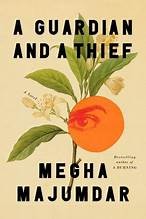
A Guardian and a Thief
2,306-word summary 10 min read 224 pages in the book
- First published
- 2025
- Publisher
- Knopf
- Pages
- 224
- ISBN
- 9780593804872
Reading options
What's inside (10 sections)
I picked this up with some reluctance, because the title sounded like a fable and I expected something tidy. It is anything but. Megha Majumdar's second novel sets a grim little question at its center and then refuses to answer it in a way that lets any of her characters off the hook. The story is set in Kolkata at a moment when the city is coming apart, and it unfolds across a single week in two alternating voices that keep circling the same desperate problem. By the last page I found myself arguing with both of them, which I take as a sign that the book is doing its job.
A family trying to get out
The Kolkata of this novel is a near-future place, and the damage is ordinary rather than spectacular. Flooding and famine have become facts of daily life. Food is scarce enough that small acts of taking carry real weight, and the machinery of leaving the country has grown its own cruel vocabulary: climate visas, papers that decide who gets to breathe clean air somewhere else. Majumdar does not pause to explain how the world reached this point. She drops you into it mid-sentence, the way you might find yourself in a city whose rules you no longer recognize.
At the center of the first thread is Ma, who manages a homeless shelter. She is days away from flying with her two-year-old daughter, Mishti, and her elderly father, Dadu, to Ann Arbor, Michigan. Her husband, Babu, is already there, working on mosquito-borne diseases. The move is the family's whole plan, the thing they have been saving for and scheming toward, and the passage out depends on documents. Passports and climate visas. Without those, the flight is a dream.
What struck me first was how much of the book's tension lives in paperwork. Majumdar understands that for people trying to cross a border, a folded document is more powerful than any weapon. Ma's careful keeping of those papers becomes a kind of love, and the threat of losing them is not abstract. It is the loss of a future. Dadu, elderly and fragile, is part of the plan too, and the novel is clear-eyed about how much care and how much hope are packed into getting three people onto one plane.
The second thread belongs to Boomba, a twenty-year-old homeless man who stays at Ma's shelter. That detail matters, because it means the two stories are not strangers to each other. Ma has been feeding him, in a sense, all along. When Boomba breaks into her apartment looking for food, the theft that follows is not an intrusion from outside. It comes from someone the shelter has already taken in. Majumdar builds the whole moral tangle out of that simple arrangement.
The break-in and the stolen papers
Boomba is hungry, and he is not hungry only for himself. He has a family of his own to feed, and that is the fact the novel keeps throwing back at the reader. He slips into Ma's apartment looking for something to eat and leaves with the passports and the climate visas. In a thriller this would be the inciting crime, the thing that starts the chase. Here it feels more like a symptom. A man stealing food turns into a man stealing a family's only way out, and the book never lets you forget that both acts are the same act.
I found this section hard to read in a comfortable way, and I mean that as a compliment. It would have been easy to make Boomba a villain or a victim. Majumdar does neither. He is young, desperate, and responsible for other people who are hungrier than he is. His reasoning is sound on its own terms and horrifying when placed next to Ma's. The stolen documents are not treasure to him. They are a means to keep his own household alive for another day.
Ma and Dadu begin searching for the papers almost immediately. They look where they can, they ask what they can, and they come up empty. The search is not a detective story with clues that neatly assemble. It is two frightened people turning an apartment inside out while the departure date gets closer. Majumdar lets the days press in on them. Every hour without the documents is an hour in which the Ann Arbor plan becomes less real.
The crimes keep growing
What makes this novel uncomfortable is that Boomba does not stop with the theft. The crimes escalate, and each one puts a little more distance between him and the reader's sympathy. He blackmails Ma over food she takes from the shelter. He strikes a bargain to move his own family into her apartment once she has left for Michigan. He briefly abducts Mishti so that he can get into a billionaire's feast. That last one is the strangest and most telling of his acts. The child becomes a kind of key, a way for a hungry young man to walk into a room where the wealthy are eating.
This is where the two title words start to argue with each other. A guardian protects. A thief takes. Ma is trying to guard her daughter and her father and their passage to safety. Boomba is stealing to guard his own family. Majumdar keeps the two roles pressed together until you cannot easily say which one of them is the guardian and which is the thief. Both of them are, at different moments, and the book's refusal to settle that is the source of its power.
I did notice that the escalation feels a bit arranged. Each new act seems designed to push the moral question one step further, and once you see the pattern you can feel the author's hand moving the pieces. Boomba's crimes stack up with a kind of deliberate neatness that the rest of the book, with its messy motives, does not quite match. It is a small complaint, but it grew on me as the week wore on.
Dadu and the useless forgeries
With the real documents gone, Ma and Dadu resort to forgeries. This is the part of the book that moved me most, mostly because of Dadu. He is old, he is dying, and still he sits down to help make false papers so that his daughter and granddaughter can leave. The forgeries are an act of love and also an act of desperation, and Majumdar treats them without judgment. You understand exactly why they do it. You also understand, with a sinking feeling, that it will not hold.
Dadu dies of natural causes before the plan can be saved. His death arrives quietly, without the drama the earlier chapters have been building toward, and that quietness is its own kind of shock. He was the reason the family was leaving as much as anyone, and now he is gone before he can see whether any of it worked. The book does not milk the moment. It simply moves on, which left me sitting with it longer than a big scene would have.
Then the forged papers fail in the most deflating way possible. The ink runs. All that work, all that hope, undone by something as small as wet ink. It is a brutal detail and a funny one at the same time, and I could not decide whether to laugh or wince. Majumdar seems to know that disaster in a bureaucratic world often looks like this: not a crashing building but a document that has quietly stopped being valid.
Just when the family seems finished, a man who knew Dadu returns the crumpled originals. The papers have been found, or at least handed back, and the possibility of leaving opens again. I wanted to believe in the reprieve. The book gives it just enough weight to feel real and then pulls it away.
The airport and what waits at home
At the airport, Ma learns that worldwide protests have indefinitely cancelled flights for climate refugees. The flight to Ann Arbor is gone. Not postponed, not rerouted, but cancelled for an indefinite stretch of time. Babu is in Michigan, the documents are back in her hands, and there is nothing to do with them. Majumdar does not give this moment a speech. She lets the cancellation land as a piece of news, and the flatness of it makes it worse.
Ma returns home to find Boomba's family installed in her apartment. The bargain he struck has become real while she was away. What follows is a struggle, and in it Boomba's father fatally strikes her. The violence arrives fast. One moment the apartment is a place Ma is trying to reclaim, and the next it is the site of a death. I finished that stretch of the book feeling that I had been sprinted past something the story had spent a week setting up.
Then comes the ending that I keep turning over. Boomba takes Mishti into his own home to protect her. The boy who stole the child to get into a feast ends up sheltering her after her mother is killed. It is a strange, almost tender gesture, and it does not erase anything that came before it. He is still a thief. He has also become, in that last movement, a guardian. Majumdar refuses to tell us what to call him, and she refuses to let the label comfort us.
The question Majumdar wanted to ask
The author has said she took six years to write this book, and that she wanted to ask when an adult stealing an orange from a child to feed their own child counts as an expression of humanity rather than its erosion. That question is basically the novel in miniature. An orange is a small thing. Taking it from a child is a small cruelty. Feeding your own child with it is a small mercy. Majumdar spends two hundred and twenty-four pages asking how those three facts can sit in the same act without cancelling each other out.
The National Book Foundation described the book as a profound examination of moral choices under scarcity, and that seems fair to me. Scarcity is the pressure that turns ordinary people into people who make impossible decisions. Ma's choices are hard. Boomba's choices are harder, because the book gives him a family to answer to and a hunger that will not wait. Majumdar's achievement is that she keeps both of them human all the way down. Neither becomes a symbol. They stay a mother and a young homeless man, each trying to protect somebody, each hurting somebody else.
The alternating structure helps with this. Getting Boomba's side of the week means seeing the theft from the inside, where it looks like necessity rather than malice. Getting Ma's side means seeing the same week as a slow disaster. The two accounts do not merge into a single truth. They stay apart, which is the right choice for a book about people who cannot afford to understand each other.
Where the book strains
I want to be honest about what did not work for me. The closing violence comes quickly after the long search for the documents, and the moral argument gets compressed in the rush. Ma's death, Boomba's act of protection, and the final turn all land within a few pages. Given how carefully the book has built its question, I wanted more room to sit with the answer, or at least more room to sit with the refusal to answer. The compression made the ending feel more like a conclusion than the rest of the novel had earned.
The near-future world is also sketched in broad strokes. Flooding, famine, climate visas, a billionaire's feast, protesters stopping flights: these are vivid ideas, but they are not fully imagined. Majumdar uses them as pressures on her characters rather than as a world she wants to map. That is a defensible choice, and it keeps the book short, but readers who want their speculative settings built in detail will find the Kolkata here more suggestive than solid. I went back a few times wanting to know more about how this society actually functions, and the book did not offer much.
There is some repetition too. Because the two threads cover overlapping days, a few discoveries are approached from both sides, and I caught myself impatient with the second telling. It is a minor cost of the structure, and it is probably easier to notice in a short novel than in a long one. At 224 pages there is not much slack, so every repeated beat stands out.
What I took from it
Still, I finished the book thinking about that orange. The question is small enough to hold, and it keeps getting bigger the longer you look at it. Majumdar has written a novel that refuses the easy comfort of a clear villain, and that refusal is what makes it worth the argument it provokes. It is a book about a mother trying to get her family out and a young man trying to keep his family alive, and it will not tell you which of them is right.
I would hand this to a reader who likes fiction that asks hard questions and leaves them open. I would be careful with a reader who wants a tidy thriller or a fully built future world. This is a short, sharp novel that cares more about the shape of a moral choice than about explaining the machinery around it. It is not a comfortable read, and I did not find it an easy one to put down and forget.
FAQ
What is A Guardian and a Thief about?
It is a 2025 Knopf novel set in near-future Kolkata, where a shelter manager named Ma is days from flying to Ann Arbor with her daughter and father until her travel documents are stolen. The book follows the theft and its consequences over a single week.
Who are the guardian and the thief in the title?
Both roles are shared. Ma guards her family, while Boomba steals to feed his own, and by the end each has played both parts.
Does the book build out its future world in detail?
No. Majumdar sketches flooding, famine and climate visas in broad strokes to put pressure on her characters, so readers looking for a fully imagined speculative setting may find it thin.
Similar books

The Emperor of Gladness
Ocean Vuong's second novel follows a young addict pulled back from a bridge in a dying Connecticut mill town and into the home of an elderly immigrant woman…
2,693-word summary · 12 min read

The Loneliness of Sonia and Sunny
Two Indian families, a failed arranged match, and years between Allahabad and New York shape a slow, sprawling romance.
2,092-word summary · 9 min read

The Compound
Aisling Rawle's debut follows a bored, shallow contestant through a brutal reality show in a desert compound, where the rules get crueler and the world outside…
2,150-word summary · 10 min read
Sunrise on the Reaping
Twenty-four years before Katniss, sixteen-year-old Haymitch Abernathy is swept into the fiftieth Hunger Games, where District 12 must send four tributes and…
2,198-word summary · 10 min read
Dream Count
Four women narrate the 2020 lockdown in their own voices: a travel writer, a friend in early labor, a banker cousin and a housekeeper assaulted in a hotel room.
2,286-word summary · 10 min read
Behold the Dreamers
A Cameroonian chauffeur and his wife chase the American dream while driving a Lehman Brothers executive through the 2008 crash in Mbue's debut novel.
2,578-word summary · 11 min read

Unaccustomed Earth
Lahiri’s second story collection follows Bengali families in America and abroad, tracing the quiet distances between parents and children, spouses, and the…
2,333-word summary · 10 min read

The Age of Miracles
A California girl grows up while the Earth's rotation slows, and ordinary adolescence continues alongside slow catastrophe.
2,417-word summary · 11 min read

This Is How You Lose Her
Yunior cycles through love affairs and betrayals in nine linked stories, tracing the damage he does and the family history behind it.
2,195-word summary · 10 min read

I Who Have Never Known Men
Forty women in a cage, one child who remembers nothing, and a nearly empty world above the bunker. Harpman's quiet, unexplained dystopia.
2,025-word summary · 9 min read
The School for Good Mothers
A mother sent to a reform school fights to keep her daughter under cold surveillance and strict rules.
2,114-word summary · 9 min read
Life As We Knew It
Sixteen-year-old Miranda keeps a diary while an asteroid strike on the moon brings tsunamis, blackouts, and a frozen year of hunger to her Pennsylvania town.
2,485-word summary · 11 min read
Among the Hidden
Twelve-year-old Luke, an illegal third child, befriends Jen and faces the cost of stepping out of hiding.
2,923-word summary · 13 min read
Our Missing Hearts
In a fearful future America, twelve-year-old Bird crosses the country to find the poet mother who left him.
2,434-word summary · 11 min read

Interpreter of Maladies
Nine stories follow Bengali families split between Calcutta and New England, through marriage, grief, and arrival.
2,412-word summary · 11 min read

Dear Edward
Twelve-year-old Edward Adler survives a plane crash that kills his family, then learns how to live with grief, letters, and love.
2,903-word summary · 13 min read

Tender Is the Flesh
After a virus makes animal meat lethal, states legalize breeding humans for meat. Marcos Tejo grieves at a processing plant when he is given a live female…
2,372-word summary · 11 min read
The Namesake
Jhumpa Lahiri follows Gogol Ganguli from a hated namesake to adult loss, marriage, and family reckoning between Calcutta and Boston.
2,878-word summary · 13 min read

On Earth We're Briefly Gorgeous
A son writes to the mother who cannot read him: war, migration, first love, and loss in one Vietnamese American family in Hartford.
3,113-word summary · 14 min read

Blindness
A white blindness sweeps a city, and an eye doctor's wife who can still see guides seven strangers through camp and ruin.
2,772-word summary · 12 min read
Lord of the Flies
William Golding's Lord of the Flies retold: Ralph and Jack, the conch, the beast, Simon, Piggy, and why the rescue is no relief.
2,254-word summary · 10 min read

The Wilderness
Four Black women move through twenty years of friendship in Angela Flournoy's discontinuous, widely praised second novel.
2,141-word summary · 10 min read
The True True Story of Raja the Gullible (and His Mother)
A gay philosophy teacher in Beirut revisits six decades of Lebanese history, family trauma, and his thorny bond with his mother.
2,274-word summary · 10 min read

The South
A seventeen-year-old moves to his family's failing fruit orchard in 1990s Malaysia, where a summer love affair unfolds as the household and the land around him…
2,903-word summary · 13 min read
The Sisters
Three sisters watch one another take the lives they imagined, across thirty years in Stockholm and Tunisia, in a novel that bends time like an accordion.
2,199-word summary · 10 min read
The Rest of Our Lives
A law professor drives his daughter to college, then heads west instead of home, testing a private promise he made twelve years ago.
2,238-word summary · 10 min read

The Nix
A stalled novelist and community college professor goes looking for the mother who left him and finds a radical activist whose rock thrown at a governor made…
2,214-word summary · 10 min read

The 100
Three centuries after a nuclear war, a hundred teenage prisoners are sent from a failing space colony to test whether Earth is livable again.
2,152-word summary · 10 min read
Palaver
A mother shows up uninvited at her estranged son's Tokyo apartment, and the two spend the weeks before Christmas talking their way toward something like…
2,465-word summary · 11 min read

Only Son
A brief, funny, melancholy debut about a boy whose father dies in 1982 Florida, and the man he becomes, still trying to read the mystery of that loss.
2,170-word summary · 10 min read