
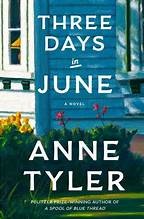
Three Days in June
2,867-word summary 13 min read 176 pages in the book
- First published
- 2025
- Publisher
- Knopf
- Pages
- 176
- ISBN
- 9780593803486
Reading options
What's inside (9 sections)
I picked this up because of a number: twenty-five. Three Days in June is Anne Tyler's twenty-fifth novel, and after that many books a writer has earned the right to work on a smaller scale on purpose. This one is 176 pages in the Knopf edition, published on 11 February 2025, and it is a first-person comedy about the three days surrounding a wedding in Baltimore. I expected something warm and tidy, the kind of Tyler book where eccentric people say funny things and everybody learns a little something by the final page. What I found was narrower and sharper than that, and it turns genuinely strange in the middle. It is a book about a woman who cannot stop talking and who is then startled by what her own mouth has produced. By the last page I had laughed a fair amount and then felt a little guilty about laughing.
The book wastes no time putting Gail Baines in a bad mood. She is second in command at the Ashton School, and she has just been passed over for the headmistress job. The incoming head is bringing a deputy of her own, which means there is no place for Gail in the new arrangement. She is out of a job, though the novel refuses to settle on the verb. She loses her job, or quits, depending on whom you ask. That small hedge is my favorite thing about the opening, because it tells you exactly what kind of narrator you are in for. Gail will give you an account of something and then, almost in the same breath, explain why her version might not be the one a disinterested party would accept. She is not lying. She is simply unable to tell the story without arguing with herself about it.
A job lost, or maybe quit
That argumentative quality is the engine of the book. Gail is one of those classic cranky but vulnerable Tyler narrators, a person whose opinions arrive before her discretion does. She blurts things out. She says what she thinks about the people around her, and she is frequently mortified a moment later, though not quite mortified enough to stop. I know readers who find this kind of narrator exhausting, and I understand the complaint. Spending three days inside a mind that keeps putting its foot in its own mouth takes a certain tolerance. But Tyler gives Gail something that makes the complaining bearable, which is that Gail is often right about the small things even when she is being unfair about the big ones. Her judgments are petty and precise at the same time.
The school plot is only the first of those judgments. Being passed over stings because of what it says about how other people see her, and that is the real wound. Gail is not mainly angry about the money or the title. She is angry because she has been overlooked in a way that feels personal. The incoming head bringing her own deputy is a practical decision, but to Gail it reads as a verdict. I thought this was a smart way to open a novel about a wedding, because it puts the question of who gets chosen, and who gets left out, in place before the bride even appears.
What is funny is that the very next day brings an occasion where Gail is worried about being left out again. Her daughter Debbie is getting married to Kenneth. In the ordinary course of things a mother would be at the center of the preparations. Gail is not. The groom's mother is hosting a spa day, a pre-wedding Day of Beauty, and Gail has not been invited. This is the second snub in as many days, and the book does not need to underline the connection. Gail's mind does that work for it. She has been passed over at the school and now she has been passed over at the spa, and she is beginning to feel that the world has quietly decided she is a person who can be left off the list.
The wedding and the missing invitation
The missing invitation matters more than it might seem, because it feeds a specific fear that Gail carries about her daughter. She worries that the prettier, more polished Debbie will prefer Kenneth's better-off parents. That is the plain version of it, and Gail would probably put it more bluntly if she were saying it out loud. She is a mother comparing herself to another set of parents and coming off worse in her own accounting. Kenneth's family has money. They can host the spa day. They presumably know which fork to use and what to wear to things. Gail, freshly unemployed and not invited to the beauty day, feels like the shabby alternative at the reception.
Here is where the comedy and the ache sit very close together. Tyler never lets Gail be only a figure of fun. The woman is ridiculous, certainly, and her worries about the wedding have a hard edge of competition in them. But underneath the competition is a real fear that her daughter has outgrown her, or is embarrassed by her, and that the wedding will make the gap official. Anyone who has been to a family gathering where two sides of a family size each other up will recognize the feeling. The spa day is a trivial event in itself. As a symbol it is enormous.
I should say that the book covers only three days, and the wedding is the fixed point that everything else orbits. The title is literal. This is not a novel that spans a marriage or a lifetime, though it keeps reaching back into one. The tight frame is part of the design. Three days is long enough for a family to say things it has been avoiding for years and short enough that there is no time to take any of it back. Tyler uses the countdown pressure of the wedding itself, the sense that something has to be resolved before the bride walks down the aisle, to keep the whole thing moving.
Max arrives with a cat
The day after she loses her job, Gail's ex-husband Max turns up on her doorstep. He is carrying a rescue cat. He has nowhere to stay. And, crucially, he has no suit to wear to the wedding, because he says Kenneth is severely allergic. This is the moment the book really opens up, and it is a wonderfully Tyler way to do it. Nothing dramatic happens in the conventional sense. A man rings a doorbell holding a cat. But into that ordinary scene Tyler loads an entire history. Max is the father of the bride, and he has arrived at his ex-wife's house without a place to go, without appropriate clothes, and with an animal he presumably acquired on impulse. The rescue cat is the perfect detail because it is both funny and sad. It is a creature someone took in, and it is also a creature Max has now brought to a house where it may not be wanted, on a day when the last thing Gail needs is another dependency.
Max is described by Kirkus as laid-back, and that quality drives much of the comedy. He is the counterweight to Gail's fretfulness. Where she is all sharp edges and worries, he is loose, unbothered, inclined to turn up and let events carry him. I can see why a reviewer would single him out as the only fully fleshed character besides Gail. He arrives with a problem and a cat and a lack of a suit, and he seems almost cheerful about it. Against Gail's loop of anxiety about the spa day and the other parents, Max's calm is both a relief and a provocation. She wants him to be more bothered. He is not.
The suit and the allergy are a small comic engine that runs through the middle of the book. Here are two people who were married to each other, now facing their daughter's wedding as a pair of awkward extras, and their shared problem is that one of them cannot wear normal wedding clothes because the groom may sneeze. It is a silly difficulty, and it is also a precise one. It forces Gail and Max to deal with each other at exactly the moment when neither of them has much else to do together. The wedding has made them a team again, for three days, and the team has a cat and a clothing problem.
The secret from the Day of Beauty
The real crisis of the book does not come from the job or the cat or the missing suit. It comes from Debbie. At her pre-wedding Day of Beauty, she learns a secret about the man she is about to marry, and she tells her mother. That disclosure is the hinge on which the whole novel turns. It divides Gail and Max, and it sends Gail back through the story of her own marriage. I want to be careful about what I say here, because the book does not need the content of the secret spelled out to make it work. What matters is the structure: a piece of information arrives late, in a confined space of time, and it forces two people who have spent years avoiding a conversation to have it anyway.
This is where a reader's patience gets tested, and I think that is deliberate. For most of the book Gail has been a comic figure, fretting about invitations and comparing herself to the groom's parents. Then her daughter hands her something heavy, and Gail has to become a person who can carry it. The shift is abrupt. One moment the problem is a suit and a cat, and the next the problem is the kind of thing that changes how a wedding looks. Tyler is not being subtle about the change in register. The comedy is still there, but the ground under it has moved.
The division between Gail and Max is the important consequence. They have been getting through the three days by treating each other lightly, with the banter of two people who know exactly where the old wounds are and agree not to press them. Debbie's news makes that arrangement impossible. Suddenly they have to decide what to do with what they know, and they disagree. The secret pries open the gap that Max's easy manner had been covering, forcing them into the conversation they had been avoiding. I found this the most convincing part of the book, because it is exactly how families work. A crisis does not create the fault lines. It reveals them, usually at the worst possible moment, and usually in front of a wedding.
Looking back at my own marriage
Once the secret is out, Gail starts revisiting her own history with Max, and specifically the infidelity that ended their marriage. This is the part of the book that the comedy had been quietly preparing for. All along, Gail's sharp remarks about other people and her worry about being compared to Kenneth's parents were a way of not looking directly at her own life. The marriage ended badly, and the reason it ended was an act of betrayal. Now, standing in the few days before her daughter's wedding, with her ex-husband back in her house and a secret in her hands, she has to look at it.
What I appreciated is that Tyler does not turn this into a trial. Gail does not deliver a verdict from a distance. She has to sit with the fact that her daughter is about to marry someone, that she once married someone who hurt her, and that the two situations are not as separate as she would like. The past is not a closed file. It is a set of habits and fears that she has been carrying around, and her daughter's engagement has forced all of it into the open. The book is short, but this particular movement is given enough room to feel earned. Gail's reconsideration is not a grand change of heart. It is more like a person finally putting down something she has been holding for years.
The infidelity itself is handled with the restraint the rest of the book shows. Tyler is interested less in the act than in what it did to the way Gail sees herself and other people. The comparisons she keeps making, the fear that she is the less polished option, the reflex of blurting out her opinions before anyone can judge her, all of it connects back to that damage. I thought this was the strongest thread in the novel, and it is also the one that makes the humor hurt a little. Gail is funny because she is quick, and she is quick partly because being quick is how she has learned to survive being hurt.
What the short book leaves out
I want to be honest about the limits, because they are real and a reviewer as sympathetic as Kirkus pointed at them. Kirkus called the novel "sweet, sharp, and satisfying," which is fair, but also noted that laid-back Max is the only fully fleshed character besides Gail. That is a serious reservation. Debbie, Kenneth, the groom's mother, the people at the school, the incoming head with her own deputy, all of them are drawn in a few lines and left there. The spa day and the Day of Beauty exist mostly as things that happen to Gail rather than as scenes with their own life. If you like your supporting cast rounded out, this book will feel like a sketch where you expected a painting.
The length is the other issue. At 176 pages, the novel does not have room to linger. The happy ending, such as it is, arrives in a very compact space. Kirkus noted that it is earned, and I agree that Tyler has done the work to make it feel deserved rather than pasted on. But a reader coming from one of Tyler's fuller novels may feel that the resolution comes in quickly, almost before the supporting characters have finished being introduced. The three-day structure creates urgency, and urgency is good here, but it also means that a lot of the people around Gail never get past being types.
There is also the matter of that central secret. Because the book keeps its attention on Gail's reaction, the secret functions more as a trigger for her than as a fully explored situation in its own right. I found that focusing choice legitimate, since this is Gail's story and the title promises a narrow window. But I can see a reader feeling shortchanged, especially one who wants the daughter's side of things. Debbie is the bride, and after the disclosure she becomes mostly a source of conflict for her mother rather than a person with her own interior life. That is a cost of the design, and it is worth naming.
Why the ending works anyway
Still, I closed the book glad I had read it. The compactness that frustrates in one moment is what makes the whole thing work in another. Three Days in June is a novel about a woman who has been left off lists, passed over, and hurt, and who arrives at her daughter's wedding with a suitcase of habits she does not fully understand. Tyler gives her exactly enough space to recognize a few of them. The rescue cat, the missing suit, the uninvited spa day, the secret from the Day of Beauty, all of it accumulates into a portrait of a mother trying to work out where she fits in a family that is changing shape without her.
What I would tell a friend is this: go in expecting a comedy and stay for something harder. The first half is very funny, full of Gail's blunt opinions and Max's calm provocations and the absurd business of a man with no suitable clothes because the groom might be allergic. The second half asks what any of that fuss was covering. I laughed at the cat and the suit and then found myself taking Gail's fear about her daughter seriously. That turn is the book's real achievement. It is small, it is quick, and it lands.
I would hand this to a reader who likes Tyler's narrators and does not need a big canvas. I would be careful with a reader who wants a large, generous family novel with a full supporting cast, because this one is deliberately slight and is content to leave most of its characters as sketches. For me, the narrowness was the point. A wedding is a very small event in the scheme of a life, and Tyler uses three days around one to show how much of a marriage can be carried, unexamined, into the next generation. Gail gets one weekend to notice. That is all the room the book gives her, and it is enough.
FAQ
Is Three Days in June part of a series?
No. It is a standalone novel and Anne Tyler's twenty-fifth, published by Knopf in 2025.
When was Three Days in June published and how long is it?
Knopf published it on 11 February 2025, and the first edition runs 176 pages.
Is the book a comedy or a serious novel?
It is a first-person comedy, full of Gail's blunt opinions and Max's calm antics, but it turns into a reckoning with her own failed marriage by the end.
Similar books
The Rest of Our Lives
A law professor drives his daughter to college, then heads west instead of home, testing a private promise he made twelve years ago.
2,238-word summary · 10 min read
The Vacationers
A New York family's two-week stay in Mallorca turns into a comedy of exposed secrets when a magazine editor's affair and a son's debts come to light.
2,324-word summary · 10 min read

A Spool of Blue Thread
Four generations of the Whitshank family in Baltimore, and the silences, resentments and quiet love they hand down without ever saying so.
2,408-word summary · 11 min read

The Nix
A stalled novelist and community college professor goes looking for the mother who left him and finds a radical activist whose rock thrown at a governor made…
2,214-word summary · 10 min read
Only Son
A brief, funny, melancholy debut about a boy whose father dies in 1982 Florida, and the man he becomes, still trying to read the mystery of that loss.
2,170-word summary · 10 min read
Theft
Gurnah traces three linked lives in Tanzania, where a servant's accusation of theft opens a family history of love, duty and quiet betrayal.
2,454-word summary · 11 min read
The Zahir
A bestselling novelist's wife vanishes from their Paris home, sending him on a search that becomes a reckoning with his own marriage and attention.
2,433-word summary · 11 min read
Black and Blue
A nurse leaves her abusive police-officer husband and vanishes into small-town Florida with her son, where a new name buys years of peace and a fear that never…
2,456-word summary · 11 min read
American Pastoral
Roth's Pulitzer winner follows a Newark glove maker's son whose perfect family life is broken by his daughter's antiwar bombing, retold by a narrator who…
2,660-word summary · 12 min read
The Mermaid Chair
Jessie Sullivan returns to her childhood home on Egret Island to care for her agoraphobic mother, then finds her marriage, her faith, and a monk's vow thrown…
2,237-word summary · 10 min read
Say You'll Remember Me
A vet who writes off a sick kitten falls for the woman who saves it, then follows her into the hard, funny work of caring for a mother with dementia.
2,293-word summary · 10 min read

Howards End
Forster's 1910 novel follows two families, a house in Hertfordshire, and a burned note, asking whether money and feeling can ever be connected.
2,187-word summary · 10 min read

2 States: The Story of My Marriage
A Punjabi boy from Delhi and a Tamil Brahmin girl from Chennai meet at IIM Ahmedabad, and turn a love marriage into a campaign to convince two families.
2,634-word summary · 12 min read
The Most Fun We Ever Had
Four Sorenson sisters orbit perfect parents hiding old cracks.
2,590-word summary · 12 min read
Prodigal Summer
Three lives in one Virginia mountain valley summer: a ranger watching coyotes, a widow learning moths and goats, and feuding elders guarding chestnuts, retold…
2,308-word summary · 10 min read
This Is Not About Us
Sisters Sylvia and Helen Rubinstein feud over apple cake in linked stories spanning divorces, bat mitzvahs and three generations of family life.
2,064-word summary · 9 min read
The Humans
An alien borrows Andrew Martin's life to erase a proof, then a dog, peanut butter, and a tired family win him over.
2,959-word summary · 13 min read

The History of Love
An elderly locksmith and a grieving teenage girl in New York are joined by a lost manuscript published in Spanish under another man's name.
2,805-word summary · 12 min read
Fates and Furies
Lauren Groff tells one 24 year marriage twice, first through Lotto's bright luck, then through Mathilde's hidden past and quiet control.
2,992-word summary · 13 min read
Freedom
A St. Paul couple and their grown children strain marriage, loyalty, and ideals in 2000s America.
2,678-word summary · 12 min read

The Vegetarian
After a bloody dream, Yeong-hye stops eating meat, and her ordinary marriage cracks open in Han Kang's spare and unsettling novel.
2,302-word summary · 10 min read
The Perfect Couple
A Nantucket wedding turns into a murder case when the maid of honor is found dead hours before the ceremony.
2,659-word summary · 12 min read
The Forty Rules of Love
A bored housewife reads a manuscript about Rumi and Shams, and the old story starts to change her life.
2,070-word summary · 9 min read
Stoner
William Stoner trades farm life for literature, then endures a cold marriage and petty campus wars in John Williams's quiet classic.
2,282-word summary · 10 min read
Let's Pretend This Never Happened: A Mostly True Memoir
The Bloggess turns a strange Texas childhood and anxious adult life into a funny, warm memoir about family.
2,479-word summary · 11 min read
The Accidental Tourist
Grieving Macon writes travel guides for haters of travel, then Muriel intrudes.
2,252-word summary · 10 min read

The Wilderness
Four Black women move through twenty years of friendship in Angela Flournoy's discontinuous, widely praised second novel.
2,141-word summary · 10 min read
The True True Story of Raja the Gullible (and His Mother)
A gay philosophy teacher in Beirut revisits six decades of Lebanese history, family trauma, and his thorny bond with his mother.
2,274-word summary · 10 min read
The South
A seventeen-year-old moves to his family's failing fruit orchard in 1990s Malaysia, where a summer love affair unfolds as the household and the land around him…
2,903-word summary · 13 min read
The Sisters
Three sisters watch one another take the lives they imagined, across thirty years in Stockholm and Tunisia, in a novel that bends time like an accordion.
2,199-word summary · 10 min read