
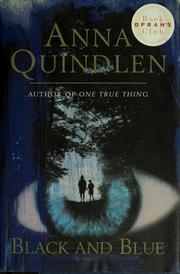
Black and Blue
2,456-word summary 11 min read 293 pages in the book
- First published
- 1998
- Publisher
- Random House
- Pages
- 293
- ISBN
- 9780375500510
Reading options
What's inside (9 sections)
I picked this up because I remembered the noise around it in 1998, when Oprah Winfrey made it a book club pick and suddenly everyone seemed to be talking about a novel concerning a battered wife. I expected a solemn, worthy book. What I found was something closer to a thriller, told in the first person by a woman who has spent eighteen years learning how to read the moods of the man who hurts her. It is Quindlen's third novel, published by Random House in 1998, 293 pages in the first hardcover edition, and it moves with a pace I did not expect from a book with this subject. By the end I was reading fast because I needed to know whether Bobby Benedetto would find her, and feeling a little guilty for wanting that so badly.
The night Fran decides to go
The narrator is Fran Benedetto, a nurse living in Brooklyn with her husband Bobby, a New York City police officer, and their ten-year-old son Robert. She tells us near the start that the first time he hit her she was nineteen. That line changes how everything after it reads. The marriage was not born violent. She fell in love with a man she describes as attractive and a little dangerous, and over the years the danger became the whole story.
Quindlen is good on the arithmetic of staying. Fran does not leave after the first blow, or the second, or the hundredth. She stays because she wants Robert to have a father, because she loves Bobby in spite of what he does, and because leaving a house means leaving the small order of a life. She writes that whenever she thought about leaving, she thought about leaving her house, the balloon shades and miniblinds, the mugs for the coffee, the small things, the routine and order that kept her there the longest. It is one of the sharpest lines in the book because it explains the delay without ever excusing it.
Quindlen also shows how the abuse works on the small scale, which is what makes it convincing. Bobby has a way of making Fran believe she is at fault, that she has been seeing other men at the hospital, that she made him slip on his bad knee. She writes about the cringing self who was afraid to pick up the remote control from the coffee table in case the sound set him off. The violence is only part of it. The humiliation comes first, and over time it turns into a hatred of herself that is harder to shake than any bruise. There are moments of tenderness too, and those are part of the trap, because they are what make the next apology believable.
The breaking point comes when Bobby breaks her nose. But the detail that actually pushes her out the door is the look on Robert's face. She has been hiding the bruises, telling herself the boy does not see, and then she sees that he has been watching all along. That is the night she stops packing an imaginary bag and really goes.
She does not vanish on her own. A woman named Patty Bancroft runs an agency for battered women that Fran describes as better than the Witness Protection Program, and through it she gets new papers and a town far from New York. The book is clear that this kind of escape takes a network of people and a great deal of nerve, not merely a suitcase and a bus ticket.
A new name in central Florida
Fran becomes Beth Crenshaw, and she and Robert end up in a small town in central Florida in a house she thinks is ugly. She tells the neighbors that her son is called Bobby, which is his father's name, and the choice is both a cover and a small wound she carries. Robert is enrolled in school. She finds work as a home health aide, helping sick people with the parts of daily living that have become hard for them.
The Florida section is where the book opens up. Fran grows close to her patients, especially Mrs. Levitt, an older woman who survived the Holocaust and who has her own history of what people can do to one another. She befriends Cindy Roerbacker, a local mother who meets her for coffee and muffins most mornings once the children are at school. And she gets to know Mike Riordan, a teacher and coach at Robert's school who takes an interest in the boy and, slowly, in her.
The practical details of the new life are handled with care. Fran has to keep the story straight, remember which name answers to which person, and avoid the kinds of attention that might put her in a newspaper. She has left a respectable life near the bay in Brooklyn, with friends and family and a home, for a duplex in a place where nobody knows her. Every ordinary pleasure is shadowed by the thought that a stray remark or a wrong document could bring Bobby to the door. Quindlen never lets you forget that safety here is a performance that has to be kept up, day after day, in front of a ten-year-old who resents it.
These people are not decoration. They give Fran a self to practice. The woman who arrives in Florida is flattened by fear, and the one who starts to make breakfast with Cindy and sit with Mrs. Levitt has a shape again. Quindlen writes about ordinary female friendship with a warmth that is easy to underestimate until you notice how little of the book is actually about Bobby. Most of it is about the life Fran builds while waiting for him.
The life she almost believes in
For a long stretch the novel lets you hope. Fran starts to feel something like safety. She is better at her job, she has friends, and her growing closeness with Mike brings back a part of her that the abuse had buried. She has spent years being told she was guilty, that she made Bobby hit her, that she brought the fist down on herself. In Florida she begins to suspect the opposite, that none of it was her fault.
There is a moment after a carnival accident when her face appears in the local paper and she refuses to move again. Up to then her plan has been to keep running whenever she feels exposed. Here she decides she has earned the right to stay. It is a small, stubborn act and one of the best scenes in the book, because it shows what recovery actually looks like. It is not a triumph. It is a woman deciding that fear no longer gets to choose her address.
Still, the fear never fully leaves. She knows Bobby has resources. He is a cop with access to databases and training, and her whole life in Florida hangs on the belief that he cannot put the pieces together. Quindlen keeps that dread running under the domestic scenes, and it is the reason the book works as suspense. Every pleasant morning with Cindy carries the question of how long it can last.
The title works on more than one level. On the surface it is the color of a bruise, the black and blue she has learned to hide under clothes and makeup. But it also names the strange chemistry the novel keeps describing between Fran and Bobby, the pull of attraction and destruction, lust and love, that she says he could provoke in her even after everything. The publisher's description calls it that combustion of opposites, and the book keeps returning to the uncomfortable fact that hatred and longing can live in the same person at the same time. Fran healing does not mean she stops feeling it. It means she finally stops obeying it.
I want to say something about the prose here. Quindlen writes in Fran's voice, clipped and watching, full of the small observations of someone who has learned to read a room for danger. On the outside, Fran writes, she looked fine: the job, the house, the kid, the husband, the smile. That sentence does more work than a chapter of explanation. The book is at its best when it stays inside that voice and trusts the reader to understand what is being described.
What Robert can't let go of
The person who cannot settle in Florida is Robert. He misses his father and cannot believe what his mother tells him about why they left. To him Bobby is simply a dad who used to be there, and Fran's warnings sound like excuses. The scene where his teacher asks the class to make a family tree and he can put only his mother's name on the page is a quiet gut punch. He is ten and he is being asked to draw a shape his life no longer has.
Fran tells him over and over that revealing who they are would put them both in danger. Robert nods and does not listen. One night he calls Bobby in New York. Fran tries to get the phone away, tells him to hang up, knows even as she reaches for it what is going to happen, and is too late. Bobby uses police technology to trace the call back to the house in Florida.
That single act is the hinge of the book. Everything Fran has built is undone by a child's loneliness, and Quindlen does not treat Robert as a traitor. He is a boy who wants his father, and the wanting is precisely what Bobby has always counted on. The tragedy is set up in the early chapters and it arrives with the feel of something that could not have been stopped.
Bobby finds them
Bobby comes to the house at night. Fran fights him, tries to get him to leave her and Robert alone, and loses. He chokes her until she passes out on the floor. When she comes to hours later the house has been torn apart and both Bobby and Robert are gone.
The aftermath is the hardest part to read. Fran does not get a clean rescue or a clear answer. She and Mike hire a private investigator, but Bobby has disappeared with the boy and neither can be found. There is no photograph, no confirmed sighting, no satisfying trail. She has to go on living without knowing where her son is or whether he is safe.
Quindlen resists the tidy solution. She gives Fran a new marriage to Mike and another child, and she lets her settle into the name Beth Crenshaw for good. Friends tell her that leaving was the right thing, that it probably saved her life. Fran hears them and is not convinced. The ending, a phone message from Robert saying he is safe with his father and unharmed, is deliberately double edged. She is relieved that he is alive and heartbroken that she will never see him again, and she spends the rest of the story wondering whether saving herself was worth losing her son.
That question is the book's real subject. Quindlen is not interested in a simple victory. She wants to show what a woman gives up when she walks out, and that the cost keeps being paid long after the immediate danger has passed.
What lands and what doesn't
I want to be fair about the parts that did not work for me. Because this began in the world of opinion columns, passages of the book read like a case being argued. There are places where Fran explains the psychology of abused women in a way that feels more like an article than a character thinking. Kirkus called the subject a talk show staple given compelling immediacy, and I think that is at once a compliment and a small criticism. The book wants to teach, and sometimes the teaching slows the story.
The book became a national sensation after Oprah Winfrey selected it in April 1998, and I think that history explains both its strengths and its limits. Quindlen was writing for an audience that wanted this subject taken seriously, and the novel clearly wants to help women understand their own delay in leaving. That ambition gives the book its moral weight. It also leads to a few passages that feel like they are addressing a meeting rather than a reader, and a modern reader may notice the argument more than the story in those stretches.
There is also the matter of the ending. Some readers find it honest and brave, others find it a cheat that pulls the punch of the chase. I land somewhere in the middle. The unresolved fate of Robert is true to the situation Quindlen is describing, and it is hard to see how a happy ending would not betray the point. At the same time, the decision to withhold a reunion leaves a chill that sits awkwardly beside the warmth of the Florida chapters.
What does land is the portrait of Fran herself. Quindlen writes about women as they really are, as Kirkus put it, neither helpless victims nor angry polemicists, but intelligent people trying to do what is right for the people they love and for themselves. That is the achievement here. The novel was an Oprah's Book Club selection in April 1998, and it was later made into a 1999 television movie starring Mary Stuart Masterson and Anthony LaPaglia, and again into the 2002 film Enough with Jennifer Lopez. Neither screen version carries the first person voice that makes the book worth reading.
Who should read it
I would hand this to a reader who wants a suspenseful novel with real weight behind it, and to anyone who has wondered why someone stays in a situation that is plainly hurting them. Fran's answer is not a slogan, and the book is better for it. It is also a novel about starting over, about the friends who make a new life possible, and about the way a mother's love can be turned against her by the man who shares her child.
It is not for everyone. If you want a clean resolution or a story that ends with the bad man punished, this will frustrate you. The violence is described plainly enough to be difficult, and the ending refuses to make the cost go away. But for a reader willing to sit with that, Black and Blue is a clear, careful, often moving book about how hard it is to leave and how long it takes to be free.
FAQ
Why does Fran leave her husband in Black and Blue?
After years of being beaten by Bobby, a New York City police officer, Fran finally runs when he breaks her nose and she sees the look on their son Robert's face. An agency run by Patty Bancroft gives her and Robert new identities in Florida.
Does Fran get away from Bobby in the end?
She escapes him physically and builds a new life as Beth Crenshaw, marrying Mike and having another child. Bobby traces a call Robert makes, attacks Fran and takes the boy, and the novel ends without a reunion.
Is Black and Blue a happy ending?
Not really. Fran survives and finds safety, but Robert is taken by his father and the book closes with her wondering whether leaving was worth the cost.
Similar books
The Sisters
Three sisters watch one another take the lives they imagined, across thirty years in Stockholm and Tunisia, in a novel that bends time like an accordion.
2,199-word summary · 10 min read
The Rest of Our Lives
A law professor drives his daughter to college, then heads west instead of home, testing a private promise he made twelve years ago.
2,238-word summary · 10 min read

Three Days in June
A Baltimore mother loses her job, and her ex-husband turns up with a rescue cat, in Anne Tyler's short, funny novel about the three days around her daughter's…
2,867-word summary · 13 min read
Theft
Gurnah traces three linked lives in Tanzania, where a servant's accusation of theft opens a family history of love, duty and quiet betrayal.
2,454-word summary · 11 min read

The Vacationers
A New York family's two-week stay in Mallorca turns into a comedy of exposed secrets when a magazine editor's affair and a son's debts come to light.
2,324-word summary · 10 min read

Good Girl
A nineteen-year-old artist in Berlin, grieving her mother, falls into an unequal romance with an American author who offers escape from the ideal of the good…
2,579-word summary · 11 min read

Flashlight
Susan Choi's Booker-shortlisted novel opens with a father and daughter on a breakwater in 1978, then follows the loss outward through four generations and…
2,849-word summary · 13 min read

Detransition, Baby
Torrey Peters's debut follows three Brooklyn adults as an unexpected pregnancy pushes them to imagine an unconventional family. Funny, sharp, and unwilling to…
2,925-word summary · 13 min read

Audition
Kitamura's Booker-shortlisted fifth novel tells the same lunch twice, with a young film student who believes he is the actress narrator's son. Two versions…
2,315-word summary · 10 min read
American Pastoral
Roth's Pulitzer winner follows a Newark glove maker's son whose perfect family life is broken by his daughter's antiwar bombing, retold by a narrator who…
2,660-word summary · 12 min read
The Mermaid Chair
Jessie Sullivan returns to her childhood home on Egret Island to care for her agoraphobic mother, then finds her marriage, her faith, and a monk's vow thrown…
2,237-word summary · 10 min read

Howards End
Forster's 1910 novel follows two families, a house in Hertfordshire, and a burned note, asking whether money and feeling can ever be connected.
2,187-word summary · 10 min read

Unaccustomed Earth
Lahiri’s second story collection follows Bengali families in America and abroad, tracing the quiet distances between parents and children, spouses, and the…
2,333-word summary · 10 min read

Sing You Home
A music therapist, her new wife and an evangelical ex-husband end up in court over three frozen IVF embryos.
2,952-word summary · 13 min read

A Spool of Blue Thread
Four generations of the Whitshank family in Baltimore, and the silences, resentments and quiet love they hand down without ever saying so.
2,408-word summary · 11 min read
The Most Fun We Ever Had
Four Sorenson sisters orbit perfect parents hiding old cracks.
2,590-word summary · 12 min read
Fates and Furies
Lauren Groff tells one 24 year marriage twice, first through Lotto's bright luck, then through Mathilde's hidden past and quiet control.
2,992-word summary · 13 min read
Dear Debbie
Advice columnist Debbie Mullen loses her job, tracks her husband's secrets, and decides it is time for payback against those who wronged her.
2,432-word summary · 11 min read
Freedom
A St. Paul couple and their grown children strain marriage, loyalty, and ideals in 2000s America.
2,678-word summary · 12 min read
There There
Twelve Native characters converge on a powwow in Oakland in Tommy Orange's 2018 debut about identity, family, and survival.
2,157-word summary · 10 min read

The Vegetarian
After a bloody dream, Yeong-hye stops eating meat, and her ordinary marriage cracks open in Han Kang's spare and unsettling novel.
2,302-word summary · 10 min read

Stoner
William Stoner trades farm life for literature, then endures a cold marriage and petty campus wars in John Williams's quiet classic.
2,282-word summary · 10 min read

Interpreter of Maladies
Nine stories follow Bengali families split between Calcutta and New England, through marriage, grief, and arrival.
2,412-word summary · 11 min read
The Namesake
Jhumpa Lahiri follows Gogol Ganguli from a hated namesake to adult loss, marriage, and family reckoning between Calcutta and Boston.
2,878-word summary · 13 min read

The Wilderness
Four Black women move through twenty years of friendship in Angela Flournoy's discontinuous, widely praised second novel.
2,141-word summary · 10 min read
The True True Story of Raja the Gullible (and His Mother)
A gay philosophy teacher in Beirut revisits six decades of Lebanese history, family trauma, and his thorny bond with his mother.
2,274-word summary · 10 min read

The South
A seventeen-year-old moves to his family's failing fruit orchard in 1990s Malaysia, where a summer love affair unfolds as the household and the land around him…
2,903-word summary · 13 min read

The Nix
A stalled novelist and community college professor goes looking for the mother who left him and finds a radical activist whose rock thrown at a governor made…
2,214-word summary · 10 min read
The Moonlight Child
On a cold January night, Sharon Lemke sees a child washing dishes in a neighbour's kitchen and decides she cannot ignore it.
2,169-word summary · 10 min read
The Loneliness of Sonia and Sunny
Two Indian families, a failed arranged match, and years between Allahabad and New York shape a slow, sprawling romance.
2,092-word summary · 9 min read