
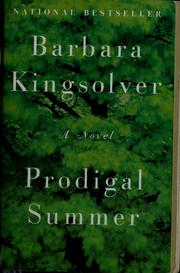
Prodigal Summer
2,308-word summary 10 min read 444 pages in the book
- First published
- 2000
- Publisher
- HarperCollins
- Pages
- 444
- ISBN
- 9780060959036
Reading options
What's inside (7 sections)
I started Prodigal Summer during a heat wave, windows open, moths tapping the lamp, and that turned out to be the right weather for it. The air in the book is just as thick. Barbara Kingsolver published it in 2000 with HarperCollins, 444 pages as listed on its Wikipedia page, ISBN 9780060959036. It follows one summer in a mountain valley in southern Appalachia, in Virginia, through three braided stories that touch more than they merge. I had read Kingsolver before and expected strong feeling about the wild. I did not expect how patient the book would be, how willing to watch a coyote cross a field for pages and call that plot.
That patience is the test. If you want a fast mystery, this will feel slow. If you like sitting on a porch while someone who knows trees tells you what is happening beyond the yard, the pace starts to feel like care. I finished it with grass in my shoes from pacing the garden between chapters, thinking about predators and moths more than I ever planned to.
Deanna Wolfe alone on the fire tower mountain
Deanna Wolfe is the first voice and the wildest. She works as a park ranger and wildlife technician, posted alone for the summer to watch a remote section of national forest, counting coyotes, checking traps, keeping poachers and stray livestock in line. She lives in a small cabin with no phone worth trusting, washes in cold water, keeps notebooks full of tracks and scat and weather. She chose the isolation after years of being the woman who knew too much in rooms where men wished she knew less.
Kingsolver gives Deanna a sharp eye and a body that belongs outdoors. She can tell a coyote track from a dog track at a glance. She knows when a den is active. She watches a female coyote she comes to think of as particular, not a pet, not a symbol, just an animal trying to raise young in a place that shoots such animals on sight. Deanna's job includes protecting predators the valley hates, which puts her at odds with almost every neighbor below.
Her solitude breaks when a young hunter named Eddie Bondo walks into her territory. He is tracking coyotes for the bounty and for pride, lean, talkative, sure of himself in the way young men are when the woods have always praised them. He finds Deanna's cabin, then finds reasons to return. He teases her about her fierceness. She corrects his biology and then, to her surprise, lets him stay for supper, then longer.
Their summer affair is physical and argued. They want each other and disagree about almost everything the forest means. Eddie sees coyotes as vermin that kill lambs and fawns and should be cleared. Deanna sees a returning native predator filling a gap left when wolves and cougars were wiped out, doing work that keeps rodents and deer in check. They fight on trails, in bed, over coffee. Kingsolver writes their talks with heat without making them lectures. He skins a kill. She shows him the pups. Neither converts the other quickly, which felt true to me. People do not change their hunting ethics in one speech, even a good one.
Deanna also carries older loss. A marriage that narrowed. A town that remembers her as difficult. A father whose memory sits in certain trees. Alone on the mountain she replays choices while she works, and the work steadies her. I liked the scenes where she simply does her job, resetting a camera, measuring a print, sitting still for an hour while light moves. Those passages ask the reader to slow down to animal time. Some readers will skim. I stopped skimming after the second chapter and let the pace set itself.
Lusa Maluf Landowski and the farm she never planned to keep
Down in the valley, Lusa's story starts with grief. Lusa Maluf, trained as an entomologist, married Cole Landowski, a farmer from a large tight family, expecting a life stitched between lab and field. Then Cole dies suddenly early in the marriage, leaving Lusa a widow in a farmhouse full of his relatives' opinions, with a small herd of goats, fields to manage, and almost no money.
Lusa knows insects, not livestock. She knows moths and pollinators, Latin names, life cycles. She does not know how to dose a sick goat or when to cut hay or how to face a Landowski Sunday dinner where everyone speaks as if she is temporary. Her sisters in law mean to be kind and still press. Sell the farm. Move back to the city. Let the family absorb the land. Lusa, stubborn in a quiet way, decides to stay, partly from love for Cole, partly because leaving would feel like erasing the choice she made.
Her ally and irritant is Jewel, one of Cole's sisters, who has children and little patience for pride. Jewel shows Lusa how to milk, how to watch for bloat, how to keep records. In return Lusa notices things the family has stopped seeing, the way moths crowd the porch light, the way a certain weed signals soil trouble, the way the goats favor one pasture. Kingsolver lets Lusa's science become practical rather than decorative. A lecture about pheromones turns into a way to trap pests without poison. A note about night pollinators turns into a reason to leave a fence row wild.
The moth thread grows through the summer. Lusa becomes fascinated by the sheer number and variety around the farm, the luna moths pale as paper, the sphinx moths hovering like small birds at dusk. She starts collecting, pinning, labeling, not from cold habit but from hunger to know one thing fully when everything else is uncertain. One strong scene has her staying up with a sheet and a light, children from the family creeping out to watch, all of them silent while wings accumulate. Grief does not lift in that scene. It loosens.
Lusa's money troubles sharpen the plot. The farm needs income. The family pushes tobacco or selling off parcels. Lusa considers goats for cheese, then discovers how much work and regulation that requires. She takes a low paying job tied to her training. She accepts help she hates accepting. Kingsolver does not rescue her with a sudden grant or romance. The rescue, if that word fits, is slower. Neighbors start to treat her as a Landowski by stubbornness rather than by blood, which in that valley counts as adoption.
Garnett Walker and the chestnut he cannot let die
The third thread belongs to Garnett Walker, an old man who has spent his retirement trying to bring back the American chestnut. The blight wiped the trees out early in the last century, and Garnett, whose family cut and loved those trees, crosses surviving shoots with resistant stock, keeps meticulous records, plants seedlings and watches many fail. He is cranky, devout in his way, lonely since his wife died, and fixed in habits that annoy everyone who likes him.
Garnett lives beside Nannie Rawley, an older woman who farms organically, keeps bees, refuses poison, and argues with Garnett across the fence about everything from pesticides to religion to whether his chestnuts will ever amount to anything. Their feud is the comedy of the book and, eventually, its tenderness. He sprays. She scolds. He leaves tomatoes on her porch. She leaves articles about chemicals in his mailbox. They both pretend not to look forward to it.
Kingsolver gives Garnett long interior passages about trees and time. He remembers chestnut trunks so wide a family could picnic in the shade of one. He remembers his father talking about the woods going grey as the blight moved through. His project is part science, part mourning. Each seedling is a bet that the future can hold something the past lost. When a storm or deer or carelessness kills a row, he plants again, swearing under his breath, writing the loss in his ledger with the date.
His age shows in good details. Stiff knees on slopes. Glasses fogging in humidity. A truck that needs coaxing. A church pew where he sits alone but still sings. He is not a quaint elder. He can be stubborn past sense, especially about Nannie. He dismisses her methods as fussy until her orchard outdoes his in a dry spell, and even then he credits rain before sense. I recognized men like Garnett from my own town, men whose love is real and whose manners need translation.
What moves his story is not a breakthrough but a softening. He starts to listen, not agree, just listen, when Nannie explains why she leaves certain weeds or why she plants for pollinators. He starts to save her a seedling without announcing it. The chestnut quest remains uncertain at summer's end, as it should. Trees outlast plans. Garnett knows that better than anyone.
Predators, moths, and the summer tying the threads
Kingsolver braids the three stories through ecology rather than coincidence. Coyotes move through all of them. Deanna tracks them on the mountain. Eddie hunts them down into the valley. Farmers, including the Landowskis, fear them for goats and calves. Garnett hears them at night and thinks about what the woods held before. Lusa reads about predator balance and wonders what removal does to everything below. The same animal is pest, wonder, data point, and neighbor depending on who looks.
Moths and night insects do similar work. Lusa studies them. Deanna notes what bats and birds take. Nannie plants for them without calling it study. Garnett notices which trees they favor. A reader who came for human drama may find these passages slow. I came to see them as the actual plot. The book argues, by showing rather than stating, that a valley is one creature with many skins, and that what happens on a ridge shows up in a goat pen weeks later.
The human crossings are light but placed well. Deanna knows of Lusa without knowing her. Lusa buys produce near Garnett and Nannie and hears about the old man's chestnuts. Eddie passes through valley stores where people talk about the widow holding on. Nobody gathers for a big finale. Summer itself gathers them, heat, storms, ripening, mating calls, migrations beginning. Kingsolver trusts the season to be the climax.
There are lovely set pieces. A storm that floods a road and strands two characters into honesty. A night of moth collecting that turns into a small party. A morning when Deanna finds proof her female coyote has pups and sits down hard from joy. A fence line argument between Garnett and Nannie that ends with shared pie rather than agreement. These scenes carry more feeling than any twist because they were earned by pages of work.
One small kindness I kept thinking about was how food moves between houses. Eggs, beans, corn, a jar of honey, a plate covered with a cloth. Nobody makes a speech about community. People just feed each other when work runs long. Lusa learns this late, after weeks of refusing help, when she finally accepts a ride, a loaned tool, a watched goat. Deanna learns it from the other side, remembering how to ask Eddie for a hand with a heavy gate even while arguing with him about the animals beyond it. Garnett and Nannie have been feeding each other for years while pretending the fence means separation.
Where the book sings and where it lectures
The strengths are clear. Place feels lived, not visited. The biology is specific enough to trust, coyote diet, chestnut blight history, moth diversity, without reading like copied notes. The three leads are distinct in voice. Deanna terse and physical. Lusa observant and raw. Garnett garrulous and formal. The valley talk sounds right, polite, evasive, suddenly blunt.
The weaknesses are just as clear and should be named. Kingsolver sometimes lets lesson crowd story. A talk about predators or poisons runs a page longer than the scene needs, and the character briefly becomes a mouthpiece. Readers who share her views will forgive it. Readers who do not may feel lectured. The plots are thin by design, a summer of work and waiting rather than reversals, so anyone needing momentum will drift in the middle third. And the naturalists are a touch saintly. Deanna and Nannie are right about most things in their fields, while skeptics like Eddie and Garnett are asked to do most of the changing. A little more fallibility on the green side would have balanced the moral weight.
I felt those drags, especially in a stretch where Deanna explains food webs while walking and Lusa explains insect decline while cooking. Both explanations are interesting. Both pause the human story to deliver them. I kept reading because the sentences are good and the details stick, but I marked pages where a firmer edit might have folded the facts tighter into action.
Even with that, the endings landed for me. Deanna must decide what her mountain solitude is for, whether knowing the coyotes means staying apart or stepping back toward people who need her knowledge. Lusa must decide what kind of farmer, and what kind of Landowski, she will be after mourning stops organizing every day. Garnett and Nannie must decide whether a lifetime of fence talk becomes something kinder before time decides for them. None of these close with a neat bow. They close like a season, with work done, work left, and seed set. Published in 2000 by HarperCollins at 444 pages, Prodigal Summer is best read slowly, a chapter a night with windows open, letting the moths and the coyotes do what Kingsolver believes they do, keep the human story honest by reminding it that it is only one story in the valley.
FAQ
What are the basic facts of Prodigal Summer?
It was published in 2000 by HarperCollins, 444 pages as listed on Wikipedia, ISBN 9780060959036. The setting is Virginia Appalachia.
How are the three stories connected?
Deanna, Lusa, and Garnett with Nannie share one summer valley. Coyotes, moths, and neighbor talk braid them without a single climax.
Is it plot driven?
No. It follows work, grief, and season change. Readers wanting fast reversals may find the middle slow, while place and biology carry it.
Similar books
Once There Were Wolves
A biologist reintroduces fourteen wolves to the Scottish Highlands while protecting her traumatized twin sister, then finds a body in the snow that could…
2,682-word summary · 12 min read

We Are All Completely Beside Ourselves
Rosemary tells of twin sister Fern, a chimp raised as family, and research fallout.
2,058-word summary · 9 min read

The History of Love
An elderly locksmith and a grieving teenage girl in New York are joined by a lost manuscript published in Spanish under another man's name.
2,805-word summary · 12 min read

Flight Behavior
Dellarobia Turnbow is stuck in a Tennessee farm marriage until a valley full of monarch butterflies, and the scientist who comes to study them, force her to…
2,051-word summary · 9 min read
The Bean Trees
Taylor Greer flees Kentucky, inherits Cherokee toddler Turtle, and roots with Tucson strays.
2,082-word summary · 9 min read
The Poisonwood Bible
A missionary drags his wife and four daughters to the Congo in 1959, and Africa remakes each of them.
2,227-word summary · 10 min read

The Japanese Lover
A Polish refugee and the son of a Japanese gardener fall in love in San Francisco in 1939, then keep the affair secret for nearly seventy years.
2,286-word summary · 10 min read
Make Way for Ducklings
A pair of mallards raise eight ducklings on the Charles River and lead them across Boston to the Public Garden, with a little help from a friendly policeman.
2,044-word summary · 9 min read

Alone With You in the Ether
Two people in Chicago agree to six conversations, and the experiment becomes a love affair that is also a study of bipolar disorder, obsession, and the shape…
2,713-word summary · 12 min read

Memories of My Melancholy Whores
A ninety-year-old journalist pays for a night with a teenage girl, cannot go through with it, and discovers love for the first time in García Márquez's late…
2,101-word summary · 9 min read

Howards End
Forster's 1910 novel follows two families, a house in Hertfordshire, and a burned note, asking whether money and feeling can ever be connected.
2,187-word summary · 10 min read

Fathers and Sons
Arkady brings the nihilist Bazarov home to his father's estate, and a generational argument turns into love, a duel, and an early death.
2,192-word summary · 10 min read

Unaccustomed Earth
Lahiri’s second story collection follows Bengali families in America and abroad, tracing the quiet distances between parents and children, spouses, and the…
2,333-word summary · 10 min read

The Age of Miracles
A California girl grows up while the Earth's rotation slows, and ordinary adolescence continues alongside slow catastrophe.
2,417-word summary · 11 min read
Peace Like a River
An asthmatic boy in the early 1960s narrates his family's search for his older brother, who is accused of two killings and has escaped custody.
1,969-word summary · 9 min read

We Are Okay
Marin fled San Francisco after her grandfather vanished and stopped answering anyone. When Mabel visits her college dorm, she has to say what happened.
2,253-word summary · 10 min read

The Chosen
A shattered pair of glasses in a 1944 Brooklyn softball game starts a friendship between a Hasidic boy and his Orthodox neighbor, and their fathers pull them…
2,443-word summary · 11 min read

A Spool of Blue Thread
Four generations of the Whitshank family in Baltimore, and the silences, resentments and quiet love they hand down without ever saying so.
2,408-word summary · 11 min read

This Is How You Lose Her
Yunior cycles through love affairs and betrayals in nine linked stories, tracing the damage he does and the family history behind it.
2,195-word summary · 10 min read
And Every Morning the Way Home Gets Longer and Longer
An elderly grandfather, his son, and his grandson share memories and fears as the old man's mind begins to fade, in a short novel about grief and love.
2,078-word summary · 9 min read

The Tiger's Wife
A young doctor in a war-scarred Balkan country chases the stories her grandfather left behind, including a deathless man and a deaf girl who loved an escaped…
2,232-word summary · 10 min read

The Story of Edgar Sawtelle
A mute boy on a Wisconsin dog-breeding farm relives Hamlet as his uncle returns, his father dies in the barn, and the dogs inherit what is left.
2,392-word summary · 11 min read

Olive, Again
Elizabeth Strout returns to Crosby, Maine, as Olive Kitteridge marries Jack Kennison, confronts her son, and faces old age, grief, and small-town judgment.
2,333-word summary · 10 min read
We Were the Mulvaneys
After a rape following a school dance, the Mulvaneys, a family that believed it was blessed, comes apart over fifteen years. Narrated by the youngest son.
2,094-word summary · 9 min read

Foster
A girl spends a summer with relatives on a Wexford farm and is cared for properly for the first time. A spare novella about family and what children notice…
2,043-word summary · 9 min read
By the River Piedra I Sat Down and Wept
Pilar, 29, meets her childhood friend again in Madrid and finds a rumored miracle worker. One winter week through the Pyrenees to the river Piedra, and the…
2,845-word summary · 13 min read
The Most Fun We Ever Had
Four Sorenson sisters orbit perfect parents hiding old cracks.
2,590-word summary · 12 min read

The Accidental Tourist
Grieving Macon writes travel guides for haters of travel, then Muriel intrudes.
2,252-word summary · 10 min read

Kitchen
Orphan Mikage finds home in a kitchen with Yuichi and Eriko after loss.
2,597-word summary · 12 min read

Drive Your Plow Over the Bones of the Dead
An old woman in Poland blames animal revenge for murdered hunters.
2,597-word summary · 12 min read