
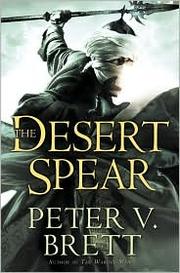
The Desert Spear
2,283-word summary 10 min read 608 pages in the book
- First published
- 2010
- Publisher
- Del Rey Books
- Pages
- 608
- ISBN
- 9780345503817
- Series
- The Demon Cycle (#2)
Reading options
What's inside (7 sections)
I came to The Desert Spear with the wrong expectations, and I think that is the most useful thing I can tell you up front. After The Warded Man I was braced for another tight, three-person scramble against the night, with Arlen, Leesha, and Rojer each getting a slice of the story and the whole thing building toward one big siege. Instead Brett opens the map wider and spends a lot of this 2010 sequel in a place the first book only hinted at: the desert city state of Krasia, where people do not hide from demons at all. They go out and fight them with spears, every single night. That decision gives the book its best material and also its longest stretches of politics and doctrine, which is a trade I would still make, but you should know the shape of it going in.
This is book two of five in The Demon Cycle, published in April 2010, by Del Rey in the United States and Voyager in Britain. It picks up after the defense of Cutter's Hollow and it is a bigger, more self conscious novel than its predecessor. Where the first book was a clean three strand narrative, this one is told through several voices and wrapped in a framing device that Brett uses to explain how the story came to be written. Some readers love that device. Some find it fussy. I landed somewhere in the middle, and I will say more about it later.
A story told from the desert
The frame is worth getting straight early, because it explains why the book sounds different from the one before it. Much of The Desert Spear is presented as a chronicle set down by Ahman Jardir, a Krasian warrior, at the request of the man the Krasians call the Deliverer. Leesha's account is woven in alongside his, so the same events get told from more than one angle, and sometimes one narrator corrects or contradicts the other. On the page this means you are never quite sure whose version you are getting, and that uncertainty is deliberate. Brett is interested in how legends get made, in who gets to write the official story of a war, and in how a man's reputation can grow teeth of its own. For a fantasy novel about demons, that is surprisingly grown up material.
Jardir is the great addition here, and he is a far more interesting figure than a simple villain or a simple hero. He grows up in Krasia as the son of a war chief, inside a culture that has turned nightly demon warfare into a religion. He is ambitious, disciplined, and certain that he was born to lead his people out of the dark. His rise through the ranks of the sharum, the warrior class, is told in detail, right up to the title of SharDumaji, the Spear of the Ward. Watching him earn that standing is genuinely gripping, because Brett makes you understand why his people would follow him. He is not a fraud. He really is brave, really is a brilliant fighter, and really does believe the old stories about a Deliverer who will one day end the night.
The Krasian chapters are where the book earns its keep. Imagine a city where dusk is not a signal to bolt the door but a call to muster. The sharum go out into a walled fighting ground and meet corelings with spear and shield, while the families wait behind strong wards and priests chant from the high places. Killing a demon is a deed that can win you status, land, and a wife. Brett builds this society with real care: the ranks, the rituals, the prayers, the uneasy alliance between the warriors and the dama, the priestly class. It feels like a place with a history rather than a backdrop painted for one fight, and the nightly battles in the maze are as vivid as anything in the series.
Brett also does something clever with the demons themselves. Readers of the first book know the corelings by their elements, flame and rock and wind and wood, and those categories carry over. In Krasia, though, the nightly fight has made people study them the way a soldier studies an enemy army. The sharum learn which demons can be outrun, which must be met head on, and which tricks of spear work buy a precious second. That practical knowledge is threaded through the battle scenes and gives them a texture beyond simple description. When a fight goes badly, you understand why, because Brett has already shown you what the warrior knew and which assumption failed. It is the sort of detail that makes a fictional war feel reported rather than imagined.
The cost of a culture built on war
The same chapters also carry the book's most uncomfortable material. Krasia is a hard, unequal place, and Brett does not soften it. Women live under strict rules, their chances shaped by marriage contracts and by the men who hold power over them. Children are trained early into roles chosen for them. Honor and shame are weapons that people use on each other, and the language of prophecy is used to justify plenty of ugly behavior. I read these sections with a mix of fascination and irritation, which I think is the intended response, though the book does not always thread that needle cleanly. If the gender politics of the first novel made you uneasy, this one pushes further, and the ambiguity around Jardir's treatment of the women around him is not resolved in any tidy way.
One of the best ways Brett has of showing you this world from the outside is Corban, a foreigner who ends up enslaved in Krasia and becomes a scribe and tutor. Because Corban comes from beyond the desert, he can ask the questions a native cannot, and he is the one who puts Jardir's story into words. He is also living proof that the world is larger than either the northern villages or the Krasian city state. His chapters give the book a patient, observant texture, and his position as a literate outsider makes the whole chronicle device feel less like a trick and more like something that could have happened. He is one of my favorite parts of the book, and he barely gets mentioned in most talk about it.
Running alongside Jardir's rise is the matter of the Deliverer himself. In the first book Arlen Bales carved fighting wards into his own skin and became the Warded Man, a figure who could walk out at night and kill corelings bare handed. Word of him has spread, and in Krasia the old prophecies have latched onto him. The trouble is that Arlen is in bad shape. The wards in his skin are failing him, his body is paying for years of scars and magic, and the identity of the Warded Man has grown into something he did not choose. When the Krasians speak of the Deliverer, they mostly mean him, but Arlen has never wanted to be anybody's savior. Watching him dodge that role while his own strength drains away gives the book a melancholy current that the first one did not have.
Two men, one title
The heart of the novel is the relationship between Arlen and Jardir, and it is a messy one. They were friends once, or as close to friends as a northern wanderer and a desert warlord could be, and then the events of the first book drove them apart over a discovery both men wanted to claim. Here they circle each other again, and the old wound is still there. Jardir respects Arlen, even reveres him, but he also wants what Arlen has. When Jardir learns that a man can put fighting wards into his own flesh, the balance shifts. Now there are two people who can do the impossible, and both have a claim on the title the Krasians have been waiting centuries to bestow.
That is the engine of the book's second half. Jardir's ambition is not simple greed; he thinks humanity needs a single leader who will stop hiding and take the fight to the corelings, and he believes he is the one to do it. Arlen's objection is not that the fight is wrong but that Jardir wants to own it, and that a prophecy wrapped around one man leaves no room for the Leeshas and Rojers of the world. Brett never fully settles who is right, which is part of what makes the argument interesting. The climax brings the two into direct confrontation, with the Krasian priesthood and the fate of both peoples tangled up in it, and it ends on a note that is closer to a standoff than a resolution. If you want every thread tied off, the last chapters will frustrate you. If you are happy to have the next book waiting, they work.
I want to linger on that earlier friendship, because the book does. The two men met in the desert in the first novel, learned from each other, and found the lost fighting wards together. What they did with the discovery tore them apart. Jardir wanted it to be the foundation of his people's rise; Arlen wanted it for everyone, including the villagers the Krasians looked down on. That argument is the real root of the rivalry, and Brett keeps returning to it, so the final confrontation carries the weight of something old rather than a last minute grudge. It is also why the book resists an easy answer. Both men have a point, and the damage between them is not undone by a single fight.
Leesha and Rojer keep the northern thread alive, and they are the reason the book still feels like a continuation rather than a spin off. Leesha has become the Herb Gatherer of the Hollow, a woman with real standing and real skill, and she is drawn into the desert story with a group that includes Rojer. Her medicine matters in a place where survival is measured in wounds, and her plainspoken competence keeps puncturing the grand religious talk around her. Rojer, the Jongleur with the ruined hand and the fiddle, gets some of the best scenes. His music has an odd power over corelings, something the book keeps circling without ever fully explaining, and watching him use it is a pleasure. The two of them have an old, tangled affection that Brett handles with more delicacy than you might expect in a book full of spears.
Where it slows, and who it is for
I want to be honest about the drag, because it is real. The Desert Spear runs more than six hundred pages in the Del Rey hardcover, and a good stretch of the middle is given over to Krasian law, succession, and argument among the dama. Some of that is fascinating. Some of it felt like reading a constitution written by people who really like titles. The framing device also takes getting used to; just as a scene gathers force, the narration can pull back to comment on how the account was recorded, and that interrupts the momentum more than once. There were evenings when I wanted Brett to stop explaining the hierarchy and get back to the demons.
The other honest point is that this is a darker, more political book than the first. Rape, slavery, and ritualized violence are not background color here; they are part of how the society works, and the book asks you to sit with that for hundreds of pages. Readers who came for the clean fun of villagers holding a wall against the night may find the mood changed. I would still recommend it to anyone who finished The Warded Man and wanted more of this world, but I would point them at it with a caveat: the best pages are the ones where Brett lets his characters act rather than explain themselves, and those pages are worth wading through the doctrine to reach.
What stays with me is the idea at the center of it all. The first book asked whether hiding could save you. This one asks what happens when somebody decides the answer is no and offers to lead the charge. Brett is smart enough to see that a savior with a spear is still a man with an agenda, and that the people who need saving rarely get a vote. The demon nights are as good as ever, the maze fights crackle, and the final confrontation between Arlen and Jardir had me genuinely unsure how I wanted it to end. That is a better feeling than certainty.
A note before you start
Read this one after The Warded Man, not instead of it. The book assumes you know who Arlen, Leesha, and Rojer are and what happened at the Hollow, and the Jardir story only lands if you remember the betrayal that set the two men against each other. The American Del Rey edition is the one I read, and it runs 608 pages in hardcover, which is the edition the ISBN on this page belongs to; the British Voyager edition is a different book block, so page numbers in reviews will not always match. Third in the sequence is The Daylight War, which picks up the Arlen and Jardir tangle and takes the fight against the corelings somewhere larger. The Desert Spear does not tidy up its arguments, but it deepens them, and it turns a two hour demon romp into something with actual weight on its mind.
FAQ
Do I need to read The Warded Man first?
Yes. The Desert Spear picks up after the defense of Cutter's Hollow and assumes you know Arlen, Leesha, and Rojer, and remember Arlen's falling out with Jardir.
Is this the last book in The Demon Cycle?
No. It is book two of five, published in 2010. The Daylight War follows in 2013, then The Skull Throne and The Core.
Is it as fast paced as the first book?
Not quite. A large share of the middle covers Krasian religion and politics, and the narration sometimes steps back to comment on how the chronicle was recorded.
Similar books
More from The Demon Cycle first, then related titles.
The Warded Man
Each night demons rise and humanity hides behind wards. Three young survivors choose to fight back in Brett's 2008 fantasy opener.
2,703-word summary · 12 min read
The Gunslinger Born
A Marvel graphic novel adapting the flashback of Wizard and Glass: a fourteen-year-old Roland earns his guns, loves Susan Delgado and first sees the Dark Tower.
2,010-word summary · 9 min read
The Devils
A monk inherits a church agency full of dangerous prisoners while a street thief is claimed as Troy's heir. Abercrombie's grimdark fantasy begins with monsters…
2,314-word summary · 10 min read
Kushiel's Dart
Born with a scarlet mote in her eye, Phèdre nó Delaunay is sold into servitude, trained as a courtesan and spy, then thrown into a conspiracy that threatens…
2,789-word summary · 12 min read
Keys to the Demon Prison
The fifth and final Fablehaven book sends Kendra and Seth Sorenson across secret preserves to keep the last keys to the demon prison out of rival hands.
2,251-word summary · 10 min read
The Lady of the Lake
Ciri is trapped by the Aen Elle while Geralt winters in Toussaint, and the Witcher saga closes with the siege of Stygga and a fog-bound farewell.
2,445-word summary · 11 min read
Ptolemy's Gate
Nathaniel and a weakened Bartimaeus face a possession plot in Stroud's dark final Bartimaeus novel.
2,328-word summary · 10 min read
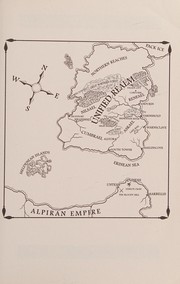
Blood Song
Anthony Ryan's Blood Song follows Vaelin Al Sorna from the Sixth Order's brutal training to the war that earns him the name Hope-Killer, in the first Raven's…
2,479-word summary · 11 min read

The Blinding Knife
Kip trains to join the Blackguard while the Prism hides his true identity, loses his colors, and fights a war against a rogue drafter who wants to birth a god.
2,049-word summary · 9 min read
Homeland
Drizzt Do'Urden is born into the cruel drow city of Menzoberranzan, where his father teaches him to fight and to doubt everything his family believes.
2,303-word summary · 10 min read
Nettle & Bone
Marra, a princess in a convent, leaves to save her abused sister, but first she must finish three impossible tasks: a bone dog, a nettle cloak, moonlight in a…
2,061-word summary · 9 min read

We Hunt the Flame
In a fractured Arabia-inspired world, a disguised huntress and a prince-assassin race to find a magic-restoring book and confront an ancient evil.
2,195-word summary · 10 min read
The Battle for Skandia
Will and Evanlyn are still hiding in the Skandian mountains when Halt and Horace arrive with word of a Temujai invasion that could roll on to Araluen next.
2,248-word summary · 10 min read
The Tower of the Swallow
Ciri flees as a bandit while Geralt gathers allies to find her.
2,580-word summary · 11 min read
The Burning God
Rin burns south and bargains with the Phoenix as the Republic splits.
2,381-word summary · 11 min read
Demon Slayer: Kimetsu no Yaiba, Vol. 1
Tanjiro joins the corps after demons kill his family and turn Nezuko.
2,478-word summary · 11 min read
The Black Prism
Dying Prism Gavin Guile hides a secret son while war brews over color magic in the Seven Satrapies.
2,169-word summary · 10 min read

The Amulet of Samarkand
Boy magician Nathaniel summons djinn Bartimaeus to steal the Amulet and stop Lovelace's coup in London.
2,350-word summary · 10 min read
Gardens of the Moon
Empire, gods, and mages collide over Darujhistan as Bridgeburners bleed for Empress Laseen.
2,188-word summary · 10 min read
Baptism of Fire
Wounded Geralt crosses war country with odd allies to find Ciri after the Thanedd coup.
2,076-word summary · 9 min read
Last Argument of Kings
Jezal takes the crown, Glokta serves two masters, and Logen faces Bethod as the Gurkish close on Adua.
2,479-word summary · 11 min read
Before They Are Hanged
Glokta holds Dagoska, West fights Bethod in the North, and Bayaz chases the Seed with Logen and Jezal.
2,090-word summary · 9 min read
The Blade Itself
A torturer, a barbarian, and a spoiled officer circle a wizard quest that serves banks more than heroes.
1,998-word summary · 9 min read

Fairy Tale
A grieving teen cares for a recluse and his old dog, then finds a shed well leading to Empis, a fading world at war.
3,203-word summary · 14 min read
City of Heavenly Fire
Clary and Jace face Sebastian's dark army while Emma and Julian's story begins in Los Angeles.
2,039-word summary · 9 min read
House of Flame and Shadow
Bryce lands outside Midgard while Hunt sits in Asteri dungeons and the war for two worlds builds.
2,983-word summary · 13 min read
City of Glass
Clary follows Jace to Alicante in Idris where Valentine plans to use the Soul-Sword on Shadowhunters and the Clave splits under pressure.
3,645-word summary · 16 min read
City of Ashes
Clary risks the Clave trial while Valentine raises demons and Jace pulls away in New York.
4,684-word summary · 21 min read

City of Bones
City of Bones retold: Clary sees Shadowhunters, Jace and the Cup, Valentine, and the Institute attack.
2,535-word summary · 11 min read
A Court of Wings and Ruin
ACOTAR book 3 retold: Feyre spies in Spring, the cauldron war, and the High Lords against Hybern.
2,454-word summary · 11 min read