
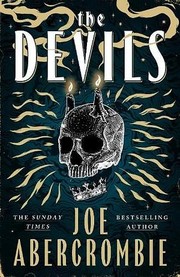
The Devils
2,314-word summary 10 min read 565 pages in the book
- First published
- 2025
- Publisher
- Gollancz
- Pages
- 565
- ISBN
- 9781399603560
Reading options
What's inside (9 sections)
I picked this up because the pitch sounded like a joke I wanted to see played straight. Abercrombie has said the whole thing began with an idea about a set of monsters employed by the pope, and that is more or less the book you get. Gollancz published it in Britain on 6 May 2025, 565 pages in the first edition, and Tor brought out a 560-page version in the United States. It is a grimdark fantasy set in an alternate medieval Europe, which is a tidy way of saying churches, dukes and holy wars with the moral comfort drained away. By the last page I had enjoyed the ride and also felt it repeat itself more than it needed to.
Brother Diaz and the Chapel of the Holy Expediency
The story starts with a monk. Brother Diaz is a man of the cloth who expects a quiet life and gets something else entirely. He is made vicar of the Chapel of the Holy Expediency, which sounds like a harmless church office until you learn what it actually is. The Chapel is a secret agency, and the people locked in its care are not parishioners. They are the devils of the title, kept prisoner because the Church finds them useful and dangerous in equal measure.
The cell is a strange collection. There is Balthazar, a necromancer whose powers are tied to the dead. There is Sunny, an elf. Baron Rikard is a vampire, Vigga is a werewolf, and Jakob is a knight. These are not heroes who have fallen on hard times. They are monsters with their own agendas, held behind walls and put to work when the Church needs something done that a respectable person could not be seen doing. The arrangement is comfortable for the cardinals and miserable for everyone else.
Diaz is the hinge of the whole design. He is an ordinary believer dropped into a room full of creatures his faith tells him are damned, and he has to learn to work with them rather than merely command them. His discomfort is the entry point for the reader. We see the monsters through his suspicious eyes at first, and then, slowly, we start to see them as people with habits and grievances and senses of humour. Abercrombie is good at this kind of reclassification. The thing that frightens you at the start becomes the thing you root for, without ever being made soft or safe.
The Chapel itself is one of the pleasures of the book. It is bureaucratic and sinister at once, a church department that files its prisoners and assigns its missions with the same dull efficiency a real institution might use for tax records. The joke is that the most frightening people in the story are often the ones in clerical robes, not the ones with fangs. That idea runs all the way through The Devils, and it gives the fantasy a sour, recognizable edge.
Alex, the thief who became a princess
Running alongside the Diaz story is a different one. Alex is a street thief, living by her wits and not particularly troubled by the niceties of other people's property. Her life changes when Duke Michael of Nicaea rescues her and tells her something she could not have expected. He says she is Princess Alexia Pyrogennetos, heir to the Serpent Throne of Troy.
Whether he believes it himself is one of the quiet questions the book keeps open. What matters for the plot is that the claim gives the Church a problem and then a mission. The late aunt Eudoxia had sons who want the throne, and they are not the sort of rivals who will settle for a polite disagreement. So the Chapel is bound to escort this supposed princess to Troy, to put her on the Serpent Throne before Eudoxia's side can take it.
I enjoyed this half of the book more than I expected to. Alex is a good creation, sharp and evasive and unwilling to be anyone's symbol. She did not grow up expecting to be a princess, and nothing about her behaves like a person who did. The gap between the role she is handed and the person she actually is gives the story its best running joke, and later its most genuine moment of tension. When she finally admits to Sunny that she is a thief who assumed the princess's identity, it lands because the book has spent hundreds of pages letting us sit inside that lie with her.
Duke Michael is a harder figure to read, and that is deliberate. He rescues Alex, promotes her, and pushes her toward a crown. He also has reasons of his own that he keeps to himself. The reveal late in the book, that he used Alex to seize the throne, re-colours everything he did earlier. Reading it the second time, you can see the calculation hiding inside the kindness. It is a neat piece of construction and a nasty one, which suits the book.
The escort mission starts to come apart
Once the Chapel is committed to the escort, the road to Troy becomes a series of attacks and betrayals. This is where the book settles into the rhythm that would eventually make some readers impatient. The group is ambushed, someone is hurt, a traitor is revealed, the monsters are unleashed to get everyone out, and then the whole pattern repeats with fresh names.
The first serious hit comes from Duke Marcian, who attacks with hybrid soldiers. These are not ordinary troops, and the fight establishes that the dukes of this Europe are willing to make monsters of their own when it suits them. Jakob, the knight among the Chapel's prisoners, is stabbed in the fighting. It is a reminder that despite the supernatural muscle on display, the people in this story can be hurt and can die like anyone else.
Vigga, the werewolf, turns on the group before being calmed. This is the book at its most blunt, showing that the devils are dangerous to their own side and that Diaz's control over them is thinner than he would like. A pilgrim bishop then betrays the company to Duke Constans. The bishop is a nice touch, because he looks like the holiest person in the story and turns out to be the least trustworthy. Abercrombie keeps using clergy that way, and the running suspicion it produces is one of the book's better habits.
The pacing here is the main thing I would argue with. Each crisis is followed by another crisis, and the pattern is close enough that after a while I could predict the shape of a scene before the details arrived. The monsters get loose, the odds look bad, somebody's particular power solves the immediate problem, and the group moves on with one more wound and one more secret. It is effective in the moment and slightly wearing across hundreds of pages.
Venice and the box from the cursed house
The company reaches Venice, where they have to retrieve a box from a cursed house. This is one of the more memorable stretches of the book, mostly because the setting gives the grotesque material somewhere interesting to happen. A cursed house in Venice feels like the right place for a church agency and its prisoners to find something they should not have touched. The box matters to the mission, and the trouble it takes to get it shows how much every step of this journey costs.
They take the box and set sail, and the sea is where the pursuit catches up with them. Duke Constans rams their ship. The sequence is violent and clear, and it ends with Jakob killing Constans. The knight has been the most reliable of the Chapel's prisoners up to this point, a figure of brute competence amid a lot of scheming, and giving him the kill here makes sense. It also puts blood on the group in a way they cannot take back.
The sea section works better than some of the road sections because it has a single, legible goal. Get the box to Troy. Everything between Venice and the next port serves that aim, and the narrower focus sharpens the writing. I found myself more engaged here than in some of the earlier skirmishes, where the stakes felt generated mainly to keep the escort moving.
Dukes of Hell, dukes of Troy
Two of the book's biggest set pieces come close together. Balthazar, the necromancer, tries to summon a Duke of Hell to break the papal binding that holds him. It fails. That failure is important because it takes away the easy exit. The monsters cannot simply call in a bigger monster and go home. They are stuck with the Church's leash and with each other, and the story gets darker for it.
Jakob then duels Duke Sabbas, while Balthazar raises undead that drag Sabbas into a pit. This is Abercrombie doing what he does best, which is stage a fight with real physical weight and then undercut any sense of glory around it. The victory is ugly and improvised. Nobody gives a speech about it. The undead do the work that a hero's sword might have done in a different fantasy, and the whole business leaves the group further from the clean fight they probably imagined when they signed on.
What I appreciate about these scenes is that the solutions belong to the characters. Balthazar's power has a cost and a limit, Jakob's strength has a price, and neither is a free pass. The trouble is that the same structure keeps returning. The Forbes review by Erik Kain called the book a rare misfire and pointed to exactly this problem, that the heroes' powers repeatedly rescue them from dire odds. I think that is a fair complaint. The fights are individually well made. Stacked together, they start to feel like variations on one trick.
Troy and the truth about Severa
The company finally reaches Troy, and the last act rearranges everything the earlier chapters set up. Lady Severa welcomes them, and Duke Arcadius proposes marriage to Alex. For a moment it looks like the story might settle into court intrigue rather than open warfare. That does not last. Alex confesses to Sunny that she is a thief who took the princess's identity, which is the emotional centre of the book and the moment when the pretence stops being a joke.
After the coronation, Eudoxia's former apprentices kill Arcadius. The devils return, and Vigga accidentally kills Baptiste. Then Balthazar makes the discovery that reframes the whole contest: Severa is Eudoxia in another body. The rival the group was fighting has been in front of them the entire time, wearing a different face. It is the kind of reveal that should feel cheap in a lesser book, and here it mostly works, because Abercrombie has planted enough odd behaviour around Severa that the answer feels earned when it arrives.
Michael's reveal follows. He tells Alex that he used her to seize the throne, and Jakob tackles him into the sea. The image of the knight taking the manipulator over the edge is a satisfying physical end to a long run of verbal schemes. Then Cardinal Zizka refuses to free the devils. That refusal is the book's final cold note. The monsters did the work, took the risks, and paid the price, and the Church that owned them simply keeps the doors locked. There is no reward and no ceremony, just the same arrangement with the same people in charge.
What worked, and what did not
I think the world is the strongest thing here. Abigail Nussbaum, writing in The Guardian, called the worldbuilding a chief pleasure and compared the book to Suicide Squad in a sideways medieval Europe. That comparison is close. The fun comes from watching a fixed team of difficult, dangerous people get pushed through a series of impossible jobs, and from the friction between their competence and their contempt for the institution directing them. The Chapel is nasty and funny, and the alternate Europe is detailed enough to feel lived in without stopping for a history lesson.
The character work is uneven in the same way the plotting is. Diaz, Alex and Balthazar have clear wants and clear ways of getting in their own way. Some of the dukes are thinner, functional obstacles with a title rather than fully realized people. That may be a matter of scale. With a large cast and a long journey, a few figures are always going to be drawn in fewer lines than others. It is a fair trade in a book this size, though it means the later conspiracies carry less weight than they should.
The repetition is the real cost. Kain's complaint about the rescue pattern is the one I kept agreeing with as I read. There are only so many times a group can be cornered, saved by a specific talent, and moved down the road before the tension becomes mechanical. The book is long enough that it could have used a tighter second act. A few of the attacks could have been cut or merged, and the ones that remained would have landed harder.
I would hand this to a reader who likes ensemble fantasy with a sour sense of humour and does not mind a book that runs long. I would be careful with someone looking for a tight plot or a clean moral line. The Devils is not interested in either. It is a book about monsters doing the Church's dirty work and finding that their masters are worse than they are, told with a lot of energy and a little too much of the same move. I finished it glad I had read it and ready for a shorter version.
FAQ
Is The Devils part of a series?
No. It is a standalone grimdark fantasy from Joe Abercrombie, published in Britain by Gollancz in 2025.
Where did the idea for the book come from?
Abercrombie has said it began with an idea about a set of monsters employed by the pope, which became the Chapel of the Holy Expediency and its prisoners.
What is the main criticism of the book?
Erik Kain of Forbes called it a rare misfire, faulting a repetitive plot in which the heroes' powers repeatedly rescue the group from dire odds.
Similar books

Homeland
Drizzt Do'Urden is born into the cruel drow city of Menzoberranzan, where his father teaches him to fight and to doubt everything his family believes.
2,303-word summary · 10 min read

Nettle & Bone
Marra, a princess in a convent, leaves to save her abused sister, but first she must finish three impossible tasks: a bone dog, a nettle cloak, moonlight in a…
2,061-word summary · 9 min read
Last Argument of Kings
Jezal takes the crown, Glokta serves two masters, and Logen faces Bethod as the Gurkish close on Adua.
2,479-word summary · 11 min read
Before They Are Hanged
Glokta holds Dagoska, West fights Bethod in the North, and Bayaz chases the Seed with Logen and Jezal.
2,090-word summary · 9 min read

The Blade Itself
A torturer, a barbarian, and a spoiled officer circle a wizard quest that serves banks more than heroes.
1,998-word summary · 9 min read
The Magician's Land
Exiled from Fillory, Quentin takes a teaching job at Brakebills, joins a crew of magical thieves, and must help rebuild a dying world to finish the trilogy.
2,204-word summary · 10 min read
The Demon King
A thief steals an amulet once owned by a legendary sorcerer, while a princess flees a forced marriage in the first volume of Cinda Williams Chima's high…
2,371-word summary · 11 min read
Jade City
On an island where jade grants power, two clans fight over the mineral, the family name, and the right to decide what loyalty costs.
2,403-word summary · 11 min read
This Kingdom Will Not Kill Me
A grocery delivery driver wakes in a fantasy capital she knows from an unfinished trilogy, only to discover she cannot die.
2,339-word summary · 10 min read
The Woman Who Rides Like a Man
Newly knighted, Alanna heads south into Tortall's desert, where a broken sword and a dead shaman leave her responsible for a rebel tribe and three Gifted…
2,894-word summary · 13 min read
The Sorceress
Flamel takes the twins to London to find Gilgamesh, while Perenelle fights for her life on Alcatraz and an older threat wakes.
2,684-word summary · 12 min read
The Lost Metal
Wax Ladrian returns to stop his sister's plot to smuggle a magical bomb into Elendel, in the conclusion of Mistborn's second era.
2,038-word summary · 9 min read
The Gunslinger Born
A Marvel graphic novel adapting the flashback of Wizard and Glass: a fourteen-year-old Roland earns his guns, loves Susan Delgado and first sees the Dark Tower.
2,010-word summary · 9 min read
The Girl of Fire and Thorns
Rae Carson's debut follows Elisa, an insecure princess born with a godstone in her navel, who is married to a foreign king and must grow into the leader a…
2,331-word summary · 10 min read
The Book of Three
A restless assistant pig-keeper in mythical Wales chases his escaped oracle pig and finds himself beside Prince Gwydion in a war against the Lord of Annuvin.
2,019-word summary · 9 min read
The Book of Lost Things
A twelve-year-old boy grieving his mother's death slips through a crack in the garden wall into Elsewhere, where fairy tales and a fading king guard the secret…
2,441-word summary · 11 min read
Temple of the Winds
In Sword of Truth book four, a magical plague sweeps the Midlands and prophecy demands that Richard enter the Temple of the Winds, but only through an…
2,962-word summary · 13 min read

Magic Study
Sentenced to die in Ixia, Yelena returns to the land she was stolen from to learn the magic that made her an outlaw.
2,542-word summary · 11 min read
Kushiel's Dart
Born with a scarlet mote in her eye, Phèdre nó Delaunay is sold into servitude, trained as a courtesan and spy, then thrown into a conspiracy that threatens…
2,789-word summary · 12 min read
Keys to the Demon Prison
The fifth and final Fablehaven book sends Kendra and Seth Sorenson across secret preserves to keep the last keys to the demon prison out of rival hands.
2,251-word summary · 10 min read
Golden Fool
FitzChivalry Farseer returns to Buckkeep as a servant and a grieving Skillmaster, teaching Prince Dutiful while court intrigue, the Piebalds and a…
2,583-word summary · 11 min read
Fool's Fate
Prince Dutiful must kill a dragon to secure his betrothal, and FitzChivalry Farseer is caught between the Fool and Chade over Icefyre's fate.
2,247-word summary · 10 min read
Dragon Rider
A silver dragon, a sharp-tongued brownie and a lonely orphan boy cross deserts and seas to find the dragons' lost homeland, pursued by a golden killer made by…
3,188-word summary · 14 min read
Blood of the Fold
In Sword of Truth book three, Richard Rahl takes command of Aydindril while a zealot army and an emperor who walks in dreams threaten everything he loves.
2,321-word summary · 10 min read
The Lady of the Lake
Ciri is trapped by the Aen Elle while Geralt winters in Toussaint, and the Witcher saga closes with the siege of Stygga and a fog-bound farewell.
2,445-word summary · 11 min read
The Desert Spear
Peter V. Brett's 2010 sequel moves the fight to Krasia, where spear-armed warriors hunt demons nightly and a rival rises to challenge the Warded Man.
2,283-word summary · 10 min read
Pyramids
A prince raised by assassins comes home to a desert kingdom where the high priest rules and a spitefully huge pyramid starts bending time.
2,441-word summary · 11 min read
Ptolemy's Gate
Nathaniel and a weakened Bartimaeus face a possession plot in Stroud's dark final Bartimaeus novel.
2,328-word summary · 10 min read
Blood Song
Anthony Ryan's Blood Song follows Vaelin Al Sorna from the Sixth Order's brutal training to the war that earns him the name Hope-Killer, in the first Raven's…
2,479-word summary · 11 min read

The Blinding Knife
Kip trains to join the Blackguard while the Prism hides his true identity, loses his colors, and fights a war against a rogue drafter who wants to birth a god.
2,049-word summary · 9 min read