
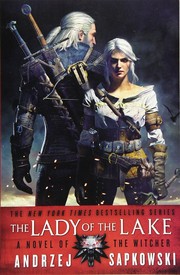
The Lady of the Lake
2,445-word summary 11 min read 554 pages in the book
- First published
- 1999
- Publisher
- Orbit
- Pages
- 554
- ISBN
- 9780316273831
- Original title
- Pani Jeziora
- Series
- The Witcher (#7)
Reading options
What's inside (9 sections)
I picked this up expecting a victory lap dressed up as a finale. It is the last volume of the original Witcher Saga, published in Polish as Pani Jeziora in 1999 and brought into English in 2017, and it has the job of closing threads that were pulled apart across the earlier novels. What I did not expect was a book that spends much of its length arguing about whether stories can be trusted at all. The frame is a conversation by a lake in ancient Britain. Sir Galahad rides up on Ciri as she bathes, and the first thing she tells him is that her tale does not have a happy ending. That warning hangs over every chapter that follows.
A story told by people who were not there
Centuries after the main events, a young sorceress named Condwiramurs sits with Nimue, the Lady of the Lake of the title, studying the legend of Geralt and Ciri. Condwiramurs has clairvoyant dreams, and through her the novel revisits scenes the reader has already seen, sometimes with small differences that make you wonder which version is the true one. Nimue is not a neutral observer either. She is a scholar with her own stake in the legend, and the book keeps reminding us that history here is something assembled by people with preferences.
This is a strange way to open the conclusion of a fantasy saga. Sapkowski could have picked up the action exactly where The Tower of the Swallow left it. Instead he puts a layer of retelling between us and the events, then lets that layer become part of the plot when Ciri eventually meets the two women in a far future beyond her own time. The trick works better than it sounds, mostly because the frame gives the ending somewhere to go.
Condwiramurs's dreams are the book's way of quoting itself. She sees Geralt at certain moments and reports them to Nimue, who corrects her or presses for more detail. The effect is like watching a playback of a match you already saw, only with a commentator who may have the score wrong. I found myself checking a few of these recalled scenes against my memory of the earlier books, and where they differed I could not decide whether the dream or my memory was at fault. That uncertainty is deliberate. By the time Ciri actually walks into Nimue's world near the end, the reader has spent hundreds of pages learning that an account of a life is never the life itself.
Ciri behind the barrier
Ciri has landed in the world of the Aen Elle, the elves who consider themselves the oldest people in the multiverse and who treat unicorns as livestock to be hunted. A magical barrier keeps her prisoner in a forest of enormous trees, and her dreams show her the troubles of the people she left behind. The sage Avallac'h explains the reason she is there. Ciri is the last descendant of Lara Dorren, and the elves bred a gene into that line over generations. If she bears a child by their king Auberon, that child will wield more magic than anyone in history and will save the world from a prophesied cataclysm. Ciri agrees, because the elves promise to send her home afterward.
Sapkowski gives the Aen Elle a grandeur that is mostly insulting to everyone else. Their trees are so vast that whole settlements sit in the branches, and their conversations about other worlds carry the weary sniff of a family that has been rich for too long. Avallac'h is the most interesting of them, an ancient elf whose knowledge is real but whose motives are impossible to read. He tells Ciri the truth about the gene and lies by omission about the price. The dreams that plague her during this stretch are not just filler. They show her Yennefer in distress and Geralt heading into trouble, and they keep the other half of the story alive while she is stuck behind the barrier.
Then Auberon simply cannot do it. He fails several times, and the scenes around his failure are played for a kind of bitter farce rather than tragedy. Eredin Breacc Glas, the commander of the elven riders, tells Ciri flatly that she will never be released. The bargain was a lie from the start.
What saves her is the attention of the unicorns. She had spared one of them, Ihuarraquax, during an earlier adventure, and now he vouches for her when the herd corners her. The unicorns reveal that the barrier can be crossed by boat. Before she goes, Ciri finds Auberon dying after Eredin fed him an aphrodisiac to force the issue, and she stays with him until he is dead. The scene is oddly gentle. A man who was used as a tool for most of the book gets a few minutes of someone sitting beside him because there is nobody else.
Eredin and his riders chase her as she flees with Ihuarraquax and her horse Kelpie. Ihuarraquax holds the riders off so she can jump between worlds, and she tumbles through several times and places without finding her own. These passages are among the strangest in the saga, short transitions in which she glimpses landscapes and dangers that the book refuses to name. The message is that she is no longer simply travelling from one place to another. She has become something that moves through stories, and the doors do not always open where she expects. She reaches the far future where Nimue and Condwiramurs live, and the two women, who have been studying her legend their whole lives, conjure the portal that finally takes her home. The circularity is deliberate, and it is also the first hint that the book might be more interested in the telling than in the destination.
Geralt's long winter in Toussaint
Back on the Continent, the search for Ciri has curdled into something close to exhaustion. Geralt spends the winter in the duchy of Toussaint with the company that has gathered around him: Dandelion, the barber surgeon Regis, the archer Milva, the young thief Angoulême, and the former Nilfgaardian officer Cahir. Toussaint is warm and vineyard-rich, ruled by the Duchess Anna Henrietta, who is Dandelion's lover. Geralt hunts monsters, takes an affair with the Duchess's cousin Fringilla Vigo, and generally behaves like a man who has stopped believing he will ever find the girl.
Fringilla is not there by accident. She belongs to the Lodge of Sorceresses and has been given the quiet task of keeping Geralt busy so the Lodge can reach Ciri first. The quality of the writing in these chapters is uneven. The Toussaint sections have charm, especially the way the Duchess treats Dandelion as a beloved pet, but Geralt is unusually passive and the affair with Fringilla never quite earns its place. The company itself is a pleasure to be around, though. Regis the barber surgeon argues with everyone and remains the calmest head in the room. Milva carries a grief she never names. Angoulême is all sharp edges and stolen goods. Cahir, a former enemy, has become the most loyal of them, which is the sort of redemption the saga keeps earning the hard way.
The monster hunts in Toussaint feel like a return to the earlier books, and that is part of the problem. They are competent, atmospheric, and ultimately beside the point. Geralt is good at the work he was made for, but the work has stopped mattering to the person who matters most to him. Then he overhears Stefan Skellen and a group of Nilfgaardian nobles plotting against Emperor Emhyr, and learns that Vilgefortz is holding Yennefer prisoner at Stygga Castle in Ebbing. The slack goes out of the story all at once. Dandelion stays behind and the rest of the company rides east.
The battle of Brenna, told from the mud
One of the boldest choices in the book is to give the decisive battle of Brenna almost no heroic viewpoint. Instead the fighting is narrated by Jarre, a scribe from the temple of Melitele who is far from the front, and by a halfling field surgeon everyone calls Rusty, who works among the wounded and amputates limbs by the dozen. Between them they give us confusion, pain, and the slow realization that the Nilfgaardian advance has broken against Redanian forces. Nilfgaard is pushed back behind its old border and sues for peace.
The cost of this device is that the war ends offstage, in reports and rumor, which is exactly the point. Jarre survives into old age and writes his memoirs. Rusty does not. He dies in a pandemic of red death, and the book later makes the quiet suggestion that Ciri carried it across the worlds during her jumping. It is a small, cold detail, and it does more to convey the damage of her journey than any number of descriptions of armies.
Stygga Castle and the reckoning
Vilgefortz has tortured Yennefer for information and now wants Ciri, intending to inseminate her and claim the prophesied child for himself. Ciri reaches Stygga first and is imprisoned, and Geralt's group storms the castle in one of the saga's most brutal sequences. The victories are expensive. Milva and Angoulême are killed. Cahir dies at the hands of the bounty hunter Leo Bonhart, and Ciri kills Bonhart in turn. When Geralt, Yennefer and Regis confront Vilgefortz, Regis is torn apart, and Geralt only wins because a protective amulet from Fringilla deflects the killing blow.
The emotional center of the book is not the fight but what comes immediately after. A Nilfgaardian force arrives under Emhyr, who arrests Skellen for treason and reveals himself to Geralt as Duny, the man who married Ciri's mother Pavetta and was believed dead. Emhyr intends to make his daughter his empress and impregnate her, because the prophecy demands a child of her blood and he sees no reason to share the throne with propriety. Geralt knows the secret, Yennefer knows the genealogy, and both are offered the chance to kill themselves rather than be executed. They are prepared to do it when Ciri interrupts. Emhyr has seen her tears at the thought of losing the only parents she has ever known, and he lets them all live. It is the most human thing he does in the entire saga.
The Lodge, Rivia, and the fog
The surviving trio has still not reached a settlement. Geralt and Ciri go back to Toussaint, where they find Dandelion about to be hanged on the Duchess's orders, another complication that dissolves as quickly as it appeared. The trio then separates again: Yennefer answers a summons from the Lodge, while Ciri and Geralt head for Rivia. Meanwhile the villainous Skellen, who escaped the Stygga aftermath, is still at work with the Nilfgaardian conspirators, so the book keeps one last thread of political danger alive right to the end.
The Lodge has decided that since Emhyr has married a false Ciri, the real one cannot claim Cintra's throne. Philippa Eilhart proposes that Ciri become the mistress of Prince Tankred of Kovir and bear the child the Lodge will raise, with the sorceresses as its guardians. It is a neat solution on paper and a horrible one if you are the girl being handed around. Ciri asks to be allowed to honour a promise to meet Geralt in Rivia first, then return. Philippa casts the deciding vote in her favor, arguing that this is Ciri's destiny rather than the Lodge's property. The vote is a rare moment where the scheming women of the saga do something simply decent, and it lands because Philippa has spent the whole series being the last person you would expect to show mercy.
Rivia is where the book breaks its own rules. Geralt meets his old friends Yarpen Zigrin and Zoltan Chivay, and a riot breaks out with humans attacking nonhumans. He draws his sword to save the dwarves and is impaled on a pitchfork. Yennefer and Triss Merigold raise a storm to scatter the mob, but Yennefer pours so much of herself into healing Geralt that she collapses. Ciri calls on Ihuarraquax, who channels power through her, and the three disappear onto a boat that emerges from the lake fog and vanishes. Geralt and Yennefer wake in a place that is hinted to be Avalon. There is no explanation of how any of it works, and that refusal to explain is the point.
Then the frame closes. Ciri finishes her story for Galahad. He asks if that is the end, and she says no, that Geralt and Yennefer were married and lived happily ever after, and she cries as she says it. Galahad invites her to Camelot and they ride off holding hands. The book asks us to accept that the truth and the comforting lie can occupy the same page.
What holds it back
This is a hard book to recommend on its own. It assumes the reader remembers a very large cast and cares about the fate of the Lodge, the Aen Elle, and the politics of Nilfgaard, and the early chapters introduce more names than most people can hold without notes. Names such as Skellen, Avallac'h, Eredin, Fringilla, Anna Henrietta and Philippa arrive in quick succession, and the book rarely stops to remind you who anyone is. The Toussaint section drags, and the translation into English by David A. French, while clear, lacks some of the rough energy that Danusia Stok brought to the earlier volumes. The ending will frustrate anyone who wants a clean accounting of who lives and who rules. There is also the question of the frame itself. The device of a story told by a woman who may be reshaping it is elegant, but it arrives late enough that a first-time reader may take it for a trick rather than a theme.
And yet the frame earns its keep. By letting Ciri lie at the last page, Sapkowski makes the whole question of what a legend is for feel lived rather than theoretical. The best chapters here are the ones about people who are not in control of the story they are in: Rusty dying of a plague nobody intended, Auberon failing in a marriage bed arranged by others, Ciri deciding which version of her life to hand to a stranger. Read it as the closing movement of a long argument about fate and it works. Read it as a standalone adventure and you will wonder why so much of it is people talking in rooms.
FAQ
Is Lady of the Lake the final Witcher book?
It closes the original five-novel Witcher Saga that began with Blood of Elves and was first published in Polish in 1999. A later prequel, Season of Storms, appeared in 2013.
Do I need to read the earlier Witcher books first?
Yes. The Aen Elle plot, Ciri's Elder Blood, the Lodge's schemes and Geralt's traveling company all carry over from The Tower of the Swallow and the earlier volumes.
Why does the ending feel so unresolved?
Sapkowski cuts away as Geralt and Yennefer drift into fog, then lets Ciri tell Galahad a happier version of her story that she admits is not true.
Similar books
More from The Witcher first, then related titles.
The Last Wish
Geralt hunts strigas genies and golden dragons while Law of Surprise binds Ciri.
2,598-word summary · 12 min read
Sword of Destiny
Geralt hunts a golden dragon, faces a doppler in Novigrad, and meets Ciri in Brokilon as old promises close around him.
2,256-word summary · 10 min read
Blood of Elves
Geralt shelters Ciri at Kaer Morhen while Triss and Yennefer train her wild Source talent as Rience hunts her and Northern kings and Nilfgaard plot open war…
3,394-word summary · 15 min read
The Time of Contempt
Geralt and Yennefer shelter Ciri as mages split and war breaks over the Thanedd coup.
2,355-word summary · 10 min read
Baptism of Fire
Wounded Geralt crosses war country with odd allies to find Ciri after the Thanedd coup.
2,076-word summary · 9 min read
The Tower of the Swallow
Ciri flees as a bandit while Geralt gathers allies to find her.
2,580-word summary · 11 min read
Blood Song
Anthony Ryan's Blood Song follows Vaelin Al Sorna from the Sixth Order's brutal training to the war that earns him the name Hope-Killer, in the first Raven's…
2,479-word summary · 11 min read

The Blinding Knife
Kip trains to join the Blackguard while the Prism hides his true identity, loses his colors, and fights a war against a rogue drafter who wants to birth a god.
2,049-word summary · 9 min read
Magician's Gambit
Garion and his companions cross haunted Maragor and the caves beneath Rak Cthol to recover the Orb of Aldur.
2,391-word summary · 11 min read
The Black Prism
Dying Prism Gavin Guile hides a secret son while war brews over color magic in the Seven Satrapies.
2,169-word summary · 10 min read
Gardens of the Moon
Empire, gods, and mages collide over Darujhistan as Bridgeburners bleed for Empress Laseen.
2,188-word summary · 10 min read
Crossroads of Twilight
Rand cleansed saidin and the whole world felt it. Book ten follows each faction as they react, stall, and choose sides.
2,264-word summary · 10 min read
Winter's Heart
Trapped in Far Madding without the Power, Rand baits his betrayers while Mat plots escape from Ebou Dar and Elayne fights for Caemlyn.
2,906-word summary · 13 min read
The Path of Daggers
Rand wields Callandor against Seanchan while Elayne and Egwene maneuver.
2,492-word summary · 11 min read
Knife of Dreams
Rand sets a Seanchan trap while Mat weds Tuon, Perrin storms Malden, Elayne takes Caemlyn, and Egwene defies Elaida.
2,988-word summary · 13 min read
A Memory of Light
Rand faces the Dark One at Shayol Ghul as all armies join the Last Battle.
2,165-word summary · 10 min read
Lord of Chaos
Rand offers amnesty to men who can channel while Egwene is raised Amyrlin in exile. Book six of The Wheel of Time builds toward rescue and reckoning at Dumai's…
2,255-word summary · 10 min read
A Crown of Swords
After Dumai's Wells, Rand holds Cairhien while Egwene besieges Tar Valon and Elayne and Nynaeve hunt relief in Ebou Dar. Book seven crowns kings and queens at…
2,828-word summary · 13 min read

Jade City
On an island where jade grants power, two clans fight over the mineral, the family name, and the right to decide what loyalty costs.
2,403-word summary · 11 min read
This Kingdom Will Not Kill Me
A grocery delivery driver wakes in a fantasy capital she knows from an unfinished trilogy, only to discover she cannot die.
2,339-word summary · 10 min read
The Girl of Fire and Thorns
Rae Carson's debut follows Elisa, an insecure princess born with a godstone in her navel, who is married to a foreign king and must grow into the leader a…
2,331-word summary · 10 min read
Temple of the Winds
In Sword of Truth book four, a magical plague sweeps the Midlands and prophecy demands that Richard enter the Temple of the Winds, but only through an…
2,962-word summary · 13 min read
Golden Fool
FitzChivalry Farseer returns to Buckkeep as a servant and a grieving Skillmaster, teaching Prince Dutiful while court intrigue, the Piebalds and a…
2,583-word summary · 11 min read
Fool's Fate
Prince Dutiful must kill a dragon to secure his betrothal, and FitzChivalry Farseer is caught between the Fool and Chade over Icefyre's fate.
2,247-word summary · 10 min read
Blood of the Fold
In Sword of Truth book three, Richard Rahl takes command of Aydindril while a zealot army and an emperor who walks in dreams threaten everything he loves.
2,321-word summary · 10 min read
Dominion
Jean Kwok opens a trilogy in a world of four Dominions, where a memoryless refugee bonds with a tyger queen and uncovers a royal past.
2,213-word summary · 10 min read
Homeland
Drizzt Do'Urden is born into the cruel drow city of Menzoberranzan, where his father teaches him to fight and to doubt everything his family believes.
2,303-word summary · 10 min read
Enchanters' End Game
Garion marches toward Torak while Ce'Nedra leads the West's army in the final Belgariad volume, where prophecy and war meet.
2,557-word summary · 11 min read

The Queen of the Tearling
Nineteen-year-old Kelsea leaves the woods to take her throne, ends a shipment of human captives, and draws the Red Queen's revenge.
2,357-word summary · 10 min read
Fool's Errand
FitzChivalry Farseer has lived in exile for fifteen years. When Prince Dutiful vanishes before his betrothal, Fitz returns to Buckkeep to find him, with a wolf…
2,606-word summary · 12 min read