
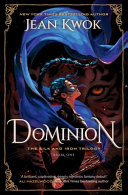
Dominion
2,213-word summary 10 min read 448 pages in the book
- First published
- 2026
- Publisher
- G.P. Putnam's Sons
- Pages
- 448
- ISBN
- 9798217044368
- Series
- The Silk and Iron Trilogy (#1)
Reading options
What's inside (8 sections)
Four Dominions, four Anchors
Jean Kwok's Dominion opens the Silk and Iron Trilogy, a 2026 romantasy from G.P. Putnam's Sons. The world is divided into four Dominions: Silver Tyger, Azure Dragon, Red Phoenix, and Onyx Tortoise. Each was once sealed off from the demon world by a magical Anchor. Three years before the story begins, the Azure Anchor failed in an event called the Annihilation. Demons destroyed the Azure homeland, and the survivors became second-class laborers in Silver territory.
That setup is doing a lot of work, and it does it quickly. Kwok gives us a world with a clear hierarchy: the Azure refugees at the bottom, the Silver court at the top, and a recent catastrophe that everyone is still living inside. Into this world steps Rubi Morningtail, who wakes on a refugee ship with no memory of who she is. She survives in Steel Haven as a ribbon dancer and a dish scrubber, living with the woman who took her in, Edith, and hiding a small singing magic. It is a deliberately small life. The book takes its time letting you feel its narrowness before it blows it apart.
The refugee ship opening is a smart place to begin. It strips Rubi of a past and drops her into a hierarchy she did not choose, which means the reader learns the world at the same time she does. We know only what she can see: which people have power, which people scrub floors, and which creatures are dangerous. I liked the opening for its restraint. Fantasy novels often announce their importance immediately. Kwok instead starts with a girl scrubbing dishes and trying not to draw attention to the strange little power she carries. For a while the largest question in the book is simply how Rubi gets through the day.
That singing magic is a good detail because it is so modest. It is not a weapon or a grand inheritance at first; it is something she hums to herself and hides. Kwok saves the scale of it for later, and the wait makes the eventual reveal feel larger.
A tyger, a wound, and the Bonding
The first big rupture comes when a wounded copper-colored battle tyger attacks Edith. Rubi stabs it, and for that she is arrested by Blake Axefire, the feared Ambush Master and leader of the Tyger Warriors. Blake sentences her to the Bonding, a lethal arena trial in which tygers choose riders and kill the rest. It is a brutal idea, and Kwok stages it as spectacle and as judgment at once.
What happens next stops the court. The tygress queen, Flame, deliberately Bonds with Rubi, who appears to be a low-magic Azure. The Silver court is stunned, and so is the reader. Why would a queen of tygers choose a refugee with almost no power? The question drives a good stretch of the book, and the answer, when it comes, rewrites Rubi's entire place in the world.
The scene works because Flame's choice is so clearly deliberate. This is not a bond formed by accident or desperation. A queen looks at a girl everyone dismisses and decides that the girl is worth choosing, and the whole court has to live with that judgment. The Bonding is the novel at its most confident. There is a clarity to the stakes: you are chosen or you die, and the choice is made by a creature rather than a person. It also introduces Flame, who becomes one of the more compelling presences in the story. The tygers are not decorative mounts here. They have wills and preferences, and the queen's decision carries real weight.
The Diviner's announcement
A masked Diviner then announces that the remaining Anchors are failing. Each Dominion must send five warriors to repair them. This is the engine that moves the book from a single city into a larger quest, and it is where the romance and the rebellion begin to braid together. The masked Diviner is one of the more intriguing figures, mostly because the book gives so little away. The announcement turns a personal story into a world-scale problem, and the mask keeps the source of the warning uncertain. Is the Diviner a helper or another manipulator? Kwok leaves that question open, which adds a useful layer of suspicion to a story full of people who are not what they seem.
Rubi joins Blake's team and trades her ribbon work for combat training. The girl who scrubbed dishes learns to fight, which is one of the more satisfying arcs in the book. Her loyalties are complicated by two men. Captain Jace is charming. Blake is brutal. Both pull at her in different ways, and neither is entirely what he seems. Blake, it turns out, is secretly the Ravager, leading a rebellion against King Uzar, a ruler who exploits refugees and dismisses his own daughter Malissa because she is a woman.
That last detail gives the political plot some genuine heat. Kwok is interested in how power decides who counts, and Malissa's treatment by her own father is a clean, angry example of it. The rebellion is not an abstract good versus evil contest. It is built on the daily humiliations of people like Rubi, which makes Blake's cause understandable even when his methods are hard to excuse. The refugees in Steel Haven are not background color. Kwok keeps returning to the fact that they are laborers in a land that was taken from them, and that their low status is a recent invention. Three years ago they had a homeland. Now they scrub dishes. That before-and-after sits behind every scene involving King Uzar and his court.
The two men work as a contrast in temperature. Jace offers warmth and ease, the sense that the world might be navigated through charm. Blake offers danger and conviction, the sense that the world has to be fought. Rubi, who does not know her own history, is pulled toward both because each seems to offer a version of who she could become. I should say that the romance never fully overwhelmed the plot for me, which is not always the case in romantasy. Kwok gives the attraction room, but she also gives Rubi work to do and a world to understand. The Bonding and the Anchor repairs keep pulling the story forward even when the feelings are being sorted out.
The Culling and the Haven of the Gods
During the Culling, Rubi survives a trial of pain and visions alongside her Azure friends Quinn and Calla. This section leans into the strange, dreamlike side of the magic, and it is where Kwok's interest in Chinese mythology comes through most strongly. The trial is not simply a test of strength. It asks Rubi to endure, to see, and to keep hold of a self that is still mostly a mystery to her.
Quinn and Calla matter here as more than names. They are the friends who tie Rubi to the Azure refugee life she has known, and their presence keeps the book from becoming only about a chosen heroine and her two suitors. The trials they endure together give the group a shared history, and that history pays off later. The Culling itself is a trial of pain and visions, and Kwok uses it to loosen the grip on what is real. Rubi sees things she cannot explain, and the reader is never quite sure which images are prophecy and which are memory. That uncertainty suits a heroine who begins the book with no past at all.
At the Haven of the Gods the teams have to cooperate, which is easier said than done. Ire Frostbane drugs Flame, abducts Rubi, and hands her to the Starved, a soul-eating demon. It is a genuinely alarming moment, and it pushes the book toward its largest set piece. Blake and the tygers rescue her, and the combined magic of four peoples repairs the Silver Anchor. The image of four divided peoples finally acting together is the book's best idea, and Kwok earns it by making each group necessary to the repair. No one Dominion can do it alone.
This is the book's central political claim, and it is more interesting than the prophecy that produces it. The Anchors were a bargain of separation, and repairing them requires the opposite: cooperation across people who have been taught to distrust one another. Kwok does not resolve that distrust overnight, which is part of why the ending feels like a beginning rather than a conclusion.
The truth about Rubi
Mortally wounded in the fight, Rubi remembers who she really is. She is Crown Princess Rubiana Phae of the Red Phoenix, twin sister of Auron, a vastly powerful fire mage. She was secretly married to Azure Prince Draven, who survived the Annihilation. Edith, the woman who took her in, is the Red Queen, her own mother, who erased her memories and disguised her to hide her from the Serpent Lord's prophecy.
The reveal is a large one, and it explains the small singing magic, the tyger queen's choice, and the strange pull Rubi has felt toward people she supposedly never knew. Kwok has been careful with the clues, and the answer feels planted rather than invented at the last minute. It also makes Edith's protectiveness legible in a way the early chapters could only hint at. The woman who took in a stray refugee was, in fact, hiding her own daughter in plain sight.
The memory loss at the center of the book is more than a convenient amnesia device. Edith's act is a mother's protection, but it is also a kind of erasure, and Rubi has to live with the fact that her own history was decided for her. Kwok lets that sit uneasily beside the more exciting reveal of her rank. Being a princess is the headline; having your memories taken is the cost.
Blake is heartbroken but promises to stay beside her, which gives the romance a bittersweet edge appropriate to a first book in a trilogy. Rubi has been handed a name, a family, and a husband she cannot fully remember, and the person she has come to trust stands just outside that circle. That tension is the most interesting romantic material in the book, more so than the simple pull between Jace and Blake. It is a sharp situation, and it sets up the next book better than a simple happy ending would. Rubi has gained everything and lost the man beside her at the same moment. Blake's promise to stay is tender, but the epilogue makes clear that staying will be dangerous.
What works, what does not, and what comes next
For all the talk of prophecy, the book's most grounded moments are the ones about work: ribbon dancing, dish scrubbing, the tedious business of training for a fight. Kwok keeps the labor visible even after Rubi's status changes, and that is part of what makes the world feel lived in rather than decorative.
The world, steeped in Chinese mythology, was loved by reviewers, and it is easy to see why. The four Dominions, the tygers, the Anchors, and the whole apparatus of prophecy give the book a rich, specific texture. Execution drew mixed responses: one reviewer called it "a little formulaic" and another said the narrative "leaves something to be desired." Both complaints have some merit. The chosen-one structure is familiar, and the middle stretch occasionally feels like a checklist of trials to be cleared before the heroine can learn who she is.
What keeps it afloat is Rubi herself. Her arc, from a girl who scrubs dishes and hides a song to a princess who remembers her name, gives the book its emotional line. The romance with Blake is tender where it needs to be, and the political anger at King Uzar's treatment of refugees and of his own daughter gives the fantasy a real-world edge. Readers who want every thread tied up in a single volume will be frustrated, since this is clearly a first installment. The supporting cast is another strength. Flame, Quinn, Calla, and Edith all have distinct roles in Rubi's survival, and none of them exists solely to explain the plot to her. Even King Uzar's treatment of Malissa gives the political side a personal edge that the rebellion plot needs.
The epilogue opens the next installment. Jace is revealed as the shapeshifting son of the Serpent Lord and the White Bone Demon, planning to kill Draven and Blake and claim Rubi. It is a nasty little hook, and it makes clear that the trilogy intends to keep raising the stakes. Jace's easy charm reads very differently once that is known, and the book quietly asks how much of his kindness was ever real. It is the sort of closing move that makes a first volume feel deliberately unfinished rather than merely incomplete. As a first volume, Dominion does its job: it builds a world, breaks a heroine open, and leaves enough unresolved to make a return likely. If you enjoy being dropped into a large, dangerous place with a lot still to learn, there is plenty here to hold you.
FAQ
Is Dominion the first book in a series?
Yes, it is book one of The Silk and Iron Trilogy, published by G.P. Putnam's Sons in 2026. The epilogue sets up the next installment.
What is the Bonding?
It is a lethal arena trial in which tygers choose riders and kill the others. Rubi is sentenced to it after stabbing a wounded battle tyger, and Queen Flame chooses her.
Does the book resolve Rubi's story?
Her identity is revealed and the Silver Anchor is repaired, but the romance and the threat from Jace remain open for later books.
Similar books
More from The Silk and Iron Trilogy first, then related titles.
The Girl of Fire and Thorns
Rae Carson's debut follows Elisa, an insecure princess born with a godstone in her navel, who is married to a foreign king and must grow into the leader a…
2,331-word summary · 10 min read
Temple of the Winds
In Sword of Truth book four, a magical plague sweeps the Midlands and prophecy demands that Richard enter the Temple of the Winds, but only through an…
2,962-word summary · 13 min read
Spark of the Everflame
A village healer stops taking the powder that keeps her strange powers quiet. After a dying king names her his heir, Diem Bellator faces a choice between a…
2,293-word summary · 10 min read
Blood of the Fold
In Sword of Truth book three, Richard Rahl takes command of Aydindril while a zealot army and an emperor who walks in dreams threaten everything he loves.
2,321-word summary · 10 min read
The Lady of the Lake
Ciri is trapped by the Aen Elle while Geralt winters in Toussaint, and the Witcher saga closes with the siege of Stygga and a fog-bound farewell.
2,445-word summary · 11 min read
Magician's Gambit
Garion and his companions cross haunted Maragor and the caves beneath Rak Cthol to recover the Orb of Aldur.
2,391-word summary · 11 min read
Crossroads of Twilight
Rand cleansed saidin and the whole world felt it. Book ten follows each faction as they react, stall, and choose sides.
2,264-word summary · 10 min read
Winter's Heart
Trapped in Far Madding without the Power, Rand baits his betrayers while Mat plots escape from Ebou Dar and Elayne fights for Caemlyn.
2,906-word summary · 13 min read
The Path of Daggers
Rand wields Callandor against Seanchan while Elayne and Egwene maneuver.
2,492-word summary · 11 min read
Knife of Dreams
Rand sets a Seanchan trap while Mat weds Tuon, Perrin storms Malden, Elayne takes Caemlyn, and Egwene defies Elaida.
2,988-word summary · 13 min read
A Memory of Light
Rand faces the Dark One at Shayol Ghul as all armies join the Last Battle.
2,165-word summary · 10 min read

Lord of Chaos
Rand offers amnesty to men who can channel while Egwene is raised Amyrlin in exile. Book six of The Wheel of Time builds toward rescue and reckoning at Dumai's…
2,255-word summary · 10 min read
A Crown of Swords
After Dumai's Wells, Rand holds Cairhien while Egwene besieges Tar Valon and Elayne and Nynaeve hunt relief in Ebou Dar. Book seven crowns kings and queens at…
2,828-word summary · 13 min read
The Hero of Ages
Vin and Elend face ash, mist, and Ruin itself as the prophecies fail and Sazed searches old faiths for answers.
2,559-word summary · 11 min read
The Final Empire
A street thief with rare powers joins a crew planning the impossible: overthrowing the immortal Lord Ruler.
2,150-word summary · 10 min read

Jade City
On an island where jade grants power, two clans fight over the mineral, the family name, and the right to decide what loyalty costs.
2,403-word summary · 11 min read
Forced Bonds
The Sanctuary's shield is down and the Resistance is inside. Oli must complete her bond group, including the hostile Nox, before the war costs her everything.
2,316-word summary · 10 min read
Wings
A homeschooled fifteen-year-old grows a blue flower from her back and learns she is a faerie sent to guard a hidden gate. Pike's debut makes plant lore feel…
2,506-word summary · 11 min read
Water Moon
A woman inherits a Tokyo pawnshop that trades in regrets, finds her father gone and one glowing bird freed, and crosses into another world to learn what her…
2,087-word summary · 9 min read
This Kingdom Will Not Kill Me
A grocery delivery driver wakes in a fantasy capital she knows from an unfinished trilogy, only to discover she cannot die.
2,339-word summary · 10 min read
The Knight and the Moth
Six of seven Diviners vanish, and the last one flees a cathedral with a mocking knight and a gargoyle who calls everyone Bartholomew. Gillig's gothic fantasy…
2,936-word summary · 13 min read
The Everlasting
A broken scholar is sent into the past to live the legend of Sir Una Everlasting, only to find that the story demands her death and that he is writing the lie.
2,464-word summary · 11 min read

The Darkest Part of the Forest
In a town built around a sleeping horned boy in a glass coffin, a girl discovers she has been spending her nights as a faerie king's knight and remembers none…
2,012-word summary · 9 min read
The Binding
In an alternate Victorian England, binders remove unbearable memories into books, and a young apprentice discovers his own past was erased from him.
2,036-word summary · 9 min read
Shadowland
Ever Bloom cannot touch Damen without risking his life. As she hunts for a cure, a mysterious surfer named Jude arrives and her loyalty to Damen is tested.
2,301-word summary · 10 min read
Nightbane
Isla Crown has thirty days to defend Lightlark after Grim threatens to destroy it, while memories of the year she spent with him return.
2,353-word summary · 10 min read

Magic Study
Sentenced to die in Ixia, Yelena returns to the land she was stolen from to learn the magic that made her an outlaw.
2,542-word summary · 11 min read

Magic Bleeds
The fourth Kate Daniels novel finds Kate investigating a magical plague in Atlanta while her relationship with Curran fractures and an ancient enemy tied to…
2,236-word summary · 10 min read
Kushiel's Dart
Born with a scarlet mote in her eye, Phèdre nó Delaunay is sold into servitude, trained as a courtesan and spy, then thrown into a conspiracy that threatens…
2,789-word summary · 12 min read
Golden Fool
FitzChivalry Farseer returns to Buckkeep as a servant and a grieving Skillmaster, teaching Prince Dutiful while court intrigue, the Piebalds and a…
2,583-word summary · 11 min read