
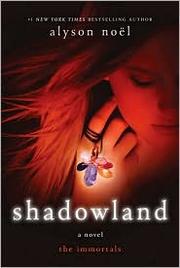
Shadowland
2,301-word summary 10 min read 368 pages in the book
- First published
- 2009
- Publisher
- St. Martin's Griffin
- Pages
- 368
- ISBN
- 9780312650056
- Series
- The Immortals (#3)
Reading options
What's inside (8 sections)
I picked up Shadowland because the last page of Blue Moon left me genuinely bothered. That book ended with Ever Bloom adding her own blood to the antidote that saved Damen's life, a desperate move that fixed one problem and quietly planted a much worse one. I wanted to see how that was going to play out. I also wanted to find out where a series that had been mostly about grief and first love went once the romance got tangled up with a literal death sentence. What I found was a book that spends most of its length on a sixteen-year-old making bad decisions for good reasons, which is both its strongest quality and the thing that made me want to shake it.
Shadowland is the third book in The Immortals, first published in 2009 by St. Martin's Griffin, and it picks up exactly where the second book stopped. Ever is still the girl who lost her family in a car crash, gained the ability to see auras and hear thoughts, and fell for Damen Auguste, an immortal who has followed her through many lifetimes. You need the first two books before this one. The story assumes you already know who Roman is, what the elixir does, and why Ever's psychic gift makes her both powerful and exhausted.
The curse that keeps them apart
The book opens with Ever telling Damen the full truth about what happened back in Summerland. She did not hand over a drop of blood without thinking. In the panic of trying to save him from Roman's poisoned antidote, she let her own blood into the mixture, and that single act means any exchange of DNA between them could kill him. They can still talk and be in the same room, but the touch they both crave has become dangerous. A kiss might send Damen into the Shadowland.
Damen's reaction surprised me. He does not rage at Ever or blame her for the mistake. He turns the anger inward instead. He decides the curse is punishment for his own past, for the centuries in which he made other people immortal out of selfish desire, especially during the plague when he saved a group of orphans and changed the course of several lives. He starts giving things away. The expensive car goes, then the fine clothes and the big house, and he begins talking about returning to a simpler state of being. Ever watches all of this happen and grows more certain that this is not the same person she fell for.
I understood why Damen would do this, and I also found it frustrating. His guilt is real, but it makes him passive at exactly the moment Ever needs a partner. She keeps telling him that Roman is the one responsible for their situation, and he keeps refusing to fully hear it. That argument runs through a lot of the early chapters, and it is the book's way of showing two people who love each other pulling in different directions. Ever wants a cure. Damen wants to accept a penalty. Neither of them is completely wrong, and watching them circle each other is the most honest part of the story.
A place darker than Summerland
Ever and Damen still travel to Summerland, the bright and peaceful place they use to seek answers, and this is where the book introduces its central image. Damen shows Ever the Shadowland, and it is the opposite of everything Summerland stands for. Where Summerland is warm and full of light, the Shadowland is a cold, dark void. It is where the souls of immortals go when their bodies are destroyed. They do not cross over into peace. They do not find their loved ones. Their souls simply end, trapped in an emptiness that has no exit.
Damen knows this firsthand. When he briefly died, he felt himself drawn toward that darkness rather than toward any light. That memory is what makes the curse so much more frightening than an ordinary separation. If either of them were destroyed now, the other would lose them for good, to a place with no comfort in it. Ever, who has already lost her family and her sister Riley, takes this hard. The threat of a second, permanent loss sits behind every decision she makes in the months that follow.
This is the part of the book I remember most clearly. The idea that an immortal's soul is not automatically safe, that eternal life can still end in a kind of eternal nothing, gives the story a real stake. It also fits the series' habit of taking a romantic idea and showing its cost. Immortality here is not a reward. It is a condition with rules, and those rules can turn on you.
A summer job and a boy named Jude
Ever's aunt Sabine, who is her guardian, wants her to get a job for the summer. Sabine hopes a little structure will keep Ever from spending every waking hour on Damen and the curse, and she is not wrong about that. Ever resists, because she would rather devote the whole summer to finding a cure, but she ends up taking work at a small mystic shop called Mystics and Moonbeams. The shop belongs to a woman named Lina and is run by her grandson, a green-eyed surfer who calls himself Jude. He also uses the name Avalon when he does readings.
Jude is the new person who complicates everything, and Noel clearly enjoys introducing him. He is calm, attractive, and strangely familiar to Ever, and he seems to understand magic and her own gifts better than most people around her. He tells her he has been seeing her dead sister Riley, and he offers to help her reach her. For a girl who misses Riley every day, that is an enormous temptation. Ever starts doing readings under the name Avalon herself, and the more time she spends at the shop, the more her certainty about Damen begins to wobble.
Damen, for his part, knows more about Jude than he lets on. He suspects Jude has appeared in Ever's past lives, sometimes as someone who cared for her, which makes the attraction feel less like a random crush and more like a pattern repeating. That is a clever idea, and it gives the love triangle more weight than it would otherwise have. It also means Damen has another reason to keep his distance, and he does. The space he opens up is exactly the space Jude moves into.
I have mixed feelings about this stretch of the book. On one hand, Jude's arrival creates real tension and forces Ever to ask whether her bond with Damen is choice or fate. On the other hand, the story leans on the love-triangle structure so heavily that some chapters feel like they are marking time until the next romantic complication. Ever's scene at the beach with Jude, where a wave knocks them over and Damen happens to see, is the kind of moment that worked for me in the moment and felt a little manufactured when I thought about it afterward.
Romy, Rayne, and the Book of Shadows
Two of the more quietly affecting figures in this book are the twins Romy and Rayne, young witches connected to Summerland who have lost their powers because they helped Ever. Their story comes out in pieces. They escaped the Salem witch trials by fleeing into Summerland, and now they are stuck in the ordinary world, unable to get back, because of a choice Ever made. Damen takes them in and even offers them the chance to have a real childhood, which is one of the kinder things anyone does in this book. Ever, meanwhile, sees in them a reminder of Riley, and that connection gives the twins an emotional weight beyond their role as magical helpers.
The twins point Ever toward a Book of Shadows hidden in the mystic shop, and they confirm that it is real and powerful. Ever becomes convinced that the book can help her force Roman to hand over the cure. Damen warns her against using it, because he knows that magic has consequences she does not understand. Ever hears him. She does not listen. This is the pattern that defines her throughout Shadowland: the people who love her keep telling her to slow down, and she keeps deciding that urgency is the same as courage.
That is not an unfair reading of her character. Ever has lost almost everyone she loves, so her impatience comes from a real place. Still, the book keeps arranging things so that her insistence on acting alone creates the next problem, and after a while the lesson stops feeling fresh. I found myself wishing that one of her plans would simply work, if only to break the rhythm.
Roman's price and the choice about Haven
Roman is the antagonist who has been pulling strings since the first book, and in Shadowland he makes his move through someone closer to Ever than she realizes. Haven, Ever's school friend, has been feeling overlooked and lonely, convinced that she matters less than Ever and her problems. Roman notices that weakness and steps into it. He pays Haven attention, brings her into a secret circle that looks glamorous from the outside, and introduces her to two other rogue immortals, Misa and Rafe. Ever can see what is happening, but her own secrecy makes it hard for her to warn Haven convincingly. She is keeping so much from her friend that she has little ground to stand on.
Ever's own mistake comes when she performs a binding spell meant to force Roman to obey her. She does it under the dark moon, without understanding what that timing means, and the twins are horrified. Instead of giving her control over Roman, the spell calls on dark forces and leaves her more exposed to him than before. This is the book at its most conventional, with a magical rule that exists mainly so the heroine can break it and face the consequences, but the consequence itself is serious enough to hold my attention.
The crisis arrives at Miles's going-away party. Miles is the friend who has been accepted into an acting program in Florence, and his departure is one of the ordinary, human threads running through the story. Roman shows up with Haven, Misa, and Rafe, making his influence over Haven plain to everyone. He leaves with Haven, supposedly for a fortune-telling appointment, and soon Ava calls with terrible news. Haven is at Roman's house and barely breathing.
What follows is the set piece the whole book has been building toward. Ever rushes to Roman's house and finds Damen there too. Roman has given Haven belladonna tea, and she is dying. He explains the price of the antidote Ever has been chasing: she can have it and be with Damen again, but only if she lets Haven die. If she saves her friend, she must give Haven the immortal elixir instead, pulling her into the same dangerous world Ever has been trying to survive. Roman frames it as a test of what kind of person she is.
Damen begs Ever not to do it. He understands what immortality actually means, not the endless beauty and ease that outsiders imagine, but the loss, the isolation, and the very real chance of ending in the Shadowland. Ever listens. Then she watches Haven's life thread begin to snap and gives her the elixir anyway. Haven survives, but she is now immortal, and Ever has given up her one chance at the cure. Damen forgives her because he knows she acted from love, and that forgiveness is the kindest thing in the book. It does not fix anything, and the story is honest about that.
What stays open
There is a moment near the end when Ever sees the Ouroboros symbol on Jude's skin and assumes the worst, because Roman's rogue immortals have claimed it as their mark. Damen later tells her the symbol may not mean what Roman has made it mean, a small reminder that this story's villains control the meaning of things as much as the events. That detail stuck with me because it contains the book's basic argument about power. Roman wins as much by defining the choices as by forcing them.
By the last page, very little has been resolved. Ever and Damen still cannot safely touch. Roman still has influence over both Ever, through the failed spell, and Haven, through the world she has just entered. Haven is immortal and does not yet know the full weight of what happened to her, and Ever is left carrying the guilt of having made that decision for her friend. The curse that gave the book its urgency remains in place. That is a deliberate choice by Noel, and it sets up the next book, but it also means Shadowland ends on a problem rather than an answer.
I would hand this to a reader already invested in The Immortals, because the character work and the Shadowland idea are worth the time. I would be careful with someone who wants a self-contained story or a clean resolution. The book's strengths are its willingness to make its heroine pay for her choices and its willingness to treat immortality as a burden rather than a prize. Its weaknesses are a repeating structure in which Ever acts rashly, suffers, and repeats, and a romantic triangle that sometimes feels more like a device than a genuine dilemma. Even with those faults, I closed it wanting the next book, which is really the only recommendation that matters for a story built to continue.
FAQ
Do I need to read the first two books before Shadowland?
Yes. It continues directly from Blue Moon and assumes you already know the curse Roman set in motion and why Ever and Damen cannot touch.
Does Ever break the curse in Shadowland?
No. The curse remains at the end, and her failed binding spell has tied her more closely to Roman.
What is the Shadowland?
It is the cold, dark place where the souls of immortals go when their bodies are destroyed, the opposite of the peaceful Summerland.
Similar books
More from The Immortals first, then related titles.

Wild Magic
A thirteen-year-old orphan in the kingdom of Tortall learns to live with the gift of speaking to animals, and discovers that the creatures she loves are not…
2,056-word summary · 9 min read

Evermore
Ever Bloom survives the crash that kills her family and meets Damen, whose touch quiets the psychic noise in her head.
3,604-word summary · 16 min read
Blue Moon
Ever Bloom tries to save her immortal boyfriend, Damen, from a mysterious illness while a new student named Roman quietly takes control of her school and her…
1,998-word summary · 9 min read
Wings
A homeschooled fifteen-year-old grows a blue flower from her back and learns she is a faerie sent to guard a hidden gate. Pike's debut makes plant lore feel…
2,506-word summary · 11 min read

White Hot Kiss
Layla is half Warden, half demon, and one kiss from her steals a soul. A demon prince warns that Hell is hunting her, and she must choose between the clan that…
2,299-word summary · 10 min read
The Girl of Fire and Thorns
Rae Carson's debut follows Elisa, an insecure princess born with a godstone in her navel, who is married to a foreign king and must grow into the leader a…
2,331-word summary · 10 min read

The Darkest Part of the Forest
In a town built around a sleeping horned boy in a glass coffin, a girl discovers she has been spending her nights as a faerie king's knight and remembers none…
2,012-word summary · 9 min read

Nightshade
Calla Tor is raised to lead a wolf pack and marry its chosen alpha, until saving a human boy makes her question the Keepers who command her kind.
2,619-word summary · 12 min read
Nightbane
Isla Crown has thirty days to defend Lightlark after Grim threatens to destroy it, while memories of the year she spent with him return.
2,353-word summary · 10 min read

Magic Study
Sentenced to die in Ixia, Yelena returns to the land she was stolen from to learn the magic that made her an outlaw.
2,542-word summary · 11 min read

The Paper Magician
A graduate magician is assigned to paper magic instead of metal, then must face a woman who tears out her mentor's heart.
2,454-word summary · 11 min read

The Siren
Saved from a shipwreck in 1930, Kahlen becomes a siren who sings men to their deaths for the Ocean, until a boy in a college library makes her want a life she…
2,369-word summary · 11 min read

The Rose & the Dagger
Shahrzad is pulled from her Caliph husband and left in a desert camp of rebels, needing to break his curse and end a war before it ends her.
2,520-word summary · 11 min read

We Hunt the Flame
In a fractured Arabia-inspired world, a disguised huntress and a prince-assassin race to find a magic-restoring book and confront an ancient evil.
2,195-word summary · 10 min read
An Enchantment of Ravens
Isobel, a mortal artist in the fairy town of Whimsy, paints a portrait of the autumn prince and falls in love with him, breaking the laws of her craft.
2,087-word summary · 9 min read

The Indigo Spell
Sydney Sage hunts an aging witch, learns forbidden magic, and finally admits she loves Adrian, while the Alchemist tattoo on her cheek may be controlling her.
2,604-word summary · 12 min read

A Winter's Promise
Ophelia reads objects and is sent to marry Thorn on a cold ark.
2,502-word summary · 11 min read

The Golden Lily
Sydney Sage guards Jill at Amberwood Prep in Palm Springs, studies forbidden magic, favors Adrian over Brayden, and faces Alchemist custody in this second…
2,988-word summary · 13 min read
Daughter of No Worlds
A former slave with rare magic hires exiled warrior Max to train her for a daring rescue, sparking slow burn love and wider war in this big 520-page fantasy…
2,529-word summary · 11 min read
Strange the Dreamer
Orphan librarian Lazlo Strange joins a quest to the lost city of Weep, where blue-skinned godspawn haunt dreams.
2,221-word summary · 10 min read
Blood & Honey
Married witch Lou and hunter Reid flee church and coven while dark magic tempts Lou to save them.
2,280-word summary · 10 min read
The Young Elites
Adelina survives fever and execution to join a secret group of gifted malfettos plotting against the queen of Kenettra.
3,310-word summary · 15 min read
Sorcery of Thorns
An apprentice librarian framed for sabotage joins a sorcerer and his demon servant to stop attacks on the Great Libraries.
2,926-word summary · 13 min read
The Reckoning
Twin heirs survive trials and hazing at Zodiac Academy while the heirs start to split.
1,984-word summary · 9 min read
Burned
Zoey's soul hides in the Otherworld while Stark must die to fetch her and Stevie Rae burns secrets.
2,074-word summary · 9 min read

Poison Study
Sentenced to die, Yelena becomes the Commander's poison taster and learns survival in Ixia has a daily price.
2,501-word summary · 11 min read
To Kill a Kingdom
A siren princess turned human must steal a siren-hunting prince's heart to win back the sea.
2,248-word summary · 10 min read
The Shadows Between Us
Alessandra plans to woo the Shadow King, marry him, and kill him for his throne, then finds someone else wants him dead first.
2,571-word summary · 11 min read

Fire
A human monster who reads minds is pulled into war in the Dells and must decide how to use her power.
2,727-word summary · 12 min read
A Curse for True Love
Evangeline wakes married with no memory of Jacks while Apollo and Jacks hunt.
2,287-word summary · 10 min read