
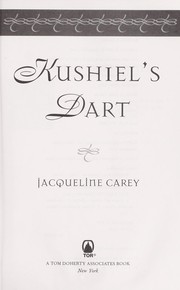
Kushiel's Dart
2,789-word summary 12 min read 701 pages in the book
- First published
- 2001
- Publisher
- Tor Books
- Pages
- 701
- ISBN
- 9780312872380
- Series
- Kushiel's Dart (#1)
Reading options
What's inside (10 sections)
I had heard the name for years without opening one of the books, and what finally made me pick it up was a single image from the back cover: a child with a red mote in her left eye, sold into a life she did not choose, who grows into a woman that kingdoms learn to fear. That promised a very different book from the one I found. Kushiel's Dart was published in 2001 by Tor Books, a first edition hardcover of about 701 pages, and it went on to win the 2002 Locus Award for Best First Novel. Carey says the idea came from a passage in Genesis about the Sons of God and the daughters of men, and took shape later when she ran into Jewish folklore while working on a coffee table book. That origin shows on every page. This is a novel about fallen angels, a nation founded by them, and a heroine who suffers for thoroughly human reasons.
A red mote in her eye
The country at the centre of the story is Terre d'Ange, which occupies roughly the ground that France does on our own map. The whole series is set on a version of Earth with the countries renamed after their histories, so a reader who likes geography will have a good time matching the places up. Terre d'Ange was founded by an angel named Elua and his companions, all of them fallen, and Elua's one commandment was "Love as thou wilt." That single line explains most of the society Carey builds. Love and physical pleasure are treated as holy here, marriage is only one arrangement among several, and the accepted forms of desire run in every direction.
One of the companions, Naamah, is the patron of courtesans. Her servants work in the Night Court, a collection of Thirteen Houses in the City of Elua, each led by a Dowayne. They take paying clients, and a client may add a gift that helps pay for the tattoo, called a marque, that covers a servant's back and marks a completed debt. Another companion, Cassiel, stayed faithful to the One God and refused to commingle with mortals. His followers are celibate warrior priests called Cassiline Brothers, and they carry blades and swear strict vows. The tension between Naamah's people and Cassiel's is baked into the world before the plot even starts.
Phèdre nó Delaunay is born to Liliane de Souverain, an adept of the Night Court, with a scarlet mote in her left eye. The mark is read as a flaw, and her parents sell her into indentured service at Cereus House. The turn comes when Anafiel Delaunay, a nobleman with a ruined reputation and a talent for spotting useful people, sees the mote for what it is. Her mark means she is an anguissette, one touched by the angel Kushiel, able to feel pain and pleasure as a single thing. He buys her bond for a startling price, and on her tenth birthday she joins his household. She is not rescued in any soft sense. She is bought, trained, and put to work. The book never pretends otherwise, and that honesty is one reason it has held up.
Delaunay's school for courtesans and spies
Delaunay already has one pupil, his foster son Alcuin, and he raises Phèdre alongside him. The education is broad. The two children learn languages, history, theology, politics, and the arts of covert work, but the lesson that matters most is simple: notice what other people miss, remember it, and work out what it means. Delaunay is a political operator with a grievance against the royal family, and he is building instruments. Phèdre's future as a courtesan gives her access to powerful men and women who speak freely in bed in a way they never would in a council room.
At fourteen, Phèdre and Alcuin choose to enter Naamah's service, and Delaunay brings in Cecilie Laveau-Perrin, a former Cereus adept and the finest courtesan of her day, to teach them the craft. At sixteen Phèdre begins taking patrons. Her first is Childric d'Essoms, a protégé of Barquiel L'Envers, and she is good at the work from the start. She listens while her clients talk and carries what she hears back to Delaunay. A patron can be generous or cruel, and several are both; the point is that she treats each encounter as information as well as service. Her closest link to the streets outside the household is Hyacinthe, a Tsingano boy she has known since childhood, who reads people well and carries a gift called the dromonde.
This is where the book asks a lot of its reader. The first stretch is slow, filled with etiquette, theology, and a pantheon of angels with names that do not stick on first reading. Kushiel, Naamah, Cassiel, Eisheth, Azza, Shemhazai, Camael, and Anael all have their own forms of love, and the invented vocabulary arrives thick and fast: anguissette, marque, signale, Cassiline. I found myself flipping back more than once. Then the machinery starts to turn, and all that setup begins to pay interest. Carey is patient in a way that modern fantasy rarely is, and the patience is mostly justified.
Joscelin, Melisande, and the leash
Joscelin Verreuil enters as a Cassiline Brother assigned to protect Delaunay's household after Delaunay's servant Guy is killed and Alcuin is attacked by Vitale Bouvarre. He is young, disciplined, and deeply uncomfortable around Phèdre. His vows include chastity and obedience, and his job is to keep his ward alive with a pair of blades. Phèdre's work, and her devotion to a god of pain, offend nearly everything he believes. Their arguments are among the best parts of the book, because neither is being stubborn for its own sake. He is trying to hold a code together in a place that mocks it. She is trying to do a job that only she can do.
The person who bends the story hardest is Melisande Shahrizai. She is a noblewoman of stunning beauty and a political mind sharp enough to make Phèdre feel clumsy, and their relationship is a game of attraction, control, and competing intelligence that runs for hundreds of pages. Melisande contracts Phèdre for Prince Baudoin de Trevalion as a farewell gift and tells Delaunay she was behind the fall of House Trevalion. Later she hires Phèdre for the Longest Night, puts a leash on her, dresses her in a sheer gown sewn with diamonds, and takes her to Quincel de Morhban's Midwinter Masque. In that scene Melisande does what no other patron manages: she makes Phèdre use her signale, the word that stops a session. In the process Phèdre gives away that Delaunay is waiting on word from Quintilius Rousse, and Melisande reveals that Delaunay was once the consort of Prince Rolande de la Courcel. The diamonds, all but the one on the collar, are sold afterward. Melisande keeps the collar, and with it a hold on Phèdre that the whole novel struggles to break.
By this point the conspiracy is visible in pieces. The succession to the throne of Terre d'Ange is in play, the Trevalions have been ruined, and a Skaldi warlord named Waldemar Selig is gathering power to the north. Delaunay is working toward an audience with Barquiel L'Envers, and Phèdre helps arrange it by passing on what d'Essoms knows about the death of Barquiel's sister Isabel. The audience happens, with Phèdre and Alcuin both present. It is the last clear victory the household gets.
The night the household died
Phèdre's final appointment is with a man named Tielhard, and Joscelin goes with her. A messenger from Quintilius Rousse arrives with a warning that Delaunay's house is being watched. They ride back too late. The household is dead, Delaunay and all of them, and Alcuin lives just long enough to tell Phèdre that Delaunay was the oathsworn protector of Ysandre de la Courcel, the Dauphine. That detail matters more than it sounds, because it turns a murder into an attack on the throne itself.
Phèdre and Joscelin go to the palace and try to get an audience with Ysandre. They fail. They look for Thelesis de Mornay, the King's Poet, and are turned away. Then they run into Melisande, who takes them to her rooms, drugs them, and tortures Phèdre for information. She hands the two of them, still drugged, to Isidore d'Aiglemort, who sells them into slavery among the Skaldi. It is a brutal stretch of the book and it comes fast after the slow opening. I remember being caught off guard by how suddenly the floor gave way. That is the design: Phèdre spends the first half learning how power works, and the second half learning what it feels like to have none at all.
Slaves in the north
Phèdre and Joscelin are sold to a steading run by Gunter Arnlaugson, where Phèdre is used as his bed servant and Joscelin has to swear loyalty to the man. He resists at first, then accepts, because refusal will get them both killed. This is the part of the book that will turn some readers away, and fairly. There is sexual violence and coercion here, and Carey does not soften it or turn it into something comfortable. It is worth saying plainly that this is dark fantasy with explicit content, not a gentle court intrigue with a romance pasted on.
Later Gunter gives both captives to Waldemar Selig as a gift. In Selig's quarters Phèdre finds a letter from Melisande and understands the shape of the plot: Melisande has conspired with the Skaldi to invade Terre d'Ange, using d'Aiglemort and his men, whom she intends to betray once the fighting is done. The information changes what Phèdre is. She is no longer a courtesan with a grudge or a spy working for one patron. She is the only person who can carry a warning home.
She and Joscelin plan an escape. Phèdre asks him to kill the guard, and he agrees, breaking another vow of his order in the doing. He takes the guard's clothes and leads her out of the steading into the Skaldi wilderness, and the flight across country is as dangerous as anything earlier in the book. They make it into Terre d'Ange and slip into the City of Elua, hiding in the Tsingani quarter while they send for Hyacinthe. His reunion with Phèdre is the warmest scene in the novel, and it does not last.
The warning and the journey west
Word has reached the city that Phèdre and Joscelin murdered Delaunay and Alcuin, so an audience with Ysandre is no simple matter. Hyacinthe helps get a message to Thelesis de Mornay, the King's Poet, and the poet arranges the meeting. Ysandre has good reason to distrust Phèdre, since Delaunay died protecting her, but Phèdre explains the frame-up and the coming invasion, and the queen comes to believe her. She takes Phèdre and Joscelin into the protection of the throne and sends her as an emissary to Alba, with Joscelin and Hyacinthe along, to ask Drustan mab Necthana, the Cruarch, for aid against Selig. Ysandre also orders Tielhard to finish Phèdre's marque, which closes one long arc of her servitude.
The voyage brings them to the Master of the Straits, a strange figure who controls the sea passage between Alba and Terre d'Ange and demands a price for safe travel. When the time comes he sets a riddle to decide who will stay with him as an apprentice. Phèdre works out the answer, but before she can speak it, Hyacinthe uses the dromonde and says it himself. The curse falls on him instead, and he is bound to the Master's island. Phèdre loses the friend who has been with her since childhood, and the series never treats that as a cheap sacrifice. It is one of several choices in this book where survival costs someone something real.
Drustan agrees to help, and Phèdre also wins over the Lords of the Dalriada. The party returns to Azzalle in the middle of the war, where they link up with Ghislain de Somerville and his army and learn that the D'Angeline forces are trapped at Troyes-le-Mont.
Troyes-le-Mont
The plan is to trap Selig's army between the fortress walls and an advancing relief force. Phèdre needs more men, and she finds them in the unlikeliest place: Isidore d'Aiglemort's traitorous force. She tells d'Aiglemort that Melisande intends to betray him to Selig and that he is a dead man either way. She offers him the choice of how he dies, and he chooses to die fighting for Terre d'Ange, with the added satisfaction of killing Selig himself. It is a fine piece of negotiation under pressure and a reminder that this book's real battles are fought with words first.
The attackers need the people inside the castle to know not to fire on d'Aiglemort's men, so Phèdre slips out at night and tries to reach the walls alone. She gets close enough to shout a message, then is caught and brought before Selig, who starts to skin her alive as a warning to Ysandre. Joscelin has followed her. He challenges Selig to a holmgang, a formal duel, and begins the terminus, the Cassiline rite of killing himself and his ward together so that neither is taken. When he sees a rescue party leaving the fort he changes course and kills her captor instead. Barquiel L'Envers brings them inside, a chirurgeon treats Phèdre's wounds, and she tells Ysandre face to face that an army is coming at dawn.
The next day Phèdre watches the battle from the battlements with Ysandre. Joscelin sees his brother Luc in danger and jumps into the fight to save him, which is the moment his code bends in a warmer direction. Phèdre sees d'Aiglemort, already carrying seventeen wounds, charge Selig and bring him down. Both die. Afterward she walks among the dead giving water to the wounded, and finds d'Aiglemort still alive. He says he fears the retribution of her lord, and she understands he means Kushiel. Her answer is that Kushiel does not send a punishment a person is not fit to bear. He dies, and one of the novel's most convincing characters goes out with a strange kind of honour.
What is left when the fighting stops
Melisande is brought to the fortress in chains by the Duc de Morhban, sold out by her own kinsmen Marmion and Persia Shahrizai. She is convicted of treason and sentenced to die. Asked what proof exists, Phèdre steps forward, throws the diamond she still wears at Melisande's feet, and says, "Take it back, this is yours, my lady, but I am not." It is the line the whole book has been building toward, and it lands because Phèdre has earned the right to say it.
Melisande asks to see Phèdre in her cell, and the conversation leaves Phèdre unsettled. She goes out to the battlements to think, and by the time she returns the cell is empty. Ysandre questions her, since she was the last person to see the prisoner, but Phèdre clears herself by pointing out that she would hardly have given the testimony that convicted Melisande if they were still allies. Ysandre clears her name fully and gives her all of Delaunay's estates. Phèdre becomes the Comtesse de Montrève and a peer of the kingdom, settles in with Joscelin, and begins learning Yeshuite with a scholar named Seth ben Yavin because she wants a way to free Hyacinthe. Then a visitor from La Serenissima delivers her sangoire cloak, lost when Melisande sold her north, along with a clue that sends her after Melisande once more. The door is left open on purpose.
I finished this book impressed and a little worn out. The first third asks for patience, the invented language takes effort, and the middle wanders through political intrigue that is sometimes hard to follow on a first pass. The explicit sexual content and the slavery scenes are not for every reader, and I would not hand this to someone looking for a light escape. The ending also refuses to close several threads, which is satisfying as a setup and frustrating if you wanted one complete story. Against that, the character work is strong, especially the slow and uneasy bond between Phèdre and Joscelin, and the Battle of Troyes-le-Mont is a genuinely exciting payoff. Carey is interested in what people will endure for love, duty, and revenge, and she lets those motives collide without making any of them simple. It is a big, dense, often harsh book that rewards the reader who stays with it.
FAQ
Is Kushiel's Dart the first book in a series?
Yes. It opens Jacqueline Carey's Kushiel's Legacy sequence, followed by Kushiel's Chosen and Kushiel's Avatar. The ending deliberately leaves several threads unresolved, including Melisande's escape and Hyacinthe's fate.
What is an anguissette?
It is a person marked by the angel Kushiel who experiences pain and pleasure as one. The red mote in Phèdre's eye signals this, and Anafiel Delaunay recognizes it when he buys her bond.
Is this book suitable for every reader?
Not for everyone. It contains explicit sexual content, coerced encounters, and slavery, and it takes time to learn the invented terms and large cast. Readers who like dark, politically intricate fantasy will get the most from it.
Similar books
More from Kushiel's Dart first, then related titles.

Jade City
On an island where jade grants power, two clans fight over the mineral, the family name, and the right to decide what loyalty costs.
2,403-word summary · 11 min read

Temple of the Winds
In Sword of Truth book four, a magical plague sweeps the Midlands and prophecy demands that Richard enter the Temple of the Winds, but only through an…
2,962-word summary · 13 min read
Blood of the Fold
In Sword of Truth book three, Richard Rahl takes command of Aydindril while a zealot army and an emperor who walks in dreams threaten everything he loves.
2,321-word summary · 10 min read

Homeland
Drizzt Do'Urden is born into the cruel drow city of Menzoberranzan, where his father teaches him to fight and to doubt everything his family believes.
2,303-word summary · 10 min read

This Kingdom Will Not Kill Me
A grocery delivery driver wakes in a fantasy capital she knows from an unfinished trilogy, only to discover she cannot die.
2,339-word summary · 10 min read

The Iron Knight
Winter prince Ash journeys to the End of the World to earn a soul and a mortal body so he can stand beside Meghan, the Iron Queen.
2,564-word summary · 11 min read

The Heart of Betrayal
Held captive in Venda, Lia must survive the Komizar's scrutiny while Rafe hides his identity and Kaden, the assassin who spared her, risks everything to keep…
2,702-word summary · 12 min read

The Gunslinger Born
A Marvel graphic novel adapting the flashback of Wizard and Glass: a fourteen-year-old Roland earns his guns, loves Susan Delgado and first sees the Dark Tower.
2,010-word summary · 9 min read
The Girl of Fire and Thorns
Rae Carson's debut follows Elisa, an insecure princess born with a godstone in her navel, who is married to a foreign king and must grow into the leader a…
2,331-word summary · 10 min read

The Devils
A monk inherits a church agency full of dangerous prisoners while a street thief is claimed as Troy's heir. Abercrombie's grimdark fantasy begins with monsters…
2,314-word summary · 10 min read

Magic Study
Sentenced to die in Ixia, Yelena returns to the land she was stolen from to learn the magic that made her an outlaw.
2,542-word summary · 11 min read
Golden Fool
FitzChivalry Farseer returns to Buckkeep as a servant and a grieving Skillmaster, teaching Prince Dutiful while court intrigue, the Piebalds and a…
2,583-word summary · 11 min read
Fool's Fate
Prince Dutiful must kill a dragon to secure his betrothal, and FitzChivalry Farseer is caught between the Fool and Chade over Icefyre's fate.
2,247-word summary · 10 min read
The Lady of the Lake
Ciri is trapped by the Aen Elle while Geralt winters in Toussaint, and the Witcher saga closes with the siege of Stygga and a fog-bound farewell.
2,445-word summary · 11 min read

The Desert Spear
Peter V. Brett's 2010 sequel moves the fight to Krasia, where spear-armed warriors hunt demons nightly and a rival rises to challenge the Warded Man.
2,283-word summary · 10 min read

Ptolemy's Gate
Nathaniel and a weakened Bartimaeus face a possession plot in Stroud's dark final Bartimaeus novel.
2,328-word summary · 10 min read
Dominion
Jean Kwok opens a trilogy in a world of four Dominions, where a memoryless refugee bonds with a tyger queen and uncovers a royal past.
2,213-word summary · 10 min read
Blood Song
Anthony Ryan's Blood Song follows Vaelin Al Sorna from the Sixth Order's brutal training to the war that earns him the name Hope-Killer, in the first Raven's…
2,479-word summary · 11 min read

The Blinding Knife
Kip trains to join the Blackguard while the Prism hides his true identity, loses his colors, and fights a war against a rogue drafter who wants to birth a god.
2,049-word summary · 9 min read
Ship of Magic
A sentient ship wakes when her captain dies, and the family that owns her starts to come apart over who gets to sail her.
2,026-word summary · 9 min read

Vow of Thieves
Kazi and Jase return to Tor's Watch to find it occupied, and their marriage is tested by captivity, betrayal, and a war for the town of Hell's Mouth.
2,059-word summary · 9 min read

Archenemies
Nova steals for the Anarchists while Adrian hides his Sentinel identity, and a serum that erases prodigy powers puts them both at risk.
2,485-word summary · 11 min read

Magician's Gambit
Garion and his companions cross haunted Maragor and the caves beneath Rak Cthol to recover the Orb of Aldur.
2,391-word summary · 11 min read

Enchanters' End Game
Garion marches toward Torak while Ce'Nedra leads the West's army in the final Belgariad volume, where prophecy and war meet.
2,557-word summary · 11 min read

Nettle & Bone
Marra, a princess in a convent, leaves to save her abused sister, but first she must finish three impossible tasks: a bone dog, a nettle cloak, moonlight in a…
2,061-word summary · 9 min read

The Rose & the Dagger
Shahrzad is pulled from her Caliph husband and left in a desert camp of rebels, needing to break his curse and end a war before it ends her.
2,520-word summary · 11 min read

The Queen of the Tearling
Nineteen-year-old Kelsea leaves the woods to take her throne, ends a shipment of human captives, and draws the Red Queen's revenge.
2,357-word summary · 10 min read

Fool's Errand
FitzChivalry Farseer has lived in exile for fifteen years. When Prince Dutiful vanishes before his betrothal, Fitz returns to Buckkeep to find him, with a wolf…
2,606-word summary · 12 min read

We Hunt the Flame
In a fractured Arabia-inspired world, a disguised huntress and a prince-assassin race to find a magic-restoring book and confront an ancient evil.
2,195-word summary · 10 min read

The Sword of Shannara
A young half-Elf and a company of companions set out to recover a magic sword before the Warlock Lord destroys the Four Lands.
2,474-word summary · 11 min read