
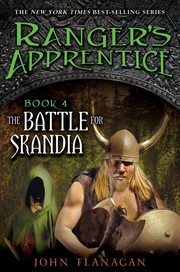
The Battle for Skandia
2,248-word summary 10 min read 294 pages in the book
- First published
- 2006
- Publisher
- Philomel Books
- Pages
- 294
- ISBN
- 9780399244575
- Original title
- Oakleaf Bearers
- Series
- Ranger's Apprentice (#4)
Reading options
What's inside (10 sections)
The first thing I noticed rereading this book as an adult is how much of it is about recovery. The series had already sent Will and Evanlyn into slavery at the end of The Icebound Land, and The Battle for Skandia opens with the aftermath of that, not with a battle. Will is hollowed out from the warmweed the Skandians dosed him with, a drug that turns a person into a compliant worker and takes something worse than health when it is taken away. Evanlyn nurses him through the shaking and the nightmares in a hunting cabin above a frozen valley, and the two of them live on what they can trap. It is a quiet opening for a war novel, and it is the strongest part of the book.
A Cabin in the Mountains
Will and Evanlyn were slaves in Hallasholm, the Skandian capital, until Erak Starfollower helped them get away. Erak is a jarl and a wolfship captain, and he is one of the better creations in this series: a raider who keeps his word and likes Will more than he wants to admit. He left them in a cabin in the mountains with supplies and the warning that the Skandians would eventually come looking. Will, an apprentice Ranger, spent his slavery hauling stone and worse, and the warmweed made the days bearable and the withdrawal almost unsurvivable. Evanlyn, whose real name is Cassandra and who is secretly the daughter of King Duncan of Araluen, dragged him through it.
The book takes its time here. Will cannot draw a full bow. He falls asleep in the middle of sentences. He notices that Evanlyn has stopped talking about her father and the palace, and he does not push, because he assumes she is a servant girl with an invented past. That gap in knowledge does most of the work in the story, since the reader knows who she is and Will does not, and the longer it goes on the harder it is to imagine it ending well.
The winter ends with a Temujai scout finding their trail. Temujai are horse-archers from the eastern steppes, and this one grabs Evanlyn while she checks the snares. His own sergeant is furious, because the patrol is not supposed to leave evidence behind, and the decision is made to kill her. Will, weak as he is, tracks them with a hunting bow, and the only shot he can make work is through the wrist of the sergeant holding her. Then Halt rides out of the trees.
The Ranger Who Got Himself Banished
Halt's arrival is the best scene in the book. He and Horace Altman have been chasing Will for the entire previous novel, and the reunion happens in the least ceremonial way possible: black-shafted arrows taking the Temujai off their horses, Horace finishing the rest with his sword. Halt explains, over camp the next night, that he insulted King Duncan in public while pretending to be drunk, which earned him a year of banishment. He needed to be free to look for Will, and being sentenced only to exile was the cheapest way out. Horace, who had just become famous for killing the warlord Morgarath in single combat, ran away from a comfortable posting to come along, mostly because following Halt is more interesting than standing in a courtyard.
The dynamic between the four of them is the engine of the book. Halt is dry and careful. Horace is earnest and very good at hitting things. Will is trying to prove he is still useful. Evanlyn is the only one who understands the Skandians, and she also has the biggest secret. Flanagan is not a subtle writer, but he is good at warmth, and the scenes where Halt teases Horace about his cooking or the size of his muscles land better than most of the battle material.
The plot turns when Halt finds a border post full of dead Skandians and recognizes the arrows. He lays out the Temujai problem with the clarity of a man who has studied old campaigns: the horse clans had almost conquered the West once before, stopped only by a succession crisis, and now they are back with a new leader and a new plan. Skandia can raise maybe two thousand warriors. The scouts Halt and Erak capture suggest an army five or six thousand strong, and it is moving with unusual discipline, burning its own dead and leaving nothing to follow.
The Enemy Nobody Watched
The Temujai invasion is the book's real subject. Halt works out early that the Skandians are not the final target. The Temujai want the Skandian fleet, a hundred and more wolfships that could put an army on any coast, including the coast of Araluen. If Skandia falls, Araluen is next, and that is what forces the alliance.
Getting there is awkward, because the Skandians have no reason to trust the Araluens. Erak vouches for Halt, and Oberjarl Ragnak, who rules from Hallasholm and hates Araluen on principle, only agrees to accept Halt's help because the alternative is oblivion. Ragnak is a hard man, and the book gives him a hard, fair ending. His son was killed in a raid years ago, and Ragnak swore a vow to kill any living relative of King Duncan. He does not know that the princess is sleeping in a cabin ten miles from his hall.
Halt takes charge of slowing the invasion. He sends out small parties to harass the Temujai on the march, which cuts their daily distance to a crawl, and he starts looking for a place to make a stand. The geography matters in this series, and Flanagan is good at using it: a narrow coastal plain between the mountains and the sea, with room for a shield wall but not for cavalry to sweep around it. He picks his ground and waits.
Archers Out of Slaves
The best set piece before the battle is Will's archery corps. Skandians fight with axes and shields and think archery is unmanly, but Ragnak has a captured store of Araluen longbows in his armory, taken off raided ships. Will proposes something the Skandians have never seen: massed volleys fired at fixed elevations by a hundred men at once, aimed by a single range-caller instead of individual archers picking targets. The offer Ragnak makes is freedom for any slave who will fight, and a hundred men step forward.
Will trains them in a matter of weeks, and the training scenes are where he comes alive again. He is an apprentice whose master is better at everything, and this is his chance to be the teacher. Horace gets a job too, commanding a line of shield-bearers who protect the archers between volleys, and Evanlyn acts as range-caller, standing in an open trench calling distances while arrows fall around her. Flanagan does not waste the irony: the princess of Araluen is standing in a hole in Skandian ground, saving Skandian lives with numbers she was taught in a palace, and nobody except Halt knows who she is.
The Vallasvow and a Princess
The middle of the book complicates all of that with a betrayal. Evanlyn stows away on a wolfship to find out what one of the captains is doing, and she overhears Slagor planning to ferry a Temujai force around the Skandian lines. Slagor catches her, and instead of killing her, which would have been tidier, he drags her in front of the council and announces that she is Princess Cassandra, invoking Ragnak's vow. Erak shields her. Halt, who has known since the first night, argues that the vow has no time limit, so Ragnak can honor it after the war without breaking his word. It is a lawyer's bargain, and Ragnak takes it because he has no better option.
Then Halt turns the trap around. Three ships fly false colors and lure the Temujai detachment to an island where they are stranded, and Slagor's treachery is exposed in front of the assembly. Flanagan handles the fate of the traitor offstage and fast, which is probably for the best, because the book is not interested in punishment. It is interested in the fact that the Skandians now know there is a royal hostage in their camp, and that Will does not know she is anything but Evanlyn, and that everyone else is waiting to see which fact destroys which person.
Will finds out shortly before the battle, and it goes about as well as a seventeen-year-old apprentice can expect. She has not lied to him, exactly, but she has let him build a picture of a future that cannot happen. He is a Ranger's apprentice with a small plot of land waiting for him; she is the heir to a kingdom with a council of nobles planning her marriage. Flanagan does not resolve this. He lets the distance grow, and the last chapter is a study in things unsaid.
The Battle of Skandia
The battle itself takes up the final quarter of the book, and it is the most technically detailed sequence in the series so far. Halt's plan accounts for the Temujai's favorite trick, the feigned retreat, by pretending to fall for it and then turning on the pursuing riders with a shield wall while axemen hit their flank. The Temujai commander, General Haz'kam, responds with what the book calls the Rolling Arrow Storm, a rolling barrage of horse archery that should shred an infantry line.
It does not, because Will has been waiting for it. The first volley from a hundred longbows drops an entire Ulan, a sixty-rider unit, in one pass, and the Temujai army hesitates for the first time. Haz'kam sends his elite archers, the Kaijin, against the hill, and men die on both sides. His deputy Nit'zak breaks through the line on foot with a group of picked warriors, and this is where the book gets genuinely tense. Will runs out of arrows. Horace fights with his sword on ground that keeps shifting under him. Ragnak, in a berserk rage, charges into the breach and takes dozens of wounds before he goes down. Erak leads a flank attack that folds the Temujai line, and Haz'kam, calculating that he can no longer get his army home, orders the withdrawal.
The book is honest that this is not a victory in the clean sense. The Skandians hold the field, but they lose a third of their fighters and their leader. Halt tells a young officer that they did not win, they made the war too expensive to continue. That is a better ending than a parade, and it ages well.
What the Victory Costs
Ragnak is burned on a pyre with full honors, and the jarls elect Erak as Oberjarl, which surprises nobody who has watched him pay for everyone else's mistakes all book. The treaty that follows is signed at Hallasholm, with Cassandra signing for Araluen as Princess Royal, because Halt's banishment technically strips his authority. Araluen agrees to station archers in Skandia and Skandia agrees to stop raiding, and the two nations end the book closer to allies than they have been in memory. Halt's year runs out three weeks after they dock, and the king grants a formal pardon that everyone politely pretends not to enjoy. Crowley presses the silver oakleaf back into Halt's hand. Horace is knighted.
Will is offered a commission in the Royal Scouts, an archer corps restricted to nobles, and turns it down to finish his apprenticeship, which should be satisfying. It is, a little. But the book's last image is not Will's. It is Cassandra on a terrace, watching him ride south with Halt and Horace, and Horace putting an arm around her because Will does not see. It is a small, sad, adult note in a middle-grade adventure, and the series takes years to pay it off.
A Simple Book, and It Knows It
The honest criticism is that Flanagan writes simply, and sometimes too simply. Characters explain their own motives out loud. The Skandians are Vikings with the edges sanded off, and the Temujai are the steppe horde from every history unit about the Mongols, competent and almost faceless. Horace, who got a whole novel of development earlier, spends most of this one being large and loyal. The battle runs long, and readers who do not care about arrow elevations and shield-wall rotations will find the last hundred pages heavier than they need to be. There is also a persistent convenience to the plotting: the right bow store, the right island, the right treaty clause at the right moment.
None of that ruined the book for me. It is written for eleven-year-olds and it respects them. The battle mechanics are worked out well enough that they feel earned, the warmweed recovery is handled with real restraint, and the friendship between Halt and Horace continues to be funnier than it should be. The series started as the story of one orphan who wanted to be a Ranger, and this is the point where it becomes a story about what it costs to keep a kingdom standing. First published in Australia in 2006 as Oakleaf Bearers, renamed for American readers when Philomel brought it over in 2008, it remains a clean, satisfying fourth step in a series that knows exactly who it is for.
FAQ
Do I need to read the earlier Ranger's Apprentice books first?
Yes. The Battle for Skandia picks up directly from The Icebound Land, with Will and Evanlyn already escaped from Skandian slavery and Halt and Horace already on the road north.
Is this book published under a different title?
Yes. It first appeared in Australia in 2006 as Oakleaf Bearers, and the American edition, published by Philomel Books in 2008, renamed it The Battle for Skandia.
How does the Battle of Skandia end?
The Temujai break against the shield wall and the archers, their commander withdraws rather than lose his army, Ragnak dies of his wounds in the breach, and Erak becomes the new Oberjarl.
Similar books
More from Ranger's Apprentice first, then related titles.
The Ruins of Gorlan
Small orphan Will becomes Ranger Halt's apprentice and helps hunt the Kalkara at Gorlan.
2,109-word summary · 9 min read
The Burning Bridge
Will and Horace burn Morgarath's secret bridge, meet Evanlyn, and face capture and a duel that decides a war.
2,412-word summary · 11 min read

The Icebound Land
Captured and enslaved in Skandia, Will fights a drug that erases him while Halt and Horace cut a bloody road through Gallica to bring him home.
2,088-word summary · 9 min read

The Blood of Olympus
Seven demigods stop Gaia waking while Reyna brings Athena statue.
2,196-word summary · 10 min read
The Thief
A boastful young thief is pulled from a prison to steal a legendary stone for the king's magus, and the story he tells about himself is not the whole story.
2,514-word summary · 11 min read

The Blinding Knife
Kip trains to join the Blackguard while the Prism hides his true identity, loses his colors, and fights a war against a rogue drafter who wants to birth a god.
2,049-word summary · 9 min read

Inkdeath
The final Inkworld novel sends Mo into the land of the dead, leaves Meggie choosing between two boys, and ends the Adderhead's immortality with three written…
2,062-word summary · 9 min read

Vow of Thieves
Kazi and Jase return to Tor's Watch to find it occupied, and their marriage is tested by captivity, betrayal, and a war for the town of Hell's Mouth.
2,059-word summary · 9 min read

Lioness Rampant
Alanna searches for the Dominion Jewel with the Shang Dragon, then returns to Tortall to face Duke Roger at Jonathan's coronation.
2,478-word summary · 11 min read

Archenemies
Nova steals for the Anarchists while Adrian hides his Sentinel identity, and a serum that erases prodigy powers puts them both at risk.
2,485-word summary · 11 min read
Dealing with Dragons
A princess who hates embroidery runs away to become the cook and librarian for a dragon, then has to outthink wizards, knights, and a plot against the dragon…
2,563-word summary · 11 min read

The Golem's Eye
Two years after The Amulet of Samarkand, Nathaniel is a rising bureaucrat, Bartimaeus is his unwilling servant again, and something made of clay is tearing…
2,299-word summary · 10 min read
Leviathan
In an alternate 1914, a prince on the run and a girl disguised as a soldier meet aboard a living airship.
2,406-word summary · 11 min read

Heist Society
A teenage art thief gets expelled from boarding school, then has two weeks to steal five paintings back from a London museum and clear her father.
2,781-word summary · 12 min read
The Chalice of the Gods
Percy needs three recommendation letters from three gods to apply to college, so his first quest is recovering a stolen chalice from the god of old age.
2,106-word summary · 9 min read

Grip of the Shadow Plague
A plague turns Fablehaven's creatures of light into shadows while Kendra hunts an artifact in Arizona and Seth races to find the cause.
2,131-word summary · 9 min read
The Ship of the Dead
Magnus and his crew sail to the edges of the Norse worlds to stop Loki from launching Naglfar, the ship of the dead.
2,426-word summary · 11 min read

The Rose & the Dagger
Shahrzad is pulled from her Caliph husband and left in a desert camp of rebels, needing to break his curse and end a war before it ends her.
2,520-word summary · 11 min read

The Queen of the Tearling
Nineteen-year-old Kelsea leaves the woods to take her throne, ends a shipment of human captives, and draws the Red Queen's revenge.
2,357-word summary · 10 min read
Saving the World and Other Extreme Sports
Max and the flock split in two to take down the lab behind their lives, one half in California and the other in Europe.
2,175-word summary · 10 min read

We Hunt the Flame
In a fractured Arabia-inspired world, a disguised huntress and a prince-assassin race to find a magic-restoring book and confront an ancient evil.
2,195-word summary · 10 min read
The Magician
Sophie and Josh flee to Paris with Nicholas Flamel, where John Dee, Machiavelli, and an awakened god close in on the missing pages of the Codex.
2,162-word summary · 10 min read
The Burning Maze
Apollo, still trapped in a mortal teenager's body, follows a dangerous prophecy through the Labyrinth with Meg and Grover as the Triumvirate's grip tightens.
2,248-word summary · 10 min read

Lore
Lore Perseous, the last of a hunted bloodline, is pulled back into the Agon when a wounded Athena offers her revenge against the god who killed her family.
2,188-word summary · 10 min read

In the Hand of the Goddess
Alanna, still disguised as a boy, survives war, court plots, and a death duel as the Goddess's chosen warrior in the second Song of the Lioness book.
2,018-word summary · 9 min read
A Knight of the Seven Kingdoms
Three novellas follow Ser Duncan the Tall and his squire, Egg, through tourneys, feuds, and conspiracies in Westeros ninety years before A Game of Thrones.
2,059-word summary · 9 min read
The False Prince
A nobleman buys four orphans and tells them only one will survive to impersonate the missing prince. The narrator, a defiant thief named Sage, has other plans.
2,044-word summary · 9 min read
A Reaper at the Gates
The Martial capital falls to an army of ghosts, Elias becomes the Soul Catcher, and Laia and Helene pay brutal prices as the Nightbringer moves to free the…
1,991-word summary · 9 min read
Fable
Abandoned on a lawless island at fourteen, Fable spends four years diving for gems to buy passage off it, straight into the cutthroat trade of the Narrows.
2,320-word summary · 10 min read
The Last Kingdom
Kidnapped by Danish raiders as a boy and raised in their halls, Uhtred of Bebbanburg must choose what he is when the fight for England begins.
1,997-word summary · 9 min read