
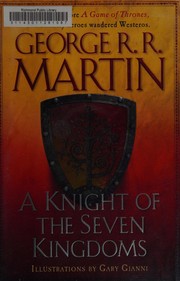
A Knight of the Seven Kingdoms
2,059-word summary 9 min read 355 pages in the book
- First published
- 2015
- Publisher
- Bantam
- Pages
- 355
- ISBN
- 9780345533487
- Series
- The Tales of Dunk and Egg (#1)
Reading options
What's inside (2 sections)
A Knight of the Seven Kingdoms collects three novellas that George R. R. Martin wrote about Ser Duncan the Tall and his squire, Egg. The stories are set in Westeros about ninety years before the events of A Game of Thrones. You do not need to have read the main series to follow them, but if you have, they add a different kind of pleasure. They are smaller, warmer, and more hopeful than the novels, even when they are describing betrayal and bloodshed. The collection was published by Bantam in 2015, with illustrations by Gary Gianni. It runs 355 pages.
The first novella is The Hedge Knight. It begins with the death of Ser Arlan of Pennytree, an old knight who has spent his life wandering from tourney to tourney without ever becoming famous. His squire, Dunk, inherits his armor, his sword, and his horse. Dunk is not a knight by birth. He is a nobody from Flea Bottom who was taken in by Arlan and trained to fight. When Arlan dies, Dunk decides to enter a tourney at Ashford and claim the name Ser Duncan the Tall. He knows he is not ready. He knows he may be exposed as a fraud. He goes anyway.
On the road, he meets a boy called Egg. Egg is bald, small, and very smart. He wants to be Dunk's squire. Dunk refuses at first, but Egg follows him, and eventually Dunk agrees to let him carry his shield and help with the horses. At Ashford, the steward does not want to let Dunk enter because he cannot prove his knighthood. Prince Baelor Breakspear speaks up for him, and Dunk is allowed to compete.
Before the tourney begins, Dunk sees Prince Aerion Targaryen breaking the fingers of a puppeteer girl. Aerion is cruel, vain, and protected by his family name. Dunk hits him. That is a crime. Aerion demands a trial by combat, and because he is a prince, he demands a trial of seven, a fight between two groups of seven knights. Dunk has to find six men willing to fight for him. He finds a few hedge knights, a drunk, and a mystery knight. The mystery knight turns out to be Baelor Breakspear, who believes Dunk is in the right. Egg reveals that he is Aegon Targaryen, Aerion's younger brother, and that he has been hiding in plain sight.
The trial of seven is the centerpiece of the first novella. It is chaotic, brutal, and confusing. Dunk is not a great swordsman. He survives because he is stubborn and because he has good people around him. He defeats Aerion and forces him to yield. Baelor is killed by a blow from his own brother Maekar's mace. The victory is not clean. It is not supposed to be. Dunk wins the fight, but he loses a prince who believed in him.
Afterward, Maekar asks Dunk to take Egg as his squire and raise him at Summerhall. Dunk says no. He says the boy needs to see the world outside the palace. Maekar agrees. Dunk and Egg ride off together. It is a simple ending, but it sets up the rest of the collection. Dunk is not a hero because he wins battles. He is a hero because he tries to do the right thing, even when it costs him.
The second novella is The Sworn Sword. Dunk and Egg are in the Reach, in the service of Ser Eustace Osgrey of Standfast. Eustace is an old man with a dusty castle and a long memory. His neighbor, Lady Rohanne Webber of Coldmoat, has built a dam across the stream that waters his land. Eustace's other sworn sword, Ser Bennis of the Brown Shield, cuts a peasant who works for Rohanne. The situation escalates. Dunk is sent to Coldmoat to negotiate, and he learns that Eustace fought for the Blackfyres during the Blackfyre Rebellion. That makes him a traitor in the eyes of the crown, and it makes his dispute with Rohanne more complicated than it first appeared.
Rohanne is one of the best characters in the collection. She is young, sharp, and trying to hold on to her lands in a world that does not want a woman to rule. Her castellan, Ser Lucas Inchfield, wants to marry her. Her cousin wants her lands. She has to be ruthless to survive. Dunk is attracted to her, and she is interested in him, but the gap between their stations is too wide. Their scenes together are full of tension that neither of them can act on.
The conflict ends in a trial by combat. Dunk fights Ser Lucas in the stream between their lands. It is a muddy, ugly fight. Dunk nearly drowns. He wins by drowning Lucas, and then he has to be resuscitated. When he wakes, Eustace and Rohanne are married. The feud is over. Rohanne gives Dunk a lock of her hair, and he rides away. It is a bittersweet ending. Dunk has done the right thing, but he has also lost something he wanted. The story is about honor, but it is also about the cost of honor.
The third novella is The Mystery Knight. Dunk and Egg are traveling north to Winterfell when they encounter a septon who has been beheaded for preaching treason. They also meet a group of knights and lords heading to a tourney at Whitewalls. The tourney is being held to celebrate the wedding of Lord Butterwell to a Frey. The prize is a dragon egg. Dunk does not care about the egg, but he needs money, so he enters the lists as the Gallows Knight.
The tourney is a trap. Most of the competitors are Blackfyre loyalists. The wedding is a cover for a conspiracy to crown a new Blackfyre king. The man behind it is Gormon Peake, a lord who lost two castles after the first Blackfyre Rebellion. The would-be king is John the Fiddler, who is really Daemon Blackfyre the Second. Egg figures out what is happening before Dunk does. That is the pattern of their relationship. Dunk is the muscle and the moral compass. Egg is the brains.
The mystery is not really a mystery for the reader, because the clues are fairly obvious. The pleasure is in watching Dunk stumble toward the truth. He befriends a group of hedge knights, including Ser Maynard Plumm, Ser Kyle the Cat, and Ser Glendon Ball. Glendon claims to be the son of the famous knight Quentyn Fireball. He is proud, poor, and desperate to prove himself. When the dragon egg disappears, Glendon is blamed. Dunk defends him. The real thief is never caught, though there are hints that Bloodraven's agents took it.
The final act is a confrontation at Whitewalls. Dunk finds Egg in the sept with Lord Butterwell. Black Tom Heddle tries to kill Egg, and Dunk kills him. Then Dunk confronts Daemon Blackfyre and accuses Gormon Peake of framing Glendon. Daemon allows Glendon to prove his innocence in a trial by combat. Glendon wins. Bloodraven's army surrounds the castle. Daemon is captured. Peake is beheaded. Butterwell is spared but loses most of his wealth, and his fortress is torn down. Dunk gets enough gold to ransom his armor. He and Egg ride on.
The Mystery Knight is the most political of the three stories. It is about the long shadow of rebellion, and about the way old grievances are passed down to children. Daemon Blackfyre is not a monster. He is a young man who has been told his whole life that he should be king. Gormon Peake is a traitor, but he is also a man who lost everything and wants it back. The story does not excuse them. It just shows how easy it is to turn resentment into war.
The Blackfyre Rebellion is the historical shadow that hangs over all three stories. It is mentioned in the main series as a failed uprising, but here it is still close enough to touch. Knights who fought for the losing side are still alive. Their castles have been taken. Their children have been raised on stories of what was stolen from them. The Mystery Knight is the story that makes this the clearest. The tourney at Whitewalls is not just a party. It is a gathering of people who are waiting for a chance to try again. Martin shows how a civil war can end on the battlefield and continue in the minds of the people who survived it. That is the most adult thing in the collection, and it is handled with a light touch.
The humor is another pleasure. Dunk is not a wit, but he is funny because he is so out of his depth. Egg is funny because he is a child who thinks he is an adult. The supporting knights are funny because they are broke, proud, and perpetually on the verge of a bad decision. The stories are not comedies, but they are warmer than the main series. They have a sense of adventure that the novels sometimes lose in their sprawl. Dunk and Egg are not trying to save the world from an army of the dead. They are trying to get paid, find a place to sleep, and keep their promises. That is a smaller scale, and it suits Martin's voice.
The illustrations by Gary Gianni deserve a mention. They are detailed, atmospheric, and slightly old-fashioned, like drawings from a medieval chronicle. They give the book the feel of an artifact, something that was found in a library rather than written last year. The collection is also nicely designed, with a map of the known world and a family tree of the Targaryens. Those extras are not necessary, but they add to the pleasure of reading a book that is trying to be a story from another time.
What holds the collection together is Dunk. He is not clever. He is not handsome. He is not a great knight. He is big, slow, and painfully aware of his own limitations. But he is kind. He tries to protect the weak. He keeps his word. He is loyal to Egg, even when Egg is being insufferable. He is the kind of knight that the songs are supposed to be about, and Martin lets him be awkward and uncertain. That makes him more convincing than a hero who always knows what to do.
Egg is a good foil. He is a prince who has been raised in privilege, but he is also a child who wants to be taken seriously. He is smarter than Dunk, and he knows it. He is also brave, and he is willing to risk his life for people he barely knows. The relationship between the two of them is the heart of the collection. It is not a master and servant relationship. It is a partnership, even if neither of them would call it that.
The weaknesses are inherent in the form. The three novellas are episodic. They do not build to a single climax. The middle story is slower than the other two, and the political intrigue in the third story is more interesting than the tourney itself. Some of the female characters are underdeveloped, especially compared with the men. The collection is also very male. That is true to the world, but it limits the range of the stories. If you are looking for the moral complexity of A Song of Ice and Fire, you will find some of it here, but you will not find the same scale.
Still, A Knight of the Seven Kingdoms is a pleasure to read. It is funny, sad, and full of small, vivid details. The illustrations by Gary Gianni are beautiful, and they add to the feeling that you are reading a story from an old chronicle. It is a good introduction to Westeros for readers who are intimidated by the main series, and it is a good return for readers who miss it. It is also a reminder that Martin can write with warmth, not just dread. Dunk and Egg are not trying to save the world. They are trying to be decent people in a world that makes decency difficult. That is enough.
FAQ
Do I need to read A Song of Ice and Fire first?
No. The collection is set ninety years before the main series and works as an introduction to Westeros.
What order should I read the three stories in?
Read them in the order presented: The Hedge Knight, The Sworn Sword, and The Mystery Knight.
Is A Knight of the Seven Kingdoms a novel?
No. It is a collection of three novellas, published together with illustrations by Gary Gianni.
Similar books
More from The Tales of Dunk and Egg first, then related titles.

The Blinding Knife
Kip trains to join the Blackguard while the Prism hides his true identity, loses his colors, and fights a war against a rogue drafter who wants to birth a god.
2,049-word summary · 9 min read
Ship of Magic
A sentient ship wakes when her captain dies, and the family that owns her starts to come apart over who gets to sail her.
2,026-word summary · 9 min read
Magician's Gambit
Garion and his companions cross haunted Maragor and the caves beneath Rak Cthol to recover the Orb of Aldur.
2,391-word summary · 11 min read
Homeland
Drizzt Do'Urden is born into the cruel drow city of Menzoberranzan, where his father teaches him to fight and to doubt everything his family believes.
2,303-word summary · 10 min read
Enchanters' End Game
Garion marches toward Torak while Ce'Nedra leads the West's army in the final Belgariad volume, where prophecy and war meet.
2,557-word summary · 11 min read

The Queen of the Tearling
Nineteen-year-old Kelsea leaves the woods to take her throne, ends a shipment of human captives, and draws the Red Queen's revenge.
2,357-word summary · 10 min read
Fool's Errand
FitzChivalry Farseer has lived in exile for fifteen years. When Prince Dutiful vanishes before his betrothal, Fitz returns to Buckkeep to find him, with a wolf…
2,606-word summary · 12 min read
The Sword of Shannara
A young half-Elf and a company of companions set out to recover a magic sword before the Warlock Lord destroys the Four Lands.
2,474-word summary · 11 min read
Magician: Apprentice
An orphan kitchen boy and a smith's son grow up in a frontier castle just as invaders from another world open a rift and begin a war that will change both of…
2,114-word summary · 9 min read
The Battle for Skandia
Will and Evanlyn are still hiding in the Skandian mountains when Halt and Horace arrive with word of a Temujai invasion that could roll on to Araluen next.
2,248-word summary · 10 min read
The Tower of the Swallow
Ciri flees as a bandit while Geralt gathers allies to find her.
2,580-word summary · 11 min read
The Emperor's Soul
Forger Shai must stamp a new soul for the dying emperor in 100 days.
2,313-word summary · 10 min read
Shadow's Edge
Kylar fakes death as a king killer while Vi hunts him for the Godking.
2,245-word summary · 10 min read
Pawn of Prophecy
Farm boy Garion learns sorcerers watch him as an old Orb wakes.
2,331-word summary · 10 min read
New Spring
Moiraine and Lan hunt the newborn Dragon before the Black Ajah finds him.
2,475-word summary · 11 min read
Furies of Calderon
Furyless Tavi defends Calderon Valley when the Marat return and lords scheme.
2,587-word summary · 11 min read
Stone of Tears
After the veil tears, Richard seeks training from the Sisters while Kahlan holds a fracturing Midlands and Zedd hunts the missing Stone.
2,483-word summary · 11 min read
The Farthest Shore
Archmage Ged and Prince Arren sail to the far west to stop Cob, whose bid for endless life drains magic across Earthsea in Le Guin's sad 1972 third volume.
2,800-word summary · 12 min read
Edgedancer
Hungry street thief Lift and her vine-like friend Wyndle cross the Herald Nale in Tashikk when a child emperor shows Radiant signs and she refuses to step…
2,328-word summary · 10 min read
Dragons of Autumn Twilight
Old friends reunite at the Inn of the Last Home, guard a glowing Blue Crystal Staff, face black dragon Khisanth, and free slaves at Pax Tharkas in this 1984…
2,803-word summary · 12 min read
The Eyes of the Dragon
In the kingdom of Delain, a jailed prince and his younger brother face a magician whose long plot for the throne turns on a napkin clue.
2,018-word summary · 9 min read
The City of Brass
Cairo con artist Nahri summons djinn Dara and is drawn to Daevabad where Ali questions pureblood rule.
1,993-word summary · 9 min read
The Burning Bridge
Will and Horace burn Morgarath's secret bridge, meet Evanlyn, and face capture and a duel that decides a war.
2,412-word summary · 11 min read
The Black Prism
Dying Prism Gavin Guile hides a secret son while war brews over color magic in the Seven Satrapies.
2,169-word summary · 10 min read
Gardens of the Moon
Empire, gods, and mages collide over Darujhistan as Bridgeburners bleed for Empress Laseen.
2,188-word summary · 10 min read
Crossroads of Twilight
Rand cleansed saidin and the whole world felt it. Book ten follows each faction as they react, stall, and choose sides.
2,264-word summary · 10 min read
The Ruins of Gorlan
Small orphan Will becomes Ranger Halt's apprentice and helps hunt the Kalkara at Gorlan.
2,109-word summary · 9 min read
Lord of Chaos
Rand offers amnesty to men who can channel while Egwene is raised Amyrlin in exile. Book six of The Wheel of Time builds toward rescue and reckoning at Dumai's…
2,255-word summary · 10 min read
Last Argument of Kings
Jezal takes the crown, Glokta serves two masters, and Logen faces Bethod as the Gurkish close on Adua.
2,479-word summary · 11 min read
A Crown of Swords
After Dumai's Wells, Rand holds Cairhien while Egwene besieges Tar Valon and Elayne and Nynaeve hunt relief in Ebou Dar. Book seven crowns kings and queens at…
2,828-word summary · 13 min read