
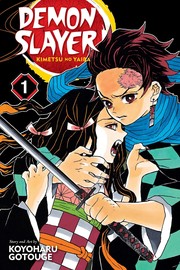
Demon Slayer: Kimetsu no Yaiba, Vol. 1
2,478-word summary 11 min read 192 pages in the book
- First published
- 2016
- Publisher
- VIZ Media
- Pages
- 192
- ISBN
- 9781974700523
- Series
- Demon Slayer: Kimetsu no Yaiba (#1)
Reading options
What's inside (8 sections)
I picked up Demon Slayer: Kimetsu no Yaiba, Vol. 1 because the anime made it look like pure action, and I wanted to see how the story reads on paper at the start. The book was first published in Japan in 2016, and the VIZ Media English edition runs 192 pages. It collects the opening chapters of Koyoharu Gotouge's series about Tanjiro Kamado, a kind boy in Taisho era Japan who loses almost everything in one night and decides to fight demons rather than accept the loss. The volume moves briskly from a mountain home to a training ground to a killing trial, and it closes just as Tanjiro takes his first job as a swordsman.
What surprised me was how much sadness Gotouge fits into a shonen opener. The fights are bloody and loud. The emotional engine is quieter. Tanjiro is kind to a fault, Nezuko is trapped between human memory and demon hunger, and every adult who helps them carries old grief. The art is rough in places and very expressive in others. Faces stretch in panic. Snow piles on roofs. Blood spreads in thick black pools. I finished the volume understanding why the series became huge, and also seeing the weak spots that later volumes had to fix.
A charcoal seller on the mountain
The story opens with Tanjiro Kamado walking down a snowy mountain path with a basket of charcoal on his back. He is the eldest son of a poor family living near the woods. His father is gone. His mother Kie keeps the house. His younger siblings Takeo, Hanako, Shigeru, and little Rokuta fill the rooms with noise. Tanjiro sells charcoal in the town below to buy rice and supplies. He has a sharp nose, able to smell a torn seam or a distant fire, and Gotouge uses that sense the way other manga use sharp eyes. Tanjiro reads people and weather by scent.
Gotouge spends time on the texture of this life. The house smells of miso and wood smoke. The children fight over small things. Tanjiro patches roofs and carries his small brothers on his back. A neighbor in town, an old man named Saburo, warns him not to climb back up after dark because demons walk at night. Tanjiro stays in town that night because Saburo insists. That decision saves his life.
The Taisho setting matters. This is early twentieth century Japan, with electric lights in towns and straw sandals on mountain paths. No phones. No cars in the hills. News travels by foot. A boy who misses one evening at home can return to find everything changed and no one nearby to help. Gotouge draws the mountain as beautiful and isolating, with tall cedars and deep snow. The quiet makes what comes next hit harder.
Tanjiro is easy to like without being complex yet. He works hard. He smiles at his siblings. He thanks customers. He apologizes to Saburo for the trouble. Some readers may find him too good, almost without edges. That goodness is the point at this stage. Gotouge needs a hero whose kindness survives contact with horror, so she establishes it first in ordinary scenes. When Tanjiro later spares enemies or weeps for demons, the opening chapters explain why.
The attack and Nezuko
When Tanjiro climbs home the next morning, he smells blood before he sees it. Bodies in the snow. A door hanging open. Everyone is dead except Nezuko, whose body is still warm. Tanjiro lifts her onto his back and runs down the mountain through snow, trying to keep her alive.
On the path Nezuko wakes changed. Her eyes are pale. Her teeth have grown into fangs. She growls and lunges at Tanjiro, no longer recognizing him. In the anime this scene plays as tragedy with music. On paper it plays as panic, with Tanjiro pinning his sister's flailing arms while snow melts under them. He begs her to remember him. She does not answer. She attacks.
What saves them both is that Nezuko stops. When a demon moves to finish them, Nezuko places herself between the attacker and her brother. Gotouge makes the choice visual. Nezuko, newly turned, bleeding, confused, still steps in front of Tanjiro.
Muzan himself appears only briefly in this volume, and Gotouge keeps him distant. He is the origin of the demons, a man who slaughtered the Kamados without explanation and turned Nezuko with his blood. Tanjiro does not learn his name yet. He only knows the smell, which his nose remembers with perfect clarity.
The handling of grief is direct. Tanjiro buries his family with the help of neighbors. He prays. He apologizes for leaving them alone. Gotouge does not rush him past tears into revenge talk. Readers who want irony or distance will not find it here.
Giyu and the choice to fight
Giyu Tomioka arrives as Tanjiro is losing the struggle with Nezuko. Giyu is a swordsman of the Demon Slayer Corps, tall, unsmiling, wearing a divided haori coat and carrying a sword with a dark blade. He moves faster than Tanjiro can follow. He pins Nezuko without killing her and prepares to execute her as a demon. Tanjiro throws himself over her body and pleads. Giyu strikes him down for getting in the way.
The scene could have played as a cold professional doing his job. Gotouge gives it more heat. Giyu tests Tanjiro, taunts his weakness, tells him that soft feelings get people killed. When Tanjiro charges him with a hatchet despite a concussion, Giyu notices two things: the boy has spirit, and the demon sister has not eaten anyone. Nezuko, starved and feral, turns on Giyu instead of the helpless Tanjiro. That choice, to protect rather than feed, convinces Giyu to break the rules.
Giyu's mercy has limits. He does not invite them to safety. He ties a bamboo muzzle on Nezuko to block her bite, tells Tanjiro to find an old trainer named Sakonji Urokodaki on Mount Sagiri, and leaves them in the snow. He warns Tanjiro that Nezuko may never recover and that the Corps will kill her if she feeds on a person. Tanjiro accepts.
This chapter sets the moral logic of the series. Demons in this world were once human. Most have lost themselves to hunger and to Muzan's control. The Corps kills them without hesitation. Tanjiro will learn to do the same, but Gotouge shows from the start that he sees the human underneath. He prays for the demons he kills. He smells their sorrow. Giyu, by contrast, represents the institution: disciplined, exhausted, slow to hope. Their brief meeting plants a conflict that runs through many later arcs, between duty and compassion.
For new readers, this is also the first taste of the power system. Giyu uses Water Breathing forms, moving like a current, striking with clean arcs. Gotouge draws water effects curling around the blade. The techniques have names and stances. Tanjiro has none of this yet. He has a hatchet, a good nose, and a sister in a box. The gap between them shows how far he has to climb.
Training with Urokodaki
Mount Sagiri is misty, wooded, and quiet. Sakonji Urokodaki lives there alone, a former swordsman who wears a red tengu mask carved with a long nose. He takes one look at Tanjiro and Nezuko and agrees to train the boy, partly from Giyu's letter, partly because he sees something in Tanjiro's resolve. He tells Tanjiro plainly that most trainees die. He does not soften the odds.
Training fills the middle of the volume and covers about two years in montage. Urokodaki is a severe teacher. He makes Tanjiro swing a sword until his hands bleed. He makes him learn Total Concentration Breathing, the method of drawing large breaths to push strength and focus past normal limits. He sends him down the mountain through traps and cold streams. Tanjiro fails constantly. He gets up.
Two other children appear on the mountain during this stretch, Sabito and Makomo, both wearing fox masks. They spar with Tanjiro, correct his stance, scold him for shallow breathing and stiff wrists. Gotouge keeps their nature ambiguous in this volume. Careful readers will notice that Urokodaki never mentions them.
Nezuko sleeps through most of this section. Urokodaki puts her in a small hut and tells Tanjiro that she is using sleep to recover instead of feeding on humans. He also plants a suggestion in her sleeping mind, that humans are family and demons are enemies. Nezuko gets little agency in Volume 1. She is carried and hidden while the men decide her fate.
By the end of the lessons Tanjiro can split a boulder, or rather split what he perceives as a boulder, with a single sword cut. Urokodaki weeps behind his mask when the boy succeeds. He has sent many students to the Corps selection and buried many of them. His pride in Tanjiro is tangled with dread. He sharpens Tanjiro's sword, fits his uniform, and sends him off with a fox mask of his own for protection. The farewell is brief. Both know what the odds are.
Final Selection on Mount Fujikasane
Final Selection takes place on Mount Fujikasane, a mountain ringed with wisteria flowers that demons cannot pass. The Corps keeps captured demons prisoner inside the blossom wall. Trainees must survive seven nights among them. Those who live are accepted. Those who die are forgotten. Urokodaki has warned Tanjiro. Nothing prepares him for the scale.
Gotouge draws the mountain as a dark forest full of misshapen demons, some huge, some crab like, some weeping. Tanjiro enters with a borrowed sword and his Water Breathing forms half learned. He panics, steadies his breath, and remembers his lessons. Smell the opening. Keep the blade moving with the water. Protect the weak. In his first real fight he saves a frightened boy from a horned demon and kills with a turning cut to the neck. The kill is messy. Tanjiro prays for the demon afterward, and the demon's last thoughts drift back to a human life.
The central fight of the selection is against the Hand Demon, a bloated creature covered with arms, each arm a life it has taken. The demon recognizes Urokodaki's fox mask and laughs. It ate many of Urokodaki's former students, including Sabito and Makomo, and it remembers their taste. The revelation reframes the training chapters. Tanjiro is not only fighting for his own life. He is facing the creature that ended the lives of the two friends who taught him. His rage makes him sloppy. His memory of their coaching steadies him.
The fight is long by Volume 1 standards and deliberately uneven. Tanjiro loses his sword, breaks bones, nearly drowns in the demon's grip. He wins by using his head in a literal sense, driving through the demon's hardened neck with a final Water Breathing form after spotting the thread of vulnerability. Gotouge draws the beheading across a full spread, water swirling around the blade. The demon dissolves, and its last moments show a small human hand reaching out. Tanjiro weeps even as he bleeds.
Only a handful of trainees walk out when the wisteria gates open at dawn. Tanjiro is among them, barely conscious, his mask split in two. A pair of white haired attendants greet the survivors, give them their Corps uniforms, and let each choose a stone for the ore of a personal Nichirin sword. They also assign each slayer a Kasugai crow for messages. Tanjiro's crow is loud and scolding. The quiet after seven nights of screaming feels unreal. Gotouge lets that silence sit for a few pages before the next assignment arrives.
First work and what the volume does well
With his sword still being forged, Tanjiro takes an urgent job in a town to the northwest where young women vanish at night. A worried young man named Kazumi asks for help after his fiancee Satoko disappears. Only her hairpin remains. Tanjiro smells something wrong in the mud near the houses, a damp demon scent that sinks underground. When night falls, a demon rises from the swamp with three bodies sharing one head stock, dragging victims below the surface. Nezuko, awake at last, fights beside her brother in her first full battle.
The swamp fight shows the partnership that will define the series. Tanjiro cuts with Water Breathing forms, calling the stance names as he moves. Nezuko kicks with shocking strength, her small body delivering blows that crater walls. She is still wearing the muzzle, still barefoot, still half asleep in a moral sense, yet she shields Kazumi and follows Tanjiro's calls. Gotouge choreographs the action around their cooperation rather than solo poses. One holds, the other strikes. The volume ends mid mission, with the demon still dangerous and Tanjiro's new sword on its way.
As an opener, Volume 1 does many things well. The premise is clean and can be stated in one line. The stakes are personal rather than abstract. The breathing system gives fights shape without pages of rules. Urokodaki is a memorable mentor, gruff and grieving. The Hand Demon gives the selection real weight. Tanjiro's kindness, which could feel bland, reads as active courage because Gotouge keeps putting it under pressure. He buries the dead. He prays for enemies. He carries his sister up mountains. The repetition builds character instead of stalling plot.
The weak spots are visible too. The pacing rushes in places. Two years of training pass in a few chapters, so Tanjiro's growth can feel asserted rather than shown. The art, full of heart, gets crowded during fast exchanges. Water effects, speed lines, demon limbs, and screams fill panels to the edge, and it can be hard to track who is where. Nezuko, the co lead on the cover, spends most of the book asleep in a box. Her big fight at the end is thrilling, but readers wanting her inner life will wait many volumes. The demons in this first outing, apart from the Hand Demon, are thin. They hunger, they boast, they die. Later arcs give enemies names and pasts. Here they serve as obstacles.
Still, the volume earns its reputation. It introduces a world where kindness is not naivete but discipline, where breathing can be trained like a muscle, where a boy with a box on his back walks toward danger because no one else will. The final pages, with Tanjiro and Nezuko standing together against the swamp, promise the shape of the series to come: short missions, hard fights, small kindnesses between horrors. Readers who like action manga with a warm center will find plenty to carry into Volume 2. Those who need tidy art or slow world building may struggle. For most, the mix of snow, blood, and sibling loyalty is enough to keep turning pages.
FAQ
Is Volume 1 a good place to start Demon Slayer?
No. Volume 1 starts at the beginning, with the attack on his family and his first meeting with the Demon Slayer Corps. It was first published in Japan in 2016, and the VIZ Media English edition runs 192 pages.
Why does Nezuko sleep instead of eating people?
She was turned into a demon when Muzan Kibutsuji killed the rest of the Kamado family. She still recognizes Tanjiro, sleeps instead of eating people, and fights beside him.
What is the Demon Slayer Corps?
The Corps is the swordsmen organization that has fought demons for generations. Giyu Tomioka, the Water Hashira who first spares Tanjiro and Nezuko, points Tanjiro toward its trainer Sakonji Urokodaki.
Similar books
More from Demon Slayer: Kimetsu no Yaiba first, then related titles.
Chainsaw Man, Vol. 1: Dog and Chainsaw
A broke teenage devil hunter and his chainsaw dog get a second life, a government leash, and a fight that stops mid-swing in Fujimoto's horror comedy.
2,584-word summary · 11 min read
Naruto, Vol. 1: Uzumaki Naruto
Naruto Uzumaki fails his ninja exam, steals a forbidden scroll, and lands on Team 7. A full chapter by chapter retelling of Vol. 1 plus Kishimoto context.
2,942-word summary · 13 min read
The Warded Man
Each night demons rise and humanity hides behind wards. Three young survivors choose to fight back in Brett's 2008 fantasy opener.
2,703-word summary · 12 min read

The Amulet of Samarkand
Boy magician Nathaniel summons djinn Bartimaeus to steal the Amulet and stop Lovelace's coup in London.
2,350-word summary · 10 min read

My Hero Academia, Vol. 1
Quirkless Izuku inherits All Might's power, trains ten months, and breaks bones to save Ochaco at the U.A. exam.
2,705-word summary · 12 min read
Fairy Tail, Vol. 1
Lucy joins rowdy Fairy Tail guild with fire boy Natsu and cat Happy.
2,049-word summary · 9 min read

One Piece, Volume 1: Romance Dawn
Rubber boy Luffy gathers Zoro and Nami to punch tyrants and share meat.
2,216-word summary · 10 min read

City of Heavenly Fire
Clary and Jace face Sebastian's dark army while Emma and Julian's story begins in Los Angeles.
2,039-word summary · 9 min read

City of Glass
Clary follows Jace to Alicante in Idris where Valentine plans to use the Soul-Sword on Shadowhunters and the Clave splits under pressure.
3,645-word summary · 16 min read

City of Ashes
Clary risks the Clave trial while Valentine raises demons and Jace pulls away in New York.
4,684-word summary · 21 min read

City of Bones
City of Bones retold: Clary sees Shadowhunters, Jace and the Cup, Valentine, and the Institute attack.
2,535-word summary · 11 min read

The Thief
A boastful young thief is pulled from a prison to steal a legendary stone for the king's magus, and the story he tells about himself is not the whole story.
2,514-word summary · 11 min read

The Blinding Knife
Kip trains to join the Blackguard while the Prism hides his true identity, loses his colors, and fights a war against a rogue drafter who wants to birth a god.
2,049-word summary · 9 min read
Ship of Magic
A sentient ship wakes when her captain dies, and the family that owns her starts to come apart over who gets to sail her.
2,026-word summary · 9 min read

Inkdeath
The final Inkworld novel sends Mo into the land of the dead, leaves Meggie choosing between two boys, and ends the Adderhead's immortality with three written…
2,062-word summary · 9 min read

Dawnshard
Rysn sails toward forbidden Akinah to save her dying larkin and finds a Dawnshard guarded by the Sleepless.
3,229-word summary · 14 min read

Bone, Vol. 1: Out from Boneville
Three cartoon cousins are run out of Boneville, separated by locusts, and dropped into a valley where rat creatures and an old grudge are waiting.
2,155-word summary · 10 min read

Vow of Thieves
Kazi and Jase return to Tor's Watch to find it occupied, and their marriage is tested by captivity, betrayal, and a war for the town of Hell's Mouth.
2,059-word summary · 9 min read

The Icebound Land
Captured and enslaved in Skandia, Will fights a drug that erases him while Halt and Horace cut a bloody road through Gallica to bring him home.
2,088-word summary · 9 min read
The Field Guide
Three siblings move into a creepy Maine estate, anger a brownie, and find a forbidden guide to the fairy world in the first Spiderwick book.
2,033-word summary · 9 min read

Magic Burns
A magic flare hits Atlanta, and mercenary Kate Daniels must recover stolen maps, find a missing witch, and keep a teenage girl alive while Celtic gods try to…
2,021-word summary · 9 min read

The Secret of the Nagas
Shiva hunts the Naga who attacked Sati, discovers her hidden twin sister and lost son, and follows the trail to the Naga capital of Panchavati.
2,442-word summary · 11 min read
Secrets of the Dragon Sanctuary
Kendra is replaced by a plant copy and held by the Society, while Seth steals a unicorn horn so the family can enter a dragon sanctuary.
2,590-word summary · 12 min read

Lioness Rampant
Alanna searches for the Dominion Jewel with the Shang Dragon, then returns to Tortall to face Duke Roger at Jonathan's coronation.
2,478-word summary · 11 min read

Archenemies
Nova steals for the Anarchists while Adrian hides his Sentinel identity, and a serum that erases prodigy powers puts them both at risk.
2,485-word summary · 11 min read

Witches Abroad
Three Lancre witches fly to Genua to stop a fairy godmother from forcing a servant girl into a storybook marriage, and find a city arranged around a happy…
2,651-word summary · 12 min read

The Time Paradox
When his mother falls ill with a fairy disease, Artemis Fowl travels back in time to find the extinct lemur that can cure her and confronts his younger self.
2,601-word summary · 12 min read
Dealing with Dragons
A princess who hates embroidery runs away to become the cook and librarian for a dragon, then has to outthink wizards, knights, and a plot against the dragon…
2,563-word summary · 11 min read

The Golem's Eye
Two years after The Amulet of Samarkand, Nathaniel is a rising bureaucrat, Bartimaeus is his unwilling servant again, and something made of clay is tearing…
2,299-word summary · 10 min read

Magician's Gambit
Garion and his companions cross haunted Maragor and the caves beneath Rak Cthol to recover the Orb of Aldur.
2,391-word summary · 11 min read