
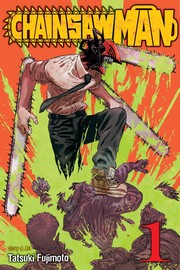
Chainsaw Man, Vol. 1: Dog and Chainsaw
2,584-word summary 11 min read 192 pages in the book
- First published
- 2019
- Publisher
- VIZ Media
- Pages
- 192
- ISBN
- 9781974709939
- Series
- Chainsaw Man (#1)
Reading options
What's inside (9 sections)
I came to this volume backwards, through the anime, which is a bad way to meet a comic that depends on how a page turns. The first episode had already shown me the dumpster and the hug. What I did not expect was how much rougher and funnier the manga is. The anime smooths Fujimoto's line into clean animation; the book leaves the scratch marks in. I read the seven chapters in one sitting, then went back to the first twenty pages to see how quickly he gets you to care about a boy and a dog.
This is the opening volume of Chainsaw Man, collected in Japan by Shueisha in 2019 and published in English by VIZ Media in 2020. It is 192 pages and seven chapters, and it ends in the middle of a fight. If you are willing to be hooked, it is one of the better hooks in recent shonen manga.
A debt with a dog in it
The first chapter is called "Dog & Chainsaw," and it earns the name twice. Denji is a teenage boy living in a shed, up to his neck in his dead father's debt to the yakuza. He hunts devils for them with Pochita, a small dog-shaped devil with a chainsaw blade growing out of his head and a starter cord along his back. The arrangement is simple: Denji finds a devil, pulls Pochita's cord, and uses him like a living chainsaw. The pay is not simple. A job worth 400,000 yen comes to 70,000 after the old man takes his fees and interest, and after Denji pays his bills he has 1,800 yen left. He has already sold a kidney, his right eye, and one testicle. He is sixteen.
Fujimoto sets the tone early. Denji kills a Tomato Devil, then a Marshmallow Devil, and the kills are drawn as jokes with consequences. He coughs blood, mentions that his mother coughed blood too, and moves on. The yakuza driver offers him 100 yen to eat a cigarette, and Denji does it, then spits it out when the car is gone. That is the whole world of the first chapter: a boy who will do anything for a hundred yen, and men who know it.
What makes it work is Pochita. The dog has the rounded face of a mascot, and the contrast between that face and the blade on his head is the book's first good visual joke. Denji talks to him about jam on bread. He has heard of jam on bread and never tasted it. He wants a girlfriend, a bed, and someone to hold. Those are his dreams, and the manga treats them without irony. When he tells Pochita to take his body if he dies, the scene is played straight.
Then the yakuza betray him. The old man leads him to an abandoned factory, says something about loyalty and the smell of dogs, and a man with a sword runs Denji and Pochita through from behind. The yakuza have made a contract with the Zombie Devil. Denji is stabbed, chopped, and thrown into a dumpster with Pochita. The panel where the lid closes is not dramatic. It is just dark.
The dumpster deal
The best pages in the volume are in the dumpster. Denji's blood drips onto Pochita, who is dying beside him. Pochita remembers the deal they made. Instead of taking Denji's body, he gives Denji his heart. He says he loved Denji's dreams and asks him to show them. Denji climbs out of the trash with a cord hanging from his chest.
The transformation is a full-page explosion: a chainsaw erupts from his head, blades push out of his forearms, and his jaw fills with jagged teeth. The zombies come at him and he cuts them apart, then cuts the Zombie Devil in half. The blood is everywhere. The sound is the point. Fujimoto draws the engine noise as much as the blades, and the fight has a mechanical rhythm: pull, rev, cut, turn.
Makima arrives after the fight is over. She walks into the factory in a suit with two men behind her, looks at the carnage, and does not flinch. She tells Denji that he smells like neither a human nor a devil. Then she hugs him, and the chainsaws retract. That hug is the most important panel in the volume. Denji has been treated like a dog and a debt for most of his life, and the first person to hold him is a woman who just explained that she could kill him too. She offers him two choices: die as a devil, or live as her pet. He asks what he would get for breakfast. She says bread with butter and jam, salad, coffee, and maybe dessert. He takes the deal.
Fujimoto plays that as a joke, but the joke has teeth. Makima's kindness is real in the moment, and it is also a leash. The volume never lets you forget that Denji is being fed by the same organization that would put him down if he ran. That tension is the engine of the whole series, and it starts here, in a hug that looks like a rescue.
Udon and a leash
Chapter 2, "The Place Where Pochita Is," is the weakest chapter in the book and still has one of its best gags. Makima drives Denji to Tokyo, gives him her coat, and stops for udon. A man runs up asking for help because a devil has taken his daughter. Makima tells Denji to handle it because her noodles will get soggy. She also reminds him that he is her pet and she does not need a pet that says no. Denji goes into the woods, finds a little girl playing with the Muscle Devil, and learns that the devil saved her from a father who beat her. He hesitates. The devil shreds the muscle in his arm. He transforms and kills it.
That little story establishes that devils can be kind and humans can be worse. It also sets the volume's rhythm: a fight, a deadpan joke, a small piece of emotional information. The chapter ends with Makima feeding Denji udon because his arms are too damaged to hold the chopsticks. He asks what kind of guy she likes. She says someone like him. He is gone.
Chapter 3 takes him to Public Safety headquarters and introduces Aki Hayakawa, who is everything Denji is not: clean, disciplined, and convinced that devils should suffer. Aki beats Denji in an alley and tells him to quit. Denji kicks him in the crotch, twice, and explains that he hits men only there. It is a stupid joke, and it is the first time Denji says out loud that he wants to keep living because someone bought him a meal. Aki threatens to tell Makima that Denji ran away. Denji tells everyone that Aki was attacked by a Testicle Devil. Makima puts them in the same experimental squad anyway.
Makima makes the stakes clear. If Denji quits or runs, he will be put down as a devil. He is a weapon with a housing allowance.
A fiend for a partner
Chapter 4 moves Denji into Aki's apartment, where Denji is messy, Aki is rigid, and neither can cook. Their first assignment together is a fiend, a devil that has taken over a human corpse. Aki explains the distinction patiently. Denji is ordered to show his power. Instead he walks up and beheads the fiend cleanly, because the chainsaws look painful and he wants to spare it. Aki is furious. Devils killed his family. He wants them to suffer. Denji says he would befriend any devil he could, since he has no friends.
That exchange is the moral center of the volume, and Fujimoto does not resolve it.
Then Power arrives. She is the Blood Fiend, a devil in a human body, with horns, sharp teeth, and a voice that fills a room. She announces herself, Denji looks at her chest, and he accepts the partnership before anyone can finish the sentence. What makes Power more than a joke is the cat.
Chapter 5, "A Way to Touch Some Boobs," is where the chapter title stops being cute. Denji and Power patrol. Power gets bored, smells blood, and smashes a Sea Cucumber Devil with a hammer made of her own blood. Makima arrives and scolds her, because a civilian hunter had already engaged the devil and Public Safety is not supposed to steal kills. Power panics and blames Denji. Then she sees a cat, softens, and tells him about Meowy, the pet the Bat Devil took. She will let Denji touch her breasts if he helps her get the cat back. He agrees immediately.
The chapter title is the plot, and that is either funny or exhausting. I laughed, and I understand why a reader would stop here. The volume asks you to accept that its hero's deepest motivation is a grope.
The worst rescue plan in Tokyo
Chapters 6 and 7 are the best sustained sequence in the book. Power takes Denji to a house in the woods, knocks him out with a blood hammer, and hands him to the Bat Devil. The Bat Devil is a huge, wounded thing with one arm torn off by human hunters, hiding in a house and waiting for blood to heal. It drinks from Denji, finds the taste disgusting, and decides to cleanse its palate with children instead. Power demands her cat. The Bat Devil swallows Meowy whole as punishment, then swallows Power too.
The flashback that follows is only a few pages, and it changes the whole chapter. Power found Meowy as a starving stray, fed her cow's milk to fatten her up, named her, and planned to eat her. Then she got attached. She had killed everything she had ever met, and the cat was the first thing that meowed at her instead of screaming. When the Bat Devil took Meowy, Power made a deal to bring it a human. She chose Denji. That is not a betrayal in her mind. It is a trade, and she is genuinely surprised when the Bat Devil does not honor its end.
Denji stays alive because his body runs on blood. He clings to the Bat Devil's leg as it flies toward the city, drinking from the wound. He remembers losing Pochita once, searching the whole town, and finding him crying at home. He thinks about how Power must have felt the night Meowy was taken. Then he pulls the cord.
The last pages of the volume are Denji as Chainsaw Man, clinging to the Bat Devil, cutting into its arm as it heads for the city. Chapter 8, "Chainsaw vs. Bat," is in volume 2. The book ends mid-swing.
How the pages actually look
Fujimoto's art is not polished in the usual Weekly Shonen Jump way. His line is scratchy. His anatomy is loose. Backgrounds are sometimes densely detailed, with careful telephone poles and apartment blocks, and sometimes almost empty, just a horizon and a figure. He uses black aggressively. A room can be a few gray screentones and one hard shadow, and then a page later the whole panel is a splash of blood.
The action reads clearly because the silhouettes do. Chainsaw Man is a simple shape: a boy with a blade coming out of his head and blades on his arms, engine exhaust curling around him. The gore is drawn with the same enthusiasm as the jokes, which is why the two tones do not fight. A zombie's head comes off in a spray, and the next scene has Denji thinking about breakfast. The cut is the joke.
The character work is in the faces. Denji's default expression is a flat stare with dark circles under his eyes, and Fujimoto uses it for comedy and for despair without changing much. Makima's smile is pleasant and closed, and the book keeps her at a distance by never letting you see her lose composure. Power is drawn with her mouth open most of the time.
The film influence is hard to miss. Fujimoto has said the chainsaw idea came from The Texas Chain Saw Massacre, and the volume has the logic of a slasher film: a small cast, an isolated location, and a hero too stubborn to stay down. The difference is that the slasher is the protagonist.
What worked and what grated
The best thing in the volume is the Pochita relationship. Denji and Pochita share a shed and a diet of bread. The dog is a tool and a friend at the same time, and the volume never pretends those are separate categories. When Pochita gives up his heart, the book earns the loss because it spends so long on the small stuff: the jam, the cough, the way Denji talks to him like a roommate.
The second best thing is the class detail. Denji's poverty is a set of transactions. He sells organs, eats a cigarette for 100 yen, and calculates his pay down to the last yen. The yakuza treat him as a dog because he is useful and cheap. When Makima offers him a bed and three meals, the offer is genuinely enormous, and that is why the leash works.
The criticism I have is mostly about thinness. The first three chapters barely sketch the supporting cast. Aki is a hostile roommate whose tragic backstory is mentioned rather than felt. Makima is a mystery with a nice smile. The Zombie Devil is a plot device with a mouth.
The sexual comedy is the other sticking point. The "touch some boobs" bargain drives the last three chapters, and it is juvenile in a way that is either the point or a problem. I think it is the point: Denji is a teenager who has been treated as a body for so long that he thinks of his own desires in the crudest possible terms. But the book also plays the joke straight for titillation, and Power is drawn to be looked at. Readers who do not want that should skip this one, and readers who want the female characters treated with more care should know this volume is not where that starts.
The gross-out humor is relentless. There is blood drinking, a cat swallowed whole, and intestines. Some of it is funny, and some of it is just gross. If you are eating while reading, put the book down.
The volume is all setup, and stopping mid-fight is a commercial decision as much as an artistic one. I did not mind because the fight is good and the cliffhanger is earned, but I would not hand this to someone who hates waiting.
If you like horror comedies, shonen fights with a mean streak, and stories about poor kids who want small things, this is for you. If you want a complete story, a gentle hero, or no sexual jokes, it is not. The manga is rougher and faster than the anime, and the dumpster chapter is still the best thing in it.
The volume closes with Denji's blade going into the Bat Devil's arm, the city small ahead of him, the fight still unfinished. I closed the book, looked up how long volume 2 was, and ordered it. That is probably the most honest review I can give.
FAQ
Does Chainsaw Man Vol. 1 end on a cliffhanger?
Yes. The seventh chapter ends with Denji transforming and cutting into the Bat Devil's arm, and the fight continues in Chapter 8, which opens Volume 2.
Is Chainsaw Man Vol. 1 suitable for younger readers?
The volume has heavy gore, dismemberment, and sexual jokes, including a bargain about touching a character's breasts. It is a horror manga for older readers rather than children.
How many chapters are in Chainsaw Man Vol. 1?
It collects seven chapters, from "Dog & Chainsaw" through "Meowy's Whereabouts," first serialized in Weekly Shonen Jump beginning in December 2018.
Similar books
More from Chainsaw Man first, then related titles.
Demon Slayer: Kimetsu no Yaiba, Vol. 1
Tanjiro joins the corps after demons kill his family and turn Nezuko.
2,478-word summary · 11 min read
Locke & Key, Vol. 1: Welcome to Lovecraft
After their father is murdered, the Locke children move into a haunted family estate where keys unlock doors to ghosts, other places, and dangerous secrets.
2,019-word summary · 9 min read

Dream Country
Four Sandman shorts on muses, cats, Shakespeare, and a veiled heroine.
2,001-word summary · 9 min read
Black Butler, Vol. 1
A twelve year old earl and his demon butler keep a Victorian manor running by day and handle dark work for the Queen.
2,877-word summary · 13 min read
Naruto, Vol. 1: Uzumaki Naruto
Naruto Uzumaki fails his ninja exam, steals a forbidden scroll, and lands on Team 7. A full chapter by chapter retelling of Vol. 1 plus Kishimoto context.
2,942-word summary · 13 min read
Preludes & Nocturnes
Dream escapes a 70 year prison, hunts his lost tools, faces Hell, and learns care from Death.
2,047-word summary · 9 min read
The Tale of the Body Thief
Lestat trades bodies with a psychic thief for one day of mortality and ends up trapped, sick, and hunting his own vampire body.
2,069-word summary · 9 min read
Bone, Vol. 1: Out from Boneville
Three cartoon cousins are run out of Boneville, separated by locusts, and dropped into a valley where rat creatures and an old grudge are waiting.
2,155-word summary · 10 min read

Magic Burns
A magic flare hits Atlanta, and mercenary Kate Daniels must recover stolen maps, find a missing witch, and keep a teenage girl alive while Celtic gods try to…
2,021-word summary · 9 min read

Demonglass
Sophie Mercer spends the summer at the Council's English estate, where two new demons, a suspicious host, and Archer's return complicate her plan to remove her…
2,771-word summary · 12 min read
Saga, Volume 3
Marko, Alana, and Hazel hide on the planet Quietus with the reclusive author who inspired their romance, while assassins and a prince close in.
1,989-word summary · 9 min read
House of Salt and Sorrows
Annaleigh Thaumas investigates her sister's death in a cursed island manor where the balls are illusions and the sea god is always listening.
2,025-word summary · 9 min read
The Stonekeeper
After their father's death, Emily and Navin chase a monster into a hidden world to save their mother, and Emily's great-grandfather's amulet offers power at a…
2,753-word summary · 12 min read
The Sandman, Vol. 2: The Doll's House
Rose Walker dreams open as Dream hunts his missing creations and the Corinthian.
2,338-word summary · 10 min read

Firefight
David hunts Firefight in flooded Babylon Restored while Prof slips.
2,462-word summary · 11 min read

Anna Dressed in Blood
Ghost hunter Cas meets Anna, the ghost who kills back.
2,622-word summary · 12 min read
Saga, Volume 2
Alana and Marko flee with baby Hazel while exes, princes, and ghosts close the net.
2,028-word summary · 9 min read

Rose Madder
After fourteen years of abuse, Rosie Daniels flees her cop husband and finds a painting that opens into a dangerous mythic world.
2,349-word summary · 10 min read
Horns
Accused of killing Merrin Williams, Ig Perrish wakes with horns that force strangers to confess their darkest sins.
2,264-word summary · 10 min read
The Witching Hour
A San Francisco surgeon inherits a haunted New Orleans house where a spirit has courted her witches for centuries, until a Christmas Eve birth gives it living…
2,953-word summary · 13 min read
Kingdom of the Feared
Kerri Maniscalco's finale retold: Emilia's lost memories, her marriage to Wrath, and the fight for balance in the Underworld courts.
2,938-word summary · 13 min read

Vampire Knight, Vol. 1
Guardian Yuki protects Day students from secret vampire Night Class while Zero hates what he may become.
2,106-word summary · 9 min read
The Warded Man
Each night demons rise and humanity hides behind wards. Three young survivors choose to fight back in Brett's 2008 fantasy opener.
2,703-word summary · 12 min read

The Talisman
Twelve-year-old Jack Sawyer flips between America and the Territories to find a Talisman that can save his dying mother.
2,050-word summary · 9 min read

The Amulet of Samarkand
Boy magician Nathaniel summons djinn Bartimaeus to steal the Amulet and stop Lovelace's coup in London.
2,350-word summary · 10 min read
NOS4A2
Vic McQueen's bike finds lost things through a bridge, pitting her against Manx's Rolls-Royce ride to Christmasland.
2,060-word summary · 9 min read
My Hero Academia, Vol. 1
Quirkless Izuku inherits All Might's power, trains ten months, and breaks bones to save Ochaco at the U.A. exam.
2,705-word summary · 12 min read

My Best Friend's Exorcism
Abby fights to save possessed best friend Gretchen in 1988 Charleston Satanic Panic horror.
2,115-word summary · 9 min read

How to Sell a Haunted House
Siblings Louise and Mark must empty puppet filled parents house that fights back.
2,085-word summary · 9 min read
Gallant
Mute Olivia Prior returns to Gallant manor where ghouls walk and a shadow Recommends.
2,081-word summary · 9 min read