
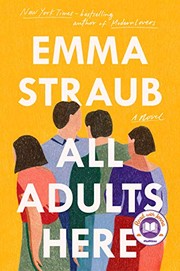
All Adults Here
2,171-word summary 10 min read 356 pages in the book
- First published
- 2020
- Publisher
- Riverhead Books
- Pages
- 356
- ISBN
- 9781594634697
Reading options
What's inside (9 sections)
I picked this up on a recommendation that it was a book about parents and grown children that did not tidy everything up at the end. That turned out to be half right. Emma Straub published All Adults Here in 2020 with Riverhead Books, and it follows a widow in a small New York town who decides, suddenly and without much of a plan, to stop hiding parts of her life from the people she loves. The book is warmer and funnier than I expected, and it is also more willing than I expected to give every problem a shape that fits neatly inside a chapter.
A bus on Main Street
The novel opens with a death that Astrid Strick witnesses and does not mourn. Barbara Baker has been her neighbor and her enemy for roughly forty years. Astrid has not liked her for a single day of that acquaintance, and when an empty school bus comes speeding through the center of Clapham and hits Barbara as she crosses the street, Astrid feels a shock she can barely tell apart from relief. It is just after eleven in the morning. Astrid has a haircut appointment at half past, and she is due at the train station to collect her granddaughter Cecelia, who is arriving with two suitcases and no parents. The bus hits Barbara at the intersection of Main and Morrison streets, near the town roundabout.
That collision sets the whole book in motion. Astrid is sixty-eight, long widowed, and living alone in the big house she raised her children in. She has been seeing a woman named Birdie, who cuts her hair, and she has kept that relationship quiet for years. Barbara's death makes the quiet feel less like privacy and more like a kind of cowardice. If a person can be gone by lunchtime, Astrid decides, then the time for protecting everyone's comfort is over. It is a small, sudden decision, and Straub is good on the way a shock can rearrange an ordinary day.
There is a nice bit of craft in how the book refuses to make Barbara a saint. She and Astrid were of an age and knew each other's histories, and Astrid's lack of grief is honest rather than cruel. Later, near the end, Straub gives Barbara a chapter of her own, and that chapter changes the weight of the opening without asking us to forgive Astrid for feeling what she felt.
The three grown children
Astrid has three children, and the book takes each of them in turn. Elliot is the oldest. He runs a successful construction business in Clapham, lives with his wife Wendy and their twin toddlers, and has quietly bought a building in the town center without telling anyone. He is not sure what to do with it. One idea is a corporate hair studio, the sort of franchise that would make life hard for small operators like Birdie. Astrid suspects a chain is coming to town and worries about it, but she does not know her own son is the buyer. Elliot looks like the child who got everything right, and the book slowly takes that picture apart.
Porter is the middle child and the only daughter. She runs a goat dairy and makes cheese, she is single, and she is pregnant after years of wanting a child and a string of relationships that did not last. She used a sperm bank and IVF, and she is nervous about telling her family, who she expects will judge her for doing it alone. Her old high school boyfriend Jeremy lives in Clapham with his wife Kristen and their children. Porter has started seeing him again, which complicates the pregnancy and nearly everything else.
Nicky is the youngest. He lives in Brooklyn, follows a pacifist, Buddhist-leaning way of life, and rarely comes back to Clapham. He is married to Juliette, and their thirteen-year-old daughter Cecelia has just been sent away from her school after a mess involving her best friend Katherine. Katherine had formed a relationship with an adult she met online, Cecelia told the grownups in her life to protect her, and Katherine turned the story around so that Cecelia looked involved too. The bullying got bad enough that Nicky and Juliette decided Cecelia needed a fresh start. She is sent to Clapham to live with Astrid and attend the junior high school there, a punishment she experiences as abandonment.
A girl on the train
Cecelia arrives at the station and is collected by Astrid, and her arrival gives the book a fourth center of gravity. She is humiliated and angry, and she is sure her parents have got rid of her. At her new school she is snubbed by a cluster of popular girls, one of whom, Sidney, takes an immediate dislike to her. But she also meets a quiet boy named August, whose family runs a thrift store, and the two of them become friends. August is actually a transgender girl named Robin, who is living as male in public and keeping her real name and identity to a very small circle. Cecelia becomes that circle, and keeping the secret gives her a reason to care about the new town.
The two of them join Parade Crew, the group of students who build a float for the annual Harvest Festival. This is where the book's small town texture does its best work. There are meetings, glue, and arguments about design, along with the slow, awkward business of a thirteen-year-old finding a place to stand. Straub writes the school material well, with an ear for the way children repeat what they hear at home and the way a rumor can travel from one school to another ahead of the child who carries it. A note passed to Cecelia makes it clear that the story from Brooklyn has followed her.
Cecelia's line about her grandmother's news says a lot about the generational gap in this family. Told that Astrid and Birdie are a couple, she says "NFG," her shorthand for not caring. Porter is delighted for her mother. Elliot is not. He accuses Astrid of lying to him, and his reaction is the first clear sign that his complaint about his mother is older and deeper than this one piece of news.
The apology Astrid keeps delaying
Astrid has one memory she keeps returning to. Years earlier, Barbara called to say she had seen fourteen-year-old Elliot kissing a boy. Astrid told Barbara she must have been mistaken, and when Elliot came home she told him he could not do that sort of thing in public and that she was embarrassed. She has thought about that call ever since Barbara died, especially now that she understands something about her own desire. She wants to apologize. She visits Bob, Barbara's widower, and Barbara's mother Mary at a retirement home called Heron Meadows, where Birdie also cuts hair, and each visit makes the apology harder to raise.
When Astrid finally says something to Elliot, he claims not to remember the phone call. That is not the end of it. Later, after the Harvest Parade, he tells her the truth. What he has carried all these years is not the kiss. He once overheard his mother telling his father that she did not think he would make it as a lawyer, and he heard the two of them laugh about his efforts. He says that memory affected his ability to make decisions, which helps explain why he has drifted into a business he does not seem to want and a marriage he has not tended. Astrid does not remember saying it, but she tells him she loves him and that both she and his father were proud of him. It is the closest thing the novel has to a reckoning, and it arrives late.
Affairs, babies, and old wounds
Porter's storyline carries the most melodrama, and at times it feels like a separate novel running alongside the family one. Her pregnancy by donor is the plan she is most nervous about, and her family's concern about raising a child alone is both loving and sharp. At a hospital appointment she runs into Rachel, an old friend from high school who is also pregnant and has recently left a husband who cheated on her. Rachel later turns up as Cecelia's English teacher, Mrs. Skolnick, which is the sort of coincidence the book asks us to accept without comment.
Porter's affair with Jeremy is the part that strains patience. He is married, he has children, and he tells Porter what she wants to hear while showing no sign of leaving. Rachel is angry because she was the wife in that arrangement once, and Porter's friendship with her suffers for it. The book also reveals that when Porter was the Harvest Queen in high school, she got pregnant with Jeremy's baby and had an abortion, with only Nicky knowing. The present pregnancy and the old one sit side by side, and Porter's fear of a miscarriage sends her to the hospital and gives her a real conversation with her mother.
There is a good scene in which Porter ends things with Jeremy and then takes Rachel for a couples massage to apologize. Another good one has her running into Jeremy's wife Kristen during the parade, with Kristen already visibly pregnant and whispering that Porter was foolish to think Jeremy would ever choose her. Porter cries in a bathroom stall until Astrid finds her and offers the kind of plain, positive words she has rarely given her daughter. These are the moments when the book earns its reputation as a writer of family feeling.
The Harvest Festival
The parade is where the strands are pulled together. Sidney, who has been voted Harvest Queen, learns Robin's secret and uses it to taunt her at school. Cecelia punches her in the face and is sent home, which brings Rachel, as Mrs. Skolnick, into the picture and helps repair her friendship with Porter. Nicky and Juliette come back to Clapham after the fight, and Nicky admits how much he regrets sending Cecelia away. At the festival, Robin puts on a dress and rides the float with the Queen and her court, and the seventh graders cheer and take selfies rather than mock her. It is a scene designed to land hard, and it does.
Elliot tries to defend Porter by confronting Jeremy, but he ends up punching the window of the empty retail space instead. That building has been the family's quiet obsession, and his failure to say what he wants out of it fits with what he has just told his mother about his paralysis. Astrid proposes to Birdie once the family is whole again. The book then gives Barbara one last chapter, moving back to the months before her death, when she met Bob young and believed him when he made her feel beautiful, when they could not have children, when Bob retired and she grew impatient with him, and when she had braces fitted and felt something she had not expected at the orthodontist. She packed a bag and left, moving in with her mother at Heron Meadows. The epilogue jumps ahead a few months. Astrid and Birdie are on their honeymoon, an Alaskan cruise, calling the kids as often as they can. Porter has given birth to a daughter named Eleanor Hope, called Hopie, and the family joins a video call.
What works and what feels too easy
I stayed with this book because the voices are good and the small scenes are better than the large ones. Astrid's judgments are often unkind, and Straub does not rush to correct them. Her first reaction to Porter's plan to have a child alone is a string of critical thoughts, and that honesty makes the later softening mean more. The scenes between Cecelia and Robin have a lightness that the adult plotlines lack, and the book is at its best when it lets those two be thirteen years old together.
The criticism I would make is that the ending gathers too much too quickly. By the final parade, the affair is over, the friendship is repaired, a baby is on the way, the son is humbled, the mother is proposed to, and the transgender girl is accepted by an entire grade. Any one of those would be enough. Taken together they give the book a tidiness that the earlier chapters did not earn. The coincidence of Rachel turning up as Cecelia's teacher also stretched my belief a little. Still, these are flaws a reader can forgive in a book that is this good to spend time with. It is a novel about how much a family can hear when it finally stops talking over itself, and it is easy to recommend to anyone who has been both a child and a parent in the same room.
FAQ
Is All Adults Here part of a series?
No. It is a standalone novel, and Astrid and her family do not return in another book.
Who dies in the opening chapter?
Barbara Baker, a woman Astrid has known for about forty years and disliked for just as long, is hit and killed by an empty, speeding school bus in the center of Clapham. Her death pushes Astrid to stop hiding her relationship with Birdie.
What are the main secrets in the novel?
Astrid hides her long relationship with Birdie, Porter hides an affair with her old boyfriend Jeremy, and Cecelia keeps her new friend Robin's identity as a transgender girl confidential.
Similar books
The South
A seventeen-year-old moves to his family's failing fruit orchard in 1990s Malaysia, where a summer love affair unfolds as the household and the land around him…
2,903-word summary · 13 min read
Palaver
A mother shows up uninvited at her estranged son's Tokyo apartment, and the two spend the weeks before Christmas talking their way toward something like…
2,465-word summary · 11 min read

The Kitchen God's Wife
Amy Tan's second novel pairs a San Jose speech therapist with her Chinese mother, whose account of war, an abusive husband, and a narrow escape comes out in a…
2,896-word summary · 13 min read
The True True Story of Raja the Gullible (and His Mother)
A gay philosophy teacher in Beirut revisits six decades of Lebanese history, family trauma, and his thorny bond with his mother.
2,274-word summary · 10 min read
Love Forms
A Trinidadian mother sent away at sixteen returns to the loss of her daughter forty years later, in Claire Adam's quiet, longlisted novel.
2,153-word summary · 10 min read
Red at the Bone
A girl's coming-of-age ceremony in a Brooklyn brownstone opens a family story shaped by Tulsa, teenage pregnancy, class and a second tragedy on September 11.
2,108-word summary · 9 min read
Oranges Are Not the Only Fruit
An adopted girl in a strict Pentecostal household learns to read the Bible, preach sermons and love women, then faces her church and mother for it.
2,384-word summary · 11 min read
Hollow Bones
On 11 September 2001, two-month-old Molly Fitzgerald loses her mother at the World Trade Center. She grows up planning for disasters, until a crisis in her new…
2,703-word summary · 12 min read

Good Girl
A nineteen-year-old artist in Berlin, grieving her mother, falls into an unequal romance with an American author who offers escape from the ideal of the good…
2,579-word summary · 11 min read

Good Dirt
A stoneware jar made by an enslaved potter links a prominent Black New England family across a hundred and fifty years of prosperity, grief and buried history.
2,069-word summary · 9 min read

Detransition, Baby
Torrey Peters's debut follows three Brooklyn adults as an unexpected pregnancy pushes them to imagine an unconventional family. Funny, sharp, and unwilling to…
2,925-word summary · 13 min read
A Reliable Wife
In a cold Wisconsin town a lonely rich man sends for a mail-order bride, and the woman who arrives has come with poison and a plan.
2,300-word summary · 10 min read
Manhattan Beach
A Brooklyn girl works the Navy Yard and dives for warships while chasing the gangster who may know why her father vanished.
2,251-word summary · 10 min read
Summer Island
A radio advice host hides a scandal, and the estranged daughter hired to write about it agrees to care for her at the family's island house.
2,325-word summary · 10 min read

We Are Okay
Marin fled San Francisco after her grandfather vanished and stopped answering anyone. When Mabel visits her college dorm, she has to say what happened.
2,253-word summary · 10 min read
Where We Belong
Marian's orderly New York life cracks when the daughter she gave up for adoption arrives, and the search for the father forces her to tell the truth.
2,056-word summary · 9 min read

Delilah Green Doesn't Care
Delilah returns to Bright Falls to photograph her stepsister's wedding and falls for Claire, a bookstore owner and single mother, while a cruel bet threatens…
2,315-word summary · 10 min read
Olive, Again
Elizabeth Strout returns to Crosby, Maine, as Olive Kitteridge marries Jack Kennison, confronts her son, and faces old age, grief, and small-town judgment.
2,333-word summary · 10 min read
The Tenth Circle
After Trixie accuses Jason of rape and he dies off a bridge, parents Daniel and Laura hide guilt and grace in Alaska flight.
2,164-word summary · 10 min read
The Bonesetter's Daughter
A ghostwriter translates her mother's hidden Chinese memoir and learns the truth about Immortal Heart, Precious Auntie, and a family curse.
2,720-word summary · 12 min read
Handle with Care
Parents of brittle bone daughter Willow sue best friend OB for wrongful birth, splitting marriage and friendships.
2,231-word summary · 10 min read
Empire Falls
Grill manager Miles stays in dying Maine town for daughter while past pulls.
2,072-word summary · 9 min read
All We Ever Wanted
A Nashville photo of a drunk boy over a passed out girl splits three families along money and race lines.
2,278-word summary · 10 min read
The Shipping News
At thirty-six, failed newsman Quoyle loses his cruel wife and flees to ancestral Newfoundland with his daughters, where a small-paper job slowly rebuilds him.
2,833-word summary · 13 min read
On Earth We're Briefly Gorgeous
A son writes to the mother who cannot read him: war, migration, first love, and loss in one Vietnamese American family in Hartford.
3,113-word summary · 14 min read
The Vacationers
A New York family's two-week stay in Mallorca turns into a comedy of exposed secrets when a magazine editor's affair and a son's debts come to light.
2,324-word summary · 10 min read
This Time Tomorrow
On the eve of 40, Alice Stern wakes up at 16 again and gets more time with her young father, testing what love can and cannot change.
2,818-word summary · 13 min read

The Wilderness
Four Black women move through twenty years of friendship in Angela Flournoy's discontinuous, widely praised second novel.
2,141-word summary · 10 min read
The Sisters
Three sisters watch one another take the lives they imagined, across thirty years in Stockholm and Tunisia, in a novel that bends time like an accordion.
2,199-word summary · 10 min read
The Rest of Our Lives
A law professor drives his daughter to college, then heads west instead of home, testing a private promise he made twelve years ago.
2,238-word summary · 10 min read