
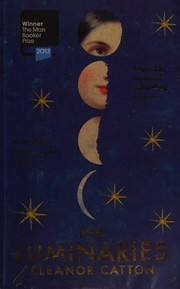
The Luminaries
2,949-word summary 13 min read 848 pages in the book
- First published
- 2013
- Publisher
- Granta Books
- Pages
- 848
- ISBN
- 9781847084316
Reading options
What's inside (8 sections)
I picked this up partly because of its reputation as the longest book ever to win the Booker Prize and partly because eight hundred plus pages felt like a dare. It is a novel that announces its own architecture almost straight away, and it asks you to admire the machinery while a detective story plays out inside it. Eleanor Catton was twenty-eight when it won the 2013 Booker, the youngest writer ever to take it, and the setting is 1866 in Hokitika, a town on the West Coast of New Zealand's South Island that existed because gold had been found in the rivers and beaches nearby. I had never read anything quite like it, and I finished it with the odd feeling that I had been watching a clock being taken apart and put back together while a group of desperate people argued in the next room.
A stranger walks into a room full of men
Walter Moody arrives in Hokitika by ship, the Godspeed, with the usual hopes of a man going to the goldfields to make his fortune. Something happens to him on the crossing that he cannot explain. He sees a man he takes to be a ghost, a figure he later names as Emery Staines, and the sight unsettles him enough that when he goes into the smoking room of a Hokitika hotel to escape the rain, he is in no mood for company. The room, though, is already occupied by twelve men in the middle of a tense and private meeting. They stop talking. They eye him. Then, once they work out who he is and that he is not connected to the trouble they have been discussing, they decide to bring him up to speed.
That is the novel's opening move, and it is a neat one. Rather than introduce a detective who calmly collects clues, Catton drops her reader into a room where the evidence has already been sorted, argued over, and disagreed about by a dozen witnesses. The twelve men form a kind of informal council, each with a trade and a stake in events. There is Te Rau Tauwhare, a Māori greenstone hunter; Charlie Frost, a banker; Edgar Clinch, a hotelier; Benjamin Lowenthal, a newspaperman; Cowell Devlin, a chaplain; Sook Yongsheng, a hatter; Aubert Gascoigne, a justice's clerk; Joseph Pritchard, a chemist; Thomas Balfour, a shipping agent; Harald Nilssen, a commission merchant; Quee Long, a goldsmith; and Dick Mannering, a goldfields magnate. None of them has the whole picture. Each has a piece, and the pieces do not fit.
What they tell Moody amounts to a string of strange events from the previous two weeks. A little-known hermit named Crosbie Wells has been found dead in his cabin by a politician called Alistair Lauderback on his way into town. The death looks peaceful, but the cabin holds several thousand pounds' worth of hidden gold, along with an unsigned deed suggesting that a rich and likeable young man named Emery Staines was to pay two thousand pounds to Anna Wetherell, a prostitute known around the Chinatown areas of Hokitika. On the same night Wells's body was found, Staines vanished. Anna was discovered lying unconscious in the road after what looked like a suicide attempt, and when she came to, she and Gascoigne found hundreds of pounds' worth of gold sewn into the lining of her dress by someone she would not name.
I found this section genuinely gripping, mostly because the men contradict one another in small, human ways. They are not interchangeable witnesses feeding facts to the reader. They are gossips, rivals, and friends, each with a reason to shade the story a particular way. Reading it feels like arriving late to a party where everyone already knows a scandal and is enjoying the telling of it.
The man at the centre of it all
As the accounts accumulate, one name keeps coming up. Francis Carver is a violent, scarred man who captained the Godspeed, the very ship Moody came on. Nine months earlier, in Dunedin, Carver had cheated Lauderback out of that ship using the false name Francis Crosbie Wells. The trick was ugly and clever. Carver had hidden a fortune in gold inside a shipment of five dresses sent under Lauderback's name, then threatened to have Lauderback arrested for smuggling undeclared gold unless he handed over the vessel. The shipping crate disappeared and washed ashore, which is why Carver has come to Hokitika looking for the fortune.
Here the plot starts to turn on those five dresses. Anna unknowingly bought them when she arrived in Hokitika. One of her clients, Quee Long the goldsmith, discovered gold in four of them and quietly replaced it with leaden makeweights while she slept. Because Anna never wore the fifth dress while visiting Chinatown, the gold in that one stayed put. Quee smelted what he had taken and submitted it to the bank, only to find that Staines had stolen it from him. So gold moves through the town like a contaminated gift, passing from hand to hand, every transfer leaving a fresh injury behind it.
Moody, having listened to all of this, finally tells his own story. He believes he saw the ghost of Emery Staines aboard the Godspeed. The words are barely out before a servant of Dick Mannering's bursts in with news that the ship has foundered just off shore. Three weeks later its wreckage is hauled up onto the beach. Moody is sent the wrong trunk, Lauderback's rather than his own, and inside he finds letters that change the shape of the case. Crosbie Wells, it turns out, was Lauderback's half-brother, a bastard born to a prostitute mother. Crosbie had come to New Zealand looking for their father and had spent years trying to contact Lauderback without getting a reply. In the letters he writes that he amassed a great fortune on the goldfields, only to have it stolen from him in circumstances he refuses to describe.
That revelation is the point where I started to understand what Catton is doing with the gold. It is never just wealth. It is the thing that lets people hide, blackmail, reinvent themselves, and destroy one another. A man can be declared dead and still have his money moving through the town. A woman can be accused of theft for carrying a dress that somebody else stuffed with stolen metal. The mystery is complicated, but the motive behind each twist is plain enough: everyone wants the gold, and nobody wants to be caught.
A séance and a promise made years before
The middle of the book widens the cast again. Lydia Wells, the widow of Crosbie Wells and the mistress of Francis Carver, announces that she will hold a séance to contact the ghost of Emery Staines. She hires Anna as an assistant, and Anna has recently given up prostitution after paying off her debt to Clinch. Lydia claims to have befriended Anna when the girl first arrived in Dunedin, but she keeps her close and will not let her go out alone. Sook Yongsheng, who supplies Anna with opium and counts her as a friend, comes to visit and recognises Lydia as Carver's mistress. Sook had sworn revenge on Carver years earlier for the murder of his father, and he has not let the promise go. He insists on attending the séance.
What happens there is one of the strangest scenes I have read in a novel of this kind. Instead of channelling Staines, Lydia speaks Cantonese and repeats the promise Sook made long ago to kill Carver. The room has been arranged as a performance, and the performance turns into a threat aimed at one of the people in it. Afterward Sook goes to Carver's hotel to finish what he started. He never gets the chance. George Shepard, the gaoler, shoots him first, acting out of revenge for a brother he believes Sook killed.
On that same night, Emery Staines appears in Crosbie Wells's cabin with a bullet wound in his shoulder. Te Rau Tauwhare brings him back into town for medical attention, and there he is reunited with Anna, who has mysteriously suffered an injury in the same place on her own body. Once the bullet is removed, Staines is kept at the gaol-house along with Anna. Cowell Devlin watches the two of them facing each other as they sleep and concludes that they are lovers. The book never lets that conclusion sit comfortably. The connection between Anna and Staines is real, but it is also stranger than romance, bound up with the opium, the ghost sighting, and the way their injuries answer one another across distance.
I will admit that this part tested me. The plot has become a knot of coincidences, and the reader is asked to accept that a bullet in one man's shoulder appears on a woman miles away. Catton is writing a melodrama with the machinery of a puzzle box, and the two impulses do not always sit easily together. Yet the oddness is also the point. This is a world in which money vanishes into dress linings, the dead are contacted through séances, and a promise spoken years ago in another language comes back to decide who lives.
The astrological machine underneath
By this stage the book's larger design has become hard to ignore. Catton discovered that there had been a triple conjunction in Sagittarius at the time the novel is set, and she used star charts and the Stellarium programme to reconstruct the night sky over Hokitika in 1866. The result is a book built on the correspondence between people and heavenly bodies. Each of the twelve men in that opening meeting stands for one sign of the zodiac. Te Rau Tauwhare is Aries, Charlie Frost is Taurus, Benjamin Lowenthal is Gemini, Edgar Clinch is Cancer, Dick Mannering is Leo, Quee Long is Virgo, Harald Nilssen is Libra, Joseph Pritchard is Scorpio, Thomas Balfour is Sagittarius, Aubert Gascoigne is Capricorn, Sook Yongsheng is Aquarius, and Cowell Devlin is Pisces. The title of a chapter in which one of these men plays a major part carries his sign, and the chapter headings reflect the real positions of planets and stars on the given dates.
A second set of characters represents the planets. Walter Moody is Mercury, the planet that governs reason, and Catton has said she built the narrative so that the person trying to unravel the mystery stays one step behind it, just as Mercury followed behind the other planets in that conjunction. Lydia Wells is Venus, Francis Carver is Mars, Alistair Lauderback is Jupiter, and George Shepard is Saturn. Anna Wetherell and Emery Staines share the Sun and the Moon between them, trading the roles back and forth. All of them are anchored by the murdered man, Crosbie Wells, who stands for the earth itself.
The structure is as precise as the character map. The novel is divided into twelve sections, and each one is shorter than the one before, a pattern meant to mimic the moon waning through its cycle. Catton described it as "like a wheel, a huge cartwheel, creaky at the beginning and spinning faster and faster as it goes." That is a fair description of the reading experience too. The early chapters are slow, crowded with the council's testimony and the details of Hokitika, and later sections accelerate into shorter, sharper scenes. A small heading at the start of each chapter offers a hint of what is coming, which takes nothing away from the suspense and instead adds another layer of order.
I admired this even when it felt overengineered. There is a risk in asking a reader to track twelve zodiac signs and seven planets while following a tangled crime plot, and some of the correspondences feel decorative rather than necessary. Still, the waning structure gives the book a shape I have not encountered elsewhere, and it makes the closing chapters feel genuinely urgent. The pace is not a trick. It is the story's argument about how a town runs out of luck.
Anna's arrival and the truth at the trial
Part Four breaks the forward motion. Catton abandons the linear narrative and goes back to Anna Wetherell's first arrival in New Zealand in April 1865. On the ship out she meets Staines for the first time, though he does not tell her his name, and he points out the mythical quality of the albatrosses flying overhead. That backward glance gives the reader something the council in the hotel never had: a sense of who these two people were before the gold and the opium and the accusations began to define them.
The book then returns to the autumnal equinox, where Staines and Anna are charged with various crimes and Moody agrees to act as their lawyer. The trial is where the threads are finally pulled together. It emerges that Carver and Lydia plotted together to steal Crosbie Wells's gold; that Carver bought the Godspeed by blackmailing Lauderback; and that Carver killed Wells by drugging him with laudanum. The hermit whose death set the whole mystery in motion was murdered, quietly and without a struggle, by the man who had spent months hunting for his money.
The sentences are almost an afterthought once the truth is out. Staines is given nine months of hard labour and Anna is acquitted. Carver is taken to prison but is found murdered on the way, with the book implying that Te Rau Tauwhare killed him using a greenstone patu as vengeance for his old friend Crosbie. Moody, having spent the whole novel one step behind events, finally leaves Hokitika to begin prospecting for gold. The ending is deliberately modest. The great machine of the plot winds down, and a young man who has spent months listening to other people's stories walks off to try his own luck.
What works, and what wears thin
I want to be honest about the parts that tested my patience. At more than eight hundred pages this is a long commitment, and there are stretches where the book seems more interested in displaying its own cleverness than in moving the story forward. C. K. Stead, writing in the Financial Times, praised the exceptional detail and verisimilitude but called the story shamelessly implausible, and said it would not let him forget for a moment that he was reading fiction, a novel as a game played brilliantly but at such length that he could not overcome his impatience. I understood exactly what he meant during the séance chapter and the run-up to the trial.
Bill Roorbach, reviewing the book in The New York Times, compared reading it to doing a Charlotte Brontë themed crossword while playing chess and Dance Dance Revolution on a balance board. That sounds like a joke, and it is, but it captures the particular pleasure on offer here. You are being asked to hold several different games in your head at once, and the reward is the moment a small detail from an early chapter clicks into place much later. Booker judge Stuart Kelly said the book felt more like a Kiwi Twin Peaks than any novel he had read, and that is another fair description of its flavor: a strange town, a dead man, and a set of people who all know more than they are saying.
The book also has a history of uneven reception that is worth knowing about. Catton has said that her high profile reviews from New Zealand were cold while the British ones were warm, and that in Britain reviewers could say what they disliked and still acknowledge that something exciting was happening on the page. She described parts of the response at home as bullying from older male reviewers. That may explain why the criticism and the praise for this book often sound like they are about two different novels. One reader sees a brilliant structure holding a hollow story; another sees a Victorian scale of ambition rebuilt for the twenty-first century. Both readings are available in the text.
So who is this for? I would hand it to a reader who enjoys puzzle narratives and does not mind a book that asks them to do real work, keeping track of names, dates, trades, and the movement of gold from dress to dress. I would be cautious with a reader who wants a brisk crime novel or a straightforward historical adventure. The astrology is not decoration, but it does ask for attention, and a reader who ignores it will miss a good part of the design. Catton read widely before writing, moving from gold rush history to the nature of wealth, to confidence tricks, to fortune telling, to the stars, and the book expects some of that curiosity from its audience.
What stayed with me after finishing was not the zodiac chart or the shrinking chapter lengths but the picture of a place where everybody is trying to get rich quickly and nobody can be trusted. Hokitika in 1866 is presented as a town built on a temporary accident of geography, full of people who have arrived from somewhere else and invented new versions of themselves. The gold in the dress lining is a perfect emblem for the whole place. It is a fortune someone else put there, and everyone who touches it ends up carrying a burden they did not choose. Catton keeps that human story visible even when the machinery threatens to swallow it, and that is why the book is worth the effort despite its length.
FAQ
Did The Luminaries win the Booker Prize?
Yes. It won the 2013 Booker Prize, and at more than eight hundred pages it was the longest book ever to win, while Catton at twenty-eight was the youngest winner.
Why is the novel called The Luminaries?
The twelve men Moody meets each stand for a sign of the zodiac, with other characters representing planets and the murdered Crosbie Wells as the earth. Catton based the structure on the real stars and a triple conjunction in Sagittarius over the town in 1866.
Is The Luminaries hard to read?
It asks for patience. The opening chapters are crowded with testimony, and the reader must track many names, dates and a shifting knot of clues. Readers who enjoy puzzle narratives tend to reward the effort, while those wanting a brisk crime novel often struggle with the length.
Similar books
The Paying Guests
A widowed mother and her unmarried daughter take in lodgers in 1922 south London, and a secret affair between Frances and Lilian pulls them into a murder case.
2,661-word summary · 12 min read
Possession: A Romance
A London Library discovery sends two scholars chasing a secret Victorian love affair, in a Booker-winning novel of invented letters, poetry and the race to own…
2,394-word summary · 11 min read
The Christie Affair
Agatha Christie vanishes for eleven days in 1926, and her husband's mistress claims to know why. Nan O'Dea's account runs from an Irish convent to a Yorkshire…
2,384-word summary · 11 min read
Bleak House
Jarndyce and Jarndyce grinds through Chancery while Esther finds her family.
2,480-word summary · 11 min read
There Will Be Bodies
Digging out a villa buried by Vesuvius, Flavia Albia finds chained corpses and a death someone tried to hide for ten years.
2,152-word summary · 10 min read
The New York Trilogy
Three linked novels turn a wrong-number call into a puzzle about names, authorship, and the stories people tell to stay sane.
2,259-word summary · 10 min read
The Hangman's Daughter
In 1659 Bavaria, a hangman ordered to torture an innocent midwife instead investigates the deaths of children marked with a strange tattoo.
2,523-word summary · 11 min read
Evil Under the Sun
Poirot's Devon holiday turns deadly when a flirtatious actress is strangled at a secluded seaside hotel in this 1941 puzzle.
2,380-word summary · 11 min read
The Tunnel
A painter in a Buenos Aires prison recounts the glance, the woman and the jealousy that led him to murder the only person who understood him.
2,313-word summary · 10 min read
Five Little Pigs
Sixteen years after a painter's murder, Poirot reopens the case at the request of a daughter who believes her dead mother was innocent.
2,027-word summary · 9 min read
Crooked House
A family gathered around a dying patriarch in a twisted old house, and one of Christie's most famous revelations about who killed him.
2,059-word summary · 9 min read
Hercule Poirot's Christmas
Simeon Lee invites his family to Gorston Hall for Christmas, then is found dead in a locked room. Poirot sorts a household where nearly everyone has a reason…
2,348-word summary · 10 min read
Child 44
Tom Rob Smith's 2008 debut follows Soviet secret policeman Leo Demidov as he hunts a child killer in a country that officially has no crime.
2,428-word summary · 11 min read

The Crying of Lot 49
A California woman named executor of her ex-lover's estate follows a muted post horn into a possible centuries-old postal conspiracy, and Pynchon refuses to…
2,003-word summary · 9 min read
The Art Forger
A disgraced Boston painter agrees to copy a Degas stolen from the Gardner Museum, then begins to suspect the original she is copying is itself a forgery.
2,117-word summary · 9 min read
The Black Dahlia
James Ellroy builds a fiction around the real Black Dahlia murder, following two Los Angeles cops whose partnership and obsessions destroy them.
2,533-word summary · 11 min read

Sophie's Choice
A young Southern writer in 1947 Brooklyn befriends a brilliant, unstable couple and slowly learns the story of the Polish Catholic woman at the center of their…
2,798-word summary · 12 min read

Ivanhoe
A disinherited Saxon knight, a great tournament, a besieged castle and a trial by combat. Scott's most famous novel, set in England in 1194.
2,834-word summary · 13 min read

Wide Sargasso Sea
Jean Rhys gives the first Mrs. Rochester a Caribbean childhood, a marriage built on money and suspicion, and a voice that Charlotte Bronte left in the attic.
2,021-word summary · 9 min read
Mother Night
Howard W. Campbell Jr., a Nazi propagandist and American spy, tells the story of his double life from an Israeli prison cell while waiting to be tried for war…
1,988-word summary · 9 min read
The Memoirs of Sherlock Holmes
Doyle's second Holmes collection gathers twelve Strand stories, including the early case of the Gloria Scott and the confrontation with Moriarty at Reichenbach…
2,390-word summary · 11 min read
Death Comes to Pemberley
P.D. James drops a murder onto the Pemberley estate and sends Wickham to trial, reading Austen's most famous marriage through the machinery of Georgian justice.
2,318-word summary · 10 min read
The Redbreast
Harry Hole chases an ageing sniper through modern Oslo while two Norwegian volunteers on the Eastern Front carry a fifty-year-old betrayal toward a royal…
2,453-word summary · 11 min read
The Murder on the Links
Poirot arrives in France too late to save his client, who is found stabbed in a grave and was not the man he claimed to be. Christie's second Poirot novel.
2,055-word summary · 9 min read
The Prisoner of Heaven
Fermin Christmas past returns with a stranger and a prison debt.
2,388-word summary · 11 min read
The Maltese Falcon
Sam Spade hunts a jeweled bird through lies after his partner is killed.
2,529-word summary · 11 min read
Notes on an Execution
Ansel waits on death row while three women carry what he broke.
2,527-word summary · 11 min read
Fingersmith
A thief plots to cheat an heiress, then the scheme flips twice in Victorian London.
2,532-word summary · 11 min read
Case Histories
A Cambridge PI takes three cold cases that tangle with his own loss.
2,465-word summary · 11 min read
The Body in the Library
A strange girl found dead in a library pulls Miss Marple into lies about dance halls and film.
2,017-word summary · 9 min read