
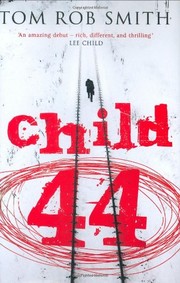
Child 44
2,428-word summary 11 min read 400 pages in the book
- First published
- 2008
- Publisher
- Simon & Schuster
- Pages
- 400
- ISBN
- 9781847371263
- Series
- Leo Demidov (#1)
Reading options
What's inside (10 sections)
I read this book expecting a cold war spy story and got something colder. Tom Rob Smith published Child 44 in 2008 with Simon & Schuster, a 400 page debut that announced itself as the first of three novels about an MGB officer named Leo Demidov. It draws on the real crimes of Andrei Chikatilo, the Rostov Ripper, but Smith moves the action back into the Stalin years and builds a world where the state has declared that crime no longer exists. That single idea, a police force that cannot admit there are murders to solve, is what makes the book more than a procedural. It is a novel about a government so committed to its own story that it would rather let children die than revise the story.
The crime that could not exist
The premise is stated early and starkly. In the Soviet Union of the early 1950s, the official line is that socialism has eliminated crime. Criminality is a bourgeois sickness, a thing of the past, so any report of a murder is treated as a mistake or a lie. That leaves a huge hole in the system, and Smith walks straight into it. When the bodies of young boys start turning up, there is no institution equipped to notice a pattern, because noticing a pattern would mean admitting the pattern exists. Detectives are reassigned. Files disappear. Someone always has a reason for why the latest death was an accident or a family matter.
This is where the book earns its grim reputation. The horror is not only in what happens to the children but in the bureaucratic machinery that refuses to see it. Smith understands that a totalitarian state does not need to hide every fact. It only needs to make the cost of naming a fact unbearable. The result is a world in which a killer can work in plain sight because everyone around him is invested in pretending he is not there. I found that idea far more disturbing than any description of a crime scene, and it is the thread that holds the whole novel together.
Smith does not stop at the idea. He shows how the doctrine works in practice, in the way an officer reports a death, in the way a file gets reclassified, in the way a mother is told her missing boy has simply run away. The language of the state is a kind of fog that rolls over everything, and Leo's job is to see through it. One of the sharper scenes involves a local official who knows perfectly well that something is wrong but repeats the approved formula because the formula keeps him safe. That is the book's real villain, not any single man: a system that rewards the person who looks away.
Leo Demidov, a man made by the state
Leo Demidov is an officer in the MGB, the Soviet secret police, and Smith gives him a past that makes him both an instrument of the system and a potential threat to it. Leo grew up in the famine and learned early how to survive by being useful to whoever held power. He became a investigator who could break a man, extract a confession, and file the result in a language that satisfied his superiors. He is good at his job in the way a person becomes good at something after doing it too many times. He is also hollowed out by it, and his loyalty has curdled into something quieter and more dangerous: a habit of noticing what the official story leaves out.
His methods belong to that world. Leo knows how to take a statement apart, how to find the lie in a carefully worded denial, and how to make a prisoner want to confess to something he did not do. Smith is interested in the cost of that skill rather than glamorizing it. When Leo turns those talents on people who have done nothing wrong, the scenes are uncomfortable in a way a simpler hero would not be. He is not a detective who happens to have a dark past. He is a man whose past is the reason he can do the job at all, and the reason he is so hard to live with.
His wife Raisa is the person who sees this most clearly. Their marriage is one of the more interesting things in the book, because it is neither a refuge nor a simple casualty of the plot. Raisa is intelligent and politically alert in a way Leo is not, and she understands the cost of the life he has built for both of them. When the state turns on them, as it always does, their relationship becomes the test of whether Leo is capable of putting anyone before himself. Smith writes their scenes with a restraint that suits the period. Much is left unsaid, and what is said carries the weight of things they cannot afford to put into words.
A pattern that no one will count
The plot proper begins with a series of child murders that Leo starts to connect before anyone else will. The victims are boys, poor and largely invisible, the kind of children a regime that has abolished crime has no category for. Leo notices links in the locations and in the way the bodies are left, and he begins the slow work of building a case that his superiors do not want to hear. This is where the title comes into focus. The number in it points to one of the dead children, a figure where a name ought to be, and the whole book keeps asking how many others like him the state will refuse to count.
The investigation is not a clean chain of clues. Smith threads the child murders through the larger machinery of Soviet life: the purges, the camps, the fear that makes neighbors inform on neighbors, and the strange official optimism that surrounds a country busy denying its own hunger. A murder investigation becomes a way to map an entire society. I liked the ambition. There are moments when the book feels like it is trying to hold the whole Stalin era inside a detective story, and sometimes that ambition gets the better of it. But the core mystery is solid, and Leo's stubbornness gives it a spine. He keeps going after the case is taken away from him, which is what turns him from a functionary into a person.
The victims are drawn with enough care that they are not just a body count. Smith gives attention to the boys' lives, to the families who are told to stop asking questions, and to the particular vulnerability of children whose parents have vanished into the camps or the famine. There is a scene near the start involving a boy whose death is processed as a formality, and the coldness of the paperwork is what makes it land. The book keeps returning to the gap between a human life and the number assigned to it. That gap is the moral center of the story, and it is why the title stings.
Exile to the provinces
Leo's refusal to play the expected part has consequences. He is stripped of his position and sent away from Moscow to a provincial town, a demotion dressed up as a transfer. There he is expected to do mundane police work in a place where nothing important is supposed to happen. Instead he finds that the pattern follows him, or that it was always wider than anyone admitted. Working with a small local force, he keeps chasing the murders while trying to stay alive in a system that watches its own officers as closely as anyone else.
This stretch of the book has the best texture. Smith is good at the small details of provincial Soviet life, the shortages, the official rituals, the way fear shapes ordinary conversations. Leo becomes a different man away from the capital, less certain of his own importance and more capable of actual attention. The hunt also picks up speed here, because the provincial setting strips away some of the bureaucratic cover that protected the killer in Moscow. The chapters are cleaner, more direct, and more frightening. For a while it feels like the novel has found exactly the shape it needs.
The local force he joins is a study in small compromises. These are men who have learned to keep their heads down, and their first reaction to Leo's questions is fear. He has to earn their trust without revealing how much he knows, and the cat and mouse of those scenes gives the middle of the book a different rhythm from the Moscow chapters. There is also a younger officer who becomes useful to him, a reminder that the next generation has to decide what kind of person it will be. Smith uses these relationships to show what loyalty looks like when loyalty is dangerous.
Raisa, and the cost at home
The emotional center of the book is not the murder case but what happens to Raisa. When Leo falls out of favor, the state does not stop with him. His wife is accused, detained, and eventually sent into the camp system, and much of Leo's energy goes into trying to get her out or at least keep her alive. This is where Smith shows he is writing about more than a clever mystery. The camps and the longer history of Soviet violence are not background decoration. They are the place where the logic of the state becomes flesh, and Raisa's imprisonment forces Leo to confront the machine he used to serve.
Smith also uses her storyline to widen the historical frame. The novel reaches back to the famine and the destruction of whole generations of children, which is how it arrives at the idea of a killer who is himself a product of that violence. The connection is thematic rather than tidy, and it gives the last act a somber weight. Raisa is more than a wife in peril, though. She is the character who keeps insisting on truth when truth is expensive, and her stubbornness mirrors Leo's. Their story is the human scale that keeps the book from becoming a lecture about totalitarianism.
Raisa's imprisonment is written without melodrama. The horror is in the routine of it, the transport, the queue, the reduction of a person to a file number and a sentence. Leo's attempts to reach her run into the same wall as his investigation: a system that has already decided the answer and has no mechanism for being wrong. The parallel is deliberate. He cannot get the state to admit that his wife is innocent any more than he can get it to admit that children are being murdered. Both fights are about the same thing, which is whether a person can be seen as a person.
The reveal and what it means
Without giving away every turn, the investigation eventually closes in on a killer whose life is bound up with the very history the state is trying to erase. Smith handles the reveal as both a solution to the mystery and an argument about causation. The man is not a mysterious outside force. He is someone the system produced and then concealed, which is the point the whole book has been building toward. The confrontation is tense, and Leo's final choices matter because they cost him something. He cannot undo what he did in the MGB, but he can refuse to keep serving the lie.
I found the ending satisfying in its main lines and a little too neat in its execution. The machinery of the plot clicks into place with a speed that undercuts the patient ambiguity of the earlier chapters. The novel has spent hundreds of pages insisting that the truth is hard to see, then resolves the case in a way that feels slightly engineered. That is a fair criticism, and it is one the book shares with many first novels that have a strong central idea and are still learning how to land it.
What works, what strains
The atmosphere is the achievement here. Reviewers at the time called it tightly woven and high voltage, and the comparison to a nightmare of paranoia is fair. Smith can make a corridor in a government building feel as dangerous as a dark alley, and his best scenes turn paperwork into suspense. The book won the CWA Ian Fleming Steel Dagger for best thriller in 2008, was longlisted for the Man Booker, and Smith took the British Book Award for Newcomer the following year. Those honors make sense given how fully the premise is realized.
The weak points are also real. Kirkus praised the pace while noting that it camouflages wild coincidences, and that is an accurate note. Several turns depend on timing and encounters that strain belief, especially once the case moves out of Moscow. The Guardian's review of the paperback said the characters and dialogue were underdeveloped and the prose bland, and there is truth to that too. Some people in the book are functions of the plot rather than fully realized people, and Smith's prose is workmanlike rather than distinctive. He also tries to fold in so much Soviet history, from the Holodomor to the camps to the secret police, that the novel occasionally buckles under the weight. A New York Times reviewer went so far as to call it an adequate police procedural. That feels harsh, but I understand the impulse. The book is at its best when it stays close to Leo and the children, and weakest when it tries to explain an entire century.
After the book
Child 44 became the first volume of a trilogy, followed by The Secret Speech and Agent 6, and it was adapted into a 2015 film produced by Ridley Scott and directed by Daniel Espinosa, with Tom Hardy as Leo and Gary Oldman in the cast. Reading it now, with that afterlife in view, it is easy to see why it traveled. The premise is exportable, the setting is vivid, and the moral question is sharp enough to survive a movie version. It is not a flawless novel. The coincidences and the character sketching hold it back. But a thriller built on the idea that a government would rather lose children than admit a mistake has a power that craft alone cannot supply, and Smith understood exactly what he had.
FAQ
Is Child 44 based on a true story?
It is fiction, but it draws on the crimes of Andrei Chikatilo, the Soviet killer known as the Rostov Ripper. Smith moved the setting back to the Stalin era and invented the investigator Leo Demidov.
Is Child 44 the first book in a series?
Yes. It opens the Leo Demidov trilogy, followed by The Secret Speech and Agent 6, and it was adapted into a 2015 film starring Tom Hardy.
What does the number 44 in the title mean?
The number is tied to one of the murdered children in the case. Rather than treating it as a clue, the book uses it to show how the state turns a boy's life into a case file.
Similar books
More from Leo Demidov first, then related titles.
The Girl in the Ice
A young socialite is found frozen beneath the ice in a south London park, and DCI Erika Foster returns to work to lead the case. Grief, privilege and three…
2,492-word summary · 11 min read
Never Flinch
Holly Gibney works two cases at once: a killer promising fourteen deaths and a threat against a feminist writer's lecture tour. King braids them into a…
2,245-word summary · 10 min read

Rules of Prey
Minneapolis detective Lucas Davenport hunts a killer who leaves a new rule at every scene and treats murder as a game of wits.
1,914-word summary · 9 min read

3rd Degree
The third Women's Murder Club novel follows a San Francisco terror cell and a three-day killing schedule, and it costs the club a member.
2,685-word summary · 12 min read

The Redbreast
Harry Hole chases an ageing sniper through modern Oslo while two Norwegian volunteers on the Eastern Front carry a fifty-year-old betrayal toward a royal…
2,453-word summary · 11 min read
The Poet
A crime reporter investigates his twin brother's apparent suicide and uncovers a killer who leaves Edgar Allan Poe quotes behind, in the novel that took…
2,020-word summary · 9 min read
Triptych
A GBI agent with dyslexia hunts a rapist while two Atlanta cops hide pasts.
2,576-word summary · 11 min read
Blindsighted
Sara and Jeffrey hunt a killer staging women in small-town Georgia.
2,400-word summary · 11 min read
The Snowman
After the first snow, a mother vanishes and Harry Hole links her pink scarf to eleven missing women.
2,750-word summary · 12 min read
Shutter Island
A U.S. marshal hunts a missing patient on a locked asylum island in 1954, where every clue turns back on him.
2,761-word summary · 12 min read

There Will Be Bodies
Digging out a villa buried by Vesuvius, Flavia Albia finds chained corpses and a death someone tried to hide for ten years.
2,152-word summary · 10 min read
The Hangman's Daughter
In 1659 Bavaria, a hangman ordered to torture an innocent midwife instead investigates the deaths of children marked with a strange tattoo.
2,523-word summary · 11 min read
The 5th Horseman
Two linked cases pull Lindsay Boxer and the Women's Murder Club into a hospital full of strange deaths and a luxury-car murder spree.
2,609-word summary · 12 min read
Th1rt3en
A former con artist turned defense lawyer takes a celebrity murder trial while a serial killer sits on the jury, steering the verdict.
2,254-word summary · 10 min read
Make Me
Reacher drifts into a quiet Midwestern town and finds a missing investigator, a trail of killers, and a deep web secret.
2,352-word summary · 10 min read
Zero Day
Army investigator John Puller is sent alone to a West Virginia coal town to solve a colonel's murder, and finds a much larger secret buried nearby.
3,434-word summary · 15 min read
The Word Is Murder
A fictionalised Anthony Horowitz is talked into chronicling a prickly ex-detective's case: a woman murdered hours after planning her own funeral. A clever…
2,296-word summary · 10 min read
The Unquiet Grave
In Dervla McTiernan's fourth Cormac Reilly novel, a body found in a Galway bog turns out to be a missing school principal, and the case opens into something…
2,253-word summary · 10 min read
The Summons
A law professor is summoned home to find his judge father dead and more than three million dollars hidden in the house.
2,265-word summary · 10 min read
The Running Grave
In the seventh Cormoran Strike novel, Robin goes undercover inside a Norfolk cult while Strike digs into a child's death from decades earlier.
2,615-word summary · 12 min read
The Reversal
Mickey Haller prosecutes a child killer's retrial with ex-wife Maggie and half-brother Harry Bosch on his team.
2,056-word summary · 9 min read
The Paying Guests
A widowed mother and her unmarried daughter take in lodgers in 1922 south London, and a secret affair between Frances and Lilian pulls them into a murder case.
2,661-word summary · 12 min read
The Midnight Line
A West Point class ring in a Wisconsin pawnshop sends Jack Reacher across the Midwest, from a biker's lie to a wounded veteran hiding from the opioid trade.
2,590-word summary · 12 min read

The Luminaries
Eleanor Catton's Booker-winning novel drops a young prospector into an 1866 New Zealand gold town where twelve men untangle a web of hidden gold, murder and…
2,949-word summary · 13 min read
The Keeper of Lost Causes
Jussi Adler-Olsen introduces Carl Mørck and Department Q, a Copenhagen cold-case unit in a basement, and a missing politician whose file refuses to stay closed.
2,759-word summary · 12 min read
The Hard Way
A man Reacher sees drive a ransom-laden Mercedes pulls him into a retired colonel's hunt for his missing wife and stepdaughter.
2,637-word summary · 12 min read
The Girl Who Takes an Eye for an Eye
Lisbeth Salander investigates a secret childhood experiment from prison while Mikael Blomkvist uncovers a twin conspiracy behind a wealthy businessman.
2,059-word summary · 9 min read
The Fix
Amos Decker watches a government contractor shoot a teacher outside FBI headquarters, then turn the gun on himself. The DIA wants the case shut.
2,315-word summary · 10 min read
The Brass Verdict
Mickey Haller takes over a murdered lawyer's caseload and a Hollywood double-murder trial, with Harry Bosch circling the edges.
2,672-word summary · 12 min read
Never Go Back
Reacher returns to his old military unit to find Major Susan Turner jailed and two invented cases hiding an opium smuggling ring.
2,245-word summary · 10 min read