
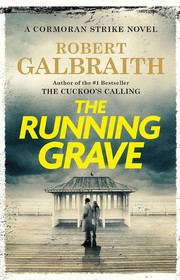
The Running Grave
2,615-word summary 12 min read 960 pages in the book
- First published
- 2023
- Publisher
- Sphere
- Pages
- 960
- ISBN
- 9780316572101
- Series
- Cormoran Strike (#7)
Reading options
What's inside (9 sections)
I came to this book with a strange kind of dread, because I knew its reputation before I opened it. This is the seventh Cormoran Strike novel, published in September 2023 by Sphere and running to 960 pages in the first edition, and it had a name for being the longest and the grimmest of the lot. It is also the one where Robin Ellacott goes inside a cult. That is a premise I do not take lightly, and the author (J. K. Rowling writing as Robert Galbraith) does not rush it either. I read it over about a week, mostly at night, and came away admiring some parts and impatient with others. This is the story as I followed it.
A case that starts close to home
The book opens with Sir Colin Edensor, a retired civil servant, coming to the agency at 12 Denmark Street. He wants Cormoran Strike and Robin to get his son Will out of the Universal Humanitarian Church, the UHC. It calls itself a charity and a force for good, but a lot of people call it a cult, and Sir Colin is one of them. Its headquarters are at Chapman Farm near Aylmerton in Norfolk. Strike knows the place the moment he hears the name. He lived there as a child, back when it was the Aylmerton Community, during the wandering years he spent with his mother Leda and his sister Lucy. The case becomes personal before anyone has done a day of fieldwork.
That connection is what pushes Strike to go and see Lucy, who is now married with three sons. Their conversation changes what the job is. She tells him she was molested at the commune as a child, by the doctor who was attached to it. It is a hard thing for him to hear, and harder because he had no idea. Mazu Wace, who now runs the church with her husband, was the person who arranged for Lucy to be sent to that doctor. Suddenly the old commune and the present-day church are the same story, and the man who once lived at the farm has a reason to want it answered.
Around this setup the usual team appears. Pat Chauncey runs the office and has switched from smoking to vaping, as Strike has. Sam Barclay is the sharp Scottish contract investigator, Midge Greenstreet is the former Greater Manchester police officer and excellent baker, and Dev Shah does his share of the grind. There is also a quiet subcontractor named Clive Littlejohn who came from a rival agency. He barely speaks, and that is worth remembering, because the book does something with him later that I did not see coming. I will leave it there rather than spoil the shape of it.
What I liked about this opening is how ordinary the entry point is. A worried father walks in with a story about a son who has stopped answering his mail. There is no corpse in the first chapter, no dramatic set piece. The horror arrives through family history, through a sister's confession and a detective's own childhood. It is a slow burn, and for the first hundred pages or so I was content to let it burn slowly.
Robin goes in
Robin volunteers to go undercover at Chapman Farm. She is Strike's business partner now rather than his assistant, and she has trained for work like this. She also carries the memory of a rape and an attempted murder from an earlier case, so the assignment deliberately puts her near similar conduct. The book does not let that pass without comment. There are moments inside the farm when she has to choose how much of her own history she can stand to have stirred up, and the writing is at its best when it stays with that choice instead of explaining it.
Her cover is that of a woman who wants to join the church and believes, or pretends to believe, its teaching. The indoctrination is described in physical terms rather than abstract ones. New members are fed very little, worked until they are exhausted, and cut off from the small comforts that make a person feel like a person. The church teaches that the body must obey and that sexual demands made by those above you are not to be refused. Over time Robin meets the people at the top. Jonathan Wace is the founder, called Papa J by his followers, and he plays the gentle father. His wife Mazu is the one who truly frightens me on the page. Becca Pirbright is a high-status member who enforces the rules on everyone below her. Taio, one of Jonathan's sons, takes an immediate and unwelcome interest in Robin. There is also Shawna, a chatty, not especially clever member whom Robin gets to know well enough to be useful.
Finding Will turns out to be easier than getting him out. Robin locates him at the farm, but he has settled into the life there. He has fathered a child named Qing with a teenager called Lin Doherty, and he wants nothing to do with his old family. He shuts down Robin's attempts to draw him into a private conversation. Meanwhile Taio keeps pressing his advantage, and Robin has to work out how to refuse a man whose church says she has no right to refuse. The tension of those scenes comes from the rules of the place, not from any one threat.
One of the strongest discoveries is a stack of Polaroid photographs Robin finds in a barn, showing young people in pig masks performing sexual acts. She manages to smuggle them out to Strike, and they become a piece of hard evidence in a case built mostly on testimony from people who either cannot or will not speak freely. The cost to her is real. Under the food and work routines she loses weight, and she starts to suffer nervous symptoms. The length of the book does a certain work here: you spend so long with her inside the farm that her exhaustion starts to feel like your own. That is a genuine effect, and it is also the thing that makes the middle of the novel feel heavy.
The drowned prophet
While Robin is inside, Strike works the outside, and a good part of that work is talking to people who have left the church. Kevin Pirbright was a former member writing a book to expose the UHC, and he died of a gunshot before it could be published. His sister Emily, who stayed but never rose far in the hierarchy, becomes one of Robin's contacts. Ralph and Deirdre Doherty left at different times, and their daughter Lin is the mother of Will's child. Flora Brewster is another ex-member, still unwell years after leaving. Strike also tracks down Cherie Gittins, who used several names over the years and was on the beach with little Daiyu Wace the day the child drowned in 1995. Cherie is slippery and hard to pin down, which is exactly what makes her interesting to him.
Daiyu is the key to the church's story. She was seven when she died, the daughter of Mazu, and the UHC turned her into the Drowned Prophet, a figure at the centre of its beliefs. Another death, that of Jonathan's first wife Jennifer in the 1980s, sits in the background. There are other members who died or disappeared, and a number of suicides that the church folds into its mythology as proof of faith. Strike begins with a suspicion that Daiyu's drowning was not what everyone says it was. The investigation that follows is not the glamorous kind. It is driving to see people, going through old inquests, and persuading frightened witnesses to say what they remember.
Running beside all of this is the thread I found hardest to read. Charlotte Campbell Ross, Strike's former fiancée, keeps contacting him. She is unwell and deteriorating, and she claims she has cancer. He refuses to take her calls, again and again. Then she kills herself after leaving him several voicemails, and he is left with guilt he cannot do anything with. I understood his reasons, given their history, but I also found the repeated calls and the refusal to be a little more than the plot needed. This strand is the weakest part of the book for me, and it is also the source of its final emotional beat, so I suspect the author knew exactly what she was doing. It just did not fully convince me.
The worst of it
The middle of the novel is where Robin's ordeal peaks, and it is not comfortable reading. After she narrowly avoids sexual coercion from Taio, Jonathan himself tries his luck. Becca, jealous and suspicious, starts closing in on her. Emily tells her something that overturns the official story: Daiyu did not drown. Robin manages to trick Will into speaking alone and tells him that his mother died a year earlier. He reacts with anger and strikes her. It is a brutal scene, and it is meant to be.
Her punishment comes next. The church drowns her in its baptismal pool, then locks her in a small box for hours. When she is let out, she is put to work caring for Jacob, a deformed and dying child whose condition the church has been hiding. By this stage the book has stopped being a detective story and become something closer to a hostage narrative, and the shift is deliberate. When Taio pressures her again, she makes a run for it and escapes the grounds with Strike. They report Jacob's condition to the police, but the UHC moves the child before anyone can find him. Then the church turns the accusation around and claims Robin molested him.
I want to be fair about this section. It is harrowing, and it is the reason the book is so long in the middle. Some readers will find it too much, and I think that is a reasonable reaction. But the sustained pressure is what gives the later revelations their force. When you have sat with Robin in that box, the idea that the church could simply deny everything feels like an insult, which is precisely the effect the author is after.
Will talks, and the church opens up
Will eventually shows up at the detectives' office with his daughter, having escaped the farm on his own. At first he refuses to contact his family or say anything against the UHC. He begins to soften once Strike and Robin agree to help get Lin out as well. He tells them that Jacob died not long after Robin's escape, which confirms the worst of what she feared. It is a quieter chapter than the ones before it, and the change of pace is welcome.
Robin then arranges a supervised therapy session between Will and Flora Brewster, and this is where the book says plainly what it has been circling. Flora speaks about what the church calls its Divine Secrets. Jonathan Wace has carried out corrective rape on mentally ill women and lesbians. The church buries its dead at the farm without reporting the deaths. There is a large child-trafficking operation built on births that were never registered. These are the facts that turn a case about one young man into a case about a whole organisation. The session is a clever device, because it lets the information arrive from someone who lived it rather than from a detective reading a file.
The raid, and who killed Daiyu
The last stretch brings everything together. Strike and Robin put pressure on their contacts in the police, and a crackdown on the UHC's activities follows, including a raid on the farm. Robin goes after Becca to the church's London temple while Strike confronts Abigail Glover, Jonathan's daughter by his first wife. Strike lays out his theory of the old death. Abigail killed Daiyu out of jealousy, got rid of the body using the pigs kept at the farm, and made the drowning look real with the help of Cherie and other teenagers who were too frightened to refuse. The pieces fit, and the motive is small and human rather than grand, which is what makes it believable.
At the temple, Robin finds Mazu hiding with a baby that has been taken from another member. She overpowers Mazu and gets the fuller story, including the fact that Becca saw Daiyu leave the dormitory long before the time she was said to have drowned, and manipulated the child's fear from then on. Jonathan is arrested. Becca stays faithful to the church even after it is discredited, which says something about how completely she was formed by it. Will is reunited with Lin and the rest of his family, and they rename Qing as Sally in memory of the mother he lost. Strike meets Charlotte's sister Amelia, and the two of them talk through her suicide note and last words, and find a measure of peace in letting her go. Then, just as Robin is about to leave on a trip with her boyfriend, the police officer Ryan Murphy, Strike makes an indirect confession of love. After 960 pages of waiting, it is a small and slightly awkward moment, and that is what makes it work.
The length problem, and what stays with me
The reviews said what a lot of readers were thinking. Jake Kerridge in The Daily Telegraph gave it three out of five stars, called it some of her most gripping writing yet, and then asked whether it had to be so long. Laura Wilson in The Guardian said it could have done with judicious trimming, but still called it an immersive and, for the most part, riveting read. I agree with both of them. There is repetition here. There are stakeouts that go nowhere, interviews that restate what the last interview told us, and long stretches of paperwork and waiting. At this length those passages add up. A leaner book would have kept the same case and lost maybe two hundred pages without losing much.
The cult material itself is more carefully done than I expected. The details of the indoctrination, the starvation, the work, the control over sex, and the way the church rewrites its own deaths into scripture all feel researched rather than invented for shock. The pig-mask photographs and the story of the Drowned Prophet are the kind of specific inventions that make a fictional organisation feel real. I also think the book is smart about money and paperwork as tools of control. So much of the damage is done through forms, names, and unregistered births, not through dramatic violence.
What I keep returning to is Will. His story is the quiet centre of the whole thing. He is autistic, he is grieving a mother he did not know had died, and he has made a child with a girl barely older than a child herself. His anger when Robin tells him the news is the most honest thing in the book, and his slow recovery afterwards is earned rather than announced. If you reading this for the mystery, the answer to who killed Daiyu is satisfying enough. If you stay for the people, it is Will and Robin who remain. I would hand this to someone who has already read the earlier Strike books and wants the pair at their most tested. I would not hand it to someone looking for a quick mystery. It asks for time, and it is not shy about taking it.
FAQ
Is The Running Grave part of a series?
Yes. It is the seventh Cormoran Strike novel, published in 2023 by Sphere, and it is the book in which Robin goes undercover inside a cult.
Why is the book so long?
At 960 pages it has a middle full of stakeouts, interviews and paperwork, and reviewers at The Telegraph and The Guardian both called for trimming. The length does make Robin's exhaustion inside the farm feel drawn out.
Who killed Daiyu Wace?
Spoilers: Strike concludes that Abigail Glover killed her out of jealousy, used the farm's pigs to dispose of the body, and faked the drowning with help from Cherie Gittins and other frightened teenagers.
Similar books
More from Cormoran Strike first, then related titles.
The Cuckoo's Calling
Broke detective Strike and temp Robin investigate a supermodel's fatal fall in London.
2,006-word summary · 9 min read
The Silkworm
A missing novelist and a cruel manuscript pull Strike and Robin into London publishing.
3,583-word summary · 16 min read
Career of Evil
A severed leg delivered to Robin forces Strike to face four men from his past as a London killer stalks, testing the agency and her wedding plans ahead.
2,887-word summary · 13 min read
Lethal White
When troubled Billy reports a buried child, Strike and Robin untangle blackmail around minister Chiswell in a long London case that strains their partnership.
3,063-word summary · 14 min read
Troubled Blood
Strike and Robin take a year long cold case: doctor Margot Bamborough vanished in 1974, with a nurse hiding more.
2,211-word summary · 10 min read
The Hallmarked Man
A body in a silver vault behind Freemasons' Hall sends Strike and Robin into a world of coded letters, secret societies and a girl whose whole identity may be…
3,084-word summary · 14 min read
The 5th Horseman
Two linked cases pull Lindsay Boxer and the Women's Murder Club into a hospital full of strange deaths and a luxury-car murder spree.
2,609-word summary · 12 min read
The Word Is Murder
A fictionalised Anthony Horowitz is talked into chronicling a prickly ex-detective's case: a woman murdered hours after planning her own funeral. A clever…
2,296-word summary · 10 min read
The Keeper of Lost Causes
Jussi Adler-Olsen introduces Carl Mørck and Department Q, a Copenhagen cold-case unit in a basement, and a missing politician whose file refuses to stay closed.
2,759-word summary · 12 min read
Jack & Jill
A senator is killed with a nursery-rhyme calling card as a child is murdered near Alex Cross's home. The third Alex Cross novel pulls him toward two cases, one…
2,646-word summary · 12 min read
Fractured
In Karin Slaughter's second Will Trent novel, a mother kills the wrong man in an Atlanta mansion, and a GBI agent with a hidden reading difficulty finds a…
2,219-word summary · 10 min read

Rules of Prey
Minneapolis detective Lucas Davenport hunts a killer who leaves a new rule at every scene and treats murder as a game of wits.
1,914-word summary · 9 min read

3rd Degree
The third Women's Murder Club novel follows a San Francisco terror cell and a three-day killing schedule, and it costs the club a member.
2,685-word summary · 12 min read

2nd Chance
Lindsay Boxer and the Women's Murder Club hunt the Chimera killer after a church shooting in San Francisco.
2,572-word summary · 11 min read
Holly
Grieving detective Holly Gibney takes a missing-girl case in 2021 and traces it to two polite retired professors with a basement secret.
2,607-word summary · 12 min read
End of Watch
A dying Bill Hodges and Holly Gibney face Brady Hartsfield again, as rigged game consoles push hurt teens toward suicide.
2,923-word summary · 13 min read
Finders Keepers
A boy finds a murdered writer's notebooks while the killer leaves prison hunting them and Hodges closes in.
2,157-word summary · 10 min read
A Slow Fire Burning
A young man stabbed on a London houseboat leaves three simmering women and a stolen memoir behind.
2,074-word summary · 9 min read
Mr. Mercedes
Retired Hodges hunts Mercedes killer Brady Hartsfield concert plot.
2,281-word summary · 10 min read
1st to Die
Lindsay, Claire, Cindy and Jill hunt a honeymoon killer terrorizing San Francisco.
2,536-word summary · 11 min read

Along Came a Spider
Detective Alex Cross hunts Gary Soneji after two children vanish from a Washington school and a Lindbergh echo grows.
2,523-word summary · 11 min read
Make Me
Reacher drifts into a quiet Midwestern town and finds a missing investigator, a trail of killers, and a deep web secret.
2,352-word summary · 10 min read
Zero Day
Army investigator John Puller is sent alone to a West Virginia coal town to solve a colonel's murder, and finds a much larger secret buried nearby.
3,434-word summary · 15 min read
The Unquiet Grave
In Dervla McTiernan's fourth Cormac Reilly novel, a body found in a Galway bog turns out to be a missing school principal, and the case opens into something…
2,253-word summary · 10 min read
The Midnight Line
A West Point class ring in a Wisconsin pawnshop sends Jack Reacher across the Midwest, from a biker's lie to a wounded veteran hiding from the opioid trade.
2,590-word summary · 12 min read
The Hard Way
A man Reacher sees drive a ransom-laden Mercedes pulls him into a retired colonel's hunt for his missing wife and stepdaughter.
2,637-word summary · 12 min read

The Girl Who Takes an Eye for an Eye
Lisbeth Salander investigates a secret childhood experiment from prison while Mikael Blomkvist uncovers a twin conspiracy behind a wealthy businessman.
2,059-word summary · 9 min read
The Girl in the Ice
A young socialite is found frozen beneath the ice in a south London park, and DCI Erika Foster returns to work to lead the case. Grief, privilege and three…
2,492-word summary · 11 min read
Never Go Back
Reacher returns to his old military unit to find Major Susan Turner jailed and two invented cases hiding an opium smuggling ring.
2,245-word summary · 10 min read

The Secret Place
Two Dublin detectives revisit a murder on the grounds of a girls' boarding school, where a bulletin board note and rival cliques hide the truth.
2,271-word summary · 10 min read