
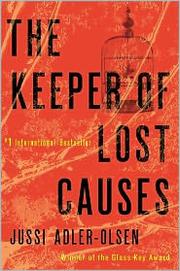
The Keeper of Lost Causes
2,759-word summary 12 min read 400 pages in the book
- First published
- 2007
- Publisher
- Dutton
- Pages
- 400
- ISBN
- 9780525952480
- Original title
- Kvinden i buret
- Series
- Department Q (#1)
Reading options
What's inside (9 sections)
I came to this book through the Netflix show, and I wanted to find out how much of that cold, dry, faintly comic tone was actually on the page. What I found was a novel that is stranger and crueller than the adaptation, and funnier in places I did not expect. The Keeper of Lost Causes was first published in Danish in 2007 as Kvinden i buret, which translates as The Woman in the Cage. The English version arrived in 2011 from Dutton, translated by Lisa Hartford, running to about 400 pages in the hardcover. In Britain the same book was published as Mercy, which tells you something about how differently the two markets sell a story like this. It is the first of the Department Q novels, and it has the job that first novels have: build a world, introduce the people who will inhabit it, and then stay with one long, ugly case for the better part of four hundred pages.
A shooting in Amager and a basement office
The book opens with the kind of scene that explains Carl Mørck before he has said a word. He is a veteran homicide detective in Copenhagen, and he and two partners, Hardy Henningsen and Anker, are called to a barracks in Amager. A gunman is inside. The details are confused, the light is bad, and a shot is fired. Anker is killed. Hardy is hit in the back and paralysed from the neck down. Carl takes a bullet to the head, or grazes it depending on which account you read, and he ends up trapped under Hardy's body for a stretch of time he cannot do anything about. That moment of helplessness is the wound that does not heal. The physical injury is bad enough, but the shame is what rules him afterwards.
Six months or so later, Carl is a different man at his desk. He is surly, careless about his appearance, given to naps, and openly contemptuous of most of the people he works with. His bosses, homicide chief Marcus Jacobsen and deputy Lars Bjørn, have a problem to solve. There is a parliamentary mandate requiring the department to review old cases, and they do not want to spend good money on it. So they create Department Q, hand it a generous budget on paper, and give Carl an office in the basement, with the understanding that the real money will be quietly diverted to the homicide division upstairs. Carl sees straight through the arrangement. He takes it anyway, because the alternative is being around people, and he plans to do as little as possible.
There is a small joke here about the letter Q standing for quarantine, and Carl uses it more than once. It is the sort of joke that runs through the whole book, a bleak Scandinavian humour that treats institutional incompetence as a fact of life rather than a scandal. I liked it. Carl is not a noble detective wrongly sidelined. He is a difficult man who has been parked somewhere convenient, and the book never pretends otherwise. When he starts to care about the work again, it happens slowly and against his own wishes, which is a great deal more convincing than a montage of renewed purpose.
Assad and the file nobody wanted
The person who changes Carl's routine is his assistant. Hafez el-Assad, usually just called Assad, is a Syrian immigrant who was hired to clean and do odd jobs. He arrives in the basement expecting to mop floors. What he actually turns out to be is curious, stubborn, and much more capable than anyone upstairs gives him credit for. The dynamic between the two men is the warmest thing in the book, and it is built on very ordinary things. Assad makes tea. He asks questions. He notices what Carl misses because Carl is busy feeling sorry for himself.
Among the dusty boxes of closed cases, Assad pulls out the disappearance of Merete Lynggaard. He remembers the name from 2002, when he was taking Danish classes and the case was everywhere in the news. Carl barely looks at it at first. When he finally does, he finds a file that is almost empty. A prominent politician vanishes, the theory is that she fell or jumped from a ferry, and the case is shut with very little effort. That thinness is exactly what hooks him. Carl has a nose for a job that was done badly, and this one smells of it.
One of the quiet pleasures of this section is watching Carl's professional instincts come back online. He complains the entire time. He mutters about Assad, about his bosses, about the chair, about the stairway. And yet he keeps going back to the file. Adler-Olsen understands that a detective's curiosity is not a virtue so much as an itch, and that a man like Carl will scratch it even when it costs him comfort. Assad, for his part, provides the patience Carl lacks. He is the one who keeps opening boxes when Carl wants to take a nap.
The politician on the ferry
The novel then splits. Alongside Carl's investigation, it tells Merete's story in the past tense, and this is where the book earns its Danish title. In 2002, Merete Lynggaard is the vice-chairperson of the Democrats' parliamentary group in the Folketing. She is clever, composed, famous for keeping her private life out of the papers, and almost impossible to get close to. What nobody outside a small circle knows is that her evenings belong to her younger brother Uffe. Uffe has been mute and cognitively disabled since a car accident on Christmas Eve in 1986, an accident that killed their parents. Merete cares for him herself, and she protects that part of her life fiercely.
Things shift when she meets a man who calls himself Daniel Hale at a delegation meeting at Christiansborg. The attraction is immediate and physical. There are messages, flowers, a valentine telegram from a persistent colleague named Tage Baggesen that complicates matters, and then Merete breaks it off and crosses Hale's name out of her phone book. On 2 March 2002, she and Uffe board a ferry from Rødby to Puttgarden on their way to Berlin. Witnesses see Merete arguing on the sun deck with a young man who is later identified as Uffe. While Uffe is in the restroom, Merete is seized from behind, drugged, and taken below.
She wakes on a cold cement floor in a sealed room with smooth walls, two large panes of glass, and an arched steel door with no handle. There is a hatch for food and water, and buckets for everything else. A distorted woman's voice comes through a loudspeaker with no explanation, just instructions. This is where Adler-Olsen is at his most claustrophobic. He does not need gore to make the chapters unbearable. He gives us the small logistics of confinement instead: the counting of days, the smell, the effort of staying sane, the way Merete recites dates and books to keep a grip on time. It is hard to read, and I mean that as a compliment.
Years in the sealed room
The captivity chapters are structured around Merete's birthdays. Each year, the voice through the loudspeaker demands that she explain why she is there. Each year she cannot, because she genuinely does not know what she is supposed to have done. Each year the air pressure in the chamber is raised by one atmosphere. This is a peculiar and genuinely nasty form of torture, slow and bureaucratic, and it fits the book's interest in people who hide behind systems. After 119 days the lights come on, and Merete discovers that the glass panes are mirrored. Her captors have been watching her the whole time.
The small acts of resistance are what make these chapters bearable. When a tooth abscess develops, she pulls the tooth herself with a pair of rusty tongs. She smears blood on the mirrored glass so the watchers cannot see her. These moments are grim, but they give Merete a kind of agency that the investigation chapters slowly build toward as well. She is not a passive victim waiting for a man to save her. She is a woman trying to stay alive under conditions designed to break her, and the book takes that seriously.
Eventually the man she has come to call Lasse steps into view, and she recognises him. He is the boy who was in the other car in the 1986 crash, now grown. His name is Lars Henrik Jensen. That crash took his father, his sister, and one of the twins his mother Ulla was carrying, and left Ulla in a wheelchair. Lasse blames Merete for it, and he has spent most of his life building a case against her in his own mind. He grew up in foster care and a children's home called Godhavn, where he picked up the nickname Atomos, and he had the technical means to do what he did because his father was an engineer whose company made containment linings for nuclear reactors and ran a pressure-testing facility. The room Merete is in is not a basement cell so much as a piece of industrial equipment.
The motive is deliberately thin, and this is where the book starts to show its weakness. Kirkus pointed out in its review that the villains are less developed than the heroes, and that they sometimes feel like caricatures twirling moustaches. I agree. Lasse's grievance is enough to power the plot, but he never becomes a person with a mind I could understand from the inside. The book asks us to accept that a man watched a woman suffer for five years over a childhood grudge, and it gives us the facts of that grudge without the psychology. For a thriller this may be enough. For a novel that otherwise takes such care with Carl's guilt, it feels like a missed chance.
Carl and Assad follow the paper trail
Back in 2007, the investigation gathers speed in a way that is genuinely satisfying. Carl and Assad visit Uffe at Egely, a care institution in Frederikssund, where the director is obstructive and Carl has to lean on him to get a supervised visit. Uffe cannot speak, but he can type, and what he communicates tells Carl that his sister did not simply walk into the sea. They talk to Helle Andersen, the former home help, who remembers a man with unusual eyes delivering a letter that read Have a nice trip to Berlin. Carl goes to Christiansborg and interviews colleagues, including Baggesen, who admits he was in love with Merete but swears he never touched her.
The break comes through the Daniel Hale identity. Carl shows Bille Antvorskov, a pharmaceutical billionaire who led the delegation, a photograph of the real Hale from a company brochure. Antvorskov does not recognise the man Merete met, which means someone impersonated him. Carl learns from InterLab, Hale's company, that the real Hale was gay and could not have been pursuing Merete. Hale then died in a car crash the day after Merete disappeared, in a collision with a car driven by a young man named Dennis Knudsen, who himself died not long after from a drug and alcohol overdose. It is the kind of chain that can feel contrived in a lesser book. Here the accumulation of small wrong details is what gives it force.
Two other threads matter. Carl has been suffering panic attacks since the Amager shooting, and he starts seeing a crisis counsellor named Mona Ibsen at police headquarters, who pushes him to stop treating his guilt as a private fact. And Dennis Knudsen's sister Camilla identifies her brother's childhood friend Atomos as the person who led him into the drugs that killed him. A retired teacher from Godhavn confirms that Atomos is Lars Henrik Jensen. Assad, meanwhile, finds Merete's old briefcase hidden in her former house, with her appointment diary and folded notes from Baggesen begging her not to expose his business dealings. Every one of these discoveries is small on its own. Together they turn a closed file into an open wound.
The house in Greve and the pressure chamber
The last stretch takes Carl and Assad to the Jensen family property in Greve, south of Copenhagen. Ulla Jensen lives there in a converted industrial building with her younger son Hans, who is disfigured by burn scars. Assad is the one who spots the details that do not fit: covered monitors glowing near Ulla's bed, cigarette butts that are unfiltered when she smokes filtered ones, an InterLab sign buried in a pile of junk. When they come back and break into the outbuildings, they find Lasse's hidden room, with surveillance photographs of Merete, documents showing how he lured Hale to his death, and a schedule of annual pressure increases ending on the date he plans to kill her, 15 May 2007.
What follows is loud and physical in a way the rest of the book is not. Carl realises Merete may still be alive and calls the naval station at Holmen for a mobile decompression unit. They find the chamber and hear her through the intercom. Lasse comes out of hiding, fires a shotgun, and wounds both men. He wraps detonation cord around Carl's neck and prepares to bring the building down. Assad recovers from a blow to the head, attacks with a concealed switchblade, and gets the shotgun away from him. Lasse runs, trailing the cord, which catches a battery terminal. The explosion kills him. Inside the chamber, Merete has punctured her wrists with sharpened plastic, trying to die before the pressure does it for her. Naval divers stabilise her and move her to the National Hospital.
I have mixed feelings about this finale. On the page it is tense and cleanly staged, and the moment when the divers get Merete out is a genuine release. But the shootout arrives after so much quiet accumulation that it feels like the book changes genre at the last minute. The Lasse who has been an almost abstract presence in the captivity chapters turns into a man with a shotgun and a detonation cord, and he is gone within a few pages. I wanted more time with him, or less. As it is, he is a plot device who gets a dramatic exit instead of a proper ending.
The ending and what lingers
The epilogue tidies up what needs tidying. Ulla Jensen is sentenced to eight years and Hans to three. Merete is kept in a medically induced coma and, weeks later, brought out of it. Carl goes to the hospital and finds Uffe sitting at her bedside. With enormous effort, Uffe speaks for the first time since the accident in 1986, forcing out his sister's name. Merete opens her eyes, sees him, and whispers her thanks. The chronic pressure in Carl's chest, the pain he has carried since Amager, finally eases. It is a closed ending, more closed than most Scandinavian crime novels manage, and I found myself willing to accept it because the Uffe scene is so quietly moving.
What I keep coming back to is the book's patience with broken institutions and broken people. Department Q exists because a politician wanted a line on a budget sheet, and because two senior officers wanted a problem out of their hair. Carl is a wreck, Assad is an outsider with a past the book only hints at, and Merete is a woman nobody in power cared about enough to look for. Out of those neglected pieces, Adler-Olsen builds something that is very nearly a proper detective story and very nearly a study of what happens when people are failed by the systems meant to protect them. The near misses matter. This is a long book that sometimes drags in the middle, and it has a villain who deserved better writing. It is also a book that made me care about a man typing his sister's name after twenty-one years, which is more than I expected when I started it.
I would hand this to someone who likes their crime fiction dark, slow, and willing to sit with discomfort. I would be careful with a reader who wants a tidy puzzle or a hero who enjoys his work. Carl does not enjoy any of this, and the book is better for it.
FAQ
Is The Keeper of Lost Causes the first Department Q book?
Yes. It is book one of Jussi Adler-Olsen's Department Q series, first published in Danish as Kvinden i buret in 2007 and translated into English in 2011. The English hardcover is published by Dutton.
Why is Merete Lynggaard kept in a pressure chamber?
Her captor, Lars Henrik Jensen, holds her responsible for a car crash in 1986 that killed members of his family and left his mother in a wheelchair. He raises the air pressure a little each year before planning to finish her on a fixed date.
Does Merete survive in The Keeper of Lost Causes?
Yes. Carl and Assad find the chamber in time, naval divers stabilise her, and she wakes from a medically induced coma weeks later. In the final scene her brother Uffe speaks her name for the first time in twenty-one years.
Similar books
More from Department Q first, then related titles.

Rules of Prey
Minneapolis detective Lucas Davenport hunts a killer who leaves a new rule at every scene and treats murder as a game of wits.
1,914-word summary · 9 min read

The 5th Horseman
Two linked cases pull Lindsay Boxer and the Women's Murder Club into a hospital full of strange deaths and a luxury-car murder spree.
2,609-word summary · 12 min read
The Running Grave
In the seventh Cormoran Strike novel, Robin goes undercover inside a Norfolk cult while Strike digs into a child's death from decades earlier.
2,615-word summary · 12 min read

The Girl in the Ice
A young socialite is found frozen beneath the ice in a south London park, and DCI Erika Foster returns to work to lead the case. Grief, privilege and three…
2,492-word summary · 11 min read
Jack & Jill
A senator is killed with a nursery-rhyme calling card as a child is murdered near Alex Cross's home. The third Alex Cross novel pulls him toward two cases, one…
2,646-word summary · 12 min read
Fractured
In Karin Slaughter's second Will Trent novel, a mother kills the wrong man in an Atlanta mansion, and a GBI agent with a hidden reading difficulty finds a…
2,219-word summary · 10 min read

The Secret Place
Two Dublin detectives revisit a murder on the grounds of a girls' boarding school, where a bulletin board note and rival cliques hide the truth.
2,271-word summary · 10 min read

Nightshade
Connelly launches Detective Stilwell on Catalina Island, where a beheaded buffalo and a Jane Doe in the harbor pull a quiet sheriff's post into violence and…
2,272-word summary · 10 min read

The Trespasser
A Dublin Murder Squad detective investigates a staged dinner-party killing and finds a cover-up that reaches into her own department.
2,051-word summary · 9 min read

The Late Show
Exiled to the LAPD night shift after accusing her supervisor, Renée Ballard keeps two cases that were meant to be handed off at dawn: a brutal assault and a…
2,563-word summary · 11 min read

3rd Degree
The third Women's Murder Club novel follows a San Francisco terror cell and a three-day killing schedule, and it costs the club a member.
2,685-word summary · 12 min read

2nd Chance
Lindsay Boxer and the Women's Murder Club hunt the Chimera killer after a church shooting in San Francisco.
2,572-word summary · 11 min read

The Bat
Oslo detective Harry Hole aids Sydney police after a young Norwegian woman is murdered and finds a wider pattern. Grief, drink, and a lost partner shape the…
2,766-word summary · 12 min read
Troubled Blood
Strike and Robin take a year long cold case: doctor Margot Bamborough vanished in 1974, with a nurse hiding more.
2,211-word summary · 10 min read

Holly
Grieving detective Holly Gibney takes a missing-girl case in 2021 and traces it to two polite retired professors with a basement secret.
2,607-word summary · 12 min read
End of Watch
A dying Bill Hodges and Holly Gibney face Brady Hartsfield again, as rigged game consoles push hurt teens toward suicide.
2,923-word summary · 13 min read

Finders Keepers
A boy finds a murdered writer's notebooks while the killer leaves prison hunting them and Hodges closes in.
2,157-word summary · 10 min read

Mr. Mercedes
Retired Hodges hunts Mercedes killer Brady Hartsfield concert plot.
2,281-word summary · 10 min read
1st to Die
Lindsay, Claire, Cindy and Jill hunt a honeymoon killer terrorizing San Francisco.
2,536-word summary · 11 min read

Along Came a Spider
Detective Alex Cross hunts Gary Soneji after two children vanish from a Washington school and a Lindbergh echo grows.
2,523-word summary · 11 min read
The Last Coyote
On stress leave, Harry Bosch reopens the unsolved murder of his mother, a prostitute strangled when he was twelve, and finds corruption reaching the DA's…
2,069-word summary · 9 min read
Make Me
Reacher drifts into a quiet Midwestern town and finds a missing investigator, a trail of killers, and a deep web secret.
2,352-word summary · 10 min read

Zero Day
Army investigator John Puller is sent alone to a West Virginia coal town to solve a colonel's murder, and finds a much larger secret buried nearby.
3,434-word summary · 15 min read

The Word Is Murder
A fictionalised Anthony Horowitz is talked into chronicling a prickly ex-detective's case: a woman murdered hours after planning her own funeral. A clever…
2,296-word summary · 10 min read

The Unquiet Grave
In Dervla McTiernan's fourth Cormac Reilly novel, a body found in a Galway bog turns out to be a missing school principal, and the case opens into something…
2,253-word summary · 10 min read
The Midnight Line
A West Point class ring in a Wisconsin pawnshop sends Jack Reacher across the Midwest, from a biker's lie to a wounded veteran hiding from the opioid trade.
2,590-word summary · 12 min read
The Hard Way
A man Reacher sees drive a ransom-laden Mercedes pulls him into a retired colonel's hunt for his missing wife and stepdaughter.
2,637-word summary · 12 min read

The Girl Who Takes an Eye for an Eye
Lisbeth Salander investigates a secret childhood experiment from prison while Mikael Blomkvist uncovers a twin conspiracy behind a wealthy businessman.
2,059-word summary · 9 min read

The Fix
Amos Decker watches a government contractor shoot a teacher outside FBI headquarters, then turn the gun on himself. The DIA wants the case shut.
2,315-word summary · 10 min read
Never Go Back
Reacher returns to his old military unit to find Major Susan Turner jailed and two invented cases hiding an opium smuggling ring.
2,245-word summary · 10 min read