
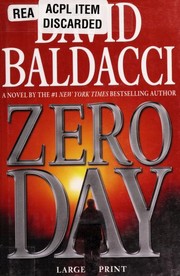
Zero Day
3,434-word summary 15 min read 656 pages in the book
- First published
- 2011
- Publisher
- Grand Central Publishing
- Pages
- 656
- ISBN
- 9781455504145
- Series
- John Puller (#1)
Reading options
What's inside (10 sections)
I picked this one up because it is where John Puller starts, and I wanted to meet him at the beginning rather than stumble into the middle of a series. It came out in 2011 from Grand Central Publishing, the first of the Puller books, and the hardcover edition I read runs 656 pages. That is a lot of room for a story that opens with a mailman knocking on a door. By the time I finished, I understood why Baldacci needed every one of those pages. He is not really solving a single murder. He is assembling a machine that links a killed family, a coal mine, and a nuclear secret, and each piece has to be put in place before the final stretch can move. Some of that assembly is slow. Very little of it is wasted.
The mailman and the visitor at the prison
Howard Reed is the first person through the door. He is a rural mailman with one last delivery on a route that has worn him down, and the landscape around him has been chewed open by coal mining. The air and the water have damaged his lungs, liver and kidneys, and he cannot complain about it out loud, because in that part of West Virginia speaking against the coal is the same as speaking against jobs. He knocks, notices the door is open a crack, sees the family dog covered in blood, looks into the living room, and runs out screaming. It is a grim way to introduce a town, and it tells you immediately that the book is going to be about what people here will and will not say.
John Puller is introduced in a very different setting. He is at the United States Disciplinary Barracks at Fort Leavenworth, Kansas, visiting his brother Robert. The military policeman checking his ID notices the family name and asks whether he is related to Lieutenant General "Fighting John" Puller. John says yes, his father is the general, but he does not mention that the old man is in a Virginia hospital with dementia. The guard also notices the titanium rod in John's forearm and the metal plate in his ankle, leftovers from an improvised explosive device in Afghanistan. Those small details do more work than a page of description could. Puller is a man made of service and shrapnel, and he carries his family history the way he carries the metal, without comment.
Robert Puller is a former major and a nuclear scientist serving a life sentence for treason. John has never fully believed the conviction, and here he finally asks his brother whether he did it. Robert will not give him a yes or a no, because he does not want to put his brother in a conflict of interest. John leaves without shedding a tear, and the book explains why: the Puller family has rules, and the first is that Puller men do not cry, while the second is that they stay calm and in control. He is beginning to suspect he has got very good at the second rule and lost the use of the first. That thread is planted early and paid off much later, in a scene I will not spoil in detail but that gave the whole book its emotional weight for me.
The assignment comes from Don White, the special agent in charge at CID headquarters in Quantico. Colonel Matthew Reynolds of the Defense Intelligence Agency has been killed in Drake, West Virginia, along with his wife and two teenage children. Puller is told to go alone, with no partner and no backup. He notices that this is strange, and so does White, who cannot say who or what is being kept quiet. That is the engine of the whole novel. An investigator who is used to working with a team is sent into a place where somebody would clearly prefer the investigation to stay small.
Three in the morning in Drake
Puller drives into Drake around three in the morning and passes two things he files away without comment. One is an enormous concrete dome sitting out in the dark. The other is a run of cheap housing that looks mostly empty. He takes a room at a motel where the clerk warns him that every place in town serves coal dust along with the food. Outside the office he finds a young man passed out near the door, checks that he is alive, and goes up to his room. At 3:20 he phones the local officer in charge, Sergeant Samantha Cole, and is taken aback that she has gone to bed before the scene was fully processed. She tells him she only just dozed off and will be back at seven. They agree to meet at the house in the morning.
He goes anyway. This is one of the habits that make Puller fun to follow: he does not wait for permission or company. The murder scene is unguarded, because the deputy and the patrol car Cole left there are both gone. Puller calls her again, asks her to secure the scene, and walks inside. The Reynolds family is seated in a row on the sofa. The parents were shot from the front with a shotgun, but there is no blood spatter, which tells him they were killed somewhere else and posed here. Before he can look closely at the children, he hears a mechanical thump from the basement. Down there he finds the missing deputy hanging from the ceiling. The body has knocked a fan over, and the spinning blades are making the noise that drew him. The killers have come back, killed the guard, taken the car, and pulled out while Puller was upstairs. He looks out a window in time to see someone running into the woods.
When Cole arrives, Puller pulls her down behind the Reynolds car because he thinks a shooter may still be watching. She recovers fast, and there is one brief crack in her voice when she sees the dead officer, a single tear before she pulls herself together. The two of them check the woods and find nobody. From here on they work as a pair, and the rhythm of their partnership is one of the quiet pleasures of the book. Cole knows the town, its power structure and its habits. Puller knows how to read a room that has been staged. Neither of them is much for small talk, and the banter stays dry.
Reading a room full of bodies
The investigation section is the best part of Zero Day, and it is worth being patient with. Puller measures the scene and sketches it, working with the police photographer, Landry Munroe. He spots three impressions in the carpet in front of the sofa and works out that a camera on a tripod was set up there. His conclusion is that the family was interrogated before being killed, then shot elsewhere, arranged on the couch and photographed so that someone could see proof of the deaths. It is a cold, professional read of a room, and it tells you what kind of people they are dealing with. These killers want a message delivered.
One question bothers both investigators. Nobody in the neighborhood reported the shotgun blasts. Cole works out that Trent Exploration, the mining company, was blasting that night, and the noise would have covered the gunfire. The mine has to post its blasting schedule, which means the killers could know exactly when the noise would happen. A special permit was needed for a Sunday night blast, another detail Puller tucks away. Cole also gives him the local picture: Roger Trent's company has choked valleys with debris, caused flooding and left the region ugly, with a string of mining accidents and a high rate of cancer, but the mine is hugely profitable and the town depends on it. Nobody wants to bite the hand that feeds them, and that is why a mailman cannot complain about the dust.
Across the street, no one has come out to watch the activity. Puller pushes into the house and finds Molly Bitner and Eric Treadwell dead in the living room, posed just like the Reynolds family, each shot through the eye. Puller recognizes the method as something Special Forces would use, which means whoever did this had military training. There is a meth lab in the basement, which gives the police an easy story if they want one. At a diner, Cole points out that one of the dead neighbors worked for Trent Exploration, and Puller notices that half the room is watching them. Trent owns a large share of the businesses in Drake, including the diner. In a town like this, every thread leads back to the mine, which is exactly why no thread means what it appears to mean.
The mine and the people who run it
Bill Strauss is the chief operating officer of Trent Exploration, and he comes to the investigators with information that is careful and well timed. Molly Bitner worked in his office, he tells them. Puller and Cole also call on Roger Trent, the owner, who seems genuinely puzzled by the murders. Then a small domestic detail lands: Trent's wife Jean is Cole's older sister. That piece of family wiring is typical of the book. People here are connected in ways that make impartial investigation difficult, and Cole has to keep her job and her blood from pulling in different directions.
Jean tells Cole there have been financial irregularities at the company, which plants the first solid idea of a motive. Remembering that Bitner had given Treadwell access to Strauss's inner office and the safe where he kept sensitive documents, Puller breaks in at night and finds a set of blueprints for the concrete dome outside town. Cole identifies the place as the Bunker, an old army research facility that has been sealed for years. A retired scientist who worked there tells Puller that nuclear material may still be on the site and explains how to get in through a ventilation shaft. The numbers 92 and 94 on a scrap of paper start to look like the atomic numbers of uranium and plutonium. A warning on the blueprints against blasting within two miles of the site suggests an old mine passage nearby, the same passage Randy Cole once used to get inside and see stored barrels. Randy had mentioned those barrels casually to Strauss, which is how a local secret became a much bigger one.
Before that, though, there is a nasty little reminder that these killers are still active. Puller returns to his motel to find a note under his door summoning him to a house outside town. He and Cole go, and find two traps that would have killed them had Puller not spent years working with improvised explosive devices overseas. The scene is a good example of how Baldacci keeps the pressure up between the quieter analytical chapters. The book also makes sure you do not mistake Puller for a man who only thinks. He can spot a trigger in the dark, and he has the scars to prove it.
A general, a homeland security man, and a prisoner
Puller goes back to Washington to speak with General Julie Carson, Reynolds's superior officer. She tells him Reynolds had said he was investigating something big in Drake, something that would happen very soon and had national security implications. That confirms the dead colonel was working on more than local crime, but it also raises the question of who else knew. On his way out, Puller is intercepted by Department of Homeland Security agents and taken to see Joe Mason. Mason tells him there are terrorists in Drake planning something devastating, and that Reynolds must have stumbled onto part of it. He offers the story as if it were a gift, and he clearly wants Puller to take it at face value.
Back in Drake, the clues still point at Trent Exploration. Puller learns that the blasting schedule for the night of the murders was never printed in the paper, so the killers could only have known the timing through inside information, and Strauss is the man who arranges the blasting permits. The financial irregularities give Trent, or someone using Trent's name, a reason to take money from anybody willing to pay. Puller puts the pieces together: the dome, the nuclear material, the missing fuel, and a bomb that would destroy the evidence of a theft.
Robert is the one who confirms the worst possibility. Puller phones the prison, and his brother says it is possible someone has built a nuclear weapon at the Bunker. Robert knows this because he is the man who understands what that kind of material can do, and because he has nothing left to lose by saying it. Puller realizes that if he has to disarm a nuclear device, he will need his brother's help, which means the prisoner he has spent the book avoiding becomes the person he most needs. The family rule about not crying gets tested long before the last chapter, and the scenes between the two men are the moments when the thriller lets its guard down.
Inside the Bunker
Puller and Cole go in through the ventilation route beneath an old firehouse, laying out a reel of phone cable as they move so they can keep a line to the outside world. Wearing protective gear, they pass through the sealed structure and find what they expected and more. Roger Trent is trussed and unconscious, surrounded by the records of the financial irregularities that were meant to point at him. Nearby sits the bomb, already counting down. The nuclear material that should have been stored there is gone. There is no team of specialists coming to take over, no expert with a neat kit and a calm voice. There is a warrant officer, a local sergeant, a bound mine owner, and a phone line running back to a prisoner at Fort Leavenworth.
Robert talks Puller through the disarming step by step. The plan is not to make the bomb safe, because it cannot be made safe. It is to disrupt the timing so that the device produces an explosion without a nuclear yield. Robert warns that there will still be a blast, and it will probably destroy the dome. Puller follows the instructions and sets a stick of dynamite to interrupt the detonation sequence. His interference makes the timer jump forward, leaving them five minutes instead of the time they thought they had. He sets his own timer for four, and he and Cole grab Trent and run. They get out with a minute to spare and survive the first detonation, but Trent is thrown headfirst into a tree and dies, and a block of concrete falls and kills Cole.
I read that section twice, because it is the point where the book's emotional bet comes due. Cole has been the steady professional who never asked for help and never complained about being left alone on a crime scene. Her death is not staged as a clever twist or a chance to show off a grieving hero. It is sudden, ugly and final, and it is the moment Puller finally breaks the family rule he has been reciting since the prison visit. He cries for a comrade and for a woman who had changed him, and the scene earns it. If you have any patience left for the character work, this is where it pays off. If you do not, it will feel like a large machinery has crushed a person to make a point.
Who actually did it
The last third pulls the mask off. Puller tracks Strauss to South America and gives him a choice: execution for treason, or life in prison in exchange for testimony against Joe Mason. Strauss talks. He, not Trent, was the one embezzling from the company. He had learned about the nuclear fuel stored at the Bunker and contacted Mason, whom he knew from their time together in the Marines. Mason arranged the sale of the fuel and set the bomb to hide the theft, apparently untroubled by the fact that thousands of people could die. Strauss dumped Trent beside the device so it would look as though Trent was the embezzler who had run off with the money before the blast. The story about terrorists was a decoy from the start, designed to pull a curious investigator away from the real conspiracy.
The rest of the chain is sobering in its simplicity. Strauss had hired Treadwell to manufacture components for the bomb without telling him what they were for. Treadwell and Bitner grew suspicious and went looking for evidence, and they shared what they found with their neighbor, Colonel Reynolds. That is why a Defense Intelligence Agency officer and his family died, why the neighbors were posed on their sofa, and why the deputy at the scene was killed. Mason had all of them silenced, and he used the language of national security to keep anyone from asking the wrong questions. Puller confronts him and gets enough of a confession out of him through rage and threats to make the case, though Mason is about to have his men kill Puller when General Carson arrives with a squad of Army Rangers and arrests them all. The entire exchange has been recorded, and Mason is likely to be executed for treason.
Puller takes leave from the Army after that. He is grieving, and the book ends quietly rather than with a parade. The last line of his arc is not a victory speech but a quiet knowledge that he will come back stronger for having known Cole. It is a restrained ending for a novel that has spent 656 pages doing everything at full volume, and I liked it better than the confrontation that comes just before it.
What holds up and what drags
The fair criticism starts with the shape of the thing. Zero Day is built from recognizable pieces: the near invincible soldier with a tragic family history, the smart local partner, the corrupt company, the official lie, the countdown, the confession. Kirkus called it relentlessly formulaic when it reviewed the book in 2011, and I see the complaint. There are stretches, particularly in the middle, where a discovery is followed by a meeting that explains the discovery, followed by another discovery, and the rhythm becomes predictable. A reader who wants invention in the structure rather than in the details may find the last hundred pages long.
The length is the other real objection. At 656 pages in this edition, the book can feel like three novels stitched together: a crime procedural, a corporate thriller, and a nuclear countdown. Baldacci is good at all three, but he lets each one run a little past its natural stop. Some chapters re-examine a clue that the reader already understands, and Puller's habit of silently cataloguing everything can slow a scene that was moving well. I found myself skipping ahead once or twice, which is not something I want to do in a book I am enjoying.
Still, the strengths are real. The crime scene work is patient and concrete in the best sense, with measurements, carpet impressions and blast schedules doing the kind of work that car chases usually do in other books. Cole is written as a person with a job and a sister, not as a prop for the hero, and her death lands hard because of it. The brother relationship gives the nuclear plot a human anchor, so the physics never floats free of the people. And the town of Drake has a texture that makes the cover-up feel plausible: a place where the mine pays for everything, including the silence.
I would hand this to a reader who likes military investigators and does not mind a book that takes its time. I would be careful with someone who wants a tight, clever puzzle solved in two hundred and fifty pages. Zero Day is a big, solid, sometimes overbuilt machine, and it works because Puller is worth following through all of it. The title refers to a moment when a system is at its most vulnerable, and by the end that describes the town, the mine, the cover-up and Puller himself. The book knows exactly what it is doing, even when it takes an extra chapter to show you.
FAQ
Is Zero Day the first John Puller book?
Yes. Published in 2011 by Grand Central Publishing, it introduces Army CID warrant officer John Puller and is followed by The Forgotten in 2012.
Who is John Puller's brother Robert?
Robert Puller is a former major and nuclear scientist serving a life sentence for treason at Fort Leavenworth. John never believed the conviction, and his brother's expertise becomes essential when a nuclear device has to be disarmed.
Is Zero Day a violent book?
It opens with a murdered family and includes further killings, a bomb countdown and a prison visit, so it is a violent thriller. The crime scene analysis is detailed but not graphic for its own sake.
Similar books
More from John Puller first, then related titles.

Six Years
A professor who promised to forget the woman he loved sees her husband's obituary and discovers that the wedding, the marriage, and the woman herself may never…
2,076-word summary · 9 min read

Bad Luck and Trouble
A deposit of $1,030 summons Jack Reacher back to his old army unit, which is being picked off one name at a time.
2,366-word summary · 11 min read
Gone Tomorrow
Reacher stops a suicide bomber on the subway, then hunts her handlers.
2,308-word summary · 10 min read
The Enemy
In January 1990, MP major Jack Reacher investigates a dead general, a stolen briefcase, and three murders tied to an Army power struggle.
2,123-word summary · 9 min read

The Camel Club
Four Washington misfits witness a murder on Roosevelt Island and stumble into a conspiracy that reaches the Oval Office, with a hostage president and a nuclear…
2,354-word summary · 10 min read
The Innocent
A government hitman refuses one kill and must protect a teenage girl at the center of a cover-up.
2,403-word summary · 11 min read
Absolute Power
A thief watches the president kill, then runs with a lawyer who believes him.
2,401-word summary · 11 min read

The Atlantis Gene
A geneticist and an intelligence operative chase two kidnapped boys through a global conspiracy about human evolution and a weapon built to cull humanity.
2,369-word summary · 11 min read
The 5th Horseman
Two linked cases pull Lindsay Boxer and the Women's Murder Club into a hospital full of strange deaths and a luxury-car murder spree.
2,609-word summary · 12 min read
State of Terror
A new secretary of state and her team unpick a web of attacks across Pakistan, Afghanistan, and Iran in this 2021 political thriller.
2,307-word summary · 10 min read
Make Me
Reacher drifts into a quiet Midwestern town and finds a missing investigator, a trail of killers, and a deep web secret.
2,352-word summary · 10 min read
The Running Grave
In the seventh Cormoran Strike novel, Robin goes undercover inside a Norfolk cult while Strike digs into a child's death from decades earlier.
2,615-word summary · 12 min read
The Midnight Line
A West Point class ring in a Wisconsin pawnshop sends Jack Reacher across the Midwest, from a biker's lie to a wounded veteran hiding from the opioid trade.
2,590-word summary · 12 min read
The Keeper of Lost Causes
Jussi Adler-Olsen introduces Carl Mørck and Department Q, a Copenhagen cold-case unit in a basement, and a missing politician whose file refuses to stay closed.
2,759-word summary · 12 min read
The Hard Way
A man Reacher sees drive a ransom-laden Mercedes pulls him into a retired colonel's hunt for his missing wife and stepdaughter.
2,637-word summary · 12 min read
Never Go Back
Reacher returns to his old military unit to find Major Susan Turner jailed and two invented cases hiding an opium smuggling ring.
2,245-word summary · 10 min read
Jack & Jill
A senator is killed with a nursery-rhyme calling card as a child is murdered near Alex Cross's home. The third Alex Cross novel pulls him toward two cases, one…
2,646-word summary · 12 min read
Gone Before Goodbye
Reese Witherspoon's first novel, written with Harlan Coben, follows a bereaved surgeon whose griefbot guides her into a medical conspiracy stretching from…
2,648-word summary · 12 min read
Fractured
In Karin Slaughter's second Will Trent novel, a mother kills the wrong man in an Atlanta mansion, and a GBI agent with a hidden reading difficulty finds a…
2,219-word summary · 10 min read

What She Knew
Rachel lets her eight-year-old son run ahead in a Bristol park, and the nine-day search turns her into a suspect in the public eye.
2,952-word summary · 13 min read

The Beach House
A young valet is beaten to death at a Hamptons party, and his law-student brother spends a year building a case against the family that covered it up.
2,049-word summary · 9 min read

Rules of Prey
Minneapolis detective Lucas Davenport hunts a killer who leaves a new rule at every scene and treats murder as a game of wits.
1,914-word summary · 9 min read

4th of July
Lindsay Boxer shoots two armed teenagers in self-defense, faces a wrongful-death trial, and spends her leave chasing a string of throat-slashing murders in…
2,192-word summary · 10 min read

61 Hours
A bus crash strands Jack Reacher in a snowbound South Dakota town where a drug gang, a corrupt police force, and a single witness are on a collision course.
2,227-word summary · 10 min read

Still Missing
A realtor is abducted at a Vancouver Island open house and held for more than a year. Told through therapy sessions, the novel follows her escape and the hunt…
2,466-word summary · 11 min read

3rd Degree
The third Women's Murder Club novel follows a San Francisco terror cell and a three-day killing schedule, and it costs the club a member.
2,685-word summary · 12 min read

Worth Dying For
Reacher stops for one night in rural Nebraska and finds a family that runs the county, a missing girl and a shipment worth killing for.
2,021-word summary · 9 min read

Say You're Sorry
A widowed prosecutor defends the teenager accused of killing her babysitter, uncovering a small town's secrets and a killer hiding in plain sight.
2,116-word summary · 9 min read

Echo Burning
Reacher hitches a ride with a Texas woman who wants her abusive husband killed, then has to prove she did not murder him when he comes home.
2,209-word summary · 10 min read

Girl, Forgotten
A rookie US marshal guards a judge with a stalker and ends up reopening the 1982 prom-night murder of the judge's pregnant daughter.
2,111-word summary · 9 min read