
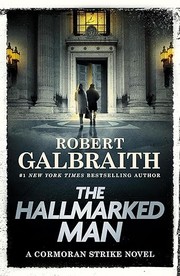
The Hallmarked Man
3,084-word summary 14 min read 912 pages in the book
- First published
- 2025
- Publisher
- Mulholland Books
- Pages
- 912
- ISBN
- 9780316586009
- Series
- Cormoran Strike (#8)
Reading options
What's inside (10 sections)
I came to this one as someone who has followed Cormoran Strike and Robin Ellacott across several books, and I finished it with the particular feeling this series knows how to produce. I was irritated by the detours and already turning back in my mind to the pages where the pieces click. The Hallmarked Man is the eighth Cormoran Strike novel, published on 2 September 2025 by Mulholland Books, and it runs to 912 pages. That is a very large book, even by the standards of this series. Robert Galbraith is the pen name J. K. Rowling writes under, and the name on the cover matters less here than the machinery underneath it, because this is a novel assembled out of coded letters, locked vaults and a secretive institution that keeps its doors firmly shut to outsiders.
What surprised me most was how much of the book is given over to institutions and paperwork rather than chase scenes. There is a great deal of looking things up, of working out who had access to what, of following a name through records that people would rather keep buried. When it works, that slow accumulation is deeply satisfying. When it does not, the book feels enormous for reasons that have little to do with the story. I found both experiences within the same hundred pages more than once.
A body in a silver vault
The case begins when Decima Mullins comes to the agency with a problem that sounds almost invented for a detective story. A body has turned up in the vault of Ramsay Silver, a firm that deals in silver antiques and sits behind Freemasons' Hall in London. The dead man has been given the name William Wright, and his body has been mutilated. That detail matters, because the condition of the corpse is what keeps the identity in doubt and lets two very different accounts of the man compete for the truth.
The police think William Wright is actually Jason Knowles, a robber. Mullins thinks he was Rupert Fleetwood, her lover. So from the first chapter the book has two names for the same corpse and two people with reasons to want the answer to go their way. I liked this setup a lot. It gives the investigation a clean, hard question at its centre, and it lets the reader watch Strike and Robin refuse to accept the easy version simply because a uniform or a grieving woman has supplied it.
The setting does quiet work too. Ramsay Silver deals in valuable objects, and the vault behind Freemasons' Hall is a place where wealth, secrecy and ceremony sit in the same building. A silver-antiques firm is not a random choice of workplace. Precious metal runs through the whole book, both as a trade and as a clue, and the first body is found among it. By the time the case closes, the silver will matter again in a way that rewards anyone who kept track of the early scenes.
I also want to note how the book handles Mullins. She is not a passive client waiting to be told what happened. Her belief that the dead man is Fleetwood gives the early investigation its emotional pressure, and it forces the detectives to treat her account with care rather than dismissing it as wishful thinking. That tension between what the evidence says and what a person needs to believe is one of the better threads running through the opening chapters.
The name in the pigpen cipher
Pretty soon the case stops being a straightforward identification job. Strike's friend Shanker insists that a Freemason was responsible, and Shanker is not a man who throws accusations around casually. Around the same time a letter arrives written in a pigpen cipher, and when it is decoded it gives a name: Dick DeLion. This is the moment the book reveals its real appetite. A coded letter and a Masonic hint would be enough to send most private investigators to the police, but Strike follows the name.
That trail leads him to Fiona Freeman, who has a theory of her own about De Leon. She believes he was executed by a Mason, and that the execution used porn actors and unwitting laypeople as part of its machinery. It is a strange, uncomfortable story, and the book does not rush to either endorse or dismiss it. What struck me was the way the sordid and the ceremonial keep touching each other. A secret society with rituals and hallmarks turns out to share space with pornography, coercion and people who never knew what they were being used for.
The pigpen cipher itself is a nice device, simple enough that a reader can grasp the idea without needing a manual, but creepy in context. Someone went to the trouble of writing a message in a code that assumes the recipient shares a certain knowledge. It is a clue and a warning at once. I found myself slowing down at these passages, partly because I wanted to follow the logic and partly because the book clearly wanted me to feel how closed this world was to people outside it.
This is also where the scale of the novel starts to show. Fiona Freeman's account opens outward into a much larger set of connections, and each one brings new people with new grudges and new secrets. The case is no longer about one body in a vault. It is becoming about a network, and networks are hard to write without either sprawl or repetition. Galbraith gets a lot of mileage from the network, though not every strand earns its place, a point I will come back to.
Into the Masonic world
Once the investigation turns toward Freemasonry, the book widens into three areas at once: the Masonic institution itself, human trafficking and the silver trade. These are not separate plots so much as overlapping rooms in the same house. A person who moves through one tends to bump into the others, and Strike and Robin keep finding that a question about a dead man opens onto something much uglier.
Alongside all of this runs a smear campaign conducted by a journalist named Dominic Culpepper. This thread gives the book a different kind of tension. The threat is not physical at first but reputational, the sense of a story being shaped in public by someone who does not care whether it is true. Anyone who has watched a news cycle turn against a person will recognise the mechanism, and the book draws it plainly. Culpepper's campaign also shows how the case reaches beyond the people directly involved, dragging in anyone connected to the agency.
Then the danger becomes bluntly physical. Robin is attacked in Harrods by a masked assailant, who leaves a Masonic dagger behind. That scene is one of the sharper shocks in the book. Up to that point a lot of the menace has been buried in documents and coded messages, and the attack on Robin makes it clear that someone is willing to hurt them to keep the investigation off certain ground. The dagger is not subtle, and it is not meant to be. It is a message in the same spirit as the cipher letter, only far more direct.
I thought the Harrods attack worked well, and not only because it raises the stakes. It also reminds the reader what Robin brings to the partnership. The case keeps pulling her into places where being a woman changes what happens to her, and the book is honest about that without turning it into a lecture. The attack leaves a mark on the rest of the investigation, because after it the reader understands that every subsequent step carries a cost that Strike cannot simply talk away.
The trail to Ironbridge
From London the trail runs through a series of names and places, among them Niall Semple, Tyler Powell and the town of Ironbridge. This is the part of the book that will either win you over or lose you, depending on your patience for detective work that proceeds by patient elimination. There are meetings, there are addresses, there are people who say one thing and then say something slightly different. The pace is deliberate, and the book seems perfectly willing to spend pages on the boring middle of an inquiry.
One location stands out. Barnaby's is a scrap yard with a car compactor, and the compactor is used to destroy bodies. This is the sort of detail that makes the book's world feel physical and unpleasant in the best way. A scrap yard is not a glamorous setting, and Galbraith uses that. The place smells of industry and money and disposal, and the idea that a person could be made to disappear inside a machine there gives the whole thread a grim weight. When the investigation reaches Barnaby's, the case stops being about documents and becomes about what can be done to a human body by people who have decided it does not matter.
Ironbridge itself gives the novel a change of air. Moving out of London lets the book show how the case has roots in places that have nothing to do with Freemasons' Hall, and the shift in scenery keeps long stretches of procedure from feeling static. I appreciated the change even where I thought the scene could have been tightened. There is a version of this book a couple of hundred pages shorter, and the road to Ironbridge is one of the places where that version starts to look possible.
Still, the accumulation has a purpose. Each name the detectives chase narrows the field around the person who ultimately matters. The book is building a structure in which nothing a person did earlier is wasted, and the payoff depends on having travelled the whole route. That is a fair bargain if you are willing to pay the page count, and a frustrating one if you are not.
The man behind the name Oz
The central discovery is that Ian Griffiths was the impostor known as Oz. Griffiths is the father of Chloe, Powell's girlfriend, and the fact that the mask belonged to someone inside the family circle is what gives the reveal its force. Strike works it out rather than having it handed to him, and the deduction pulls together the trafficking thread, the false names and the silver in a way that makes the long build-up feel justified.
What Oz actually did is horrible, and the book does not soften it. Griffiths ran a trafficking ring. He killed a tourist named Reata Lindvall, and he passed Lindvall's daughter Jolanda off as his own child. That last act is the one I found hardest to read. Killing an adult is one thing, but taking a child's identity and raising her as your own is a particular kind of cruelty, because it steals the truth of a whole life from the person living it. The book gives this its due. Jolanda is not a footnote of the case; she is a person whose entire sense of herself rests on a lie someone else installed.
This is where the novel is at its strongest as a crime story. The mechanism is intricate, but the human damage at the centre of it is simple and appalling. A ring that moves people around, a father who is not a father, a girl who does not know who she is. Galbraith is good at keeping the emotional fact in view while the technical facts pile up, and that balance is what keeps the book from becoming a mere exercise in plotting.
It is also worth saying that the resolution depends on a lot of coincidences being quietly accepted. Names surface when the story needs them, and people turn up in the right places at the right time. I did not find this fatal, because the series has always traded in a heightened version of coincidence, but it is the sort of thing a skeptical reader will notice. The book asks you to trust that the puzzle is fair more than it proves that it is.
Strike's own family troubles
Running beside the case are two subplots about Strike's own connections. One involves his father, the rock star Jonny Rokeby. The other involves Rena Liddell, whose brother Ben was killed by Daesh. Neither strand solves the murder in the vault, but both add to the sense that Strike is a man whose private life keeps getting pulled into his work, whether he wants it there or not.
The Rokeby material gives the book a look at fame and its wreckage. A rock-star father is the kind of relationship that arrives with a long history of damage, and the series has never pretended that Strike's family background is tidy. I found these pages interesting, though they also contribute to the feeling that the novel is trying to hold too much. At 912 pages there is room for a lot, and the book uses the room.
The story of Rena Liddell and her brother Ben is heavier. Ben was killed by Daesh, and that loss sits behind Rena's presence in the book with a gravity the lighter subplot does not have. It connects to one of the book's larger concerns, which is how people disappear into systems and causes that swallow them. In the main case that happens through trafficking and secret societies. Here it happens through violence and political hatred. The echo is there whether or not the book insists on it.
My honest reaction to these threads is mixed. They give Strike a life outside the case and keep the book from being a single frozen puzzle, which I value. At the same time, the Masonic material is already sprawling, and adding two more personal histories makes the whole thing feel even bigger. A reader who wants a tight investigation may find the detours hard to forgive. A reader who comes for Strike as a person will probably find them necessary. I am closer to the second group, though I noticed every page where the book could have moved faster.
The house in the climax
The ending brings the strands together at Griffiths's house. Strike goes in with Barclay and Wardle, and together they subdue the ring. This is the payoff the earlier scenes have been building toward, and it is staged with the blunt physicality the scrap-yard chapters promised. The house turns out to hold more than the investigators expected. They find Sapphire Neagle chained in the basement, a discovery that makes the abstract talk of trafficking suddenly concrete and close.
The worst revelation is about Chloe. The real Chloe, the daughter of Griffiths and the girlfriend of Powell, had been murdered by Griffiths, who had impregnated her, and her body was buried in the house. It is a brutal answer to the question of who the dead girl really was, and it recontextualises a character who had been moving through the book as a living person. That is a difficult trick, and the book handles it by making the horror land before it makes the cleverness land.
The stolen silver is found behind a wall, closing the loop with the silver-antiques firm and the vault that started everything. Fergus Robertson exposes the corrupt Mason Oliver Branfoot, which gives the institutional thread its reckoning, and Culpepper is fired, which closes the smear campaign. The destruction of the ring, the recovery of the silver, the downfall of the corrupt official and the collapse of the journalist's story all arrive together. I have some sympathy for the view that this is too tidy a convergence for a book this size, but I also think the series has earned the right to gather its threads in one place.
Then the book turns from the case to the two people who solved it. With Ryan Murphy about to propose to Robin, Strike confesses his feelings to her. This is the emotional beat the long-running readers have been waiting for, and the book places it right after the violence, which gives it a raw, unguarded quality. It is not a polished romantic moment, and that suits the characters. They have spent hundreds of pages working together under pressure, and the confession arrives like something that could no longer be held back. Whether you find it satisfying will depend on how much of the slow burn you have invested in, but it is clearly meant to matter.
Where it lands
The reception to The Hallmarked Man was mixed, and I think that is about right. Clare Clark, writing in The Guardian, called it a "terrific, tightly plotted romp," and there is a real sense in which the book earns that description. The puzzle is intricate, the final convergence is satisfying, and the moments of personal danger have genuine force. Wikipedia records a more mixed response from both the press and the public, with other reviewers less convinced by the sprawling Masonic material. I understand that reaction too. There are long stretches where the machinery of the secret society and the details of the trade feel like they have taken over the book.
For my part, the strongest parts are the ones where a person is hurt by someone they should have been able to trust. Jolanda's stolen identity, Chloe's murder and Robin's attack in Harrods all stay with me far longer than the details of the cipher or the layout of the vault. The weakest parts are where the book seems to enjoy its own complexity for its own sake, piling on names and hypotheses at a point when the reader is already following the main thread. At 912 pages there is more here than the story strictly needs, and a firmer edit would have made it a better book even if it had made it a shorter one.
I would hand this to someone who has already spent time with Strike and Robin and wants to see where their long, tangled relationship goes. I would be more careful recommending it to a reader looking for a self-contained mystery, because so much of the weight here depends on knowing the history between these people. Taken on its own terms, it is a large, ambitious, sometimes overstuffed novel with a cruel and memorable case at its centre and a romantic payoff that has been a very long time coming.
FAQ
Is The Hallmarked Man part of a series?
Yes. It is the eighth Cormoran Strike novel, published on 2 September 2025 by Mulholland Books, and it follows private detectives Cormoran Strike and Robin Ellacott.
Who is Robert Galbraith?
Robert Galbraith is the pen name used by J. K. Rowling for the Cormoran Strike crime novels, of which The Hallmarked Man is the eighth.
What is the case in The Hallmarked Man about?
Decima Mullins hires the agency after a mutilated body turns up in the vault of Ramsay Silver, a silver-antiques firm behind Freemasons' Hall in London.
Similar books
More from Cormoran Strike first, then related titles.
The Cuckoo's Calling
Broke detective Strike and temp Robin investigate a supermodel's fatal fall in London.
2,006-word summary · 9 min read
The Silkworm
A missing novelist and a cruel manuscript pull Strike and Robin into London publishing.
3,583-word summary · 16 min read
Career of Evil
A severed leg delivered to Robin forces Strike to face four men from his past as a London killer stalks, testing the agency and her wedding plans ahead.
2,887-word summary · 13 min read
Lethal White
When troubled Billy reports a buried child, Strike and Robin untangle blackmail around minister Chiswell in a long London case that strains their partnership.
3,063-word summary · 14 min read
Troubled Blood
Strike and Robin take a year long cold case: doctor Margot Bamborough vanished in 1974, with a nurse hiding more.
2,211-word summary · 10 min read
The Running Grave
In the seventh Cormoran Strike novel, Robin goes undercover inside a Norfolk cult while Strike digs into a child's death from decades earlier.
2,615-word summary · 12 min read

There Will Be Bodies
Digging out a villa buried by Vesuvius, Flavia Albia finds chained corpses and a death someone tried to hide for ten years.
2,152-word summary · 10 min read
The Word Is Murder
A fictionalised Anthony Horowitz is talked into chronicling a prickly ex-detective's case: a woman murdered hours after planning her own funeral. A clever…
2,296-word summary · 10 min read
The Unquiet Grave
In Dervla McTiernan's fourth Cormac Reilly novel, a body found in a Galway bog turns out to be a missing school principal, and the case opens into something…
2,253-word summary · 10 min read
Fractured
In Karin Slaughter's second Will Trent novel, a mother kills the wrong man in an Atlanta mansion, and a GBI agent with a hidden reading difficulty finds a…
2,219-word summary · 10 min read
Nightshade
Connelly launches Detective Stilwell on Catalina Island, where a beheaded buffalo and a Jane Doe in the harbor pull a quiet sheriff's post into violence and…
2,272-word summary · 10 min read

3rd Degree
The third Women's Murder Club novel follows a San Francisco terror cell and a three-day killing schedule, and it costs the club a member.
2,685-word summary · 12 min read
The Body in the Library
A strange girl found dead in a library pulls Miss Marple into lies about dance halls and film.
2,017-word summary · 9 min read
The Last Coyote
On stress leave, Harry Bosch reopens the unsolved murder of his mother, a prostitute strangled when he was twelve, and finds corruption reaching the DA's…
2,069-word summary · 9 min read
The Hangman's Daughter
In 1659 Bavaria, a hangman ordered to torture an innocent midwife instead investigates the deaths of children marked with a strange tattoo.
2,523-word summary · 11 min read
The 5th Horseman
Two linked cases pull Lindsay Boxer and the Women's Murder Club into a hospital full of strange deaths and a luxury-car murder spree.
2,609-word summary · 12 min read
Evil Under the Sun
Poirot's Devon holiday turns deadly when a flirtatious actress is strangled at a secluded seaside hotel in this 1941 puzzle.
2,380-word summary · 11 min read
The Reversal
Mickey Haller prosecutes a child killer's retrial with ex-wife Maggie and half-brother Harry Bosch on his team.
2,056-word summary · 9 min read
The Keeper of Lost Causes
Jussi Adler-Olsen introduces Carl Mørck and Department Q, a Copenhagen cold-case unit in a basement, and a missing politician whose file refuses to stay closed.
2,759-word summary · 12 min read
The Ice Princess
Camilla Läckberg's debut follows writer Erica Falck and detective Patrik Hedström as a frozen bathtub in a small Swedish town unravels a secret kept for…
2,321-word summary · 10 min read
The Girl Who Takes an Eye for an Eye
Lisbeth Salander investigates a secret childhood experiment from prison while Mikael Blomkvist uncovers a twin conspiracy behind a wealthy businessman.
2,059-word summary · 9 min read
The Girl in the Ice
A young socialite is found frozen beneath the ice in a south London park, and DCI Erika Foster returns to work to lead the case. Grief, privilege and three…
2,492-word summary · 11 min read
The Brass Verdict
Mickey Haller takes over a murdered lawyer's caseload and a Hollywood double-murder trial, with Harry Bosch circling the edges.
2,672-word summary · 12 min read
The Beautiful Mystery
In a cloistered Quebec monastery, a chant-singing monk is murdered and Gamache must break a vow of silence to find the killer. Eighth in the Chief Inspector…
2,262-word summary · 10 min read
Jack & Jill
A senator is killed with a nursery-rhyme calling card as a child is murdered near Alex Cross's home. The third Alex Cross novel pulls him toward two cases, one…
2,646-word summary · 12 min read
Five Little Pigs
Sixteen years after a painter's murder, Poirot reopens the case at the request of a daughter who believes her dead mother was innocent.
2,027-word summary · 9 min read
Eight Perfect Murders
A Boston bookseller's old blog post listing eight perfect fictional murders becomes the blueprint for a real killer, and the narrator knows more than he admits.
2,292-word summary · 10 min read
Body of Evidence
Kay Scarpetta investigates the murder of a reclusive romance novelist who opened her door willingly, and finds a missing manuscript and a web of…
2,007-word summary · 9 min read
A Drop of Corruption
Bennett's second Shadow of the Leviathan novel pairs a blindfolded detective and an engraver with perfect recall in a locked-room case during an imperial…
2,333-word summary · 10 min read
The Secret Place
Two Dublin detectives revisit a murder on the grounds of a girls' boarding school, where a bulletin board note and rival cliques hide the truth.
2,271-word summary · 10 min read