
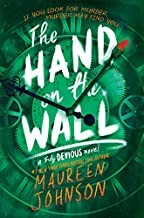
The Hand on the Wall
2,219-word summary 10 min read 369 pages in the book
- First published
- 2020
- Publisher
- Katherine Tegen Books
- Pages
- 369
- ISBN
- 9780062338112
- Series
- Truly Devious (#3)
Reading options
What's inside (8 sections)
I picked up The Hand on the Wall because the second book ended with a burned house and a phone call that stopped mid sentence, and I needed to know who was behind it. This is the third and final volume of the Truly Devious trilogy, published on 20 October 2020 by Katherine Tegen Books, an imprint of HarperCollins, and the first hardcover runs 369 pages. I expected a long setup and a quick solution. What I got was a book that spends its last chapters arguing about the price of the answer, which is a stranger and more interesting thing to do in a mystery.
Three deaths and a blizzard
Stevie Bell begins this book in a state of quiet shock, and the reasons pile up quickly. David Eastman, the boy she kissed and then lost, paid someone to punch him in the face, uploaded the video, and disappeared. Dr. Irene Fenton, the scholar who was helping her work the Ellingham case, died when her house burned in Burlington. A student named Hayes Major is dead, and so is Ellie Walker, whose body Stevie found in a tunnel the year before. Three deaths, all connected to her, all arriving at the moment she thinks she has solved the century's greatest kidnapping.
Stevie's theory is neat and, as it turns out, half right. She believes George Marsh, the FBI agent who worked for Albert Ellingham, was the mastermind behind the 1936 kidnapping. In her version, Marsh slipped into the dome in the walled garden, was spotted by a student named Dottie Epstein, and killed her before she could tell anyone. Stevie also thinks the taunting Truly Devious letter was a student prank rather than the work of a kidnapper. She has no hard evidence, and the adults around her do much of what adults do in this series, which is to withhold.
She goes to see Dr. Charles Scott, the head of Ellingham, under the pretext of talking about her feelings. On his desk she notices an antique clock that belonged to Albert. Scott tells her that Alice's inheritance is being spent on new buildings because Alice was never found, and that Fenton's nephew Hunter, now homeless after the fire, will be coming to live at the school. He gives Stevie a credit card and sends her into Burlington to buy the boy some warm clothes. It is a small errand that opens the whole present-day case.
In town, Stevie finds Larry, the school's former head of security and a retired homicide detective, who explains how Fenton died. A gas burner was left on, and years of heavy smoking had destroyed her sense of smell, so she lit a cigarette and the house went up. Larry also delivers the line Stevie cannot shake: three people connected to her are now dead. Stevie then visits an artists' colony and meets Bathsheba, a friend of Ellie's, who tells her two things. The glowing Truly Devious message that once appeared on Stevie's wall was real, not a stress induced dream, and Ellie used to talk about things hidden inside the walls at Ellingham.
Then Janelle Franklin's Rube Goldberg machine, a huge contraption she has built for a demonstration, collapses and sends pieces flying into the art barn. Students are hurt. Janelle is horrified, and Stevie is sure someone tampered with it. Scott uses the accident as a reason to close the school early, and with a blizzard coming, everyone is told to leave. This is where the book does its most satisfying trick. Stevie, David, Nate, Janelle, and Vi decide to stay.
Francis, Eddie, and the prank in the wall
The book keeps two timelines running, and the 1930s sections are the ones I trusted most. It opens in December 1932, in a private hospital in the Swiss Alps, where Albert Ellingham and his wife Iris welcome a baby girl they name Alice Madeline. The child was carried and born by Flora Robinson, Iris's closest friend, and the adoption is kept secret. Flora refuses to name the father. The scene is short, but it plants everything that will matter eighty years later.
In 1936, two students are making plans to leave Ellingham with a bang. Francis Crane and Eddie Davenport fancy themselves Bonnie and Clyde, and they meet in an underground grotto beneath a campus statue where extra building supplies, including dynamite, are stored. They write a threatening poem, sign it Truly, Devious, and mail it from Burlington for a laugh. Francis records their ideas in a red leather notebook she carries everywhere. When she gets back to her dorm, she notices the photographs she and Eddie took of themselves dressed as outlaws are missing. They have slipped out of the notebook. Another student, Dottie Epstein, has seen them acting strangely, picked up the photographs, and hidden them in a tin inside the wall of her room. That is the tin Stevie finds in Ellie's room in the first book.
The 1930s chapters are the engine of this novel. Francis and Eddie's joke becomes the signature on a real kidnapping, and the witnesses to their game turn into the witnesses to a murder. Johnson understands that a mystery is made of accidents that harden into fate, and she lets the older chapters carry the sadness of people who cannot take back what they did.
Stevie finds Francis's red diary hidden in the wall of her own closet, and it changes the shape of the case. The draft versions of the letter prove the prank, and a coded poem gives directions to the grotto. For the first time in three books, Stevie has physical evidence instead of a theory.
What actually happened to Alice
The historical mystery comes apart in two pieces, and the first is about fatherhood. Flora tells Leo Nair, a painter and family friend, that George Marsh is Alice's biological father. Leo has guessed it already. Flora had a brief relationship with Marsh and never told him about the pregnancy. After the kidnapping she finally does tell him, and from that moment finding his daughter becomes the only thing Marsh cares about.
The second piece is uglier. In 1937 Marsh tracks down the men he hired to grab Iris and Alice. One of them, Jerry, says the pair left Alice with a couple in a cabin in the woods in New York. Marsh eventually learns the truth from the people who took her. Iris was killed while fighting to protect her daughter, against Marsh's orders, and Alice died of measles in the couple's care. Marsh buried her body in a tunnel beneath the dome on the anniversary of the kidnapping. Leo Nair discovered the burial and confronted him, and the two men agreed to say nothing, on the reasoning that hope of finding Alice kept Albert's legacy alive. When Marsh tried to tell Albert the truth on his boat, the boat exploded and both men died. The earlier book left that explosion ambiguous. This one settles it without making it less sad.
What I like about these chapters is that Marsh is neither a clean villain nor a victim. He set the kidnapping in motion to pay a gambling debt, and the plan was his fault from the start. He also lost a daughter he did not know he had and spent years trying to get her back. Johnson does not ask you to forgive him, which makes the reveal more painful than a simple guilty or innocent verdict would have been.
The flash drives and the codicil
Back at Ellingham, the storm closes in. David reappears at Minerva with flash drives he took from his father's safe, and he wants the group to read them. Senator Edward King is running for president, and his son believes the files hold proof of illegal campaign activity. Stevie, Nate, Janelle, and Vi agree to stay. David disables the security cameras, and the five of them settle into the gym with tablets and laptops while the rest of the school drives away.
The files show that King blackmailed donors into funding his campaign. What the teenagers do with that evidence is the moral centre of the book. After a real argument, they destroy the stolen material rather than use it. That decision is more interesting than the mystery around it, because it forces David to choose what kind of person he wants to be instead of inheriting his father's methods.
David then strikes a bargain with Stevie. He will use a fake identity, Jim Malloy, to request the codicil from the school, but only if she stops speaking to him. She takes the information. Dr. Quinn confirms in a dismissive reply that the codicil exists, and Charles sends the actual document. It promises ten million dollars, now worth close to seventy, to whoever finds Alice's remains, with faculty and administrators explicitly barred from claiming it.
Stevie decodes the poem from Francis's diary and heads out into the blizzard toward the grotto. She falls through a hidden hatch into the cavern below. David follows her down and gets trapped as well. They rig a length of old dynamite with wire and a flashlight battery and blast the hatch partly open. Germaine Batt, a student journalist who stayed behind on her own, sees the explosion and pulls them out. It is a good action sequence, and it arrives late enough in the book that it feels earned.
Stevie lays it out
The solution belongs to Charles Scott, and Stevie gathers the survivors in Albert Ellingham's office to say so. I will not pretend the accusation is short. Johnson gives Stevie a long, deliberate run at it, and the effect is less like a detective snapping a trap than like a lawyer reading a case file aloud. That is both a strength and a drag, which I will get to.
Charles found Alice's remains during construction on campus, but the codicil barred faculty from claiming the reward, so he hid the body in the wall of his own office. He tried to recruit Fenton as a partner who could discover the child and split the money. When Hayes Major got close to what he was doing, Charles killed him by flooding a tunnel with carbon dioxide. He projected the glowing message to make Stevie look unstable, trapped Ellie in a sealed passage once she knew too much, and turned on Fenton's gas stove when she refused to cooperate. The wrecked Rube Goldberg machine was his work too, meant to force the school to close so he could bring Hunter in as a replacement partner.
Larry hikes out through the storm after Stevie emails him and arrives with a wall scanner. Behind the wall of Charles's office, they find the remains of a child. Stevie says quietly:
Hello, Alice. It's okay. It's over.
Charles is held under guard, escapes into the passages, and falls to his death. The police later confirm him as the killer of three people.
Then comes the twist that explains the DNA test. The child's remains do not match Albert or Iris, and Stevie has already worked out why. Alice was adopted. Flora Robinson was her mother and George Marsh was her father, which is why Marsh carried her body back to Ellingham. Stevie decides not to claim the fortune herself, hoping the money will keep the school running instead.
What solving it costs
The aftermath tidies up most of the loose ends. King's donors abandon him once the blackmail scheme is exposed, Germaine publishes audio recorded by David's sister of her father ranting about the destroyed files, and King withdraws from the presidential race. Ellingham reopens under Dr. Quinn. David and Stevie do not resume anything easily, and the bargain about the codicil hangs over them. In the last scene Stevie walks toward class with her friends around her, the case closed and her life still ahead of her.
I finished this book glad that it answered the questions I had carried across three volumes, and uneasy about how it answered them. The denouement is long and heavily explained. Stevie's accusation restates nearly every clue, and a few of the discoveries depend on convenient arrivals: the diary in the wall, the codicil arriving by email just when asked for, Germaine staying behind for no reason that matters until she is needed. A reader who wants a tight puzzle may find the machinery visible.
The book also has to carry a heavy load of setup from two earlier novels, which makes it a poor place to start. Read it without the others and the emotional weight of Ellie's tunnel or David's beaten face will not land. Read it after them and those moments do real work.
Still, the historical sections are the best thing here, and the portrait of a school built on a fortune, a secret, and a lot of hidden architecture is as strong as it was in the first book. I would hand all three volumes to a reader who likes their puzzles dense and their answers costly. I would not hand this one to someone hoping for a quick, clean ending, because Johnson is more interested in what Stevie does with the truth than in the moment she finds it.
FAQ
Do I need to read the first two Truly Devious books?
Yes. This is the direct sequel to The Vanishing Stair and it depends on the deaths, betrayals and clues established in both earlier novels.
Who wrote the Truly Devious letter?
It was a prank composed by students Francis Crane and Eddie Davenport in 1936, which Stevie confirms when she finds Francis's diary hidden in her closet wall.
Is this the last Truly Devious book?
It closes the original trilogy of Truly Devious, The Vanishing Stair and The Hand on the Wall. The wider Stevie Bell series continues in The Box in the Woods.
Similar books
More from Truly Devious first, then related titles.
Truly Devious
True crime buff Stevie Bell arrives at Ellingham to solve its 1936 kidnapping as present murder strikes.
2,072-word summary · 9 min read
The Vanishing Stair
Stevie Bell returns to Ellingham Academy under a secret bargain, chasing the truth about a 1936 kidnapping while a new death makes the school feel smaller and…
2,026-word summary · 9 min read

Ace of Spades
Two Black seniors at an elite academy are celebrated by day and hunted by an anonymous texter in this YA thriller about institutional racism.
2,066-word summary · 9 min read
The Cellar
Abducted in her small English town, sixteen-year-old Summer is locked in a cellar with three other girls. Their captor calls himself Clover and wants a perfect…
2,551-word summary · 11 min read
All In
Cassie Hobbes and the Naturals chase a Las Vegas killer whose victims share wrist tattoos, while a break in her mother's case pulls her away.
2,484-word summary · 11 min read
Cross My Heart and Hope to Spy
Cammie Morgan returns to Gallagher Academy for a second year of spy training, only to fall for a boy from a rival spy school and hunt a mole in her own school.
2,567-word summary · 11 min read
Finlay Donovan Knocks 'Em Dead
Someone has put a contract on Finlay Donovan's ex-husband, and the novelist and her nanny have to find the hitman before the school pickup.
1,990-word summary · 9 min read
The Reappearance of Rachel Price
Bel films a doc when her missing mother walks back after years.
2,254-word summary · 10 min read
Killer Instinct
Teen profiler Cassie Hobbes rejoins the FBI Naturals to stop a copycat repeating Dean Redding father murders.
2,600-word summary · 12 min read
Kill Joy
Pip hosts a 1920s murder mystery party with her friends, solves the fake case, and feels a real scare that points toward A Good Girl's Guide to Murder.
2,537-word summary · 11 min read
The Cousins
Three cousins work at their rich grandmother island resort while digging into why their parents were cut off.
2,565-word summary · 11 min read
Sadie
Sadie hunts sister killer while podcast chases her in split narrative thriller.
2,091-word summary · 9 min read

Reconstructing Amelia
A grieving lawyer mother reopens her teen daughter's alleged suicide at an elite Brooklyn school, uncovering bullying and secrets.
2,032-word summary · 9 min read
The First Time I Saw Him
Five years after Owen vanished, Hannah and Bailey have rebuilt in California until Owen walks into her exhibition and danger returns.
2,407-word summary · 11 min read
Two Can Keep a Secret
Twins new to Echo Ridge dig into aunt's murder as homecoming threats return.
2,078-word summary · 9 min read
Five Survive
Six teens on spring break get a flat tire, a red dot sight, and one ultimatum in an RV.
2,867-word summary · 13 min read
The Unbecoming of Mara Dyer
Sole survivor of a collapse that killed her friends, Mara Dyer moves to Miami, where visions that come true suggest her grief hides something darker.
2,152-word summary · 10 min read
The Naturals
Teen profiler Cassie Hobbes joins an FBI program for gifted teens and hunts a killer tied to her past.
2,401-word summary · 11 min read
The Lying Game
Isa returns to Salten with her baby when bones surface in the marsh and force four school friends to face what they buried.
2,277-word summary · 10 min read
Listen for the Lie
Lucy Chase cannot remember the night her best friend Savvy died in Plumpton, Texas, until a true crime podcast pulls her back.
2,160-word summary · 10 min read

I'd Tell You I Love You, But Then I'd Have to Kill You
Cammie Morgan trains at a secret spy school and falls for a town boy she can never tell the truth.
2,179-word summary · 10 min read

Pretty Little Liars
Four girls get texts from dead Alison a year after she vanished, and secrets start leaking.
1,922-word summary · 9 min read
One of Us Is Next
A year after Simon's death, a copycat texter drags Maeve, Knox and Phoebe into a cruel Truth or Dare game in Bayview.
2,348-word summary · 10 min read

All Good People Here
A journalist returns home to care for her uncle and reopens a 20 year old child murder tied to a new abduction.
2,006-word summary · 9 min read
As Good As Dead
Pip faces online threats and a stalker as she investigates a serial case in the trilogy finale.
2,962-word summary · 13 min read

Good Girl, Bad Blood
Pip swears off sleuthing, then podcasts a missing friend case that tests fame and cost.
2,011-word summary · 9 min read
We Were Liars
Cadence Sinclair returns to Beechwood Island after an accident she cannot recall, chasing summers with Johnny, Mirren and Gat toward the truth.
1,923-word summary · 9 min read
One of Us Is Lying
Five Bayview teens enter detention and Simon dies, leaving Bronwyn Nate Addy and Cooper suspects.
3,158-word summary · 14 min read
A Good Girl's Guide to Murder
Pip reopens a closed murder case for a school project and finds the town wanted it shut.
2,621-word summary · 12 min read
Whisper Network
Four women at a Dallas sportswear company decide to name their boss in an anonymous spreadsheet of bad men, and the office turns on itself.
2,152-word summary · 10 min read