
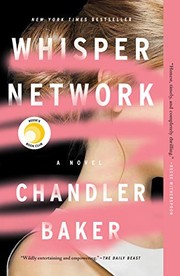
Whisper Network
2,152-word summary 10 min read 352 pages in the book
- First published
- 2019
- Publisher
- Flatiron Books
- Pages
- 352
- ISBN
- 9781250205360
Reading options
What's inside (8 sections)
The first chapter takes place in a supply closet. Ardie Valdez, a lawyer at a Dallas sportswear company, ducks inside to hide from her boss and finds her friend Grace sitting on a leather sofa with a breast pump attached and a cow magnet stuck to the door. They share a La Croix. Grace watches Ellen. The CEO has just died of a heart attack, and the two women are trying to work out what that means before anyone notices they are gone. I have read a lot of office thrillers that open with a body. This one opens with a lactation break, and the choice tells you almost everything about how the book intends to get under your skin.
Three weeks earlier
That first chapter is headed "Three Weeks Earlier: The Day It Began" and dated 20-MAR, so the novel announces its structure early. A collective "we" narrates, speaking for the women in the office in a voice that is wry, exhausted, and very funny. Before the CEO died, the narrator explains, their lives ran along an invisible roller-coaster track, held to the rails by forces they could not wholly grasp despite their abundance of academic degrees. They were connoisseurs of dry shampoo brands. It took them four days to finish an episode of The Bachelor on their DVRs. They fell asleep with laptops burning their thighs, took two-hour breaks to read bedtime stories to toddlers, and tried not to calculate how many hours they spent working as mothers and as employees. They were overqualified and underused, bossy and always right. They had firm handshakes and hefty credit card balances. Then the roller coaster threw them off.
The news travels through the hallway. Desmond Bankole, the company's CEO, died at home that morning while getting ready for work; his wife found him in the bathroom. Ardie had met him once, a handshake in the elevator, and remembers his very white teeth and his birdlike wrists. Her immediate worry is not grief but succession. Ames Garrett, the man who keeps asking where Sloane is, could be the next CEO. He looks like one, Ardie thinks. He is tall, and people like tall. There are the rumors about an intern, and the story about his executive assistant two years earlier at the Byron Nelson golf tournament, after which the assistant, not Ames, was fired. Ardie has another reason to worry: Ames does not care for her, because he dislikes having to listen to someone he does not enjoy looking at. She does not say that part to Grace.
Grace, meanwhile, has teased bleached blonde hair, belongs to the TriDelta Alumni Club, attends Preston Hollow Presbyterian with her husband Liam, and is on the invite list for the opening of the George W. Bush Presidential Library. She and Liam describe themselves as compassionate conservatives and keep a handgun in a lock safe on a garment shelf in her closet. Ardie likes Grace in spite of all that, which the book treats as its own small miracle. Ardie herself has opted out of the appearance work expected of women at the firm. She sleeps in instead of doing hair and makeup, never shops, and does not spend a minute on Pilates. Her son Michael was adopted almost four years earlier after a long struggle with infertility. The breast pump, the handgun, the dry shampoo, and the adoption all arrive in the first few pages as domestic detail, and the novel is patient about letting them become something more.
The women of Truviv
The book follows four colleagues at Truviv, Inc. Sloane, Ardie, Grace, and Rosalita have worked there for years. Sloane is the Senior Vice President of North American Legal Affairs and is technically the boss of the others, which makes Ames her boss's boss. All of them are lawyers, all of them are good at their jobs, and all of them have learned that being good at the job does not remove the other calculations. They have become friends and something like a support group, because they are outsiders by gender in a corporate culture built for men. Nobody says this out loud. As the chorus puts it, they are not oppressed, they are achieving.
The narrator is precise about the small mechanisms. Even the good men, especially the good ones, pretended not to notice the lines: how much more deference a male voice earned on the phone, or how height and stature and morning stubble gave a man's ideas an authoritative weight that theirs never had. That passage is the book's argument in miniature. Nothing dramatic has to happen for the imbalance to work. It lives in telephone calls and in who gets interrupted.
The men who cross lines are discussed only in whispers, because the stakes are too high to do anything else. That is the whisper network of the title: the informal, unwritten system by which women warn one another about a man, passed along in hallways and over drinks because a formal complaint carries a cost. The book treats it as both a protection and a kind of surrender. For years, the women have managed risk by talking quietly. The death of the CEO and the possibility that Ames will take his place force them to decide whether quiet has stopped working.
The BAD Men List
The tipping point is a spreadsheet. An anonymous document begins circulating at Truviv and in the wider Dallas professional world, a list of male names paired with misdeeds ranging from the uncomfortable to the predatory. Its shorthand is BAD Men, which stands for Beware of Asshole Dallas Men. The list is gossip and evidence at the same time, a piece of office folklore that suddenly has consequences. When Ames is put up for the top job, Sloane cannot stand by and watch him do to younger associates what he once did to her. She adds his name.
From that decision, the book accelerates. The publisher's description promises a catastrophic shift in the office, with lies uncovered and secrets exposed, and a warning that not everyone will survive. Critics have called the result part whodunit and part revenge fantasy, a feminist thriller written for the era of #MeToo. Chandler Baker had written young adult fiction before this, including This Is Not the End, but Whisper Network was her first adult novel. It was published in 2019 by Flatiron Books and became an instant New York Times bestseller and a Reese's Book Club x Hello Sunshine pick. The edition cited here is the trade paperback, which runs 352 pages.
What follows the list is where the book plays its structural games. Baker folds excerpts from legal depositions into the narrative, and those documents offer a glimpse into the third act before the story has properly arrived there. The depositions are not decoration. They change the status of everything you have read, because a deposition is a performance meant for a record, and voices that sounded candid in the hallway sound different under oath. One of the characters is keeping a very large secret, and the book is careful about when it lets that secret affect the surface of the story. The office comedy of the opening becomes something harder to laugh at, not by changing the tone abruptly but by changing what the same details mean.
I wanted to know, reading the breast-pump scene again later, whether the gun in Grace's closet was a joke. The novel does not answer that question directly, and that is part of its design. Details that seem like character flavor in chapter one acquire weight once the depositions start appearing. The same is true of Ardie's decision to hide from Ames rather than confront him, and of Sloane's long history with a man she has spent years declining to name in public.
The chorus and the joke
The "we" voice is the most distinctive thing about the book. Kirkus called it a Greek workplace chorus, and that seems exactly right. It speaks for a group rather than for a single woman, which allows Baker to make observations that a first-person narrator could not. The chorus can say that the women were bossy and always right, and that they forgot their lunches on kitchen countertops, and that they were tired in a way no amount of achievement fixed. The humor comes from the gap between how competent these women are and how absurd the situations are that they have to navigate.
Some of the jokes are sharp. Ardie marvels that her robotic vacuum can find its home and put itself to bed at the end of the night while nobody has invented a better device for pumping milk. Grace, watching the machine pull at her, says men have teeth and floors, meaning that the world has been designed around male bodies and male convenience. Ardie thinks about breastfeeding as she had imagined it: serene skin-to-skin contact under a handwoven scarf, rather than the violent yanking she is actually witnessing. The book's comedy is not pasted on top of the serious material. It is how the characters get through the day, and the joke turns over when the stakes rise.
The opening line, which appears on the first page, is a direct address: if only you had listened to us, none of this would have happened. It reframes the entire novel as something being told after the fact, by people who already know how the story ends. That is a strong choice, and it puts the reader in the position of someone being given a warning too late. The chorus is not simply narrating events. It is making a case.
The rage under the froth
Reviewers kept reaching for the same comparison, pairing the book with Big Little Lies and with the workplace comedies of an earlier era. Those hooks are useful up to a point. There is a murder mystery here, and there is an office at war, and there are women who have been pushed too far. But the comparison can oversell the slickness and undersell the argument. Kirkus described the book as viciously funny and compulsively readable, and noted that beneath the froth sits an unmistakable layer of justified rage. The Daily Beast made a similar point from the other direction, saying that the insights land so directly they can provoke a physical response.
That directness is a strength if you want a novel that names the thing it is about. It is also the main source of the book's friction. Baker is not interested in letting a reader mistake the story for a neutral observation of office life. The men who behave badly are not mysterious, and the systems that protect them are not subtle. A reader looking for ambiguity about whether harassment is real will not find it here, and the novel is better for that. A reader looking for ambiguity of any other kind may feel that the argument crowds out the people.
The supporting characters are drawn with a broad hand. Grace's politics and her handgun, the country-club references, the TriDelta club, all of it arrives quickly and a little too neatly. Rosalita, who is part of the central group, gets less room on the page than Sloane, Ardie, and Grace. The depositions, which are such an effective device, also make the third act feel assembled in places, as though the machinery of the reveal is being fitted together in front of you. Several reviewers gave the book starred reviews, including Kirkus, Booklist, and Library Journal, and its commercial success is well documented. None of that means the construction is flawless.
Who this is for
This is a fast, talky novel for readers who want a workplace story with teeth and are willing to have a point of view pressed on them. The trade paperback moves quickly, helped by the short chapters and the chatty narration, and it is easy to finish in a weekend. Readers who prefer a quieter literary novel, or who dislike a narrator that speaks as a group rather than as a person, may find the voice too knowing. Readers who want a tidy moral at the end will also be frustrated, because the book is built to make you argue about whether these women had any other choice.
What stays with me is not the mystery machinery but the closet in chapter one: two friends, a breast pump, a can of sparkling water, and the news that the man they fear may soon run the company. Baker understands that for the women in this office, a career decision and a bodily decision and a risk calculation are the same event happening at once. The whispers in the title are what they have instead of power. The novel spends its length asking what happens when the whispering stops.
FAQ
What is Whisper Network about?
Four women at a Dallas sportswear company decide to act on the rumors surrounding their boss when he is in line to become CEO. A death and a set of legal depositions turn the story into a murder mystery.
Is Whisper Network based on real events?
No. It is a work of fiction set in the #MeToo era, and reviewers compared its office dynamics to real accounts of harassment in the media industry.
Is this Chandler Baker's first novel?
No. She had written young adult fiction, including This Is Not the End, before Whisper Network, which was her first adult novel, published by Flatiron Books in 2019.
Similar books
The Moonlight Child
On a cold January night, Sharon Lemke sees a child washing dishes in a neighbour's kitchen and decides she cannot ignore it.
2,169-word summary · 10 min read
You Are Not Alone
A lonely New Yorker witnesses a subway suicide and falls in with the dead woman's friends, where a makeover and a framed murder hide a hidden mastermind.
2,588-word summary · 12 min read
The Secret of Secrets
Robert Langdon travels to Prague with Katherine Solomon, a scientist whose work on consciousness has made her a target. A dream, a bomb and a killer called the…
2,251-word summary · 10 min read

Broken Country
A historical love story built like a thriller: a farmer's wife in 1968, a son lost two years before, and the return of the man who once broke her heart.
2,461-word summary · 11 min read

The Divorce
A Long Island mother is evicted by her hedge-fund husband on their anniversary, and a twisty custody fight hides an older secret about her son.
2,227-word summary · 10 min read
Never Flinch
Holly Gibney works two cases at once: a killer promising fourteen deaths and a threat against a feminist writer's lecture tour. King braids them into a…
2,245-word summary · 10 min read

Six Years
A professor who promised to forget the woman he loved sees her husband's obituary and discovers that the wedding, the marriage, and the woman herself may never…
2,076-word summary · 9 min read

The Best of Friends
Three lifelong friends discover their teenage sons were hiding more than anyone knew after a night that leaves one dead, one in a coma and one silent.
2,040-word summary · 9 min read
Finlay Donovan Knocks 'Em Dead
Someone has put a contract on Finlay Donovan's ex-husband, and the novelist and her nanny have to find the hitman before the school pickup.
1,990-word summary · 9 min read
One of Us Is Dead
In Buckhead, Atlanta, five women narrate a murder among manicures, fundraisers, and social warfare. Jeneva Rose's 2022 thriller is a gossipy revenge fantasy…
2,471-word summary · 11 min read

Girl, Forgotten
A rookie US marshal guards a judge with a stalker and ends up reopening the 1982 prom-night murder of the judge's pregnant daughter.
2,111-word summary · 9 min read

The Boy from the Woods
Wilde, found feral in a New Jersey forest in 1986, hunts for a missing teenager while a senator's secrets tear a wealthy town apart.
2,270-word summary · 10 min read
Notes on an Execution
Ansel waits on death row while three women carry what he broke.
2,527-word summary · 11 min read
Keep It in the Family
Mia and Finn renovate a long empty house and find seven children hidden in the attic.
2,270-word summary · 10 min read

Every Last Secret
A wealthy wife tracks a possible affair, but dinners, therapy, and a sudden death expose buried secrets across two polished suburban marriages and force her to…
2,687-word summary · 12 min read
Bring Me Back
Finn lost Layla at a French rest stop twelve years ago. Now engaged to her sister Ellen, he faces sightings, emails and Russian dolls that reopen everything.
2,912-word summary · 13 min read
The Other Mrs.
A Chicago family inherits a house on a Maine island, then a neighbor is found murdered. Kubica's 2020 thriller builds to a final reframe.
2,267-word summary · 10 min read
The Cousins
Three cousins work at their rich grandmother island resort while digging into why their parents were cut off.
2,565-word summary · 11 min read

Reconstructing Amelia
A grieving lawyer mother reopens her teen daughter's alleged suicide at an elite Brooklyn school, uncovering bullying and secrets.
2,032-word summary · 9 min read

Pieces of Her
After her mother kills a mall shooter with shocking skill, Andy Oliver uncovers a hidden 1980s past of radicals and wealth.
2,791-word summary · 12 min read
What Lies in the Woods
Naomi returns after Olivia vanishes to face what happened in the woods at eleven.
2,213-word summary · 10 min read
The Storm
A struggling innkeeper, a returning murder suspect, and a true crime writer collide as another hurricane bears down on the Alabama coast.
2,349-word summary · 10 min read
The Last House Guest
A year after her best friend dies in Littleport, Maine, a local woman finds a hidden phone that reopens the case.
2,596-word summary · 12 min read
The First Time I Saw Him
Five years after Owen vanished, Hannah and Bailey have rebuilt in California until Owen walks into her exhibition and danger returns.
2,407-word summary · 11 min read
Such a Clever Girl
Fifteen years after the Tanners vanished, Aubrey returns at 30 as a new disappearance forces three women to face old secrets.
2,203-word summary · 10 min read

Strangers in the Villa
A strained couple in a Spanish villa takes in guests who refuse to leave.
2,208-word summary · 10 min read
Someone We Know
A teen burglar, two unsigned apology letters, and a murdered neighbor wife turn a quiet suburb paranoid.
2,743-word summary · 12 min read

My Husband's Wife
Artist Eden Fox returns from a run to find her key fails at Spyglass and her husband claims a stranger is his wife in Hope Falls.
2,437-word summary · 11 min read
Anatomy of an Alibi
Two Louisiana women swap lives for twelve hours to spy on a husband, then he turns up murdered and only one of them has an alibi.
2,278-word summary · 10 min read

All the Little Houses
In 1980s Longview, Texas, social queen Charleigh and daughter Nellie guard mean-mom secrets when a new family threatens their empire.
2,206-word summary · 10 min read