
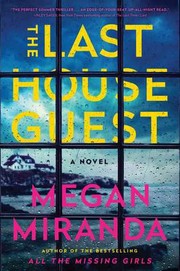
The Last House Guest
2,596-word summary 12 min read 343 pages in the book
- First published
- 2019
- Publisher
- Simon & Schuster
- Pages
- 343
- ISBN
- 9781501165375
Reading options
What's inside (8 sections)
I picked up The Last House Guest because I wanted a summer thriller that actually felt like summer. Megan Miranda published it with Simon and Schuster in 2019, a 343 page hardcover with ISBN 9781501165375. It became a Reese Witherspoon book club pick, which tells you something about the packaging, but the book itself is saltier and sadder than that sticker suggests. The setting is Littleport, Maine, a town split between people who live there all year and people who summer there with money. Avery Greer belongs to the first group. Sadie Loman belongs to the second. Their friendship is the whole engine.
Avery lost her parents in a car crash on Harbor Drive when she was young and was raised by her grandmother. After her grandmother died, she was alone except for the Lomans, who own half the coastline and most of the rental business in town. They gave her work managing their vacation houses and a small guesthouse to live in behind their big house. Sadie was the Loman daughter, golden and restless, a year or so tangled up with Avery for almost a decade of summers. Parker is Sadie older brother, charming in the way rich boys who have been forgiven too often can be charming. Grant and Bianca are the parents, polished and private. Around them orbit Luciana Suarez, called Luce, who dates Parker for a stretch, and Connor Harlow, a local boy who runs a boat and carries history with Avery. Faith Sylva is an old friend of Avery who drifts away and then back in a painful way. Detective Ben Collins is the local officer who handled Sadie case.
The structure moves between two summers. In 2017, on the night of the annual Plus-One party at a rental called the Blue Robin, Sadie is found dead on the rocks below the bluffs at Breaker Beach. Her gold sandals are left neat at the edge. A note is found in the trash. Police call it suicide by drowning after a fall. In 2018, a year later, Avery is still in Littleport, still working for the Lomans, still watched by town talk. The Lomans have started a foundation and plan a memorial with a brass bell. Break-ins start happening at the rentals. Avery finds Sadie phone hidden in linens at the Blue Robin. From there she starts pulling at threads most people wish she would leave alone.
Littleport in two seasons
Littleport reads true in the off months and performative in July and August, and Miranda gets that split without lecturing about it. In winter the town empties. Avery cleans houses, checks pipes, drives Harbor Drive with the windows up. The houses sit dark. The grocery clerk knows her name and her business. In summer the population triples. Rich families arrive with coolers and requests. Avery changes sheets, fixes televisions, smiles through complaints about paths and spiders and views. She lives close enough to the Loman main house to hear their parties but far enough that she has to be invited.
What makes the friendship between Avery and Sadie work on the page is how uneven it is. Sadie has options. Avery has rent. Sadie can leave in September. Avery stays and rakes leaves. Yet for nine or ten summers they swim and drink and tell each other things they tell no one else. Sadie loves the water and the cliffs and her family boat. Avery loves being let inside that world for a few months. There is love there, real love, plus the quiet ache of knowing one friend can always walk away.
Money shapes every room. The Lomans help with bills and keep Avery employed after her grandmother dies. It looks generous. It also keeps Avery nearby and loyal. Greg Randolph at the local bar makes cracks about Avery being Sadie shadow. Faith family runs a bed and breakfast that struggles while Loman rentals fill. Connor works the water for wages while Parker drifts through. None of this is subtle, but it does not need to be.
The Plus-One night
The 2017 party chapters come in fragments, which suits how Avery remembers that night. She arrives early at the Blue Robin to set up. She texts Sadie. Sadie answers with typing dots that never turn into a message. Guests filter in. Parker arrives late. Luce arrives with a tight smile. Connor is there, though no one can quite pin down when he walked in. The power cuts out for a stretch. Someone is pushed into the pool by a figure leaving fast. A window breaks during a fight in a back room. Tire marks cut the grass outside.
Police arrive with news that lands like a door shutting. Sadie body has been found across town at the base of the bluffs. No drugs or alcohol in her system. No signs of a struggle at the scene. Shoes placed side by side. A note in Sadie hand, or what looks like Sadie hand, found in the kitchen trash at the rental. The ruling follows quickly. Suicide.
Avery remembers small wrong things and tries to set them aside. Sadie car keys. Sadie ruined shoes. The way Sadie had acted that day, bright and normal, making plans. Detective Collins takes statements and writes names and times on a pad. Avery says she was setting up. Parker says little. Luce cries. Connor stands apart.
One strength here is how Miranda lets Avery be a steady narrator without making her innocent in every direction. Avery lies about small things. How much she drank. When she last saw Sadie. She lies because she is scared and grieving, not because she is scheming.
A fair complaint about this stretch is pace. The back and forth between 2017 and 2018 creates mood but also repeats beats. Another power flicker. Another pointed question from Collins. Readers who want fast answers may fidget. I kept reading because the place and the friendship held me.
A phone in the linens
A year later the case is closed on paper and open in town talk. Parker is back for the summer, attentive in a way that confuses her. He puts her on the memorial committee. He asks for a photo of Sadie. Sometimes he seems kind. Sometimes he watches her the way Collins watches her.
The break-ins push everything forward. At the Blue Robin, a television is smashed and a vase is broken and nothing is stolen. At another house, drawers are pulled and linens are tossed. Renters blame Avery. The Lomans blame renters. Avery goes to assess damage and sort keepsakes and finds Sadie phone buried deep in a chest under blankets in the master bedroom. It still holds charge enough to open. She looks before she turns it in, which is wrong and completely understandable.
What she finds redirects her. Photos of Connor, which feed rumors that Sadie and Connor were meeting privately before she died. A photo of Harbor Drive, the exact stretch where Avery parents died. No long message explaining why Sadie kept the phone hidden. Just images that do not fit the story of a girl planning to end her life that night. Avery starts asking questions she had trained herself not to ask.
She talks to Parker about the note. He says police matched the handwriting to a journal found with Sadie things. That journal, Avery realizes with a cold drop, is actually hers. And the note itself is hers too, an apology written to Sadie after a fight earlier that summer about money missing from the rental accounts. Finding her own words reframed as Sadie last message shakes her badly.
This is where the book is best, in my reading. Not in clue hunting but in showing how easily a woman history can be borrowed to close a case. Avery depression as a teen becomes Sadie motive. Avery apology becomes Sadie goodbye. The town already sees Avery as fragile. Paperwork makes it official. She has to prove her reading is sound while everyone treats grief as instability.
The Horseshoe and the payments
Connor has avoided Avery since Sadie died, partly from guilt and partly from old hurt. They were close once, then not. Rumors say he and Sadie were involved. Connor admits to taking Sadie out on his boat one time near the end. She asked to go to the Horseshoe, a small cove on an island where locals hide things and teenagers test courage. She hid something there and made him promise not to tell.
Connor takes Avery back out. The water chapters are plain and strong, all rope and diesel. On the island Avery finds a plastic bag with a box inside and a small flash drive in the box. One file. A list of transfers from Loman accounts. One set went to Avery grandmother, starting right after the crash that killed Avery parents.
Avery knew the Lomans helped her grandmother. She did not know the payments started that fast or ran that steady. She checks mortgage records for her grandmother house. The balance drops sharply a month after the accident. The Lomans later buy the house outright after her grandmother dies. It looked like kindness from the outside. From the inside, with the dates in a row, it looks like something else.
Luce helps here in a way I appreciated. She has split from Parker by 2018 and works at a hospital. She tells Avery what she saw at the Plus-One party. Parker fighting with Faith Sylva in a back room. Faith swinging a stone pillar and breaking a window instead. Connor confirms he saw Faith there and told her to leave. Faith later admits she has been letting herself into Loman rentals with a kept key to scare guests toward her family place.
Whose car, whose note
Avery starts to map the Plus-One night with fresh eyes. The tire marks. The car parked facing out at Sunset Retreat when she remembers parking it facing in. A bloodstain scrubbed thin in a bathroom at the Blue Robin. Dents inside her own trunk that suggest someone was inside, alive, pushing to get out. A missing buckle from Sadie broken sandal caught in the trunk latch.
The idea forms slowly and horribly. Whoever took Sadie from the party used Avery car. That choice matters twice. It moves Sadie without drawing notice. And it leaves Avery fibers all over the transport. Avery had a copy of her keys go missing that summer. Sadie had one.
Medical records add another layer. Avery searches the Loman office and finds proof Parker was treated for a concussion two days after her parents died. The official story was a one car accident on Harbor Drive. Parker asking Avery, years later, if she thinks he is a good person, stops sounding like idle guilt.
Put together, the older secret looks like this. As a teen, Parker was behind the wheel in the crash that killed Avery parents and injured her grandmother. The Lomans paid Avery grandmother to stay quiet. They paid Ben Collins, then a young officer first on the scene, to keep Parker name out of reports. Sadie found the payments while digging through family papers after she started doubting the stories she grew up with. She hid the flash drive. She took photos. She planned to tell Avery. Then she died on the night she was typing a message that never sent.
This construction works because it uses people Miranda already built. Parker is not evil in a cape. He is a boy who caused death and was shielded until shielding became identity. Grant and Bianca are not cartoon villains. They are parents who chose one child over truth and kept choosing it until the cost spread. Collins is not a stranger with a knife. He is a local cop who took money young and then had to protect the lie with bigger lies.
A criticism worth naming is that Sadie herself stays slightly out of focus. We see her through Avery love and Parker grief and Luce wariness, but rarely as a person making ordinary choices. She is photographed more than she is known. The book gives us flashes, like the genealogy tests the girls take on a whim, but more of that texture would have deepened the loss.
What holds and what slips
The last stretch moves fast and turns physical. Collins finds Avery in the Loman house just before the memorial dedication. She shows what she has. He burns papers in a trash can. He admits he was paid after the Harbor Drive crash and that Sadie confronted him with proof. He killed her to keep the cover, staged the bluffs to look like a jump, planted the note, used Avery car to muddy the trail. Avery runs. She goes over a balcony, hits ground hard, and sprints toward the bluffs where the town has gathered for the bell.
Parker arrives as Collins catches up. Avery says what she knows out loud so witnesses hear. Collins confirms enough with his fury. Parker lunges and knocks Collins back off the edge to his death on the rocks. It mirrors Sadie fall without repeating it beat for beat, because this time people are watching.
The epilogue jumps to summer 2019. Avery has used money from the sale of her grandmother house, which she invested quietly, to buy small properties with Faith. The two women, whose friendship broke under Parker and class pressure, repair enough to start a rental company together. Rumor says Parker took a plea for his role in the old crash and in Collins death. Avery is back on Harbor Drive by choice, driving it without the old dread. Littleport still favors the bold, as Grant once told her about risk and reward, but Avery redefines bold as telling truth in public rather than keeping secrets for safety.
What holds for me is tone. Miranda writes grief without making it pretty and suspicion without making everyone a suspect board. Avery checking locks, resetting a fuse box by flashlight, hearing wind in thin cottage windows, those small nights carry more fear than any chase. The friendship holds too, even in absence. Avery talks to Sadie in her head, replays the last time Sadie stood in her doorway, wonders what she missed. That ongoing conversation feels lived.
What slips, besides the sag noted earlier, is the crowd of reveals in the final fifty pages. Fire in a trash can. A balcony jump. A sprint to the bluffs. A confession at the edge. Each beat works alone. Stacked, they rush. The book chooses speed. Most thriller readers will forgive it. I did, barely, because the emotional logic stayed clear even when the logistics blurred.
Read it if you like friendship mysteries with class friction, like Ruth Ware island houses or Mary Kubica family pressure points. Content notes include death by suicide discussed and staged, drowning and falls from height, car crash deaths in backstory, grief and depression journals, police corruption, and property break-ins. Suitable for older teens and up, better for adults who know how small towns keep score.
I closed thinking about guesthouses. Small rooms behind big houses where someone lives year round while others visit. Avery cottage has low ceilings and rattling windows and a partial ocean view through trees. By the end she wants rooms of her own with books and keys she controls. A woman who managed other people houses learning to own her doors. Keys cut new. Locks changed.
FAQ
When was The Last House Guest published?
Simon and Schuster published it on June 18, 2019. The first hardcover runs 343 pages and the ISBN is 9781501165375.
Who are the main characters?
Avery Greer, her friend Sadie Loman, Sadie brother Parker, parents Grant and Bianca, Luce, Connor Harlow, Faith Sylva, and Detective Ben Collins.
Is The Last House Guest part of a series?
No. It stands alone.
Similar books

What Lies in the Woods
Naomi returns after Olivia vanishes to face what happened in the woods at eleven.
2,213-word summary · 10 min read

All the Missing Girls
Told backwards over fifteen days, a woman probes two disappearances ten years apart in her hometown.
2,064-word summary · 9 min read

The Other Mrs.
A Chicago family inherits a house on a Maine island, then a neighbor is found murdered. Kubica's 2020 thriller builds to a final reframe.
2,267-word summary · 10 min read

Such a Clever Girl
Fifteen years after the Tanners vanished, Aubrey returns at 30 as a new disappearance forces three women to face old secrets.
2,203-word summary · 10 min read

Pretty Little Liars
Four girls get texts from dead Alison a year after she vanished, and secrets start leaking.
1,922-word summary · 9 min read

Six Years
A professor who promised to forget the woman he loved sees her husband's obituary and discovers that the wedding, the marriage, and the woman herself may never…
2,076-word summary · 9 min read

Worth Dying For
Reacher stops for one night in rural Nebraska and finds a family that runs the county, a missing girl and a shipment worth killing for.
2,021-word summary · 9 min read

The Best of Friends
Three lifelong friends discover their teenage sons were hiding more than anyone knew after a night that leaves one dead, one in a coma and one silent.
2,040-word summary · 9 min read

Say You're Sorry
A widowed prosecutor defends the teenager accused of killing her babysitter, uncovering a small town's secrets and a killer hiding in plain sight.
2,116-word summary · 9 min read

The Survivors
Kieran Elliott returns to Evelyn Bay twelve years after a storm killed his brother, and a young woman's murder forces the town to face what it has concealed.
2,571-word summary · 11 min read

One of Us Is Dead
In Buckhead, Atlanta, five women narrate a murder among manicures, fundraisers, and social warfare. Jeneva Rose's 2022 thriller is a gossipy revenge fantasy…
2,471-word summary · 11 min read

Girl, Forgotten
A rookie US marshal guards a judge with a stalker and ends up reopening the 1982 prom-night murder of the judge's pregnant daughter.
2,111-word summary · 9 min read

The Boy from the Woods
Wilde, found feral in a New Jersey forest in 1986, hunts for a missing teenager while a senator's secrets tear a wealthy town apart.
2,270-word summary · 10 min read

The Affair
In 1997, Reacher goes undercover in a Mississippi town where a murder near an army base collides with a senator's power. The case that ends his military career.
2,039-word summary · 9 min read

Blindsighted
Sara and Jeffrey hunt a killer staging women in small-town Georgia.
2,400-word summary · 11 min read
Keep It in the Family
Mia and Finn renovate a long empty house and find seven children hidden in the attic.
2,270-word summary · 10 min read

Every Last Secret
A wealthy wife tracks a possible affair, but dinners, therapy, and a sudden death expose buried secrets across two polished suburban marriages and force her to…
2,687-word summary · 12 min read
Bring Me Back
Finn lost Layla at a French rest stop twelve years ago. Now engaged to her sister Ellen, he faces sightings, emails and Russian dolls that reopen everything.
2,912-word summary · 13 min read

We Were Never Here
Best friends Emily and Kristen hide a backpacker death in Chile, then face another in Vietnam with trust cracking.
2,076-word summary · 9 min read
The Cousins
Three cousins work at their rich grandmother island resort while digging into why their parents were cut off.
2,565-word summary · 11 min read

Reconstructing Amelia
A grieving lawyer mother reopens her teen daughter's alleged suicide at an elite Brooklyn school, uncovering bullying and secrets.
2,032-word summary · 9 min read

Pieces of Her
After her mother kills a mall shooter with shocking skill, Andy Oliver uncovers a hidden 1980s past of radicals and wealth.
2,791-word summary · 12 min read

The Storm
A struggling innkeeper, a returning murder suspect, and a true crime writer collide as another hurricane bears down on the Alabama coast.
2,349-word summary · 10 min read
The First Time I Saw Him
Five years after Owen vanished, Hannah and Bailey have rebuilt in California until Owen walks into her exhibition and danger returns.
2,407-word summary · 11 min read

Strangers in the Villa
A strained couple in a Spanish villa takes in guests who refuse to leave.
2,208-word summary · 10 min read

Someone We Know
A teen burglar, two unsigned apology letters, and a murdered neighbor wife turn a quiet suburb paranoid.
2,743-word summary · 12 min read

Reckless Girls
Six young travelers chase paradise on remote Meroe Island, where old lies, smashed radios and hidden cash turn sun and sand deadly.
2,703-word summary · 12 min read

My Husband's Wife
Artist Eden Fox returns from a run to find her key fails at Spyglass and her husband claims a stranger is his wife in Hope Falls.
2,437-word summary · 11 min read

Anatomy of an Alibi
Two Louisiana women swap lives for twelve hours to spy on a husband, then he turns up murdered and only one of them has an alibi.
2,278-word summary · 10 min read

All the Little Houses
In 1980s Longview, Texas, social queen Charleigh and daughter Nellie guard mean-mom secrets when a new family threatens their empire.
2,206-word summary · 10 min read