
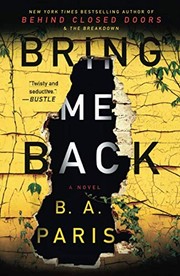
Reading options
What's inside (8 sections)
I picked up Bring Me Back on a wet Saturday because the checkout shelf at the used shop had three copies and the clerk said people either loved the ending or wanted to argue about it. I had read Behind Closed Doors two years earlier and remembered the flat chill of that book. I wanted something quick for a train ride to visit my sister. B.A. Paris published this one in June 2018 with St. Martin's Press, and it reads like it was built for exactly that kind of trip. Short chapters. A boyfriend who cannot stop explaining himself. A missing girl who will not stay missing. I finished it in two sittings with cold tea beside me and a list of questions I had not expected to care about.
Finn is telling the story, and from the first pages he sounds like a man rehearsing. He and Layla were young and broke and in love in the way that makes you drive too far on a holiday you cannot afford. They were coming back from France through the night. He stopped at a rest area. She was asleep in the car or awake and cross with him, depending on which version he gives. He went inside. When he came back, she was gone. No note. No coat taken properly. No clear sighting after. Police searched. Family printed flyers. Years passed and the absence hardened into a fact everyone lived around.
That is the spine Paris gives you early, and she keeps returning to small physical things. The layby lights. The cold air off the road. A parking space that felt too empty. Finn says he called out her name. He says he checked the toilets and the shop and the edge of the trees. He says a lorry driver saw nothing. The details shift a little each time he repeats them, and after a while I started marking those shifts in the margin. Was the car locked? Was her bag still there? Did they argue before he pulled over? Finn answers, then corrects himself, then adds a reason for the correction. It feels less like lying in the big sense and more like smoothing. He wants to sound like a decent man who had bad luck.
The stop in France that splits everything
The France section takes up the first part of the book in memory flashes. Finn and Layla are on the road after days that were supposed to fix them. Money was tight. Layla could be sharp and restless. Finn could go quiet instead of dealing with it. Paris does not give you a perfect victim and a perfect boyfriend. Layla steals small things when she is bored. She flirts to get a reaction. Finn keeps score and calls it patience. On the drive back they bicker about directions and about who wanted to stop. He pulls into the rest area because he needs the toilet and wants air. She stays in the car. That choice, ordinary a thousand times before, becomes the hinge for everything after.
What I liked here is how Paris stays with procedure. Finn waits a minute, then longer. He knocks on the passenger window. He looks in the service building. He asks the attendant. He rings her phone and hears nothing. He drives a loop around the car park thinking she walked off angry and will wave him down. When she does not appear, he rings the police. The French officers take details with calm faces. Name. Age. Hair. Clothes. Last seen. They ask if they argued. He says no, then says a little. That little change matters later.
Paris also plants the family texture early. Layla has a sister, Ellen, who is steadier and kinder in Finn's telling. Their parents are worn down by hope. Finn stays in touch at first out of duty, then out of something warmer with Ellen. He remembers Layla's laugh and her temper in the same paragraph. He keeps a photo that creases at the edges. He says time helped, which is a strange thing to say about a missing partner, and he knows it sounds strange, so he explains it twice.
I believed the confusion of those pages even when I did not believe Finn. Anyone who has lost someone in a public place knows that sick scan of crowds. You think you see the coat. You follow a stranger for three steps. Paris gets that beat right without stretching it.
Twelve years later, an engagement built on grief
Twelve years after that night, Finn is engaged to Ellen. They live together in a small house with a garden Finn tends on weekends. He works. She works. They plan a wedding. Friends say it makes sense. Shared loss brought them close. Ellen understands what that night cost him because it cost her too. On the surface it is tender. Underneath it is awkward in ways neither will name. Her parents are polite but watchful. His friends joke about finally settling. Ellen keeps Layla's old things in a box and does not open it often.
Paris is good on the domestic unease. Ellen leaves notes on the fridge. Finn forgets to buy milk. They talk about seating plans while avoiding the one guest who will never come. Ellen asks now and then what Layla would have thought of the house, and Finn answers too fast. He wants to prove he loved Layla and loves Ellen now, as if love were a ledger he can balance. Ellen wants to believe him. She also checks his phone when he is in the shower. That detail landed hard for me. Not dramatic. Just tired and human.
The engagement itself feels fragile. Ellen's smile does not reach her eyes in photos. Finn drinks a bit more than he admits. They have not told the full story to newer friends, only that Finn lost someone years ago. When pressed, Finn gives a short version that ends with a shrug. Ellen fills silences with plans. Flowers. Music. A registrar or a church. It is the normal scaffolding people put up when the ground underneath is soft.
I found this middle stretch sad more than scary. Two decent-seeming people trying to build a life on top of an unsolved disappearance. Paris lets you sit in that discomfort. You start to wonder if marrying your missing girlfriend's sister can ever be simple, however kind the intentions. The book does not preach about it. It just shows the small frictions. A name said by mistake. A song turned off fast. A drawer that sticks because something inside was shoved in haste.
A neighbor, an email, and dolls on the step
Then the past starts knocking. A neighbor mentions seeing Layla near the house. At first Finn laughs it off. Tired eyes. Wishful thinking. Then more signs arrive. An email account Finn thought dead sends a message that sounds like Layla. Small items from her old life turn up where they should not be. A bracelet. A postcard. And then the Russian dolls.
The dolls are the image that stayed with me. A set of painted wooden dolls that nest inside each other, chipped at the rims from handling. Layla owned them as a child. Ellen kept them. One appears on the garden wall. Another on the doorstep. Another inside the house when the doors were locked. Finn finds them and feels sick. Ellen goes pale and says someone is playing games. The police take notes and do not promise much after so many years. Friends suggest a prank. Finn cannot sleep.
Paris handles this stretch with patience. Each incident is small enough to explain away and strange enough to keep. A car slows outside. A call ends with breathing. A familiar perfume in a shop that turns out to be someone else. Finn starts checking locks twice. Ellen starts crying in the kitchen and saying it is hay fever. They argue about whether to tell her parents. Finn wants to protect them. Ellen says they have a right to know. Both positions make sense, which makes the fights worse.
I liked how Paris uses technology without making it the whole book. Emails with wrong timestamps. A social account with no photo. A message that could be Layla or could be someone quoting her. Finn forwards one to an old detective contact and gets a careful reply. No proof. Keep a log. Do not reply in anger. Finn replies in anger anyway. That felt true. When you have waited years for word, restraint is hard.
The neighbor sighting gets more weight as others repeat it. An older man across the road is sure he saw a woman with Layla's walk and hair near the bus stop. A shopkeeper remembers selling cigarettes to someone who looked like an older version of her photo. Finn drives to places on thin tips and comes home empty. Ellen begs him to stop chasing. He hears pleading as hiding. She hears chasing as guilt. They are both partly right, which is why I kept turning pages.
Finn tells the story again and leaves holes
About halfway through, Paris makes you sit with Finn's unreliability. He narrates in present tense and in flashback, and the two do not always line up. He says he loved Layla's spontaneity, then describes being embarrassed by it. He says he never lied to police, then admits he left out the row they had in the car. He says Ellen knows everything, then hides the newest email because he does not want to worry her. Each omission has a reason that sounds fair in the moment. Together they form a pattern.
There is a long section where Finn goes back over the rest stop hour by hour. He draws a little map. He lists what he carried. Keys. Phone. Wallet. He tries to remember if he locked the car. He thinks he did. Then he thinks he did not. He remembers music playing low. Or was the engine off? He remembers Layla saying she would wait. Or did she say she needed air too? Paris does not underline these slips. She just lets them gather. I started to distrust his kindness, not because he seemed cruel but because he seemed eager to be seen as kind.
Other voices press in. Ellen remembers Layla differently, as harder to live with and harder to leave. A former friend says Layla planned to leave Finn that weekend. A detective notes Finn never quite answered why he waited so long to call for help. Finn has answers for all of it. Tired. Shocked. Confused by language in France. Each answer fits. None settle.
This is where the book is strongest for me. Not in jump scares but in that slow sense that memory is a story we edit to live with. Finn is not a monster here. He is a man who has told his sad story so often that he polished off the rough parts. Paris lets you watch him polish in real time. You want to shake him and you also feel sorry for him. That mix kept me engaged through chapters that are mostly talking in kitchens.
I should note one choice that may annoy some readers. Finn repeats himself. He circles the same three or four facts. Rest stop. Phone. Dolls. Ellen. If you like lean thrillers, you may find the middle baggy. I did not mind much because the repetition felt like rumination, but two scenes with Ellen's parents cover similar ground about grief and permission. A tighter edit could have cut ten pages without losing force.
The sisters and the night as it really was
Without giving away the exact turns, the last third reframes what you thought you knew about the sisters and that night. Paris reveals that Finn did not tell the whole truth about his relationship with each of them, and that Ellen has kept her own counsel about Layla. What looked like a simple disappearance followed by a slow healing turns out to involve older jealousies and newer plans. The dolls, the emails, and the sightings begin to fit a different shape. Some were meant to comfort. Some were meant to warn. Some were meant to push Finn toward admitting what he did and did not do.
I will stay general on mechanics because the pleasure is in watching Paris slot pieces together. The book answers the main questions. What happened at the rest stop. Why Finn and Ellen found each other. Who left the tokens and why now, just before the wedding. The answers involve choices made in panic and stories told to cover those choices, then years of small lies to keep the cover whole. No secret twin or wild coincidence carries the weight. It is people protecting themselves and the ones they love, badly.
The final scenes move quickly. A confrontation in the house. A box opened that should have stayed shut. A drive that echoes the France drive. Paris writes these pages in short bursts. Doors. Voices. Hands shaking. I read them standing up in my kitchen because sitting felt wrong. One reveal about Ellen's knowledge landed for me and recast several earlier kindnesses as something sharper. One reveal about Finn's actions made me dislike him more while also understanding his fear that night. He is weak rather than evil, which in some ways is harder to forgive.
Does it all hold together? Mostly. Paris plays fair with clues. The dolls matter. A line about keys matters. A remark Ellen makes about sleeping matters. On a second skim I found three moments I had brushed past that point straight at the ending. That is satisfying. What is less satisfying is speed. After so much slow circling, the truth arrives in a rush and is explained in long speeches. People say exactly what they mean for the first time in the book, all at once. It feels a little staged, like actors stepping forward to deliver their piece. I accepted it because I wanted answers, but I noticed the seams.
What kept me reading and what wore thin
Paris writes readable dread. She is not showy. Her sentences are plain. Her chapters end on small hooks. A sound upstairs. A name on a screen. A doll facing the wall. I never felt lost about who was where, which matters in a book with two timelines and a small cast. The house feels real. The chipped mugs. The damp patch by the back door. The garden Finn weeds when he cannot think. Those touches kept the strange events grounded.
The marriage plot also kept me reading. Finn and Ellen are trying to love each other while loving a ghost. Paris shows how grief can look like closeness. They finish each other's stories about Layla. They visit her parents together. They cry at the same photos. Is that intimacy or mutual use? The book does not settle it neatly, and I liked that. Ellen is more than the good sister. She is tired, loyal, angry, and capable of cold decisions. Layla, seen only in flashback and stories, is more than the wild one. She could be funny and cruel in the same hour. These are not deep portraits, but they are not cardboard either.
Now the fair knocks. Finn is hard to like for long stretches. He sulks. He drinks and drives too fast. He withholds from Ellen while demanding her trust. He is rude to people trying to help. Paris clearly means him to be flawed, but there were chapters where I put the book down because I did not want his company. If you need a hero to root for, this is not that book. Ellen carries much of the sympathy, and she gets less page time than she deserves.
The book also leans on coincidence. A neighbor happens to look out at the right second. An old item happens to surface the week of the wedding. An email happens to arrive when Finn is alone. One or two such nudges are fine in a thriller. Here there are enough that the plot sometimes feels arranged rather than found. Paris smooths this with pace, but if you pause to think, you will see strings.
The reveal, as noted, is rushed. After careful buildup, motives get stated rather than shown. One character explains too much in too few pages. I wanted one more quiet scene where Ellen and Finn sit with what they now know instead of speaking it all. The book prefers to close the loop cleanly and move to the final image, which is strong but comes fast.
Still, I would press this into a friend's hands for a weekend. It wants to keep you up and make you argue. On those terms it works. Published in June 2018 by St. Martin's Press with ISBN 9781250130396, it sits beside Paris's other domestic thrillers but has its own sour tang. If you like missing-person stories where the missing person refuses to stay gone, start here.
I closed it thinking about rest stops at night and how thin the line is between waiting and leaving. I did not love Finn, but I understood why both sisters made room for him and why that room turned cold. Read it for the pull, forgive the neat speeches at the end, and talk it over after.
FAQ
When was Bring Me Back published?
In June 2018 by St. Martin's Press. The ISBN is 9781250130396.
Who are the main characters?
Finn, his missing girlfriend Layla, and her sister Ellen, who is now Finn's fiancee.
Is Bring Me Back part of a series?
No, it is a standalone domestic thriller with no series.
Similar books

Every Last Secret
A wealthy wife tracks a possible affair, but dinners, therapy, and a sudden death expose buried secrets across two polished suburban marriages and force her to…
2,687-word summary · 12 min read

Six Years
A professor who promised to forget the woman he loved sees her husband's obituary and discovers that the wedding, the marriage, and the woman herself may never…
2,076-word summary · 9 min read

The Best of Friends
Three lifelong friends discover their teenage sons were hiding more than anyone knew after a night that leaves one dead, one in a coma and one silent.
2,040-word summary · 9 min read

Girl, Forgotten
A rookie US marshal guards a judge with a stalker and ends up reopening the 1982 prom-night murder of the judge's pregnant daughter.
2,111-word summary · 9 min read

The Boy from the Woods
Wilde, found feral in a New Jersey forest in 1986, hunts for a missing teenager while a senator's secrets tear a wealthy town apart.
2,270-word summary · 10 min read

The Widow
A widow of a suspected criminal faces reporters and police while hiding what her marriage really cost.
2,599-word summary · 12 min read
The Silent Wife
A Chicago psychologist watches her twenty-year partnership collapse when Todd leaves for Natasha, then plans murder.
2,591-word summary · 12 min read

Keep It in the Family
Mia and Finn renovate a long empty house and find seven children hidden in the attic.
2,270-word summary · 10 min read
The Other Mrs.
A Chicago family inherits a house on a Maine island, then a neighbor is found murdered. Kubica's 2020 thriller builds to a final reframe.
2,267-word summary · 10 min read
Reconstructing Amelia
A grieving lawyer mother reopens her teen daughter's alleged suicide at an elite Brooklyn school, uncovering bullying and secrets.
2,032-word summary · 9 min read
Pieces of Her
After her mother kills a mall shooter with shocking skill, Andy Oliver uncovers a hidden 1980s past of radicals and wealth.
2,791-word summary · 12 min read
Strangers in the Villa
A strained couple in a Spanish villa takes in guests who refuse to leave.
2,208-word summary · 10 min read

My Husband's Wife
Artist Eden Fox returns from a run to find her key fails at Spyglass and her husband claims a stranger is his wife in Hope Falls.
2,437-word summary · 11 min read

Anatomy of an Alibi
Two Louisiana women swap lives for twelve hours to spy on a husband, then he turns up murdered and only one of them has an alibi.
2,278-word summary · 10 min read

All the Little Houses
In 1980s Longview, Texas, social queen Charleigh and daughter Nellie guard mean-mom secrets when a new family threatens their empire.
2,206-word summary · 10 min read
The Wives
A woman who sees her husband only on Thursdays tracks down his other wives and learns her marriage is not what she believed.
2,454-word summary · 11 min read
The Golden Couple
A cheating wife, a watchful husband, and a rule-breaking therapist collide in a marriage repair that hides stalking, a vanished woman, and a murder plot.
2,677-word summary · 12 min read
Something in the Water
Honeymoon divers find a bag of cash and diamonds at sea, then lie until lies cost more.
1,943-word summary · 9 min read

Sometimes I Lie
Radio host Amber wakes in a coma, able to hear but not move. Her husband may not love her, and three timelines close in.
2,399-word summary · 11 min read
The Wife Upstairs
A struggling dog walker falls for a wealthy widower in Alabama, but his missing wife may still be alive upstairs.
3,255-word summary · 14 min read

The Last Mrs. Parrish
A con artist targets a rich wife, then the marriage game turns with a hidden past.
2,018-word summary · 9 min read
The Wife Between Us
A jealous ex-wife stalks her replacement, but nothing in this marriage is what it seems.
2,756-word summary · 12 min read

Rock Paper Scissors
Amelia and Adam spend a locked anniversary weekend at Blackwater Chapel, trading letters that hide who wrote what.
3,135-word summary · 14 min read
The Perfect Marriage
A defense lawyer defends her husband accused of killing his mistress.
2,084-word summary · 9 min read
The Couple Next Door
After a dinner next door, Anne and Marco find baby Cora gone and every neighbor has a motive.
2,053-word summary · 9 min read

Never Lie
Newlyweds snowed in at a missing psychiatrist's house find tapes of patients.
3,849-word summary · 17 min read

The Therapist
A couple moves to a gated street where the previous therapist was murdered in their house.
2,437-word summary · 11 min read
Behind Closed Doors
Grace seems to have a perfect marriage to Jack, until her sister and a friend see the locks and rules.
2,056-word summary · 9 min read

What She Knew
Rachel lets her eight-year-old son run ahead in a Bristol park, and the nine-day search turns her into a suspect in the public eye.
2,952-word summary · 13 min read

The Beach House
A young valet is beaten to death at a Hamptons party, and his law-student brother spends a year building a case against the family that covered it up.
2,049-word summary · 9 min read