
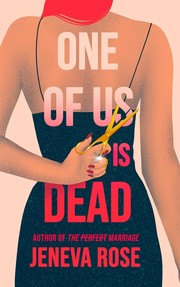
One of Us Is Dead
2,471-word summary 11 min read 320 pages in the book
- First published
- 2022
- Publisher
- Orion Publishing Group
- Pages
- 320
- ISBN
- 9781398723689
Reading options
What's inside (8 sections)
I picked this up because the title promises a body and the cover promises manicures. Jeneva Rose's 2022 novel opens with a police interview and then spends most of its time among women who would rather ruin a reputation than break a nail. The edition I read is the Orion Publishing Group paperback, 320 pages, ISBN 9781398723689. It is a gossipy, fast-talking thriller set in Buckhead, one of Atlanta's wealthiest neighborhoods, and it knows exactly what kind of fun it is having.
The first scene is not a party but an interrogation. Detective Frank Sanford sits with Jenny, the owner of the Glow Beauty Bar, and asks about a murder. Jenny is calm in a way that reads as rehearsed. She has been doing hair and nails for Buckhead women long enough to know which secrets are currency and which can get someone hurt. Then the book jumps back three weeks. That structure matters. We know someone is dead before we know who, and the wait is the point.
Rose rotates five first-person narrators: Jenny; Karen Richardson, a successful realtor married to plastic surgeon Mark; Shannon Madison, recently divorced from congressman Bryce Madison; Crystal Madison, Bryce's much younger new wife from Texas; and Olivia Petrov, the social queen bee married to Dean Petrov, a wealthy man with a talent for disappearing into meetings. Each woman gets a distinct voice, though the voices share a taste for zingers. The chapters are short. The cliffhangers are frequent. It is the kind of book you finish in two sittings and then feel slightly hungover from.
Jenny is the closest thing to an outsider. She works for these women but does not live like them, and her chapters have a different texture. She notices the cost of the performances. Olivia's chapters are all calculation. Shannon's are all ache. Crystal's are watchful. Karen's are tired. Rose lets each woman misunderstand the others, which is why the book can keep surprising you even when the plot is obvious.
Buckhead itself is a character. The lawns are enormous, the cars are German, the fundraisers are competitive, and everyone knows who married whom and how much the house cost. Status is measured in invitations. A woman can be rich and still be nobody if the right people do not return her calls. Rose has fun with that hierarchy. She also understands the loneliness underneath it. These women have personal trainers, nannies, and lawyers on retainer, and most of them are desperate to be chosen.
The queen and the gala
Olivia Petrov runs the social calendar. She is vice chair of the Buckhead Women's Foundation, which gives her a podium and a guest list. Shannon has been chair of the foundation, and the gala she organizes is meant to be her night. Olivia uses it to strip Shannon of the chairmanship in public. The scene is brutal in a polite way: applause, a microphone, a smile that does not reach the eyes. Olivia frames the move as concern for the foundation's image. Everyone in the room understands it as a public execution.
The cruelty is methodical. Olivia tries to get Jenny to drop Shannon as a client. She tries to get Karen to drop Shannon as a friend. She does not shout or threaten. She suggests, implies, and waits for people to fall in line. The message is that loyalty to Olivia is the price of belonging. Shannon's divorce has made her messy, and messy women are bad for the brand. Olivia's own marriage is a closed door, but she has learned to present it as a fortress.
This is where the novel's satire is broadest. The women talk about charity the way other people talk about stock options. They judge each other's clothes, parties, and parenting. They keep score. Rose writes it with a straight face and a wink, and the jokes mostly land because the observations are specific. The foundation gala, the silent auction, the seating chart, the careful placement of a rival near the kitchen: it is all recognizable. The exaggeration is the pleasure.
The gala also establishes the novel's central irony. The foundation exists to raise money for people who need it, but the women use it to settle scores. Charity is another room in which they can be cruel. Rose does not push the irony too hard. She lets the champagne and the auction paddles do the work.
The ex-wife, the new wife, and the congressman
Shannon is not ready to be replaced. Bryce divorced her and married Crystal, a younger woman from Texas who is trying to learn the local rules. Shannon still loves Bryce, or at least still wants the life that came with him. She tries to win him back. Bryce responds by humiliating her in public, announcing that they will never reunite. The scene lands like a door slamming. Shannon has spent weeks grooming herself for a comeback, and Bryce makes her look foolish in front of the people whose approval she needs.
Crystal is not the airhead the other women expect. She is observant, insecure, and increasingly suspicious of her husband. She notices how Bryce talks about women when he thinks no one is listening, and she starts to see the gaps between the life he shows her and the life he keeps elsewhere. Crystal came from Texas with a suitcase and a marriage certificate, and she is learning that Buckhead is a town where the welcome mat has a price tag. Her chapters have a fish-out-of-water humor that keeps the book from drowning in its own nastiness.
Bryce, meanwhile, is a congressman who behaves like a man who has never been told no. His charm is a tool, and his marriage to Crystal is a performance for donors. The age gap is not examined in depth. It is another sign of his appetite and her vulnerability. Rose is more interested in how the women react to the marriage than in the marriage itself, which is a fair choice but leaves Bryce thin.
Olivia's cruelty goes beyond social exclusion. She catfishes Shannon with a fake online date named Jonathan. Shannon, lonely and hopeful, dresses up and waits at a restaurant. The reader knows the person on the other end is Olivia. It is a mean prank with real humiliation behind it. Rose uses the sequence to show how loneliness makes Shannon easy to manipulate. It also shows Olivia's appetite for control. She does not want Shannon gone from the foundation. She wants her small and grateful.
The salon attack
Jenny's life is the spine of the present-tense plot. The Glow Beauty Bar is a refuge and a confessional. Women tell Jenny things while she works on their hair, and Jenny has learned to keep her mouth shut. That silence has kept her business alive. It has also made her complicit in small ways, and the novel starts to press on that guilt. After the salon is attacked and Jenny is nearly strangled by a masked intruder, she stops treating silence as professionalism. The attack appears to be on Olivia's orders. Jenny begins to reevaluate her life, her marriage, and the secrets she has been keeping for clients. She is not a detective, but she becomes the closest thing the book has to a conscience.
The attack is also the moment the novel's two modes collide. The social comedy has been about invitations and insults. Now there is a man with his hands around a woman's throat. Rose does not linger on the violence, but she does let it change the temperature. Jenny's clients keep calling. The salon reopens. The ordinary routines continue, which makes the fear more believable. Jenny starts locking doors she never used to lock.
Karen's story runs alongside. She is married to Mark, a plastic surgeon with a good jaw and a cold streak. Their house is beautiful, their marriage is hollow. Karen discovers she is gay and begins an affair with Keisha, Jenny's friend and employee. The affair is written as relief rather than scandal. Karen has spent years performing the role of the doctor's wife, and Keisha sees her without the performance. The scenes between them are some of the warmest in the book.
Mark has dark edges. He is controlling, and the novel suggests his cruelty is not limited to his marriage. Karen's realization gives the book one of its few tender storylines, though it is also the one most easily resolved. The ending hands her a divorce and a new relationship with very little friction. That is satisfying, but it is not difficult. Rose is better at writing the performance of a happy marriage than the messy work of leaving one.
Mark's presence in the novel is a low hum. He calls Karen at odd hours. He questions her plans. He is the kind of man who can make a room feel smaller without raising his voice. The novel never turns him into a full villain, which is more unsettling than if it did.
What Crystal found
The engine of the last third is a laptop. Crystal finds video files on Bryce's computer that show Bryce and Dean running a human trafficking operation. The files are specific enough to be undeniable: locations, timestamps, faces. Crystal does what a decent person would do. She takes the evidence to Olivia, expecting help. Olivia is the woman with connections, the one who knows how to handle a crisis. Instead, Olivia sees an opportunity. She demands $500,000 and a stake in the operation. Her reasoning is fear. She is terrified of poverty, and she will not go to the police.
Olivia's credit cards are declined around this time. Dean admits that money is tight after problems with a shipment and that he moves illegal goods. Olivia assumes drugs. She intends to take over. The revelation is meant to show how little she knows her husband, and how quickly she can turn someone else's nightmare into a business plan. It also makes her the most dangerous person in the book. The social villain becomes a criminal one, and the novel does not pretend the transformation is clean.
Dean is even thinner. He is a checkbook with a temper, a man whose wealth is assumed until the credit cards start failing. The trafficking operation is the novel's attempt to give the gossip a body count, and it works as a plot device more than as a social critique.
This is where the plot starts to strain. Olivia's decision is monstrous, but it is also convenient. She has spent the whole novel being awful, so the turn from social cruelty to criminal conspiracy feels less like a reveal and more like a confirmation. The trafficking plot is serious, and Rose treats it seriously, but it sits awkwardly beside the manicure jokes. The tone wobbles. The novel wants to be both a beach read and a story about monstrous men, and sometimes the two halves pull in different directions.
Halloween
The climax takes place at Bryce and Crystal's Halloween housewarming party. The party is a perfect stage: costumes, alcohol, a house with too many rooms. Karen dresses as Olivia to create a false alibi. If witnesses see Olivia at the party, the real Olivia has cover for whatever happens later. It is a clever plan, and it depends on everyone in Buckhead being too self-absorbed to look closely at a costume.
Crystal lures the real Olivia to a guesthouse. She knocks her out with a baseball bat, then takes her to a shipping container. The plan is not elegant. It is angry. Jenny shoots Olivia dead. The women then feed Dean false information that Bryce killed Olivia. Dean walks into Bryce's office and shoots him in the head. Police arrest Dean. Detective Sanford never suspects the women who planned it.
The sequence is the book's biggest gamble. It asks the reader to believe that a group of wealthy women with no criminal experience can organize a kidnapping, a shooting, and a frame-up in one night, and that a detective will accept the obvious story. Rose writes it with such momentum that the implausibility almost disappears. Almost. The container, the bat, the costume, the convenient guesthouse: it is a revenge fantasy dressed in designer clothes. The fantasy is the point, but a reader looking for a tightly plotted crime novel may balk.
The moral question is left hanging. Olivia is a monster, but the women who kill her are not heroes. They are frightened, angry, and tired of being handled. Rose gives them the victory without asking what it costs them, and the novel is lighter for it. That lightness is a feature for readers who want a romp and a flaw for readers who want the violence to mean something.
Three weeks later
The epilogue is a victory lap. Shannon and Crystal co-lead the Foundation. Karen has filed for divorce and is openly dating Keisha. Jenny is dating Detective Sanford. The survivors walk free. The women who spent the book being judged by their husbands, their neighbors, and each other have finally arranged the world to their liking. It is petty, funny, and deeply unserious about the murders they have committed.
That unseriousness is both the pleasure and the problem. Rose's characters are mostly types: the queen bee, the wronged ex-wife, the trophy wife, the put-upon salon owner, the closeted realtor. The social satire is broad enough to see coming from the valet stand. The ending is implausibly neat, and the men are so obviously monstrous that the novel never has to ask whether the women's violence is anything more than a mirror. But the voice is addictive. The pacing is ruthless. The one-liners do the work that deeper characterization might have done.
Sanford's blind spot is the novel's final joke. He is a decent detective who cannot imagine the women he interviews as killers, because he sees them as wives, clients, and socialites. The book has spent 320 pages showing how invisible wealthy women can be when they are useful or decorative. Their escape is less a comment on justice than on who gets believed.
What stays with me is the image of Jenny at the salon, listening. She has built a life on other women's secrets, and the book's real subject is what happens when she decides to stop keeping them. Buckhead is a town where a reputation can be destroyed with a seating chart and a rumor. By the end, the women have traded gossip for something far more literal. It is ridiculous. It is also, in its trashy way, satisfying. Rose knows that revenge is a dish best served with a blowout and a good alibi.
FAQ
Who are the five narrators in One of Us Is Dead?
Jenny, Karen Richardson, Shannon Madison, Crystal Madison, and Olivia Petrov each tell parts of the story in first person.
What is One of Us Is Dead about?
It follows a wealthy Atlanta social circle after Bryce Madison divorces Shannon and marries Crystal, setting off jealousy, cruelty, and a murder plot.
Is One of Us Is Dead part of a series?
No. It is a standalone 2022 novel published by Orion Publishing Group.
Similar books

Bad Luck and Trouble
A deposit of $1,030 summons Jack Reacher back to his old army unit, which is being picked off one name at a time.
2,366-word summary · 11 min read
Finlay Donovan Knocks 'Em Dead
Someone has put a contract on Finlay Donovan's ex-husband, and the novelist and her nanny have to find the hitman before the school pickup.
1,990-word summary · 9 min read

The Redbreast
Harry Hole chases an ageing sniper through modern Oslo while two Norwegian volunteers on the Eastern Front carry a fifty-year-old betrayal toward a royal…
2,453-word summary · 11 min read
Razorblade Tears
Two ex-con fathers, one Black and one white, hunt their murdered sons' killers in a Richmond that never gave the boys a fair shake.
2,880-word summary · 13 min read
We Were Never Here
Best friends Emily and Kristen hide a backpacker death in Chile, then face another in Vietnam with trust cracking.
2,076-word summary · 9 min read
What Lies in the Woods
Naomi returns after Olivia vanishes to face what happened in the woods at eleven.
2,213-word summary · 10 min read
The Last House Guest
A year after her best friend dies in Littleport, Maine, a local woman finds a hidden phone that reopens the case.
2,596-word summary · 12 min read
Reckless Girls
Six young travelers chase paradise on remote Meroe Island, where old lies, smashed radios and hidden cash turn sun and sand deadly.
2,703-word summary · 12 min read
The House in the Pines
Maya's best friend died at seventeen; seven years later a video of Frank with another dead girl pulls her home.
2,081-word summary · 9 min read
I Am the Messenger
Nineteen year old Ed stops a robbery, then gets playing cards sending him to help strangers.
2,124-word summary · 9 min read
The Lying Game
Isa returns to Salten with her baby when bones surface in the marsh and force four school friends to face what they buried.
2,277-word summary · 10 min read
Pretty Little Liars
Four girls get texts from dead Alison a year after she vanished, and secrets start leaking.
1,922-word summary · 9 min read
Luckiest Girl Alive
Ani FaNelli reinvents herself as a glossy New Yorker, but a documentary about her Bradley past threatens to expose everything.
2,222-word summary · 10 min read
If We Were Villains
Seven Shakespeare students at a cutthroat conservatory close ranks after a death by the lake, and one serves ten years for it.
2,715-word summary · 12 min read
In a Dark, Dark Wood
Writer Nora joins hen party Clare in glass house where a murder happens.
2,253-word summary · 10 min read
Turtles All the Way Down
Aza Holmes lives with intrusive thoughts while chasing a missing billionaire with Daisy.
2,007-word summary · 9 min read
The Maid
Hotel maid Molly Gray finds a dead guest and must use her eye for detail to clear herself.
2,031-word summary · 9 min read
Remarkably Bright Creatures
A widowed night janitor, a lost young man, and a grumpy octopus circle the same old loss in a small seaside town.
2,012-word summary · 9 min read
A Good Girl's Guide to Murder
Pip reopens a closed murder case for a school project and finds the town wanted it shut.
2,621-word summary · 12 min read
You Shouldn't Have Come Here
Grace books a remote Wyoming ranch Airbnb to reset, but her attentive host Calvin blurs hospitality, attraction, and threat until twists reframe it.
2,515-word summary · 11 min read
The Perfect Marriage
A defense lawyer defends her husband accused of killing his mistress.
2,084-word summary · 9 min read

What She Knew
Rachel lets her eight-year-old son run ahead in a Bristol park, and the nine-day search turns her into a suspect in the public eye.
2,952-word summary · 13 min read

The Beach House
A young valet is beaten to death at a Hamptons party, and his law-student brother spends a year building a case against the family that covered it up.
2,049-word summary · 9 min read

Size 12 Is Not Fat
Former teen pop star Heather Wells investigates two dorm elevator deaths while juggling her ex, her crush, and a size-12 wardrobe.
2,805-word summary · 12 min read

Six Years
A professor who promised to forget the woman he loved sees her husband's obituary and discovers that the wedding, the marriage, and the woman herself may never…
2,076-word summary · 9 min read

The Trespasser
A Dublin Murder Squad detective investigates a staged dinner-party killing and finds a cover-up that reaches into her own department.
2,051-word summary · 9 min read

Rules of Prey
Minneapolis detective Lucas Davenport hunts a killer who leaves a new rule at every scene and treats murder as a game of wits.
1,914-word summary · 9 min read
Little Earthquakes
Four Philadelphia women meet during pregnancy and discover that new motherhood is nothing like the plan, while friendship becomes the thing that holds them…
1,997-word summary · 9 min read

Dumplin'
Willowdean Dickson enters her town's beauty pageant as a protest and discovers that confidence is harder to keep once she lets someone close.
1,922-word summary · 9 min read

Ace of Spades
Two Black seniors at an elite academy are celebrated by day and hunted by an anonymous texter in this YA thriller about institutional racism.
2,066-word summary · 9 min read