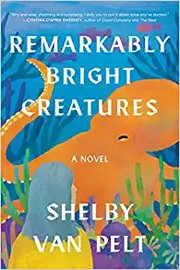
Remarkably Bright Creatures
2,012-word summary 9 min read 368 pages in the book
- First published
- 2022
- Publisher
- Ecco
- Pages
- 368
- ISBN
- 9780063204157
Reading options
What's inside (7 sections)
I went into Remarkably Bright Creatures braced for whimsy overload, an octopus narrator sounded like a gimmick auditioning for a movie deal, and came out converted. Shelby Van Pelt published it as her debut with Ecco on May 3, 2022, a 368 page novel that became a Jenna Bush book club pick, sold millions, and earned its film adaptation honestly. It is set in the fictional seaside town of Sowell Bay in the Pacific Northwest and follows three threads, Tova Sullivan, a seventy-year-old widow who mops floors at the aquarium on the night shift, Cameron Cassmore, a feckless thirty-year-old drifting through life, and Marcellus, a giant Pacific octopus who narrates his own chapters with magnificent disdain for humans. The threads converge on a thirty-year-old loss, and the convergence is handled with unusual grace.
Let me address the octopus first, since he is the reason many readers pick this up and the reason some put it down. Marcellus works. His chapters are short, wry, and observant, full of complaints about his tank, his joints, and the stupidity of bipeds, and they slowly reveal that he knows something about Tova's past that she does not. Van Pelt keeps his intelligence plausible. He does not talk to humans or solve crimes. He watches, remembers, escapes his tank at night for snacks, and puts together what he sees with the patience of a creature that has nothing but time and eight arms. His voice is the book's boldest choice and its best. Without him this would be a pleasant small-town novel. With him it is something stranger and kinder.
Tova is the book's anchor. Eighteen years old when her son Erik died on a boat in the Puget Sound, widowed later when her husband Will passed, she has spent decades converting grief into routine. She cleans the aquarium at night because the work is honest and the hours suit someone who prefers the company of sleepy fish to condolences. She belongs to a knitting circle, tolerates the town's concern, keeps her house exactly so, and visits the past in small doses she can control. Her friendship with Ethan Mack, who owns the local grocery and has quietly loved her for years, is drawn with lovely restraint. He brings her soup. She deflects. Everyone in town sees what she will not.
Cameron drifts into town
Cameron is the mess that makes the plot move. Thirty, underemployed, dumped by his girlfriend, raised by Daphne, a mother whose addiction made his childhood chaotic, he arrives in Sowell Bay chasing a rumor. An old photo, a few comments his mother let slip, a feeling that his absent father might be findable here. He rents a room, takes a maintenance job at the aquarium, fumbles everything, and starts a tentative romance with Avery, a capable young woman who owns the paddleboard shop and has no patience for drifters. Cameron is easy to dislike for the first hundred pages, flaky, self-pitying, quick to blame Daphne for everything while cashing the freedom her failures bought him. Van Pelt knows this and lets Avery say it to his face more than once.
The aquarium chapters braid the three leads. Tova mops. Cameron unclogs. Marcellus watches both from his tank, recognizing in Cameron something familiar, a face, a mannerism, a detail he cannot place but cannot drop. The workplace comedy is gentle, a new director with big plans, a sea lion with opinions, teenage summer staff, budget crises, and it gives the grief story somewhere to breathe. Tova takes Cameron under her wing in small ways, a sandwich, a lecture on showing up, the maternal attention he never got and she never stopped having nowhere to put. Their scenes together have a warmth that sneaks up on you. Neither would call it family. Both are starved for exactly that.
Around them, Sowell Bay fills in. Ethan's quiet courtship. The knit-night friends with their gossip and casseroles. Daphne calling from California with chaos in her voice. Avery's clear-eyed assessment of Cameron, attraction plus conditions. And Marcellus, aging, his body failing the way giant Pacific octopuses fail after three or four years, feeling time shorten and deciding, with octopus logic, that he must act on what he has figured out before he cannot act at all.
The mystery at the center is the night Erik Sullivan died. He was eighteen, out on his small boat, and never came home. The town ruled it an accident, fog and water and youth. Tova has spent thirty years replaying it, blaming herself for letting him go, for the argument they had, for everything mothers blame themselves for. What Marcellus knows, pieced together from years of overheard conversations and one crucial object, reframes that night. I will not detail the reveal, except to say it involves Cameron's parentage, a connection between the Cassmore and Sullivan families that neither suspected, and a small human cruelty that snowballed into tragedy. The reveal is not a thriller twist. It is a grief twist, the kind that changes what the living owe each other.
How the threads knot
The last third moves quickly once Marcellus acts. Confined to a tank, dying by inches, he does what he can with what he has, manipulating objects, timing his escapes, leaving signs the way a very smart animal would, drops and placements that nudge Tova and Cameron toward each other and toward the truth. Van Pelt plays fair here. Every clue Marcellus uses was shown earlier. The humans do the actual understanding, as they must. Tova confronts Daphne. Cameron confronts himself. Ethan finally says his piece. And the question of what Tova will do with a grandson she never knew she had, and what Cameron will do with a grandmother who is everything his mother was not, gets answered in scenes that are emotional without being soupy.
The ending gives each thread its due. Marcellus, whose lifespan was always the book's clock, gets a farewell that made me cry in an airport, dignified, strange, right for what he was. Tova loosens her grip on routine without abandoning herself, accepting help, accepting love, keeping the night shift because she likes it rather than because she needs to hide in it. Cameron, the book's biggest surprise, grows up, not all at once, but enough, a job kept, a woman courted properly, a mother forgiven without being excused. Avery gets to be a person rather than a prize, with her own business and boundaries. Even Daphne, the easiest character to hate, gets a chapter of grace that neither erases her damage nor denies her humanity.
There is a temptation to call the book's vision of healing too neat, and I felt it flicker once or twice. Sowell Bay is the kind of town where casseroles arrive on schedule and the grocer is secretly noble. Real grief is lonelier and less witty. But Van Pelt earns her warmth by refusing to cheapen the cost. Erik stays dead. Thirty years stay lost. Nobody gets the past back. What they get is smaller and truer, company, honesty, a use for love that has nowhere else to go.
What works and what drags
What works is the trio and the tone. Tova is a wonderful creation, prickly and proper and quietly funny, and her chapters never condescend to old age. Marcellus is a gamble that pays off on every appearance. Cameron's arc from man-child to man is patient and believable. The prose is clean and warm without turning syrupy, and the short chapters keep 368 pages moving. The mystery is seeded with care. Readers who guess early will still enjoy watching the characters catch up.
What drags is thinness in places. Daphne is sketched more than drawn until very late. The aquarium's financial peril subplot resolves conveniently. A few coincidences, the timing of arrivals, the smallness of the town's secrets, require goodwill. And readers who want their fiction unsentimental should know this book believes in casseroles, second chances, and the moral authority of octopuses. It is sincere all the way down. If sincerity embarrasses you, the Marcellus chapters will be the only ones you like, and even those end tenderly.
Routine as grief management
What I keep returning to is how honestly the book treats routine. Tova's life is a fortress of habits, the same shifts, the same meals, the same knitting nights, and Van Pelt neither mocks nor romanticizes it. Routine is what kept Tova upright after Erik died and after Will died. It is also what keeps her from living. The novel's quiet argument is that coping strategies expire. What saves you at thirty can starve you at seventy. Tova's arc is not about abandoning order but about letting new things inside it, a grandson, a suitor, a different shift now and then. The scene where she first accepts a dinner invitation she would normally refuse carries more charge than most thrillers manage, because the book has taught you what refusal costs her.
Cameron is the mirror image, a man with no routine at all. He drifts through jobs, apartments, and relationships, calling it freedom while everyone can see it is fear. His growth is the reverse of Tova's, learning to keep a schedule, to show up, to maintain. Their parallel tracks give the book a shape that feels discovered rather than imposed. Family, Van Pelt suggests, is partly just people whose routines include each other. By the end, Tova's includes Cameron, Cameron's includes a job and a woman, and Marcellus, who measures time in heartbeats, gets to witness the knot hold.
The Erik grief itself is handled with rare patience. Thirty years on, Tova still replays the argument, the boat, the fog. The book understands that old grief does not fade so much as compact, becoming denser and smaller, carried everywhere without comment. When the truth about that night finally arrives, it does not heal Tova in the way revelations heal characters in lesser books. It rearranges the grief without removing it. She gains a grandson and loses the story she told herself for decades. Both things are true. Both hurt. The honesty of that exchange is what elevates the novel above comfort reading, even as it comforts.
Sowell Bay and its people
The town deserves a paragraph because ensemble is half the pleasure. Ethan Mack, the grocer with his quiet devotion, could have been a saint and is instead something better, a widower himself, patient but not passive, willing to be refused without bitterness and willing, finally, to ask directly. The knit-night women, with their gossip that functions as surveillance and care at once, nail small-town friendship. Avery, Cameron's love interest, is drawn with unusual respect for a romantic subplot. She has a business, standards, and a life that does not pause for his drama. Her conditions for dating him, steadiness, honesty, effort, are the book's values stated plainly.
Even minor figures get grace notes. The aquarium director's bluster covers real love for the place. The teenage staff's laziness covers tenderness. Daphne, Cameron's mother, gets the hardest job, embodying addiction's damage without becoming a monster, and her late chapters, while brief, refuse both excuses and condemnation. Van Pelt clearly likes people, all of them, including the prickly ones, and the affection is infectious without turning blind. Sowell Bay feels like a town you could visit, where the café knows your order and the past sits at the next table.
I recommend it to anyone grieving, anyone who loves a smart animal, anyone who wants a mystery where the solution heals rather than shocks. It is the gentlest book in this batch and, to my surprise, the one I have pressed on the most friends since. Read it for Marcellus's grumbling. Stay for Tova mopping her way toward morning. Close it believing, at least for an evening, that attention is a form of love and that even the strangest minds, eight-armed or two, are trying to tell us something worth hearing.
FAQ
When was Remarkably Bright Creatures published?
Ecco published it on May 3, 2022. The hardcover runs 368 pages and the ISBN is 9780063204157.
Does the octopus really narrate?
Yes, Marcellus narrates chapters in his own voice. He is wry, observant, and nearing the end of a giant Pacific octopus lifespan.
Is it part of a series?
No. It stands alone as Van Pelt's debut novel.
Similar books
More like Remarkably Bright Creatures →
Turtles All the Way Down
Aza Holmes lives with intrusive thoughts while chasing a missing billionaire with Daisy.
2,007-word summary · 9 min read
The Maid
Hotel maid Molly Gray finds a dead guest and must use her eye for detail to clear herself.
2,031-word summary · 9 min read

The Raven Boys
Blue Sargent joins four Aglionby boys hunting a Welsh king on a Virginia ley line.
2,537-word summary · 11 min read

In a Dark, Dark Wood
Writer Nora joins hen party Clare in glass house where a murder happens.
2,253-word summary · 10 min read

The Flatshare
Two strangers share one bed on opposite shifts and fall in love through notes left around the flat.
2,793-word summary · 12 min read

Slammed
Grieving Layken falls for neighbor Will, then learns he is her teacher, and poems carry them.
2,793-word summary · 12 min read