
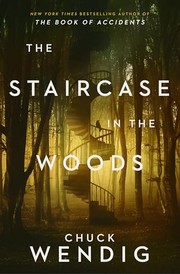
The Staircase in the Woods
2,023-word summary 9 min read 400 pages in the book
- First published
- 2025
- Publisher
- Del Rey
- Pages
- 400
- ISBN
- 9780593156582
Reading options
What's inside (8 sections)
A date and a warning
The novel opens with a date and a warning, which is an effective way to start a horror book. On Friday, June 5, 1998, five teenagers went into the woods around Highchair Rocks in Bucks County, Pennsylvania, and only four came out. The five are Matt Shiffman, Owen Zuikas, Lauren Banks, Hamish Moore and Nick Lobell. They go drinking and taking acid, they find a staircase to nowhere at the end of a trail, and the wood of it is pale and cracked like old bones. Hamish suggests climbing it. Matt rushes up and vanishes at the top.
That is the whole hook, and Chuck Wendig does not waste it. A staircase in the woods that leads somewhere else is a wonderfully simple image, and the book keeps returning to it from different angles. What waits at the top is withheld for a long time. What waits behind the four survivors, in their ordinary adult lives, is the thing the book is really about.
I have a weakness for horror novels that begin with a specific date. It promises that what follows will be a record rather than a story, as though somebody found a file and is reading it aloud. Wendig keeps that feeling alive through the shifting structure. The book moves between the summer of 1998 and the present, and between the separate points of view of the four survivors, and it never quite lets you settle into one version of events.
Wendig is very good on the texture of that afternoon. The heat, the woods, the particular stupid bravado of five teenagers who have taken too much acid and think they are invincible. The staircase is described in a way that makes it both alluring and wrong: pale wood, cracked like old bones, going up between trees to nowhere in particular. There is no house at the top, no building it could belong to. It simply stands there in the forest, waiting. Hamish's suggestion that they climb it is the kind of thing that seems funny at the time, and Matt's rush up the steps is over before anyone can stop him. At the top, he is gone.
What the others do in that moment matters as much as the disappearance. They do not climb after him. They call, they look, they panic, and eventually they go back. The book returns to that failure again and again, because it is the thing none of them can forgive in the others. Each survivor remembers a slightly different version of who said what and who hesitated. Twenty-five years later those differences have hardened into grievances.
What happened after
More than two decades later the four survivors are estranged. Owen works in a bookstore. Lauren, who now goes by Lore, is a celebrated game developer who once used an idea the five of them made together, which is a small resentment that has had twenty years to grow. Hamish is a suburban family man with a wife and three children. Nick has spent the years obsessively emailing the others about the staircase, filling their inboxes with theories and warnings that nobody wants to read.
Nick's emails are one of the book's better inventions. For years he has been sending the others long, unanswerable messages about the staircase: research, theories, fragments of folklore, pleas to come back. They delete them, or they let them pile up unread. There is something painful about the picture of a man spending two decades writing to people who will not listen, because the emails are not really about the staircase. They are about his inability to accept that the others have moved on. He needs the past to still be happening, and they need it to be over.
Nick is dying of pancreatic cancer when he summons them. He invokes the Covenant, the rock-solid, die-hard, go-to-the-grave promise they made as teenagers, the kind of vow that kids make with absolute confidence that it will never be called in. It is called in now. The others travel to New Hampshire expecting a party, or a deathbed reconciliation, or at worst another one of Nick's long emails delivered in person. What they find is another staircase.
The trip to New Hampshire has the shape of a reunion gone wrong. They expect Nick to be frail and perhaps maudlin. Instead he is urgent, almost angry, and he has brought them to a place none of them recognizes. The second staircase is not hidden in the woods this time. It is waiting in a clearing, as though it has been put there for them. That is when the book's rules become clear: the stairs do not appear to people who are looking for them. They appear to people who have been called.
That is where the book stops being a story about grief and memory and becomes a creature of its genre. Climbing the stairs drops them into a liminal haunted house, a place marked by signs that read THIS PLACE HATES YOU. The rooms are tailored to each of them. They are forced to encounter the specific shape of their own guilt, and the house is not interested in subtlety about it. Wendig has a great deal of fun with the architecture of dread: corridors that change, rooms that know your name, the sense that the building is assembling itself around its visitors.
The empty coffin
One of the strongest threads is the memory of what happened after Matt disappeared. An earlier scene shows Matt's family burying an empty coffin while the four friends stand under the suspicion of the town. They were the last people to see him alive. They were drunk and high. They cannot explain what happened, and even if they could, the explanation would make them sound insane. So they keep the secret, and the keeping of it shapes all four lives.
The town's suspicion is presented as a kind of weather. Nobody charges them with anything, but nobody believes their story either. Doors close when they walk down the street. Parents keep children inside. The funeral is attended by people who want to be seen there and who treat the four friends as evidence of something. Wendig understands how a rumor becomes a permanent condition. The friends do not need to be convicted to be punished. They only need to be known as the ones who were there.
This is the part of the book I found most convincing. The horror is not the staircase itself. It is what a person becomes after twenty-five years of carrying an event that nobody will ever believe. Owen's retreat into a bookstore, Lore's success built on a shared idea, Hamish's desperate normalcy with his wife and three children, Nick's obsessive emails: all of them are different ways of failing to move on. Wendig understands that a secret does not sit still. It becomes a structure that a life is built around.
The friendship frays in the present, and the thing that breaks it is politics. Lore and Hamish clash over his support for Trump, and the argument is ugly in a way that feels real. This is an interesting choice for a horror novel. Most books of this kind use the past as the source of division and let the present unite the survivors against the monster. Wendig does the opposite. The years have made these people disagree about who they are, and the staircase is almost a relief because at least it is a problem they can all see.
Dread, then gore
The structure has been compared to Stephen King's It, and the comparison is fair in the broad sense: a group of friends bound by a childhood trauma, summoned back as adults to face it again. Locus reviewer Ian Mond made that comparison and also identified the book's main weakness. He found that the friends feel avatar-like, each carrying a one-sentence profile, and suggested that this characterization has the potential to be a deal-breaker. His point is that Wendig gives us four positions rather than four people: the bookstore worker, the successful game developer, the suburban dad, the dying obsessive.
I think that is harsher than the book deserves, but I understand it. The first third is rich in atmosphere and the relationships have a history you can feel. Then the staircase opens and the characters are sorted into functions. The tailored rooms are a clever device, but they require each person to represent one thing, and the novel does not always resist the pressure to flatten them.
Wendig's great asset is verve. The book moves. He builds dread with real skill, using the slow accumulation of detail and the restraint of not showing what is at the top of the stairs. Then he shifts into gore, and the change is deliberate. The first half asks you to imagine; the second half shows you. Readers who prefer the suggestion will find the later chapters too much. Readers who thought the setup was taking too long will get their payoff. Kirkus called the book flawed but visceral, which seems exactly right.
The middle and the politics
Two criticisms recur in the reviews and both have some force. The first is that the middle sags. Once the four are inside the house and the rooms have begun their work, the book spends a long time moving them from one tailored nightmare to the next. Each room is well made, but the rhythm becomes predictable, and the novel's forward motion stalls while the characters learn the same lesson in four different ways. There is a version of this book that is eighty pages shorter and stronger for it.
The second is that the politics feel forced. The argument between Lore and Hamish is convincing as a fight between people who used to be close, but it arrives with a neatness that serves the theme rather than the characters. Other reviewers made the same point. The book wants to say that a shared past is not enough to hold a friendship together when the present has divided you, and it makes that point by scripting a confrontation that lands a little too cleanly.
I did not mind it as much as some reviewers did, partly because the argument gives Hamish the only moments in which he is more than the suburban dad. He becomes someone with a rage he cannot quite justify, which is more interesting than his profile suggests. Lore, too, has a sharpness about having been used that makes her more than the successful one. The avatar problem is real, but it is not total.
What stayed with me
The image of the empty coffin is what I keep coming back to. A family holding a funeral for a body that was never found, and four teenagers standing at the edge of a town's suspicion, knowing that the truth would be worse than silence. That is a horror image that does not need a monster. It is about the way a community decides what story to tell about a disappearance, and about the people who know a different story and cannot bear to tell it.
The staircase works for the same reason. It is not evil in any complicated sense. It is a thing that is there, and people make choices about it. Hamish suggests climbing it. Matt runs up. The others follow. Twenty-five years later Nick decides to call in a promise. The supernatural element gives these choices a stage, but the choices are ordinary ones, made by ordinary frightened people.
That is the book's best idea. The house says it in letters on the wall: this place hates you. But the book knows that the place is only reflecting what the people brought with them. I finished it wanting a little more patience with the characters and a little less of the middle, but I finished it thinking about Matt's empty coffin, which is the test a horror novel has to pass.
FAQ
What is The Staircase in the Woods about?
It is a 2025 horror novel about five teenagers, one of whom vanishes at the top of a mysterious staircase. Twenty-five years later the four survivors are summoned back to face what happened.
Is the book compared to Stephen King's It?
Yes. Locus reviewer Ian Mond compared its structure of childhood trauma and adult survivors to It, while noting that the four friends are drawn more as one-sentence profiles than fully developed people.
What is the Covenant in the novel?
It is the unbreakable promise the five teenagers made in 1998. Nick invokes it decades later to force the others to return, turning a childhood vow into the mechanism of the horror.
Similar books
The Bewitching
A gothic horror novel that moves between 1908 Mexico and 1998 Massachusetts as an old family curse and a folkloric bewitchment repeat across three timelines.
2,332-word summary · 10 min read

Marina
A fifteen-year-old boarder in 1979 Barcelona follows a singing voice into a ruined mansion and finds a girl, a watch, and a mystery the city has kept buried…
2,352-word summary · 10 min read
Ghost Story
Four elderly friends who trade ghost stories every week find their tales coming true after a fifth member dies in this 1979 horror novel.
2,461-word summary · 11 min read
Bat Eater and Other Names for Cora Zeng
A Chinese American crime scene cleaner in pandemic-era New York is haunted by her sister's racist killing and a string of deaths among East Asian women.
2,014-word summary · 9 min read
Wolf Worm
An illustrator hired to draw parasites in 1899 North Carolina finds her employer's locked shed holds something far worse than insects.
2,404-word summary · 11 min read
The Unknown
A struggling actress joins an isolated film shoot about five women who vanished on a Vermont island in 1926, and the staged haunting turns deeply personal.
2,424-word summary · 11 min read
What Moves the Dead
Alex Easton arrives at the Usher house to find Madeline dying, the tarn full of fungus, and the local hares refusing to stay dead.
2,586-word summary · 11 min read
The Tale of the Body Thief
Lestat trades bodies with a psychic thief for one day of mortality and ends up trapped, sick, and hunting his own vampire body.
2,069-word summary · 9 min read

Night Film
A disgraced journalist investigates the death of a reclusive horror director's daughter, following a red coat through hospitals, secret clubs, and a family…
2,690-word summary · 12 min read
Locke & Key, Vol. 1: Welcome to Lovecraft
After their father is murdered, the Locke children move into a haunted family estate where keys unlock doors to ghosts, other places, and dangerous secrets.
2,019-word summary · 9 min read
Later
Boy Jamie Conklin sees dead people who must answer truthfully, pulling him into NYPD cases and a drug crew's greed.
2,009-word summary · 9 min read
We Have Always Lived in the Castle
Merricat guards sister Constance after arsenic deaths, until cousin Charles invades and fire frees them.
3,011-word summary · 13 min read
Christine
Misfit Arnie restores a wrecked 1958 Plymouth Fury that takes him over, forcing best friend Dennis and girlfriend Leigh to fight back.
2,106-word summary · 9 min read
The Historian
A daughter traces her father's search for Dracula through letters and archives across Europe.
3,237-word summary · 14 min read
The Outsider
Coach Terry Maitland's DNA and witnesses point to an impossible murder, until Ralph Anderson and Holly Gibney trace it to El Cuco.
2,586-word summary · 11 min read
Mexican Gothic
In 1950 Mexico, glamorous Noemi Taboada leaves Mexico City for High Place after a desperate letter, to rescue cousin Catalina from the chilling Doyles and…
2,523-word summary · 11 min read
Hidden Pictures
Nanny Mallory sees Teddy drawings predict a murder in New Jersey.
2,332-word summary · 10 min read
The Strange Case of Dr. Jekyll and Mr. Hyde
A London lawyer traces a violent stranger to his respectable friend in Stevenson's 1886 tale of two selves.
2,286-word summary · 10 min read
Miss Peregrine's Home for Peculiar Children
Jacob Portman finds his grandfather dead in the woods, follows a cryptic letter to a ruined orphanage in Wales, and meets children living inside a repeating…
2,331-word summary · 10 min read
John Dies at the End
Two slacker friends, a drug called soy sauce, and a portal to something that wants every universe.
2,382-word summary · 11 min read
Forever Odd
Six months after Stormy's death, Odd Thomas tracks a kidnapped friend to a decaying hotel and faces a cultist who wants his gift.
2,308-word summary · 10 min read
Witchcraft for Wayward Girls
In 1970 Florida, a girl sent to a maternity home for unwed mothers finds a spellbook, and the real horror turns out to be what the adults do to her and her…
2,077-word summary · 9 min read
We Live Here Now
After a near-fatal fall, a woman moves with her husband to a remote Dartmoor house where strange events happen only when she is alone, and a raven watches from…
2,016-word summary · 9 min read
Wake Up and Open Your Eyes
A Brooklyn father drives to Richmond to find his parents lost in a cable news trance, in Chapman's splatterpunk horror about possession spread through…
2,381-word summary · 11 min read
Wake
Seventeen-year-old Janie Hannagan is pulled into other people's dreams whenever they sleep near her. A nursing-home job, a secretive boy and a drug bust give…
2,488-word summary · 11 min read
Through the Woods
Five horror comics in which sisters vanish into the snow, a bride finds a secret in the walls, and a walk through the woods turns fatal.
2,513-word summary · 11 min read
The Winter People
A century-old ritual for calling back the dead connects a Vermont farmhouse, a girl who came back from the well and a modern investigation into a…
2,037-word summary · 9 min read
The Lunatic Cafe
Anita Blake takes a missing-shapeshifter case into St. Louis werewolf politics while Jean-Claude and Richard both press their claim on her.
2,327-word summary · 10 min read
The Impossible Fortune
Osman gathers the Coopers Chase pensioners for a fifth mystery that opens on a quiet year, a wedding, a vanishing guest and a code worth a fortune in Bitcoin.
2,685-word summary · 12 min read
The Distant Hours
A letter posted in 1941 reaches Edith Burchill in 1992 and draws her to Milderhurst Castle, where three elderly sisters still guard the secret of a stormy…
2,261-word summary · 10 min read