
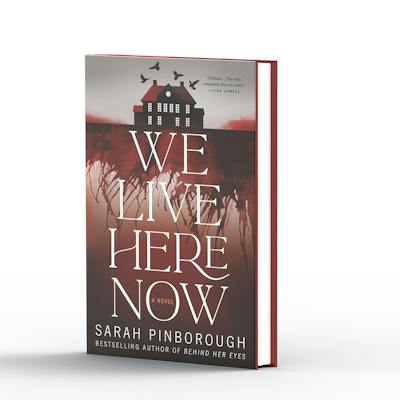
Reading options
What's inside (8 sections)
The house on the moor
Emily Bennett is at a low point when she moves to Dartmoor. She has fallen from a cliff, developed sepsis and spent time in a coma. She has lost her job. She and her husband Freddie leave London for Larkin Lodge, an isolated house on the moor, and the move is meant to be a fresh start. It is a classic setup, and Sarah Pinborough knows exactly what she is doing with it. A big house, a remote location, a woman whose recent illness makes her account of events unreliable.
What makes the book unusual is its choice of narrators. Emily tells part of the story. Freddie tells part. And a male raven tells part. That third voice is the book's distinctive invention, and it is played straight. The raven has been watching Larkin Lodge for a long time. His mate, Broken Wing, disappeared down the chimney, and he has been trying to understand what happened to her ever since. The bird's sections are funny and strange, and they also carry the novel's central metaphor: the idea that one self can be split from another and left behind.
Pinborough takes her time with the aftermath of the accident. Emily's recovery is described in physical detail: the hospital, the coma, the slow return to a body that does not feel like her own. That experience gives the novel its first split self. The woman who fell from the cliff and the woman who wakes up are not quite the same person, and the people around her treat the second one as damaged goods. Her doctor's warning about post-sepsis hallucinations is medically reasonable, which is why it is so infuriating. It gives Freddie a ready-made explanation for everything she says.
The move to Dartmoor is therefore not a fresh start so much as a relocation of the problem. Freddie has decided what her perceptions are worth, and the house gives him endless opportunities to be right. When she tells him about the footsteps or the smell, his response is a kind of gentle exhaustion that is worse than anger. He has stopped treating her as a reliable witness, and the book understands how lonely that is.
The strange events happen only when Emily is alone. There are footsteps overhead. There is a rotting stench she cannot locate. Four books on a shelf have titles whose first words spell out YOU WILL DIE HERE. A nail she pulls from a door reappears. Her doctor has warned her that post-sepsis hallucinations are possible, and Freddie dismisses her fears with the patient exasperation of someone who has already decided what is happening. The reader is left in the same position as Emily. Is the house haunted, or is she ill?
What they are hiding
Pinborough does not let the reader rest in that question for long, because both spouses are concealing things. Emily slept with her boss to get a promotion, and she cannot be certain that the baby she lost in the accident was Freddie's. Freddie's gambling has left him thousands of pounds in debt to a loan shark. These secrets are not side details. They are the real furnishings of the house. The marriage is held together by mutual ignorance, and the supernatural events force each of them toward what the other does not know.
The New York Times praised the book's atmospheric surprise, which is a fair description of its first half. Pinborough is very good at the accumulation of small wrongness: the book titles, the nail, the smell, the sense of being observed. The raven's chapters make the observation literal, since someone really is watching, but that does not make Emily's experience less frightening. She is right that something is happening. She is simply wrong about who is doing it.
I found the raven sections the most engaging part of the book. The bird's account of his search for Broken Wing is touching in a way the human plot is not. He finds her dead in the fireplace. He drops her carcass into an upstairs room and flies away with another female, Bright Wing. Then he discovers that Broken Wing is alive. The logic here belongs to the book's own rules rather than to ornithology, and once you accept it, the bird becomes the clearest example of the novel's preoccupation with divided selves and improbable returns.
The diary
The raven's chapters are written with a dry, observational humor that the human chapters seldom match. He catalogues the house's routines, the arrivals and departures, the small cruelties of the people who live there. His search for Broken Wing gives the book a plot thread that is genuinely mysterious, because the reader does not know for a long time whether she is dead or has simply changed. When he finds her body in the fireplace and later discovers she is alive, the contradiction is not explained. It is presented as the normal operation of this world, which is the correct choice. A house that can split a person in two can also return a bird from the dead.
Bright Wing complicates the raven's story in a way I appreciated. He does not remain faithful to his lost mate. He flies off with another female, and the book refuses to judge him for it. This is one of the reasons his narration feels fresh. The human characters are caught in elaborate betrayals and concealments, while the bird behaves with a straightforward appetite that the novel treats as wisdom.
Guests arrive. Iso and Mark, and Cat and Russell, use a Ouija board that spells out FINDIT. Emily blackmails Mark over his affair with Cat. The social tensions of the house are as nasty as the supernatural ones, and Pinborough clearly enjoys writing people who are worse to each other than ghosts could be.
The Ouija scene is one of the book's best set pieces, partly because it is so banal. Four adults sitting around a board in a remote house, drinking and half-believing, is a familiar horror image. Pinborough uses it to expose the relationships rather than to deliver a scare. The board spells FINDIT, and the message seems to point toward something hidden in the house. But the real finding is social: Emily discovers she can blackmail Mark over his affair with Cat, and the gathering quietly rearranges the power structure of the weekend.
That scene also establishes that the house responds to attention. The strange events happen when Emily is alone, but the board's message arrives when a group is present. The place is not simply waiting for a vulnerable woman. It is drawing everyone into the same game, and it does not care who wins.
The revelation comes through a surgeon's diary. It describes a procedure, or a curse, or a superstitious ritual: if you kill someone you love and leave the body in the upper bedroom, they will return as their best self while the bad half remains trapped upstairs. Emily learns that a man named Joe Carter killed his jealous wife Sally on the nail, then revived her. That story is the key to Larkin Lodge, and it reframes everything that has happened. The house is not haunted by the dead. It is a machine for dividing people in two.
This is a strong idea, and it is the best thing in the book. The upper room becomes a place where the parts of people they would rather disown are stored. The horror is not that a ghost might hurt you. It is that the version of you that gets to leave might be the one you have spent your life pretending to be.
The reversal
Freddie plans to kill Emily for the insurance money. He reads her emails and learns what she has hidden. Then he stabs her. What happens next is the book's reversal: Emily returns improved, and she poisons him. The arrangement the surgeon's diary described works exactly as promised. The woman who comes back is better than the woman who went in, and the bad parts are left behind in the upper room.
I want to say a word about Joe Carter and Sally. The diary's account of what he did is the book's clearest statement of its rules. He killed his jealous wife on the nail, then revived her, and the ritual gave him a version of her that was easier to live with. That story is disturbing because it is recognizably a fantasy people have about their partners. The idea that you could remove the difficult parts of someone you love and keep the rest is not alien. It is a daily temptation, amplified into horror. Pinborough understands that the most frightening thing about the upper room is how appealing it is.
The novel ends with the dark halves of Emily, Freddie and Broken Wing trapped upstairs, watching their better selves leave for France. It is a bleak and clever image. The improved versions of these people get a life, and the parts that made them difficult are sealed in a room where nobody has to look at them. Pinborough does not resolve the moral question. She simply leaves the reader with the picture.
The problem of the middle
The book has been criticized for repetition, and the charge has some force. A Cozy Escapism reviewer found it repetitive and unsatisfying. There is a stretch in the middle where the same discoveries happen in slightly different ways: a strange event, a denial, a secret revealed. The four books spelling a warning is a great image, but the book keeps returning to the same well of domestic dread long after the reader has understood that the house is dangerous.
The horror elements also compete with the thriller elements. Once Emily and Freddie's secrets are out, the supernatural plot has to share space with a story about a loan shark and a marital betrayal, and neither thread gets the room it needs. The raven's storyline, which should tie everything together, sometimes feels like a separate novel that has been interleaved with the human one.
That said, the structure is more deliberate than it first appears. The raven's experience of losing and recovering his mate is a miniature of what happens to Emily and Freddie. Broken Wing's dark half is trapped upstairs just as theirs are. By the end, the three storylines have converged on the same idea, and the convergence is satisfying even if the route is uneven.
What I took from it
The book is a modern Gothic in the fullest sense. Larkin Lodge is a house that takes the measure of the people who live in it and returns a revised version. Dartmoor provides the isolation, the weather and the sense of a landscape that does not care what happens to you. Pinborough uses the setting well. The moor is not scenery. It is the reason nobody can simply leave.
I finished it admiring the premise and wanting a tighter book. The idea of a house that splits people into better and worse selves is one of the strongest horror concepts I have encountered in a recent novel, and the raven is an unexpected narrator who earns his place. But the middle drags, and the ending resolves the mechanics more neatly than the moral complications deserve. Readers who like their horror atmospheric and their marriages catastrophically dysfunctional will find a great deal to enjoy. Readers who want a fast, clean thriller may find the repetition frustrating.
That is the book's final, uncomfortable joke. The better people get away, and nobody asks what it cost to make them better.
The title is worth one last thought. "We live here now" is what the improved versions of the characters might say to each other as they settle into a life that is not really theirs. It is also what the trapped halves might say from the upstairs room. The phrase is deliberately ambiguous about who "we" are, which is exactly the question the book is asking.
FAQ
Why does the book have a raven as a narrator?
The raven has watched Larkin Lodge for years while searching for his mate Broken Wing. His sections supply the book's central metaphor of a self split in two, and his search parallels what happens to the human characters.
Is We Live Here Now a horror novel or a thriller?
It is marketed as both. The New York Times praised its atmospheric surprise, while some reviewers found the middle repetitive and the resolution unsatisfying. Its real subject is the fantasy of removing the difficult parts of a person you love.
What does the nail in the house signify?
It is the instrument in the surgeon diary's account of Joe Carter killing his wife Sally and reviving her, which explains the rules governing Larkin Lodge and what happens to the people who die there.
Similar books
Blood Orange
A criminal barrister with a drinking problem takes on her first murder case and finds the defendant's story mirroring her own crumbling marriage in this sharp…
2,469-word summary · 11 min read
The Divorce
A Long Island mother is evicted by her hedge-fund husband on their anniversary, and a twisty custody fight hides an older secret about her son.
2,227-word summary · 10 min read

The Widow
A widow of a suspected criminal faces reporters and police while hiding what her marriage really cost.
2,599-word summary · 12 min read
The Last House on Needless Street
A lonely man, a cat and a mysterious neighbor pull you into a house full of buried trauma.
2,627-word summary · 12 min read
The Broken Girls
A journalist revisits her sister's murder while a restored boarding school gives up a girl missing since 1950.
2,579-word summary · 11 min read
Later
Boy Jamie Conklin sees dead people who must answer truthfully, pulling him into NYPD cases and a drug crew's greed.
2,009-word summary · 9 min read
The Sun Down Motel
In 1982 Viv vanishes from a Fell motel desk; in 2017 niece Carly takes the same shift to find her.
2,150-word summary · 10 min read
The Wives
A woman who sees her husband only on Thursdays tracks down his other wives and learns her marriage is not what she believed.
2,454-word summary · 11 min read
Forever Odd
Six months after Stormy's death, Odd Thomas tracks a kidnapped friend to a decaying hotel and faces a cultist who wants his gift.
2,308-word summary · 10 min read
You Are Not Alone
A lonely New Yorker witnesses a subway suicide and falls in with the dead woman's friends, where a makeover and a framed murder hide a hidden mastermind.
2,588-word summary · 12 min read
The Winter People
A century-old ritual for calling back the dead connects a Vermont farmhouse, a girl who came back from the well and a modern investigation into a…
2,037-word summary · 9 min read
The Maid's Diary
A cleaner who snoops through her wealthy clients' lives finds a secret that could destroy them, while a detective investigates a bloody waterfront house with…
3,459-word summary · 15 min read
The Love of My Life
Emma loves her husband Leo and their little girl. Then Leo, an obituary writer, starts filing the facts of her life, and the woman he thinks he married begins…
2,803-word summary · 12 min read
The Cellar
Abducted in her small English town, sixteen-year-old Summer is locked in a cellar with three other girls. Their captor calls himself Clover and wants a perfect…
2,551-word summary · 11 min read
Eight Perfect Murders
A Boston bookseller's old blog post listing eight perfect fictional murders becomes the blueprint for a real killer, and the narrator knows more than he admits.
2,292-word summary · 10 min read
Bat Eater and Other Names for Cora Zeng
A Chinese American crime scene cleaner in pandemic-era New York is haunted by her sister's racist killing and a string of deaths among East Asian women.
2,014-word summary · 9 min read
The Tenant
A marketing VP loses his job and rents out a room, and his Manhattan brownstone becomes a trap built from planted evidence, old identities and staged…
2,264-word summary · 10 min read
The Flight Attendant
A flight attendant wakes in a Dubai hotel beside a dead man she may have killed, and spends the rest of the novel lying to everyone who could help her.
2,496-word summary · 11 min read
Never Flinch
Holly Gibney works two cases at once: a killer promising fourteen deaths and a threat against a feminist writer's lecture tour. King braids them into a…
2,245-word summary · 10 min read
Intensity
A college student survives a brutal home invasion, then follows a killer's motor home in a bid to save the teenage girl he holds captive.
2,290-word summary · 10 min read

What She Knew
Rachel lets her eight-year-old son run ahead in a Bristol park, and the nine-day search turns her into a suspect in the public eye.
2,952-word summary · 13 min read
Night Film
A disgraced journalist investigates the death of a reclusive horror director's daughter, following a red coat through hospitals, secret clubs, and a family…
2,690-word summary · 12 min read

Still Missing
A realtor is abducted at a Vancouver Island open house and held for more than a year. Told through therapy sessions, the novel follows her escape and the hunt…
2,466-word summary · 11 min read
The End of Her
A sleep-deprived mother of twins faces a stranger's accusation that her husband murdered his first wife in Shari Lapena's domestic suspense novel.
2,383-word summary · 11 min read
Strange Sally Diamond
Sally Diamond takes her dying father's joke literally and burns his body, then learns her whole childhood was built on a kidnapping and a lie.
2,411-word summary · 11 min read
The Therapist
A couple moves to a gated street where the previous therapist was murdered in their house.
2,437-word summary · 11 min read
The Night Swim
A true crime podcaster covers a rape trial while probing an old drowning in a small town.
2,260-word summary · 10 min read
The Chalk Man
Childhood chalk codes lead to a murder that follows friends thirty years later.
2,350-word summary · 10 min read
Relic
A museum beast kills during an exhibition while an agent investigates.
2,066-word summary · 9 min read
In My Dreams I Hold a Knife
College friends reunite ten years after a murder with a trap set.
2,252-word summary · 10 min read